


The Chief of Staff handbook
The Chief of Staff Network's handbook to the role: the six levels, the weekly work, pay ($167,954 average base), how people get in and where they go next.

Ask AI
 Share

A Chief of Staff is the primary strategic operator reporting directly to a senior executive, often the CEO, and acts as that leader's trusted advisor and right hand. The title covers six levels of seniority, from Analyst to Executive. The average base salary is $167,954. Just over half leave the role more senior than they arrived.
- Judge a Chief of Staff role by its principal and the decisions you'll own before you look at the title. Fewer than half of postings that name a principal say CEO, founder or president.
- Price a role from its level. Moving from Manager to Director adds about $29,000 in average base.
- If you come from operations, sales or marketing, apply anyway. Each supplies more Chiefs of Staff than consulting does, though 27% of postings ask for consulting.
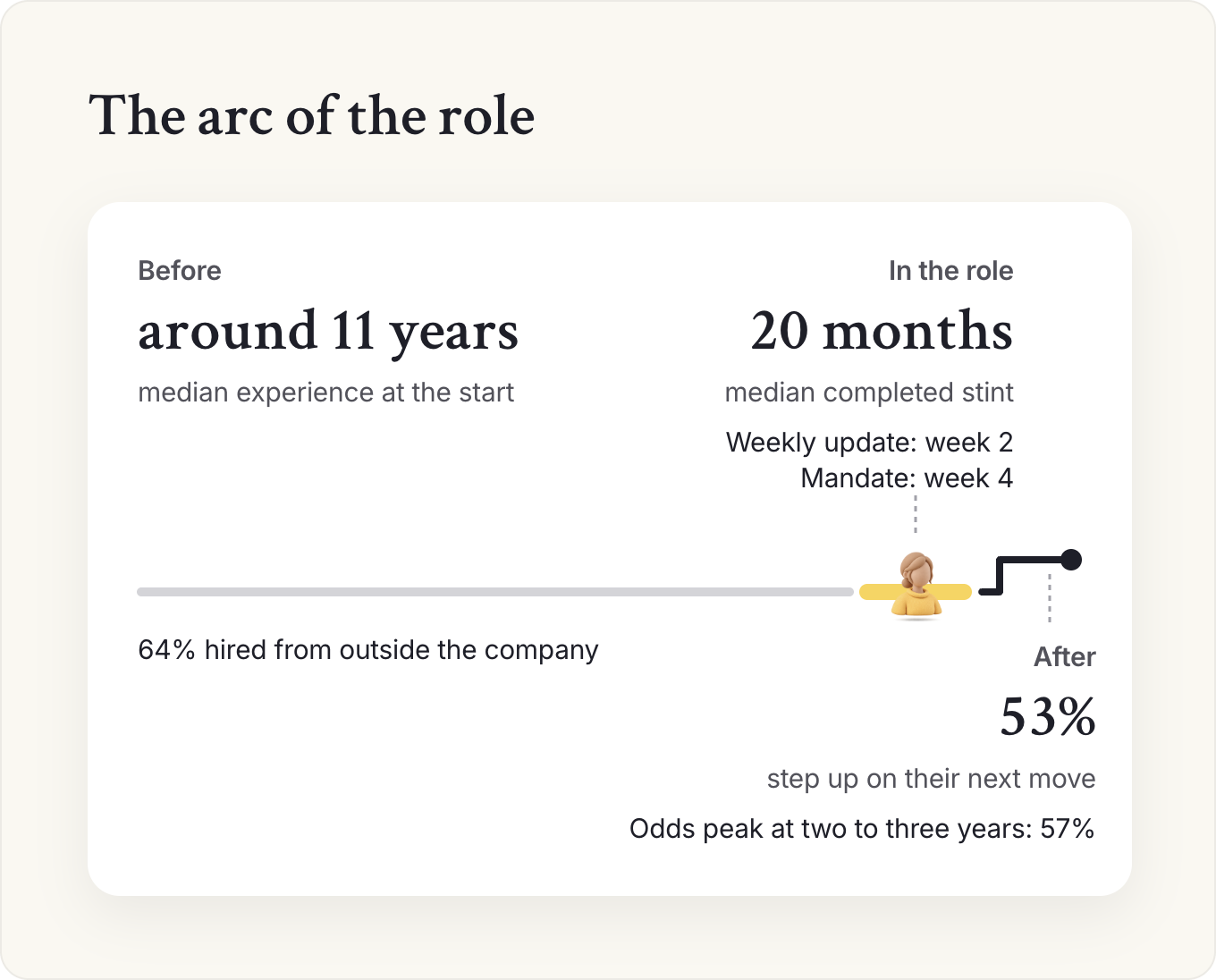
- In a new role, agree a one-page mandate by week 4 and send a weekly update from week 2. They answer the two complaints we hear most from members: unclear scope and invisible work.
- If you're hiring a Chief of Staff, write down what the role will own before you write the job post. Then set the level from those decisions and the pay from the level.
Ask five Chiefs of Staff what they did last week and you'll get five jobs. Some run the leadership meeting, the planning cycle and board prep for a whole company. Alexa Gellman, then Chief of Staff to a managing partner at a venture fund, spent most of her week on deals.
I became Chief of Staff to the CEO at Spring in 2016 and started this network a year later. This handbook is what the Chiefs of Staff who compare notes here have taught us.
What exactly is a Chief of Staff role?
A Chief of Staff is the primary strategic operator reporting directly to a senior executive, often the CEO, and acts as that leader's trusted advisor and right hand. That leader is called the principal. Tasks vary by company. The same four core responsibilities come up almost everywhere: priorities and decisions, running the operating rhythm, communication up and down, and cross-functional projects. Few postings ask for gatekeeping. Only 20% mention guarding the executive's time.
Which Chief of Staff guide do you need?
- Deciding whether the role is for you: start with how to become a Chief of Staff, then see what each level demands in Chief of Staff skills.
- An executive assistant who wants the bigger job: Chief of Staff vs executive assistant shows where the two jobs split and how people move across.
- Holding an offer: check the decision rights against the levels in Chief of Staff skills, then price the role with the salary guide.
- Starting in the next month: your first 90 days, then agree a mandate by week 4.
- Scope keeps growing, or nobody sees your work: rewrite your mandate with your principal and start a weekly update.
- Taking over your principal's calendar: executive calendar management.
- Working for a functional leader or a new principal: map who you depend on with a stakeholder map.
- Running the leadership team's rhythm: build the operating rhythm first, then leadership meetings and board meetings.
- Writing for your principal or the company: start with internal communications, then briefs for your CEO.
- Bringing AI into the work: AI and the Chief of Staff, then the step-by-step AI setup and the company context file.
- Hiring one: Chief of Staff vs COO if you're weighing both, then how to hire a Chief of Staff and the job description guide, or a fractional Chief of Staff if you need part of one.
- Looking for templates: the Chief of Staff toolkit.
What types of Chief of Staff are there?
The role takes its shape from who the principal is, how large the company is and what the leader needs most this year.
In government, a chief of staff runs an official's office, as the White House Chief of Staff does for the US president and the Downing Street Chief of Staff does for the UK prime minister. In the military, the title means the officer who runs a commander's staff, and in the US Army and Air Force it belongs to the service's senior uniformed officer. These guides cover the role in companies and other private organizations.
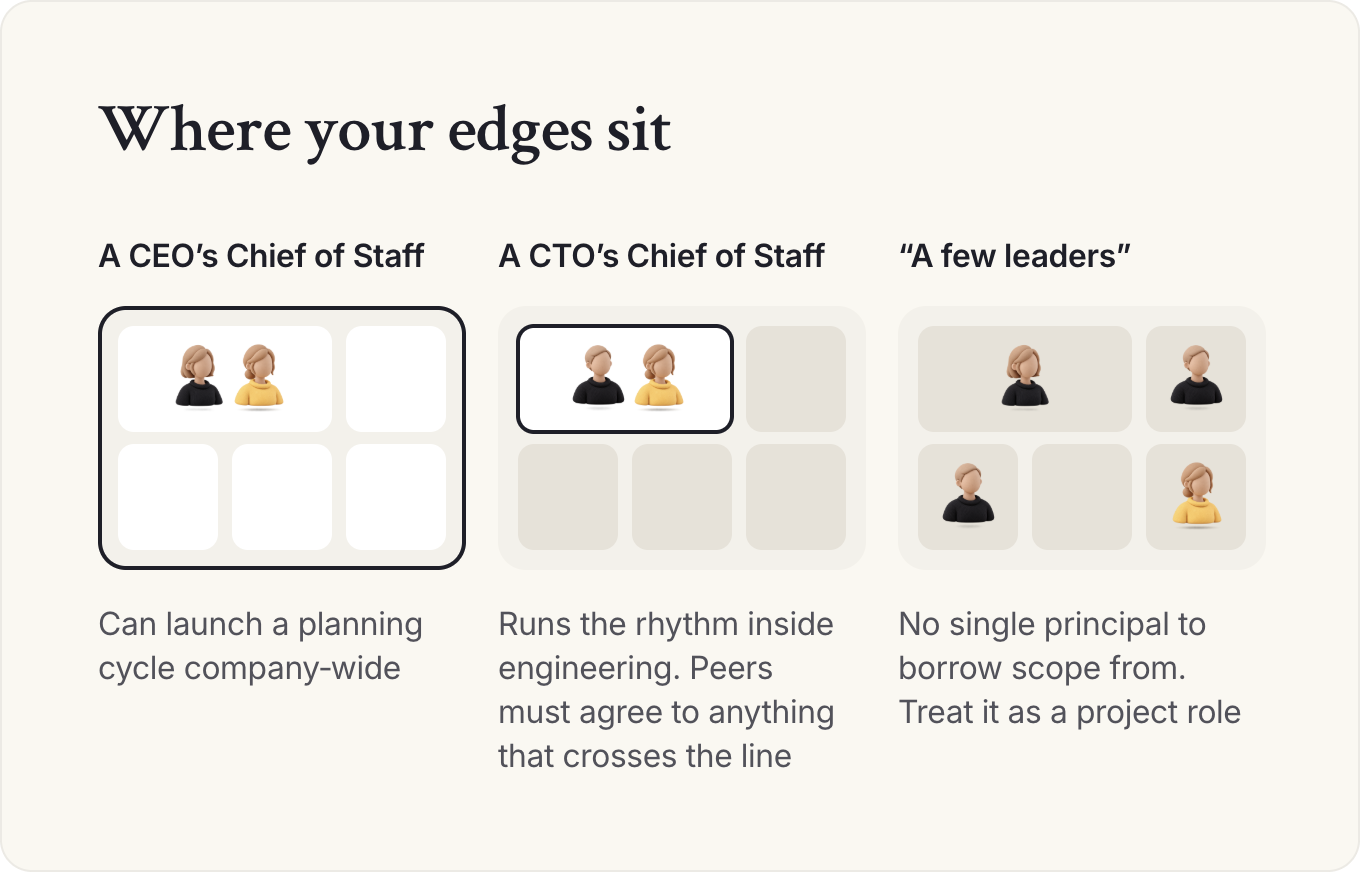
The edges of your job sit where your principal's do. A CEO's Chief of Staff can launch a company-wide planning cycle; a CTO's Chief of Staff runs the same rhythm inside engineering and needs peers to agree to anything that crosses that line. Before you accept, find out what your principal owns, whether there's another Chief of Staff and what the leader needs most this year.
Of postings that name a principal, 44% say CEO, founder or president, but most postings (59%) name no principal at all. If a posting won't say which leader, ask on the first call. If the answer is "a few leaders," you have no single principal to borrow scope from, so I'd treat it as a project role and price it that way.
My advice: choose the principal before you choose the company. A strong principal at an ordinary company will grow you faster than a weak one at a famous name, so ask what happens to the role if your principal leaves.
What does a Chief of Staff do each week?
Most weeks run on a fixed rhythm agreed with the principal: a prep block before the leadership meeting, the meeting itself, a standing one-to-one and a pass over what's slipping. Book those first and fit the rest around them; when they slip, the same decisions come back the next week. A day in the life shows real weeks hour by hour.
What changes across the six levels?
Our Leveling Framework runs from Analyst to Executive across eight competencies, and one question tells the levels apart: does this person carry out strategic decisions, give meaningful input to them or act as a key influencer?
The six Chief of Staff levels
| Level | Decision role | What the work looks like | Average base, 2025 |
|---|---|---|---|
| Analyst / Associate | Not usually involved in strategic decisions | Executes assigned tasks, implements tools and processes | $91,462 |
| Sr. Associate / Jr. Manager | Implements strategic decisions | Designs processes, starts to lead others, handles unfamiliar problems | $111,474 |
| Manager / Sr. Manager | Gives meaningful input | Turns the principal's priorities into projects, runs recurring alignment meetings | $144,464 |
| Director | Gives meaningful input | Authors department or company strategy, breaks silos between teams | $173,667 |
| Vice President | Key influencer | Builds relationships with investors, partners and customers; an organizational leader in their own right | $186,739 |
| CXO / Executive | Key influencer | Controls budget and resource allocation, drives company-wide change | $193,999 |
Source: Leveling Framework; Salary Report 2025.
Managers and Directors both give meaningful input, so the difference is reach: a Manager turns the principal's priorities into projects, and a Director authors department or company strategy. Go by the decisions you'll own, since a "VP, Chief of Staff" at a 30-person company can still be doing Manager work.
At the offer, ask which decisions you'll make without checking, which you'll recommend and which you'll only carry out, and settle the level then. Only about 8% of completed stints end with a bigger Chief of Staff title at the same company, so if the company won't settle it, write the decisions that would trigger a re-level, and a review date, into your mandate.
What does a Chief of Staff earn?
In our 2025 survey, the average base salary is $167,954 and the median is $160,000. Both are base pay only, so they run below the total-pay figures you'll see elsewhere.
Level and company size move pay most: base more than doubles from Analyst to Executive, and it averages about $142,000 at companies with 11 to 50 employees against about $200,000 above 10,000 employees. US postings that list pay advertise a median of $180,000, and the salary guide has every cut, from city to equity.
How do people become a Chief of Staff?
Most people become a Chief of Staff after about a decade of operating work. The median Chief of Staff starts with around 11 years of experience, and the backgrounds are broader than job postings suggest.
Operations, sales and marketing each produce more Chiefs of Staff than consulting does, yet 27% of postings ask for consulting. If you're an operator without that background, you're the norm, and how to become a Chief of Staff has the route from each function.
Most hires come from outside the company (64%), often through a personal connection. Our resume examples show how to write up operating results.
Moving into your first Chief of Staff role? Launchpad's first module leaves you with your mandate and a 90-day plan, and its Job Search Masterclass covers positioning, the hidden job market and negotiation.
Explore LaunchpadWhat should you do in your first 90 days?
Spend month one learning how decisions get made and taking one real task off your principal's plate, month two owning part of the rhythm, and month three running one strategic project.
The mandate is the piece most new Chiefs of Staff skip, and without it your scope becomes whatever was asked most recently. The first 90 days guide has the listening tour questions and a day-30 memo, and the mandate guide has the one-page template.
What's hard about the job?
The hardest part of the job is doing high-stakes work that no one can see, in a role whose edges were never written down.
An unclear role means you get told off for doing too much one month and too little the next. Invisibility means that when things run well, nobody asks who made them run, so your promotion case has no evidence. And with no team, every new responsibility lands on one calendar.
Asked what would make them leave, Chiefs of Staff in our 2025 survey put bad management, pay and lack of advancement on top, at about one in seven answers each. Write the mandate so the edges are visible, send a weekly update so your work is on the record every week, and renegotiate scope at your six-month review, or sooner if it has doubled. The longer an informal scope runs, the more it looks like the job you agreed to.
When the job goes wrong, try to renegotiate it with a rewritten mandate before you leave. A principal who edits a written scope and agrees a review date wants the role to work; one who agrees in the room but won't put it in writing probably does not. If you win new decision rights, ask your principal to announce them, because if you announce them, peers read it as a land grab.
How long do people stay, and where do they go next?
Most Chiefs of Staff stay about two years and leave more senior than they arrived. The median completed stint is 20 months, and 53% step up on their next move. The odds peak at two to three years, at 57%, and are lowest for people who leave inside a year, at 38%.
A move inside the company is more often a step up. 61% of next moves at the same company are a step up, and 48% of moves to another company are.
How is AI changing the role?
AI tools are only as good as the context you give them. After the principal, the Chief of Staff holds more of that context than anyone, so more of the work is deciding what the leader should see, and checking what the tool wrote against what's actually going on.
Our guide to AI and the Chief of Staff covers the workflows and the policy, and the Chief of AI Fellowship is for Chiefs of Staff who want to lead adoption.
How do you hire a Chief of Staff?
Hire one when decisions wait on you and the same ones come back to your leadership meeting week after week. Then write down what the role will own before you write a job post. I'd put more failed Chief of Staff hires down to skipping that step than to anything else, because "help me with everything" gives neither side a way to tell, six months later, whether it worked.
Set the level from the decisions on that page and the pay from the level. Manager work averages about $144,000 in base and Director work about $174,000. Pay is lower at small companies, about $142,000 at 11 to 50 employees.
How to hire a Chief of Staff covers scoping, sourcing, interviews and onboarding, the job description guide has a template and three examples, and when you're ready, post the role on our job board or reach candidates through our talent network.
How do you know a Chief of Staff is working?
You know it's working when fewer decisions wait on the leader and the same decisions stop coming back.
At six months, check that the mandate's outcomes are moving, the leadership meeting decides things once, bad news reaches the principal early and at least one cross-functional project runs without the Chief of Staff. The six-month scorecard in what a Chief of Staff does turns these into measures with a baseline and a target.
If most of these checks fail at six months, rewrite the mandate together before either of you gives up on the role.
Keep reading
 Chief of Staff vs COO: what's the difference?Basics
 Chief of Staff vs executive assistant: what's the difference?Basics
 A day in the life of a Chief of StaffBasics
Basics
- The Chief of Staff handbook
- What does a Chief of Staff do?
- Chief of Staff vs COO: what's the difference?
- Chief of Staff vs executive assistant: what's the difference?
- A day in the life of a Chief of Staff
- Chief of Staff skills: what the job demands at every level
- Chief of Staff salary (2026): pay by level, company size and city
- How to become a Chief of Staff
Take this guide with you
The full guide as a PDF: every section, template and chart, ready to print or share with your team.
Your PDF is ready.
Download the PDFFree. We may email you new guides; unsubscribe anytime.
Frequently asked questions
Is there a Chief of Staff handbook?
Yes. This page is the Chief of Staff Network's handbook: a short answer to each core question about the role, with a link to the full guide. Near the top, a list of common situations takes you straight to the guide that fits yours. The guides are free to read.
Is Chief of Staff a good job?
Yes, if the role has a written mandate and real decision rights. 53% of Chiefs of Staff leave the role more senior than they arrived, and the role pays an average base of $167,954. It's a poor job when it's mostly calendar management under a bigger title.
Is a Chief of Staff higher than an executive assistant or a COO?
A Chief of Staff usually sits above an executive assistant and below a COO. The EA manages time and logistics; the Chief of Staff manages priorities and decisions; the COO runs operations with a team and a budget, which most Chiefs of Staff don't have. A role that is mostly calendar work is an EA job with a bigger title. Among US postings that list pay, the median is about $95,000 for EAs and $180,000 for Chiefs of Staff.
What do Chiefs of Staff do after the role?
The most common next moves are operations and strategy roles (30%) and functional leadership (29%). 16% take another Chief of Staff role and 7% found a company, the fastest-growing exit: 1.8% of moves in 2020, 10.4% in 2025. Most (78%) change function across the role. Within three years, about one in five reach COO, VP of Operations, General Manager, Chief Strategy Officer or CEO.
- 2025 Chief of Staff Salary Report, Chief of Staff Network, 2025 (479 respondents). Earlier editions 2019 to 2024.
- 2026 Chief of Staff Pathways Report, Chief of Staff Network, 2026 (2,869 career histories, 1,819 job postings).
- Chief of Staff Leveling Framework, Chief of Staff Network.
- The State of Chief of Staff Jobs, Chief of Staff Network, 2024.
- The Chief of Staff podcast: Alexa Gellman (Inspired Capital).
Learn the job with people who do it
Membership gets you the Power Skills program, member events and a private community of working Chiefs of Staff.
Land your first Chief of Staff role
Launchpad helps you prepare, position yourself and interview for the role.
Starting out in the role?
The Fundamentals email course walks you through scoping the mandate, setting the cadence and earning trust.
Lead AI adoption from the Chief of Staff seat
The Chief of AI Fellowship is for operators turning AI into how the company runs.
Hiring a Chief of Staff?
Post the role on the Chief of Staff job board, or browse open roles.
Get your resume ready for the role
Get feedback on your Chief of Staff resume before you apply.
Let the right roles find you
Join the talent network and hear about Chief of Staff roles first.
The Chief of Staff newsletter
What Chiefs of Staff are reading, hiring for and building.
Get the full report
Every chart and cut from our latest salary research, sent to your inbox.
Using AI with sensitive data?
Learn the legal side of using AI at work.
Keep going in this series