

How to brief your CEO
How a Chief of Staff writes meeting briefs, decision memos, pre-reads and a CEO daily briefing that get read: 4 templates, 2 AI prompts and the data.

Ask AI
 Share

A briefing memo is a short written note that prepares your principal for a meeting, a decision or a conversation. Put the ask and your recommendation first, then the context, who's in the room, the risks and what happens after. Chiefs of Staff use five formats: meeting briefs, decision memos, pre-reads, a daily briefing and the verbal brief.
- Lead every brief with the ask and your recommendation. A principal who reads only the first two lines should still walk in ready.
- Write a full brief only for the two or three meetings a day where a decision, a commitment or a relationship is at stake. Every other meeting gets one line in the daily briefing.
- Keep meeting briefs under 250 words and put depth in an appendix. Write the sensitive read on people for a conversation, and keep it out of the document.
- Let AI turn your notes into a draft, including what each person wants and where they stand, and predict the questions. Check every line. Write the recommendation yourself, and keep your private read on people out of the tool.
Your principal, the executive you work for, reads your brief between meetings, often on a phone and often minutes before they walk in. Write it so the point lands in about ninety seconds: what the meeting is for, what you think they should do and who is likely to push back.
A brief that opens with three paragraphs of background sends your principal in with the background and none of the rest. Put the ask and your recommendation first. That order holds for every format below.
What is a briefing memo, and what does a principal need from one?
A briefing memo is a short written note that prepares your principal for a meeting, a decision or a conversation. What they need from it is speed: the point, your view and the risks, readable in a minute or two.
The rule under every format is bottom line up front (BLUF), a term from US military writing: the request or the conclusion comes first, and the evidence follows. A brief is either for information, so your principal knows something before a meeting, or for decision, so they choose by a date. Say which in the first line; in a meeting brief, the ask does that. A principal who can't tell will read an information brief looking for the decision.
In UK government the decision version is called a submission. Canada's federal public service calls both kinds a briefing note.
Chiefs of Staff use five formats: four written and one spoken, the verbal brief.
Five briefing formats a Chief of Staff uses
| Format | Who reads it | Length we recommend | When to send it | What makes it work |
|---|---|---|---|---|
| Meeting brief | Your principal | Under 250 words | The evening before, or 2 hours ahead | The ask, and who's in the room |
| Decision memo | Your principal, sometimes peers | 1 to 2 pages, plus appendix | 2 to 3 days before the decision | A clear recommendation and real options |
| Pre-read | Everyone in the meeting | One page, a 5-minute read | 24 hours ahead, with the agenda | One question for the room to answer |
| Daily briefing | Your principal | One screen | A fixed time, before their first meeting | Consistency your principal can rely on |
| Verbal brief | Your principal | 30 to 90 seconds | Walking into the room | Ask, recommendation, one risk |
Employers ask for the skills behind it. 46% of more than 1,800 Chief of Staff job postings ask for executive communication and content, and 37% for a thought partner on decisions. Briefing sits inside two of the four core responsibilities: priorities and decisions, and communication up and down.
If your principal has an executive assistant, agree the split once: they own logistics and the calendar, you own the substance. The brief is often the only piece of your judgment your principal sees before a meeting. One with a view they hadn't considered gets every later brief read.
This week, check the first two lines of the last three briefs you wrote. If neither contains the ask or your recommendation, rewrite the openings before you send the next one.
If you're the principal, tell your Chief of Staff how you actually read: on a phone or at a desk, the first line or every word. Reply to the part of the brief you used, so they know what to keep. Expect a recommendation whenever there's a decision to make, even when you'll decide the other way. Ask for a reply line on every decision memo, so you can answer from your phone in one word. If you take things in better by ear, say so, and get a ninety-second verbal brief on the way in.
Which meetings get a brief?
Write a full brief for the two or three meetings a day where a decision, a commitment or a relationship is at stake. Every other meeting gets one line in the daily briefing: the meeting and its ask.
To decide whether an item goes in front of your principal at all, ask three questions. If you can decide it without them, decide it, keep it off the agenda and note it in the daily briefing. If they need to know but not decide, send it in writing. If it needs their voice, their judgment or one of their relationships, put it on your next 1:1 agenda, or in the brief for the meeting where it comes up.
What goes in a meeting brief?
A meeting brief runs in this order: the ask, your recommendation, the context, who's in the room, the risks, two or three questions to ask, your fallback, and what happens after. Keep that order even when the brief is three lines long, because your principal may stop reading at any line.
Template: Meeting brief
Brief: [meeting name] · [date, time, length]
The ask: What you need to get from this meeting, in one sentence.
My recommendation: The position I suggest you take, and the main reason, in two lines.
Context (3 to 5 lines):
- What changed since you last discussed this (with numbers and dates)
- What's already been decided
- What's still open
Who's in the room
- [Name, role]: what they want, where they stand, what they'll push on
- [Name, role]: ...
Risks: What could go wrong in the room. Anything sensitive, I'll tell you in person.
Questions to ask: 2 or 3.
If it goes sideways: Your fallback position.
After the meeting: Follow-ups with owners and dates. I'll send the summary to [names] by [time].
Appendix: Links to the deck, data and prior decisions.
# Brief: [meeting name] · [date, time, length]

**The ask:** What you need to get from this meeting, in one sentence.

**My recommendation:** The position I suggest you take, and the main reason, in two lines.

**Context (3 to 5 lines):**
- What changed since you last discussed this (with numbers and dates)
- What's already been decided
- What's still open

**Who's in the room**
- [Name, role]: what they want, where they stand, what they'll push on
- [Name, role]: ...

**Risks:** What could go wrong in the room. Anything sensitive, I'll tell you in person.

**Questions to ask:** 2 or 3.

**If it goes sideways:** Your fallback position.

**After the meeting:** Follow-ups with owners and dates. I'll send the summary to [names] by [time].

**Appendix:** Links to the deck, data and prior decisions.
Example: Meeting brief for a Series B CEO (illustration)
Brief: Q4 pricing with Dana and Sam · Tue, 2:00, 45 min
The ask: Agree a pricing change Dana's team will sell.
My recommendation: Approve the 8% list increase, and let reps keep current discounts for 90 days only. It protects margin without stalling her pipeline.
Context:
- Discounts averaged 14% last quarter, up from 9%
- Two of the five largest deals closed at the discount ceiling
- Finance wants the increase live by January 1
Who's in the room
- Dana, VP Sales: wants pricing settled this quarter so her team can set targets; will push for longer than 90 days
- Sam, Finance: supports the increase; will resist anything past 90 days
Risks: Dana agrees in the room and her managers keep discounting.
Questions to ask:
- Which open deals would the 90-day limit touch?
- What would make 90 days workable for your managers?
If it goes sideways: Run the new pricing as a 60-day trial, then check the discount rate.
After the meeting: I'll send the summary to Dana and Sam by 5pm.
# Brief: Q4 pricing with Dana and Sam · Tue, 2:00, 45 min

**The ask:** Agree a pricing change Dana's team will sell.

**My recommendation:** Approve the 8% list increase, and let reps keep current discounts for 90 days only. It protects margin without stalling her pipeline.

**Context:**
- Discounts averaged 14% last quarter, up from 9%
- Two of the five largest deals closed at the discount ceiling
- Finance wants the increase live by January 1

**Who's in the room**
- Dana, VP Sales: wants pricing settled this quarter so her team can set targets; will push for longer than 90 days
- Sam, Finance: supports the increase; will resist anything past 90 days

**Risks:** Dana agrees in the room and her managers keep discounting.

**Questions to ask:**
1. Which open deals would the 90-day limit touch?
2. What would make 90 days workable for your managers?

**If it goes sideways:** Run the new pricing as a 60-day trial, then check the discount rate.

**After the meeting:** I'll send the summary to Dana and Sam by 5pm.
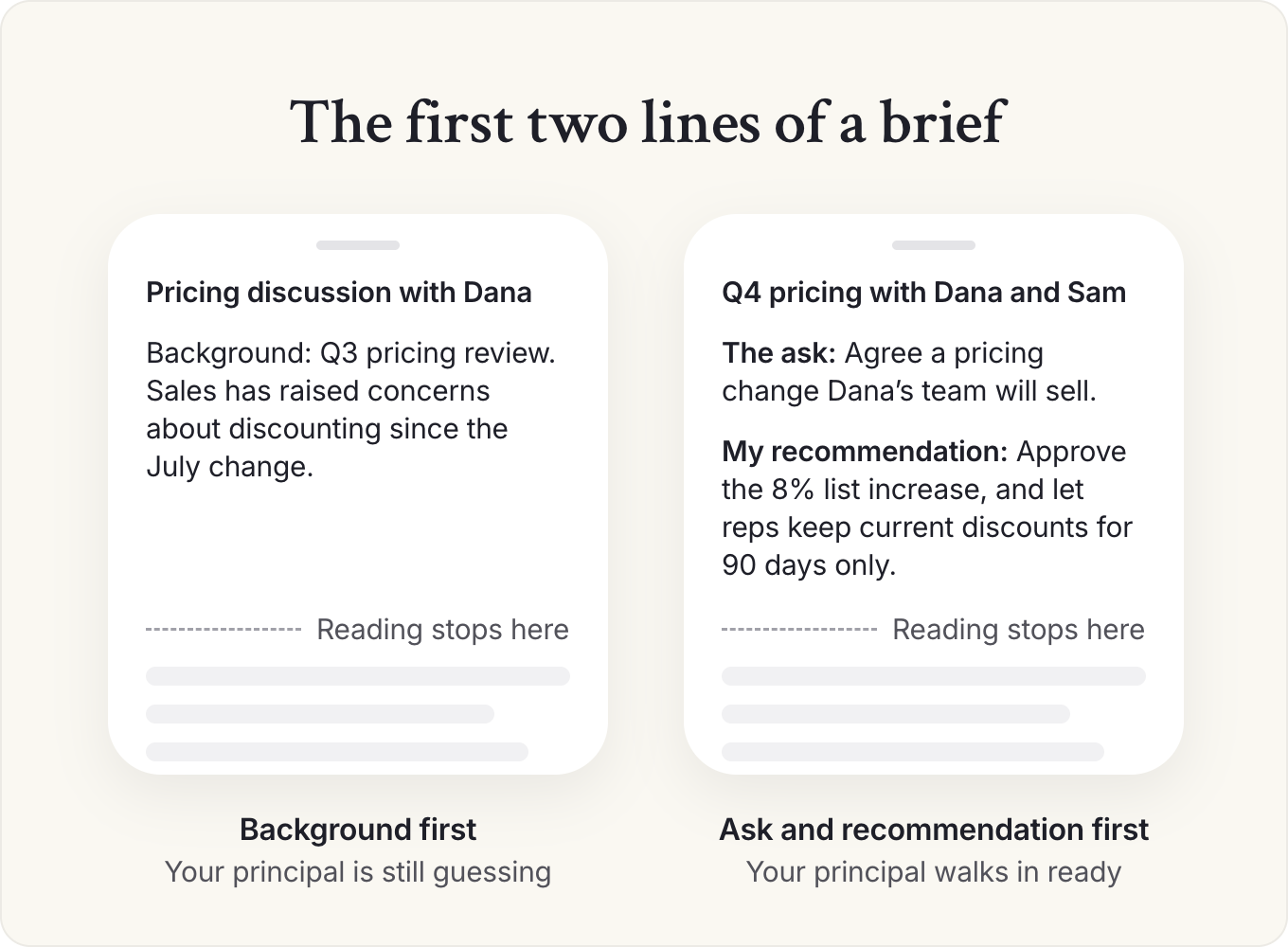
Start with the ask, in one sentence. "Agree a pricing change Dana's team will sell" is an ask. "Pricing discussion with Dana" is a calendar title.
Then your recommendation. New Chiefs of Staff often leave it out, because they worry about overstepping. Your principal can disagree with a recommendation in two seconds. If you don't have a view yet, write that, and say what would give you one. I'd rather read a recommendation I disagree with than a page of balanced context.
A weak version of the same brief would open: "Background: Q3 pricing review. Sales has raised concerns about discounting since the July change." Your principal would finish that line still guessing what you want from the meeting.
Context, people and risks
Context comes third, in three to five lines: what changed since your principal last thought about this, with numbers and dates. Anything longer goes into the appendix.
Who's in the room is what an assistant's brief doesn't have. Write one line per person: what they want, where they stand and what they'll push on. You know this because you talk to people your principal doesn't have time to talk to. Risks are what could go wrong in the room, with the fallback if it does.
Crystelle Desnoyer, who was Chief of Staff to the CEO at Techstars, set up one-on-one intro calls when she started a later Chief of Staff role at a much larger company. In each one she asked, "What's your favorite mode of communicating?", and wrote the answer down. "I have cheat sheets about everyone," she told us. Notes like hers, kept on everyone you meet, are where the people lines start.
The pricing example comes in under 200 words.
Your principal will repeat parts of your brief in the meeting, sometimes word for word, so check every number twice. One wrong figure repeated by a CEO in front of the board costs more trust than a month of good briefs builds.
Where briefs go wrong
The hardest case is disagreeing with a position your principal has already taken. Write your recommendation anyway, say plainly that it differs, and give the one fact that would change their mind. If they've heard the argument and decided, a brief that repeats it reads as lobbying; help their position land, and take the disagreement to your next 1:1.
The other is briefing every meeting the same way. When your principal is a guest in someone else's meeting, the ask is usually what they should say or support, and the people section matters more than the context. For an investor or customer meeting, the people lines come from your CRM, past notes and the account owner, so say where each came from.
Over a quarter, your principal starts asking "what's the ask?" before meetings that don't have one, and people start briefing you. Once the head of sales knows your principal walks in with a one-line read on where she stands, she'll call you the day before to make sure it's accurate. Write the template down, so whoever covers for you produces the same shape.
Put the ask and your recommendation in the first two lines of every brief, before any background.
How do you write a decision memo?
A decision memo asks your principal to make one decision, by a date, and recommends which way to go. It lays out the options honestly, names the trade-offs, says who has been consulted and describes what happens once the decision is made.
Write the decision as a question at the top: "Do we move the enterprise launch from March to May?" If you can't phrase it as one question, you have two memos. Put a reply line under it (approve, reject or discuss) so your principal can answer from a phone in one word.
Template: Decision memo
Decision memo: [the decision, as one question]
Decision owner: [name] · Decide by: [date] · Prepared by: [you]
Your decision: approve / reject / discuss
Recommendation
[Option] because [the one reason that matters most].
Confidence: high / medium / low, and what would change it.
Why now
What happens if we wait, and what it costs.
Options
| Option | What we get | What it costs | Main risk | Who it affects |
|---|---|---|---|---|
| A | ||||
| B | ||||
| Do nothing |
Trade-offs
What we give up with the recommended option, in plain words.
Who has been consulted
- [Name, team]: supports / has concerns / opposes. What would change their view.
After the decision
- First three actions, with owners and dates
- How we'll know it worked
- Review date
# Decision memo: [the decision, as one question]

Decision owner: [name] · Decide by: [date] · Prepared by: [you]

Your decision: approve / reject / discuss

## Recommendation
[Option] because [the one reason that matters most].

Confidence: high / medium / low, and what would change it.

## Why now
What happens if we wait, and what it costs.

## Options
| Option | What we get | What it costs | Main risk | Who it affects |
| --- | --- | --- | --- | --- |
| A | | | | |
| B | | | | |
| Do nothing | | | | |

## Trade-offs
What we give up with the recommended option, in plain words.

## Who has been consulted
- [Name, team]: supports / has concerns / opposes. What would change their view.

## After the decision
- First three actions, with owners and dates
- How we'll know it worked
- Review date
Example: Decision memo for a Series B CEO (illustration)
Decision memo: Do we move the enterprise launch from March to May?
Decision owner: CEO · Decide by: Jan 20 · Prepared by: Chief of Staff
Your decision: approve / reject / discuss
Recommendation
Move the launch to May, because two of the three security features enterprise buyers asked for won't pass testing by March.
Confidence: medium. A clean test result on February 1 would change it, but waiting for it costs us the prospects' trust.
Why now
Sales has announced March to three prospects. Every week we wait makes the call to them harder.
Options
| Option | What we get | What it costs | Main risk | Who it affects |
|---|---|---|---|---|
| March as planned, without the features (do nothing) | The date sales announced | Rework after launch | First enterprise deals stall in security review | Sales, three prospects |
| May with all three features (recommended) | The product we promised | One quarter's enterprise pipeline | Prospects buy elsewhere while they wait | Sales, finance plan |
| March for a few design partners | Momentum and early feedback | Engineering time nobody has budgeted | A small team carries launch support | Engineering, customer success |
Trade-offs
We give up one quarter's enterprise pipeline to ship something that passes a buyer's security review the first time.
Who has been consulted
- Head of sales: opposes, because she announced March to three prospects. She'd accept May if we tell them ourselves this month.
- Head of engineering: supports May.
- CFO: has concerns about the pipeline gap and wants the revenue plan updated before the board meeting.
After the decision
- CEO and head of sales call the three prospects by Jan 31
- CFO updates the revenue plan by Feb 7, in time for the board pre-read
- Head of engineering shares the Feb 1 test results with the leadership team
- It worked if all three prospects are still in the pipeline on March 31
- Review date: Feb 3
# Decision memo: Do we move the enterprise launch from March to May?

Decision owner: CEO · Decide by: Jan 20 · Prepared by: Chief of Staff

Your decision: approve / reject / discuss

## Recommendation
Move the launch to May, because two of the three security features enterprise buyers asked for won't pass testing by March.

Confidence: medium. A clean test result on February 1 would change it, but waiting for it costs us the prospects' trust.

## Why now
Sales has announced March to three prospects. Every week we wait makes the call to them harder.

## Options
| Option | What we get | What it costs | Main risk | Who it affects |
| --- | --- | --- | --- | --- |
| March as planned, without the features (do nothing) | The date sales announced | Rework after launch | First enterprise deals stall in security review | Sales, three prospects |
| May with all three features (recommended) | The product we promised | One quarter's enterprise pipeline | Prospects buy elsewhere while they wait | Sales, finance plan |
| March for a few design partners | Momentum and early feedback | Engineering time nobody has budgeted | A small team carries launch support | Engineering, customer success |

## Trade-offs
We give up one quarter's enterprise pipeline to ship something that passes a buyer's security review the first time.

## Who has been consulted
- Head of sales: opposes, because she announced March to three prospects. She'd accept May if we tell them ourselves this month.
- Head of engineering: supports May.
- CFO: has concerns about the pipeline gap and wants the revenue plan updated before the board meeting.

## After the decision
- CEO and head of sales call the three prospects by Jan 31
- CFO updates the revenue plan by Feb 7, in time for the board pre-read
- Head of engineering shares the Feb 1 test results with the leadership team
- It worked if all three prospects are still in the pipeline on March 31
- Review date: Feb 3
Write every option, including the one you don't recommend, well enough that its strongest supporter would agree you represented it fairly. A memo that stacks the deck gets found out in the meeting, by the person whose option you undersold.
The consulted section is where your political work shows: each person whose team the decision affects, their view and what would change their mind. Your principal sees the resistance before the room does, and can settle it before the meeting, if the decision is theirs to make. After a few memos, leaders start lobbying you before you write, so describe every view the way its holder would.
Close with the first three actions, owners, dates and a review date; decisions without one tend to get relitigated by whoever lost. Send it two to three days ahead, because less than a day forces a decision on instinct. If your principal decides in the room, send it anyway, because it becomes the record of why the launch moved.
Judgment calls on a memo
Medium confidence is an honest answer, and more useful than a firm recommendation you'd back away from under questioning. If the evidence can't support a recommendation yet, recommend "not yet", name the date the evidence arrives, and say what waiting costs.
If the call belongs to another leader under your principal's decision rights, the memo goes to that leader with a copy to your principal. A memo that pulls a decision up to the CEO teaches the leadership team to escalate everything.
For a remote team, or a decision that doesn't need a meeting, send the memo with a comment deadline, collect objections in the document, and have the decision owner record the outcome at the top. Before you send any memo, run it past someone who reads the way your principal does, or use the prompt below to play that reader.
Prompt: Pressure-test my decision memo
Act as my principal, [role], reading this decision memo in three minutes between meetings. Here is the memo: [paste].

1. In one sentence, what do you think I'm asking you to decide? If that differs from the decision I state, say so.
2. What is the first question you'd ask me?
3. Which option looks under-argued, and what evidence is missing?
4. Who is affected by this decision and not mentioned in the memo?
5. What would make you say "not yet"?
6. Rewrite my recommendation in 40 words or fewer, keeping my position.

Don't add facts. Where the memo needs data I haven't provided, say what's missing.
When do you send a pre-read, and how is it different from a meeting brief?
A pre-read prepares a whole meeting: it goes to everyone 24 hours before, on one page, so everyone arrives with the same facts and the owner's recommendation. A meeting brief prepares only your principal, and adds what you'd never put in a shared document: your own view of that recommendation, who will push back and the outcome your principal wants.
Some leadership teams open each decision with five minutes of silent reading. Most don't, and many people skim the pre-read on the way in, so put the question for the room in the first line, keep it to one page and state the read time at the top. Our guide to the operating rhythm has standard pre-reads for each recurring forum, and the meetings guide covers an item that won't fit on a page.
The item's owner writes the pre-read and files it in the shared folder 48 hours out; you check it is one page and send it with the agenda 24 hours before. Write one yourself only for an item you own. Whoever writes the pre-read shapes the decision, and leaders notice. I'd show every draft to the people whose work it covers, even when the deadline is tight. It costs a day, and it saves you a meeting that opens with someone disputing your numbers.
Template: Pre-read for a leadership meeting
Pre-read: [the question for this meeting, in one sentence] · for [meeting], [date]
Owner: [name]
Read time: 5 minutes. Please read before the meeting; we'll start with questions.
Background (max 5 bullets)
- ...
The data
One chart or table, with its source and date.
Options and recommendation (if we're deciding)
- ...
- ...
Recommended: [option], because [reason]. Trade-off: [what we give up].
Who was consulted
- [Name, team]: supports / has concerns / opposes
Questions for discussion
- ...
- ...
What happens next
Who owns the follow-up, and when the outcome will be shared.
# Pre-read: [the question for this meeting, in one sentence] · for [meeting], [date]

Owner: [name]

Read time: 5 minutes. Please read before the meeting; we'll start with questions.

## Background (max 5 bullets)
- ...

## The data
One chart or table, with its source and date.

## Options and recommendation (if we're deciding)
1. ...
2. ...

Recommended: [option], because [reason]. Trade-off: [what we give up].

## Who was consulted
- [Name, team]: supports / has concerns / opposes

## Questions for discussion
1. ...
2. ...

## What happens next
Who owns the follow-up, and when the outcome will be shared.
What goes in a CEO daily briefing?
A CEO daily briefing gives your principal the day on one screen: the three things that matter today, the decisions waiting on them, what changed since the last briefing and one thing to watch this week. Send it at a fixed time, before their first meeting.
Once your principal trusts that anything important will be in it, they stop scanning email and chat to find out what changed. Leave out one decision that was waiting on them, and the next morning they're back to scanning. Each line points to an action: "Board deck v2 is in your folder; I need your comments on slides 4 and 9 by Thursday" is a daily briefing line, and "Board deck progressing" teaches your principal to skim.
The daily briefing lists today's meetings with the one-line ask for each and links to the full briefs. Once a week, the day before your 1:1, the weekly update goes out in its place. Other leaders will ask to be on the daily briefing; keep it for your principal, because a briefing for six readers becomes a status report. I'd start with three days a week and go daily when your principal asks for it on the days it doesn't arrive.
Template: CEO daily briefing
[Day, date] · Daily briefing for [principal]
Three things that matter today
- [Item, with the decision or action it needs]
- ...
- ...
Waiting on you
- [Decision or approval] · needed by [date/time] · my recommendation: [one line]
Handled without you
- [Item I decided, in one line]
Today's meetings
- [Time] [Meeting]: the ask in one line · [link to brief, if there is one]
What changed since the last briefing
- [Fact, with number and source]
One thing to watch this week
- [Risk or open question, and when you'll know more]
# [Day, date] · Daily briefing for [principal]

**Three things that matter today**
1. [Item, with the decision or action it needs]
2. ...
3. ...

**Waiting on you**
- [Decision or approval] · needed by [date/time] · my recommendation: [one line]

**Handled without you**
- [Item I decided, in one line]

**Today's meetings**
- [Time] [Meeting]: the ask in one line · [link to brief, if there is one]

**What changed since the last briefing**
- [Fact, with number and source]

**One thing to watch this week**
- [Risk or open question, and when you'll know more]
How do you brief on people and politics without putting it in writing?
Write down what people want and where they stand. Say out loud anything about their performance, their motives or their relationships, because a written brief can be forwarded, screenshotted or left open on a shared screen.
"Dana wants pricing decided this quarter so her team can set targets" is useful and fair to Dana. "Dana is worried about her number and will dig in" is a read you give your principal in the car or on a call.
Getting honest information in the first place is harder. Nick Greif was Chief of Staff to a Los Angeles City Council member and later at InStride. He borrowed a rule from the press.
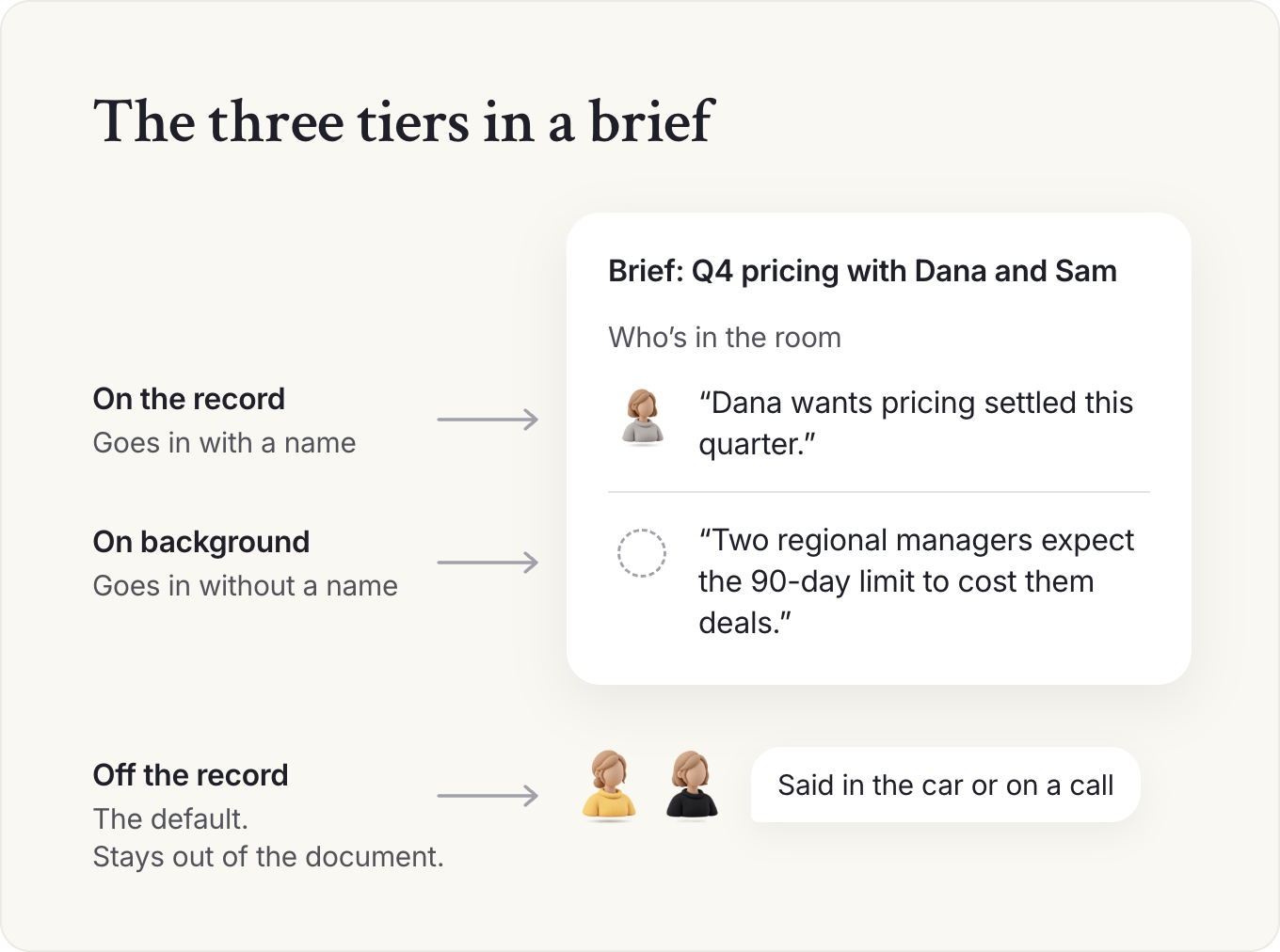
Everything we talk about is off the record unless we explicitly agree it's on the record or on background.
Nick Greif, former Chief of Staff, InStride · Listen on the podcast
That let him raise issues with his principal without anyone knowing where they came from. The first time a confidence shows up in a brief with a name attached, people stop telling you things, and your briefs get worse.
How the three tiers work in practice
In his first year Nick met every VP and every director one to one and explained the rule in each meeting. Off the record was the default, on background meant he could pass the point on without a name, and on the record meant the person was happy to be named. As he put it, once you divulge a name, "it's over. You can't get that trust back."
The tiers map onto a brief. On-the-record views go in the people section with a name: "Dana wants pricing settled this quarter." Background goes in without one: "Two regional managers expect the 90-day limit to cost them deals." Off the record stays out of the document and shapes what you say in the car.
I'd add one exception when you explain the rule, up front: anything involving harassment, fraud or someone's safety goes to the people who have to handle it, whatever tier it was told in.
Where it gets harder
Small teams break anonymity: if a team has four people, "someone on the team" names them, so raise a pattern and keep the detail for the person who can act on it. In remote companies more arrives in direct messages, which screenshot as easily as a brief, so move anything sensitive to a call.
In the first months people test the rule with small things. If nothing comes back to them, the real problems start arriving, often weeks before they'd reach your principal any other way. Agree early that "someone who asked not to be named" is an acceptable answer when your principal asks who said it.
How do you change a brief for a different principal?
Ask your principal how they like to read, then watch whether the answer is true. Some read every word of a two-page memo at night, others read the first line on a phone, and many say they want detail and then read the headline.
Rachel Peck, who leads sessions in our Launchpad program, was Chief of Staff to the two founders of Harry's. In her episode on saying it well, she said learning to write in each founder's voice took a lot of time together, a lot of drafts and plenty of trial and error. Learning how a principal reads takes the same kind of time. Expect your first month of briefs to be calibration. Our first 90 days guide has you learn how your principal likes to receive information in your first two weeks.
Watch which briefs get a reply and which part the reply is about, which questions your principal asks that the brief already answered, and whether they forward your brief. Then adjust and say so: "I've moved the people section to the top, since that's what you ask about." When your principal changes, start again, and write down how each principal liked to be briefed for whoever comes next.
New to the role? Our Fundamentals email course has 15 short lessons on working with your principal, leading without authority and setting the operating rhythm.
Start the courseHow do you get your principal to actually read your briefs?
Send them at the same time and in the same place, keep them shorter than your principal expects, and if they still don't land, find out whether your principal is a listener. Some principals take in a ninety-second verbal brief better than any document.
Pick one home for briefs, whichever your principal already checks: a shared document, a calendar invite or a message thread. If a brief is late, say so in the first line. Keep the main brief to one screen; the appendix is for the meeting where your principal is challenged on a number and needs it in thirty seconds.
When your principal still isn't reading, ask: "Would a ninety-second verbal version on the way in work better?" For a listener, the written brief becomes your preparation and the verbal brief the delivery. When a meeting lands with ten minutes' notice, text the ask, your recommendation and one risk. For the pricing meeting: "The ask: agree a pricing change Dana's team will sell. Approve the 8% increase and let reps keep current discounts for 90 days only. Risk: she agrees in the room and her managers keep discounting."
How can AI help you draft briefs, and what has to stay yours?
AI is useful for the first draft and for pressure-testing: turning raw notes into the brief structure, summarizing long documents into context lines, and predicting the questions a reader will ask. The recommendation, the read on people and the decision about what to leave out stay with you.
Ana Flávia Silva, Chief of Staff at Section, described two practices in her episode on using AI to be more effective. Her company keeps a shared Claude project loaded with company context and the templates for its product and project briefs, so a new project brief starts from the right structure. She was also building an agent to run the board deck through several models and draft the questions board members are likely to ask; for now she does that question prep herself.
Question prep is the part to automate first, because AI covers the obvious questions and leaves you time for the ones only you would think of. Keep personal reads on people out of AI tools entirely. Our guide to AI for Chiefs of Staff covers approved tools. Our AI setup guide has a meeting prep pack. It prepares you. The brief is what you then write for your principal.
Prompt: Draft a meeting brief from my notes
You're helping me, a Chief of Staff, write a meeting brief for my principal, [name, role].

How my principal reads: [e.g. on their phone between meetings; wants the ask first; skips long context].
The meeting: [name, attendees with roles, date, length, goal].
My raw notes: [paste notes, email summaries, numbers].

Write the brief in this structure:
1. The ask (one sentence)
2. My recommendation (two lines). If my notes don't state one, write [MY RECOMMENDATION] and never invent one.
3. Context: 3 to 5 lines, using only numbers and dates from my notes
4. Who's in the room: one line each on what they want and where they stand, only from my notes
5. Risks
6. 2 or 3 questions to ask
7. My fallback if it goes sideways
8. Follow-ups with owners

Rules: under 250 words. Use no information that isn't in my notes. Mark anything uncertain with [CHECK]. Leave out anything about a person's performance, motives, relationships, health or personal life.

After the brief, list the three things a busy reader is most likely to misread, and how to fix each.
No tool knows that your principal and the head of sales had a difficult conversation last week, or that the CFO agreed to the plan in the hallway yesterday. That's the part of the brief your principal values most, so let a tool draft and spend your time on the lines only you could write.
Keep reading
 Leadership team meeting agenda: how to run the meeting, take notes and follow upToolkit
 How to write a Chief of Staff weekly updateExcel in the role
- Executive communications for Chiefs of Staff: writing for the CEO and running internal commsToolkit
Toolkit
- The Chief of Staff toolkit: tools and templates for the daily work
- How to brief your principal: briefing memos, decision memos and pre-reads
- Executive communications for Chiefs of Staff: writing for the CEO and running internal comms
- Leadership team meeting agenda: how to run the meeting, take notes and follow up
- Executive calendar management: how a Chief of Staff runs the calendar and inbox
- Context management for Chiefs of Staff
- Stakeholder management for Chiefs of Staff: how to map and track the people your principal depends on
- How Chiefs of Staff research decisions, with and without AI
- How a Chief of Staff runs board meetings and investor relations
Take this guide with you
The full guide as a PDF: every section, template and chart, ready to print or share with your team.
Your PDF is ready.
Download the PDFFree. We may email you new guides; unsubscribe anytime.
Frequently asked questions
What is the difference between a memo and a brief?
A brief prepares your principal for a meeting, a decision or a conversation, and can be written or spoken. A memo is a written document. So a briefing memo is a written brief, and a decision memo is a briefing memo that asks for a decision. A meeting brief goes to your principal alone and can carry your read on the people in the room. A decision memo can be forwarded to the peers it affects, so write only what you'd be comfortable seeing forwarded.
What is the format of a briefing memo?
Most briefing memos are meeting briefs, so use the meeting brief template above. Title it with the meeting name, date, time and length. Then write, in this order: the ask, your recommendation, three to five lines of context, who's in the room, the risks, two or three questions to ask, your fallback and what happens after. Depth goes in an appendix.
How long should a briefing memo be?
A meeting brief should fit on one screen, under about 250 words, with any depth in a linked appendix. A decision memo can run one to two pages because it has to lay out real options. These are our recommendations, based on how principals read: between meetings, often on a phone.
Should a Chief of Staff include a recommendation in every brief?
Yes, whenever there's a decision or a position to take. A recommendation shows your judgment and saves your principal from forming a view from scratch. If you don't have a view yet, say so and say what would give you one.
Can I use AI to write briefs for my CEO?
Yes, for drafting and pressure-testing, using tools your company has approved. 70% of the 1,200+ senior leaders who took our AI Readiness Diagnostic have used AI for board decks or executive briefings. Keep the recommendation and any personal read on people as your own work, and check every number before it goes to your principal.
How do I brief my principal before a board meeting?
Treat it as a series of briefs: a pre-read for the board, a meeting brief for your principal with the likely questions from each board member, and a short list of numbers they must know cold. Generating likely questions from the board deck, with or without AI, is in my view the most valuable part of the preparation. Our guide to running board meetings covers the board deck and the wider board relationship.
Should a briefing be a memo or a deck?
A memo, for almost every brief your principal reads alone. A deck spreads one argument across slides and hides the recommendation; a memo puts it in the first two lines. Use slides only when the brief will be presented to a group, and even then, send the memo version to your principal first.
- 2026 Chief of Staff Pathways Report, Chief of Staff Network, 2026 (1,819 job postings).
- AI Readiness Diagnostic, Chief of Staff Network, 2026 (1,200+ senior leaders).
- Nick Greif, Chief of Staff Network podcast.
- Rachel Peck, Chief of Staff Network podcast.
- Ana Flávia Silva, Chief of Staff Network podcast.
- Crystelle Desnoyer, Chief of Staff Network podcast.
- Writing Tips Plus: write clear and effective briefing notes, Government of Canada.
- Making decisions in government, Institute for Government.
- Lengths and send times: Chief of Staff Network editorial recommendations.
Learn the job with people who do it
Membership gets you the Power Skills program, member events and a private community of working Chiefs of Staff.
Land your first Chief of Staff role
Launchpad helps you prepare, position yourself and interview for the role.
Starting out in the role?
The Fundamentals email course walks you through scoping the mandate, setting the cadence and earning trust.
Lead AI adoption from the Chief of Staff seat
The Chief of AI Fellowship is for operators turning AI into how the company runs.
Hiring a Chief of Staff?
Post the role on the Chief of Staff job board, or browse open roles.
Get your resume ready for the role
Get feedback on your Chief of Staff resume before you apply.
Let the right roles find you
Join the talent network and hear about Chief of Staff roles first.
The Chief of Staff newsletter
What Chiefs of Staff are reading, hiring for and building.
Get the full report
Every chart and cut from our latest salary research, sent to your inbox.
Using AI with sensitive data?
Learn the legal side of using AI at work.
Keep going in this series