

How to hire a Chief of Staff
How to hire a Chief of Staff: a three-question test of whether you need one, then decision rights, level, pay ($180,000 US posted median) and interviews.

Ask AI
 Share

To hire a Chief of Staff, first confirm the gap: decisions and cross-team work wait on you, and no single leader can own them. Then write what the role decides, set the level and pay from that, and test candidates with a work sample and your leadership team. Plan on four to eight weeks from first interview to offer.
- Hire only for a gap you can name in two sentences and that crosses your leaders' areas. Your calendar needs an executive assistant, and one project needs a program manager.
- Level the role to the leaders it sits beside, and ignore the candidate's last title.
- Look inside first, and drop the consulting filter: 27% of postings ask for it, yet 7% of Chiefs of Staff came straight from it.
- In the offer, name the next role and a tour of two to three years, when the odds of a step up peak.
- Tell your leadership team, in writing, which decisions the Chief of Staff makes alone, before the person starts.
Two kinds of Chief of Staff hire fail often. Both failures start before the first interview, when the executive posts a vague job description and lets the role define itself. The result is an assistant with no decision rights, running your calendar and decks at Chief of Staff pay, or a strong operator stuck running the machinery, who takes a bigger title elsewhere within two years.
As our guide to the Chief of Staff role defines it, a Chief of Staff is the primary strategic operator reporting directly to a senior executive, often the CEO, and acts as that leader's trusted advisor and right hand. I became Chief of Staff to the CEO at Spring in 2016 and started this network a year later. Decide first whether you need a Chief of Staff, then follow the steps in the order I'd run them.
- Run the three-question test to confirm a Chief of Staff is the right hire for your problem.
- Write the mandate: why now, the principal (the executive the Chief of Staff works for), the decision rights, success at six months.
- Set the level from the decision rights, then the pay band.
- Decide what to look for, and drop the consulting filter.
- Source inside your company and network first, then post the role.
- Interview in four or five stages, including your leadership team.
- Test with a short work sample and references.
- Make an offer that names the level, the pay, the equity facts, the likely next role and a tour of two to three years.
- Onboard for 90 days, and plan the next role so the person doesn't stall.
If you're a candidate, the same steps show you what to ask for: who the principal is, the decision rights in writing, and an offer that names the level and the next role. Our guide on how to become a Chief of Staff covers your side of the process.
Do you need a Chief of Staff, and when should you hire one?
You need a Chief of Staff when you have become the bottleneck: decisions wait for you, the leadership team runs on your memory, and the work that crosses teams has no owner.
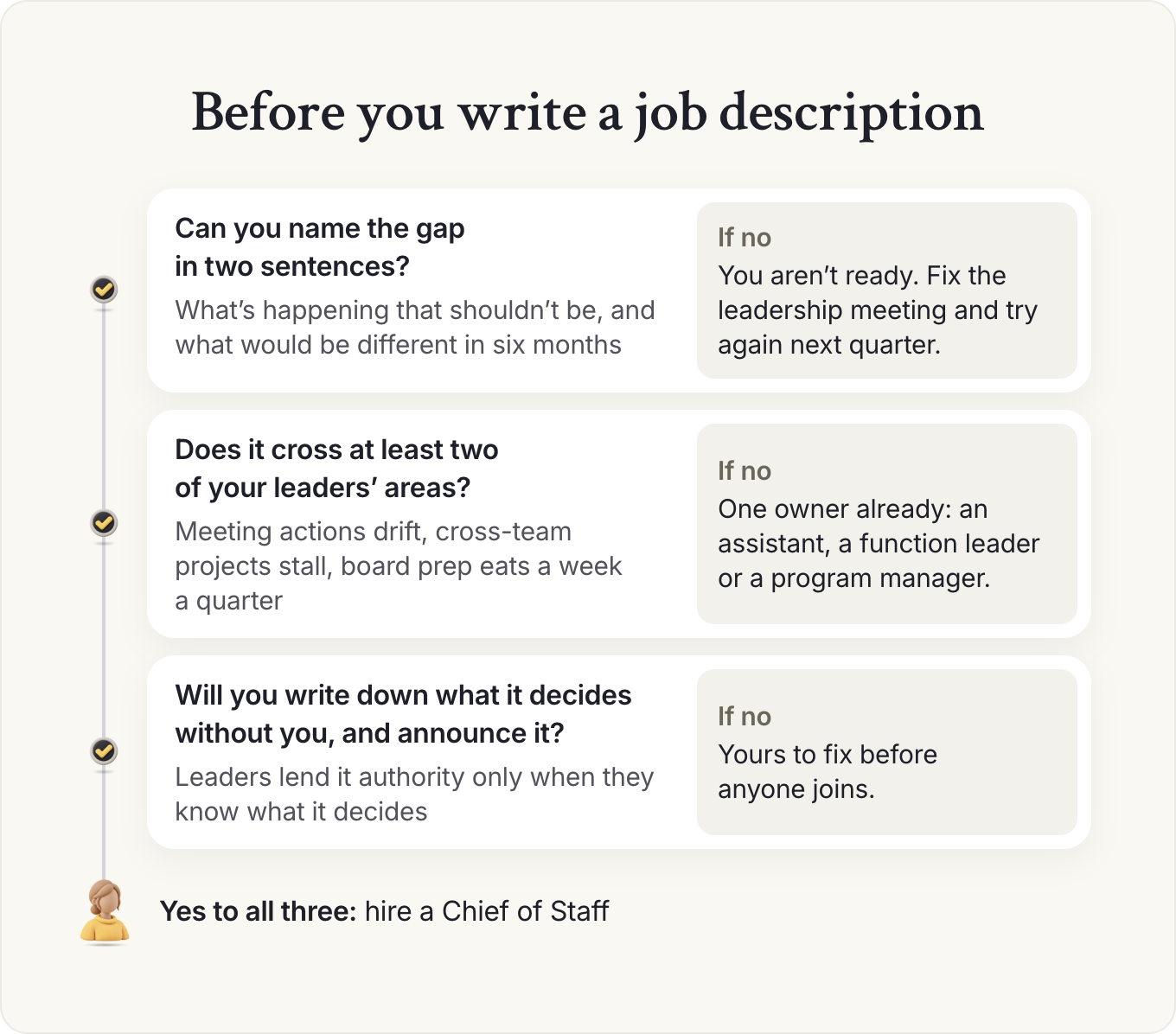
Test it before you write a job description. You need a Chief of Staff only if you can answer yes to all three questions:
- Can you name the gap in two sentences? The first says what is happening in the business that shouldn't be. The second says what would be different in six months if someone owned it. That second sentence is the return you're paying for, and your answer when the CFO asks why the role exists.
- Does the gap cross at least two of your leaders' areas? Actions from the weekly meeting drift, cross-team projects stall because each team owns a piece, and board preparation eats a week each quarter.
- Will you write down the decisions the role can make without you, and announce them to your leadership team? Your leaders lend a Chief of Staff authority only when they know what the role decides.
A no to the first question means you aren't ready to hire: fix the leadership meeting and try again next quarter. A no to the second means the gap has one owner already, and the table below shows who. A no to the third is yours to fix before anyone joins.
Often you're not the first to notice the gap. Zach Garippa, CEO of the procurement company Order.co, says the idea came from advisors. Before he wrote a job description, he called Chiefs of Staff in his network to learn what the role does day to day.
Chief of Staff or another hire?
| If your main problem is... | Hire | Why not a Chief of Staff |
|---|---|---|
| Your calendar, inbox, travel and follow-ups | Executive assistant | A Chief of Staff doing this full time is under-used and will leave |
| One function underperforming (sales, ops, finance) | A leader for that function | A Chief of Staff has no line authority to fix it |
| Day-to-day execution across the whole company | COO | The COO owns execution and teams; a Chief of Staff owns alignment and has no reports |
| Data, planning models and business reviews | Business operations or strategy lead | Narrower, analytic scope |
| One large project with a known end date | Program manager | The project already has an owner and a finish line, so it doesn't need your authority |
| Planning and leadership rhythm that fills two or three days a week | Fractional Chief of Staff | Cheaper until the work fills a full week |
| Cover until a permanent hire starts | Interim Chief of Staff | Holds the seat while you search |
| Priorities and decisions, the operating rhythm, communication and cross-functional projects across your leadership team | Chief of Staff | This is the job |
The executive assistant line is the one principals blur most often. Andrew Rea, co-founder and CEO of Taxwire, drew it when he explained why he hired David Moon as his Chief of Staff.
I could hire an EA to help me keep the trains running, whereas David is fundamentally someone I trust.
Andrew Rea, co-founder and CEO, Taxwire · Listen on the podcast
If you need both, the assistant usually comes first. For most leaders, the first thing to break is their time. Our guide to Chief of Staff vs executive assistant shows how the two split the work once you have both.
When should a startup hire a Chief of Staff?
There's no funding stage that triggers the hire, and I'd be suspicious of anyone who says "Series B". The trigger is structural: a leadership team of four or more, work that crosses their boundaries, and a cadence (planning, board meetings, a weekly leadership meeting) that someone has to run. That can happen at 25 people or at 250.
Small companies hire Chiefs of Staff too, and they hand out senior scope. About 20% of Chiefs of Staff at companies up to 500 employees hold an Executive or CXO level, against 5% at companies over 50,000.
What should you decide before you hire a Chief of Staff?
Decide four things before you post anything: why the role exists now, who the principal is, which decisions the Chief of Staff can make without you, and what success looks like in six months.
Write the decision rights
- Rank the four core responsibilities for your role: priorities and decisions, running the operating rhythm, communication up and down, and cross-functional projects. A founder drowning in cross-team chaos needs projects first. A CEO whose leadership meeting decides nothing needs the rhythm first.
- Name the principal. Only 41% of the Chief of Staff postings in our Pathways Report say who the role supports, and among those, just 44% name the CEO, founder or president. A candidate can't judge a role without knowing whose role it is.
- Write three lists: Decide (they decide alone), Recommend (they shape it and you decide) and Not own (another named owner holds it). Our guide to the Chief of Staff mandate has a one-page template with these three tiers.
Write the lists down. When scope is unwritten, each leader draws the narrowest boundary that protects their turf, and the new hire negotiates the job one meeting at a time. The lists also set the level, and the level sets the pay band. Skip them and the level gets set by the candidate's last title, which is how a Director-sized job ends up with a manager-sized offer.
A worked example: one CEO's decision rights
Here's a composite illustration. A Series B software CEO runs a 120-person company with six direct reports. Board prep takes her a week, planning slips every quarter, and two cross-team launches have stalled because product and sales each own half. Her two sentences: "Planning and the leadership meeting run on my memory, so decisions wait for me. In six months, the leadership team should run the quarter without me chasing it."
She ranks the operating rhythm first, priorities and decisions second, cross-functional projects third and communication fourth. Then she writes the lists.
Decision rights for an illustrative Series B Chief of Staff
| Decide (alone) | Recommend (she decides) | Not own (named owner) |
|---|---|---|
| Leadership meeting agenda, pre-reads and action tracking | Quarterly priorities and what gets cut | Headcount and hiring plans (each VP) |
| Planning calendar and deadlines for every team | Board deck narrative and asks | Budget and forecast (CFO) |
| Which requests reach the CEO's calendar | Owners for cross-team launches | Product roadmap (VP Product) |
| Format of the weekly company update | Reorg and leadership changes | Performance reviews of VPs (CEO) |
Read the first column and you can see the level. Someone who sets every team's planning deadlines and runs the leadership agenda sits beside the VPs, which is Director in the level table below. Her six-month outcomes are checkable: planning closes on the date set, the board pre-read goes out five days early, and both stalled launches have one owner and a ship date.
Where principals get the scope wrong
- The junk drawer. Every task nobody wants lands in the Decide column. If the Decide column spans more than two of the four responsibilities, you're describing several jobs. Keep your top two in Decide, and move the rest to Recommend or to Not own with a real owner. At a large company, a strategy team or PMO already claims part of the work, so name those handoffs in Not own.
- A different job. If the Decide list holds managing teams or a P&L, you want a COO. If it is mostly your calendar, travel and inbox, write an executive assistant role and pay it properly.
Even a clean mandate meets new work every week. When her CEO pointed her at a new problem, Ali Sardinia, then Chief of Staff at Order.co, asked right away what to deprioritize, and whether the work was hers to do or to direct. Write that question into the mandate as a standing rule.
Prompt: Draft my Chief of Staff mandate and interview plan
I'm hiring a Chief of Staff. Help me write a one-page mandate and an interview plan before I post the role.

About me and the business:
- My title and who I report to: [e.g. CEO, reporting to the board]
- Company: [stage, headcount, industry]
- What's happening that shouldn't be: [two or three sentences]
- My leadership team: [roles and how many]

Use this structure for the mandate:
1. Why the role exists now (two sentences)
2. The principal (me) and how I like to work
3. Rank the four core responsibilities for this role, with one example each: priorities and decisions, running the operating rhythm, communication up and down, cross-functional projects
4. Decision rights: what the Chief of Staff decides alone, what they shape and I decide, and what is not their job
5. What success looks like at six months (three outcomes I could check)
6. Expected tour length and the likely next role

Then propose an interview plan with four to five stages, what each stage tests, and a two to three hour work sample based on a real problem from my business.

Rules: don't invent facts about my company. Where you need information I haven't given, ask me instead of guessing. Flag anything in my answers that sounds like an executive assistant role or a COO role.
Share the draft mandate with your two most senior leaders before you post. If they disagree about what the role is for, you've found your first problem. Once they agree, turn the mandate into a posting with the template in our job description guide.
What level should a Chief of Staff be, and how much should you pay?
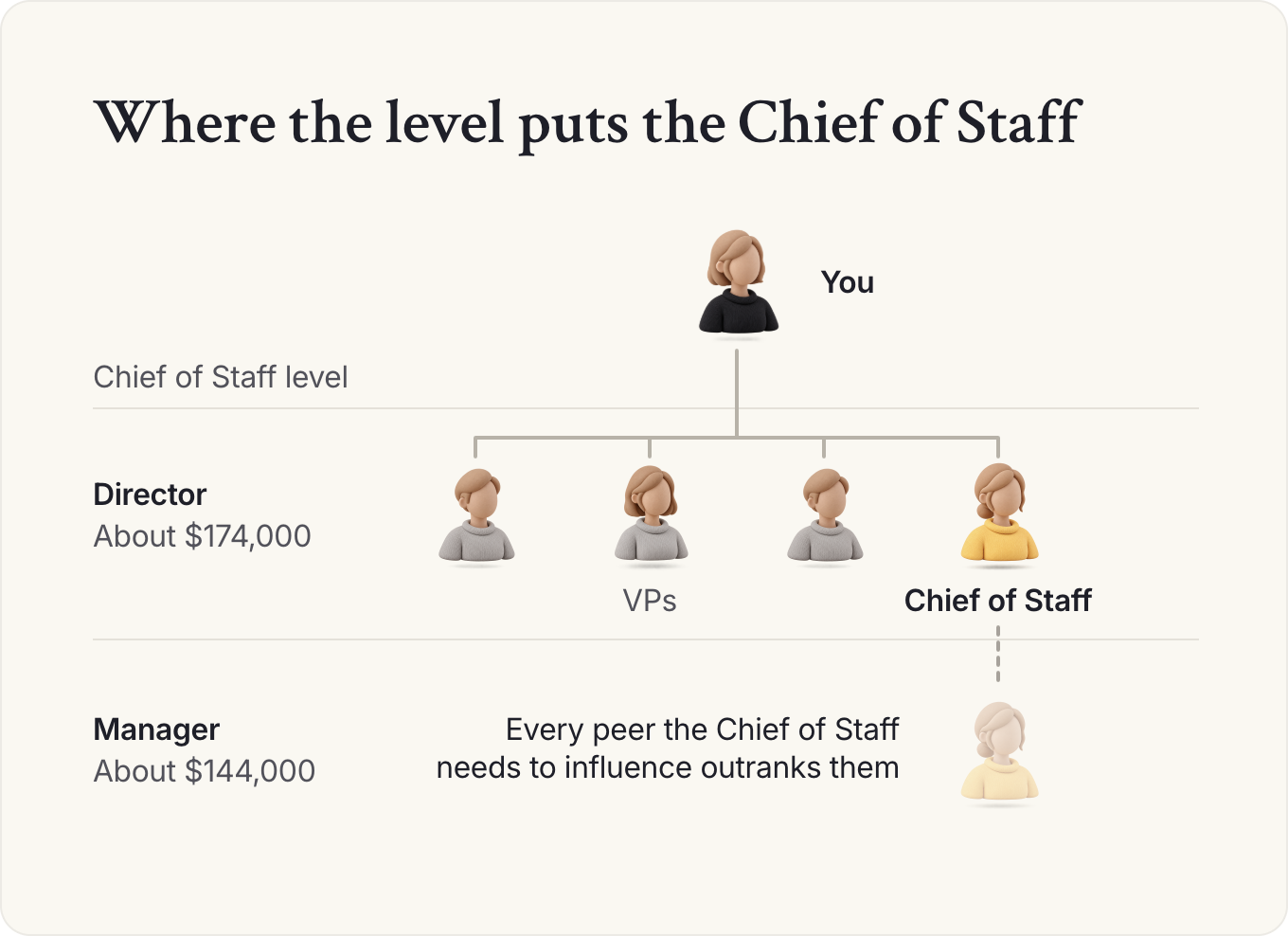
Set the level from the decision rights you just wrote, then pay to that level. In our 2025 salary survey, Manager work averages about $144,000 in base and Director work about $174,000. US job postings that list pay run higher, with a median of $180,000, partly because postings skew larger and more senior.
Our Leveling Framework sets the level by how much the person shapes decisions, from not involved to key influencer. It measures the same thing your Decide list does, so check each Decide item against the table below.
Match the level to the decision rights
| What the role decides | Typical level |
|---|---|
| Runs projects and logistics you assign; no decisions of its own | Analyst / Associate |
| Owns workstreams and follow-through; flags issues to you | Senior Associate / Junior Manager |
| Runs the operating rhythm; gives input on decisions before you make them | Manager / Senior Manager |
| Owns the planning cycle and cross-team priorities; peers with your direct reports | Director |
| Represents you in leadership and board work; makes calls in your absence | VP or CXO / Executive |
Our salary guide works through pricing a Director hire by level, company size and city.
Outside the US, set the band from local pay at the level you chose. In EU countries that have put the pay transparency directive into law, candidates get the starting pay or its range, for example in the job ad or before the interview, and you can't ask about their pay history. Our job description guide covers the rules.
Under-leveling is the most expensive mistake here, because every peer the Chief of Staff needs to influence outranks them. My take: level the role to the leaders it sits beside. If the band is lower than the work, change the work or the band before you post.
What should you look for in a Chief of Staff?
Look for judgment under ambiguity, writing a busy executive can act on, cross-team work done without authority, discretion, and the stamina to do unglamorous work well. Those come from wider backgrounds than most postings ask for. 27% of Chief of Staff postings ask for consulting experience, but only 7% of Chiefs of Staff came straight from consulting. Operations and strategy, sales and customer success, and marketing each supply more Chiefs of Staff than consulting does.
Consulting is a fine background. Screening for it is the mistake, because most of the people doing the job wouldn't pass the filter. Andrew Rea says he wouldn't have hired most of the junior VCs who have asked him about jobs like David's, because he doubts they want to grind. What sold him on David was a record of raising money from LPs plus a willingness to "eat glass" and do whatever the company needed.
Where do you find a Chief of Staff?
Check inside your company and your network first, then post the role. About a third of Chief of Staff hires come from inside the company (36%), and 64% come from outside. The internal third is the cheapest to check.
Internal hires bring trust, which is the hardest thing to hire for. They also risk a stall: a person promoted into a role built around them often keeps their old level, pay and half their old job. Re-level the role properly.
External hires usually come through a posting and a personal network at the same time. Where to look, in the order I'd use them:
- Inside your company. Who already does cross-team work your leaders rely on? Look in operations, strategy, revenue operations and program management, and at senior executive assistants.
- Your network and your investors'. Ask other executives who has been a great Chief of Staff, and ask Chiefs of Staff you know who they'd hire.
- A posting. Post on our Chief of Staff job board, where Chiefs of Staff and people who want the role look for jobs, and share it with your network.
- A search firm, for senior roles where confidentiality matters. We also run Chief of Staff searches for companies.
Hiring a Chief of Staff? Candidates in our talent network have opted in to hear from companies hiring through us. Tell us about the role.
Tell us about the roleHow do you interview a Chief of Staff?
Run four or five stages, each testing something different. Our guide to Chief of Staff skills describes what strong looks like at each level, so you can set the bar first.
You can test chemistry properly. Zach Garippa listened for his company's values in Ali Sardinia's stories: she talked about what hadn't worked at her previous company rather than its successful exit. Ali interviewed him back, asking why he wanted a Chief of Staff, and was direct that she wasn't the person to build the operating plan. Treat that candor as a strong signal: a candidate who tells you where they won't fit will tell you uncomfortable things later.
A Chief of Staff interview process
| Stage | Who | What it tests | Time |
|---|---|---|---|
| 1. Principal conversation | You | Why they want this role now, what they'd fix first, chemistry | 45 min |
| 2. Judgment interview | You or your most senior leader | How they prioritize, decide with partial information, push back | 60 min |
| 3. Leadership team panel | Two or three of your direct reports | Influence without authority, credibility with the people they'll align | 60 min |
| 4. Work sample | Candidate, then a debrief with you | Thinking, writing and synthesis on a real problem | 2 to 3 hours plus 45 min |
| 5. References | You, plus back-channel | Discretion, follow-through, how they handle bad news | 3 to 4 calls, about 30 min each |
Four questions, and what good answers sound like
The first two ask for a specific past event, which is hard to fake for ten minutes of follow-up. The last two test how they think about your situation.
- "Walk me through a cross-team project you drove where nobody reported to you. Who resisted, and what did you do?" A strong answer names the person who resisted, what they needed and the trade the candidate made. A weak answer says "I aligned stakeholders" and never names anyone.
- "Tell me about a time you told an executive something they didn't want to hear. How did you say it, and what happened?" Strong candidates raised it early and in private, and can tell you what the executive did next. If the story ends with "and they thanked me", ask what changed afterwards.
- "Here are my priorities for the next quarter. Which would you cut, and why?" Hand over a real list. Good candidates ask two or three questions, then cut something you care about and explain the trade. Watch for anyone who cuts nothing, or only the items you clearly don't like.
- "What kind of work would make you leave this role in a year?" This tells you whether their idea of the job matches yours, and whether they see it as a tour with a next step. "Nothing, I'm flexible" is the answer to worry about.
Probe each answer twice: "What would you do differently?" and "What did the other person think?" The second separates people who drove the work from people who sat near it. Our post with 33 Chief of Staff interview questions shows what well-prepared candidates will say.
Running the leadership panel
Don't skip the panel. Your Chief of Staff will spend more time with your direct reports than with you. Give the panel something real: a live disagreement between two of your leaders, such as who owns a launch, and ask the candidate to run 20 minutes of it as they would in week three.
Watch whether they ask questions before taking sides, summarize each view fairly and name a next step. Afterwards, ask each panelist one question: "Would you take this person's call on a busy Tuesday?"
If you love the candidate and the panel doesn't, side with the panel, or find out exactly why before you overrule them. A Chief of Staff your leaders resist on day one starts with a deficit you'll spend months covering. Interview an internal candidate as hard as an outsider. For a remote search, send the candidate the panel's pre-read 24 hours ahead, and see what they send back without being asked.
Template: Chief of Staff interview scorecard
Chief of Staff interview scorecard
- Candidate: [name] · Role: Chief of Staff to [principal] · Level: [from the mandate]
- Interviewer: [name] · Stage: [1 to 5] · Date: [date]
Score each area 1 to 4. 1 = clear concern, 2 = below the bar, 3 = meets the bar for this level, 4 = strong evidence above the bar. Write the evidence: what they said or did. Leave impressions out.
1. Judgment and prioritization
Can they decide what matters with partial information, and explain the trade-off?
- Score: [ ]
- Evidence:
2. Getting work done without authority
Have they moved cross-team work through people who didn't report to them? How?
- Score: [ ]
- Evidence:
3. Honest communication
Will they tell the principal and the leadership team what they don't want to hear, and do it well?
- Score: [ ]
- Evidence:
4. Writing and synthesis
Can they turn messy inputs into something an executive can act on in five minutes?
- Score: [ ]
- Evidence:
5. Operating rhythm
Have they run planning, a leadership meeting or a reporting cycle themselves?
- Score: [ ]
- Evidence:
6. Discretion and trust
How do they handle confidential information, people issues and conflict?
- Score: [ ]
- Evidence:
7. Fit with this principal
Do their working style and the principal's complement each other? Where will they clash?
- Score: [ ]
- Evidence:
8. Motivation and next step
Why this role now? What do they want to be doing in three years? Is that something this role can lead to?
- Score: [ ]
- Evidence:
Overall
- Decision: hire at the planned level / hire at a different level / no hire
- The one thing that would make this person fail in the role:
- Questions for the next interviewer to probe:
# Chief of Staff interview scorecard

- Candidate: [name] · Role: Chief of Staff to [principal] · Level: [from the mandate]
- Interviewer: [name] · Stage: [1 to 5] · Date: [date]

Score each area 1 to 4. 1 = clear concern, 2 = below the bar, 3 = meets the bar for this level, 4 = strong evidence above the bar. Write the evidence: what they said or did. Leave impressions out.

## 1. Judgment and prioritization
Can they decide what matters with partial information, and explain the trade-off?
- Score: [ ]
- Evidence:

## 2. Getting work done without authority
Have they moved cross-team work through people who didn't report to them? How?
- Score: [ ]
- Evidence:

## 3. Honest communication
Will they tell the principal and the leadership team what they don't want to hear, and do it well?
- Score: [ ]
- Evidence:

## 4. Writing and synthesis
Can they turn messy inputs into something an executive can act on in five minutes?
- Score: [ ]
- Evidence:

## 5. Operating rhythm
Have they run planning, a leadership meeting or a reporting cycle themselves?
- Score: [ ]
- Evidence:

## 6. Discretion and trust
How do they handle confidential information, people issues and conflict?
- Score: [ ]
- Evidence:

## 7. Fit with this principal
Do their working style and the principal's complement each other? Where will they clash?
- Score: [ ]
- Evidence:

## 8. Motivation and next step
Why this role now? What do they want to be doing in three years? Is that something this role can lead to?
- Score: [ ]
- Evidence:

## Overall
- Decision: hire at the planned level / hire at a different level / no hire
- The one thing that would make this person fail in the role:
- Questions for the next interviewer to probe:
Example: leadership panel scorecard, Chief of Staff to a Series B CEO, 120 people (illustration)
Chief of Staff interview scorecard
- Candidate: Priya · Role: Chief of Staff to the CEO · Level: Director
- Interviewer: VP of Sales · Stage: 3, leadership panel · Date: May 14
| Area | Score | Evidence |
|---|---|---|
| 1. Judgment and prioritization | 4 | Asked which launch date was fixed before taking a side, then proposed a sequence both leads accepted |
| 2. Getting work done without authority | 3 | Ran a pricing change across three teams at her last company through a weekly review she set up |
| 3. Honest communication | 3 | Told the panel the product plan had no support hiring in it, with the ticket numbers |
| 4. Writing and synthesis | 4 | Sent a one-page summary of the panel debate within the hour |
| 5. Operating rhythm | 2 | Has contributed to planning; has never run a cycle end to end |
| 6. Discretion and trust | 3 | Kept the client anonymous in her conflict story without being asked |
| 7. Fit with this principal | 3 | Writes first and talks second; our CEO thinks out loud. Watch fast decisions |
| 8. Motivation and next step | 4 | Wants to run a P&L in three years; the GM path here fits |
Overall
- Decision: hire at the planned level
- The one thing that would make her fail: running Q3 planning alone, for the first time, in month two
- For the next interviewer: probe the planning gap; ask for the last process she designed herself
# Chief of Staff interview scorecard

- Candidate: Priya · Role: Chief of Staff to the CEO · Level: Director
- Interviewer: VP of Sales · Stage: 3, leadership panel · Date: May 14

| Area | Score | Evidence |
| --- | --- | --- |
| 1. Judgment and prioritization | 4 | Asked which launch date was fixed before taking a side, then proposed a sequence both leads accepted |
| 2. Getting work done without authority | 3 | Ran a pricing change across three teams at her last company through a weekly review she set up |
| 3. Honest communication | 3 | Told the panel the product plan had no support hiring in it, with the ticket numbers |
| 4. Writing and synthesis | 4 | Sent a one-page summary of the panel debate within the hour |
| 5. Operating rhythm | 2 | Has contributed to planning; has never run a cycle end to end |
| 6. Discretion and trust | 3 | Kept the client anonymous in her conflict story without being asked |
| 7. Fit with this principal | 3 | Writes first and talks second; our CEO thinks out loud. Watch fast decisions |
| 8. Motivation and next step | 4 | Wants to run a P&L in three years; the GM path here fits |

## Overall
- Decision: hire at the planned level
- The one thing that would make her fail: running Q3 planning alone, for the first time, in month two
- For the next interviewer: probe the planning gap; ask for the last process she designed herself
Send the mandate and the scorecard to your panel before any candidate arrives, and agree on the bar for each area at the level you set.
How do you test a Chief of Staff before you hire?
Give a short work sample built on a real problem from your business, then call at least three references, including one peer. The work sample shows how they think about your business. The references show how they behave under pressure, which interviews hide.
The work sample
Keep it to two or three hours with a 45-minute debrief, and pay for anything longer. Sofia Badalamenti set her own: in her first interview she asked Nihal Mehta what project he'd want her to start in her first couple of weeks, then did it over the weekend. Build yours from work like the first project you'd give the hire. Use a problem you've already solved, so you can compare their answer with what happened.
A good sample copies the job's conditions: incomplete information, a deadline, and an executive who will read one page. Match the format to the top one or two responsibilities in your ranking.
- The leadership meeting, for an operating-rhythm role. Share last month's leadership meeting notes and actions (redacted). Ask for next week's agenda, a one-paragraph pre-read, and the two decisions the meeting should make.
- The priority cut, for a priorities-and-decisions role. Give 15 requests competing for the principal's next quarter. Ask the candidate to rank the requests, cut half, and write the message telling the leadership team what got cut and why.
- The board update, for a communication-heavy role. Hand over messy inputs: a few metrics, two team updates, a customer escalation. Ask for a one-page update to investors.
- A cross-team problem with no owner, for a projects role. Describe a real problem that sits between two teams. Ask for a plan for the first two weeks and who they'd talk to first.
For VP or Executive hires, swap the take-home for a 90-minute working session on a real decision, with your two most senior leaders in the room. For internal candidates, set the sample only for the part of the job that's new to them. Some principals test with a paid contract: Andrew Rea said David Moon started at Taxwire as a contractor, "for us both to test and see". That works at small companies inventing the role. At a larger company, a contractor stays outside the leadership team for too long.
A work sample, start to finish
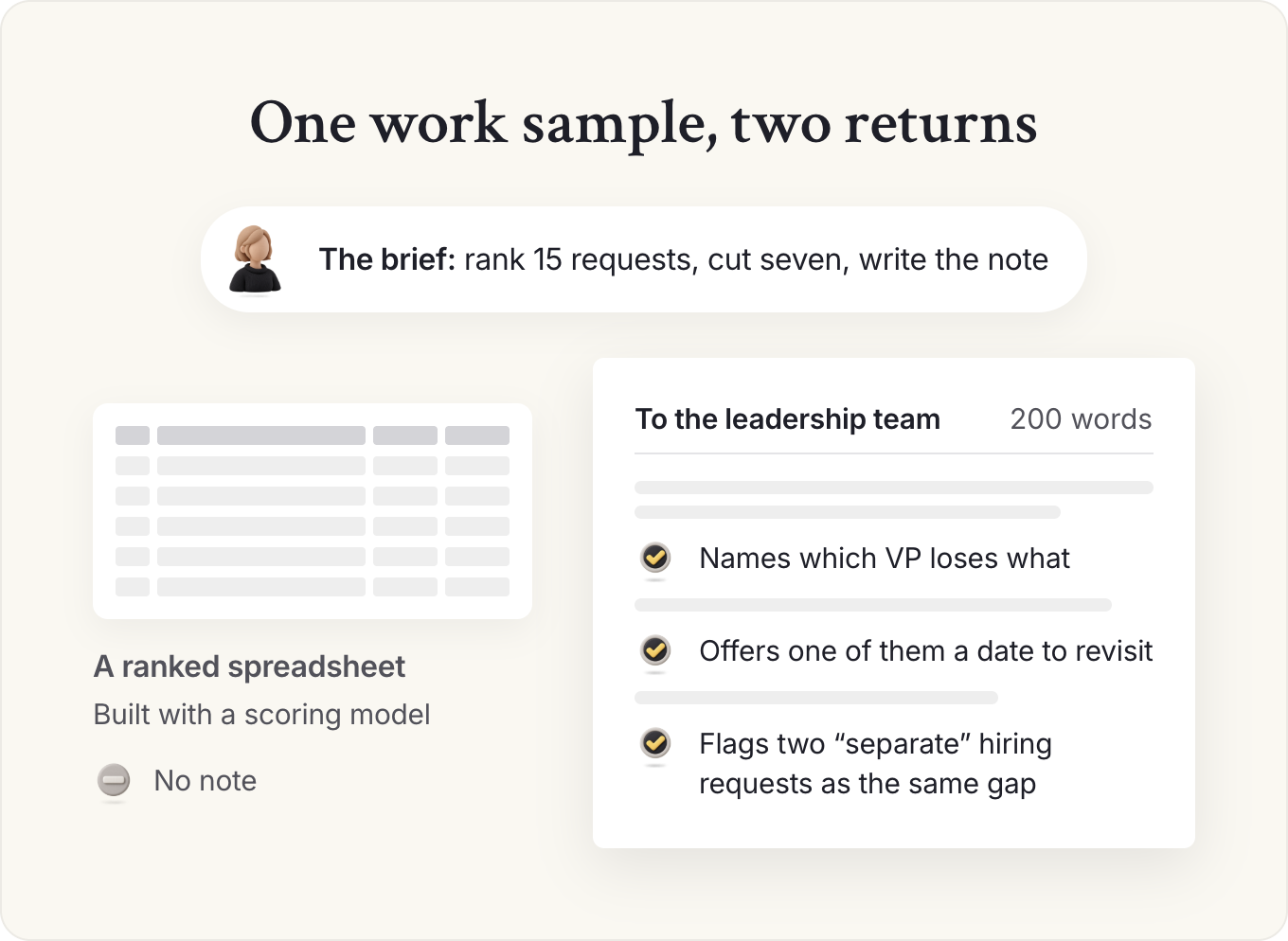
Take the Series B CEO from earlier (still an illustration). She ranked priorities and decisions second, and she tests that with a priority cut from last quarter's backlog, where she already made the calls. She sends 15 anonymized requests on a Thursday with a Monday deadline: two board asks, a pricing change, an office move, three hiring requests, a partner integration, a customer escalation and six smaller items. Rank them, cut seven, and write the note to the leadership team.
One candidate returns a ranked spreadsheet with a scoring model and no note. Another cuts seven items and writes a 200-word message that names which VP loses what, offers one a date to revisit, and flags that two "separate" hiring requests are the same gap. That second note is the job.
In the debrief, she pushes on the cut that hurts most: "The VP of Sales will call me the day this goes out. What do I tell him?" A strong candidate suggests she call him before the note lands. She scores the sample on three scorecard areas only: judgment, honest communication and writing.
The references
A former principal will say the person was indispensable, which is true of most competent Chiefs of Staff. What you need is how they behaved when they had to deliver bad news, push a peer who outranked them, or keep a confidence. The strongest reference is the one Zach Garippa got: Ali's former CEO called him and said, "My chief of staff is available."
Ask questions that force examples:
- "Tell me about a time they disagreed with their principal. What did they do?"
- "When a leader on the team was blocking something, how did they handle it?"
- "What would you not give them to own?"
- "If you were their principal again, what would you set up differently from day one?"
The last answer doubles as advice for your onboarding. Never call someone at the candidate's current company without permission; discretion is part of the job you're hiring for.
This week, pick a problem you solved last quarter and write it up in half a page. That's your work sample.
How do you make a Chief of Staff offer, and how long does hiring take?
Put the level, the pay, the equity facts, the likely next role and a tour of two to three years in writing. Plan on four to eight weeks from first interview to signed offer. Write these terms into the offer letter or the note that goes with it:
- The level and title, matched to the decision rights in the mandate, with the band it sits in.
- Base pay inside that band, benchmarked against the salary guide. If you're below the band, say why and when it moves.
- Bonus, with how it's decided. A clear one stands out, because many Chiefs of Staff get none.
- Equity, with the four facts a candidate needs to value it: the number of shares or options, the fully diluted share count, the strike price, and the last preferred price.
- The expected tour and likely next role. Two to three years, with the paths you'd support named.
- A 12-month review of level and pay, tied to the six-month outcomes in the mandate.
Count the all-in cost against the return you wrote down at the start: base, bonus, equity, benefits and any search fee. Five stages, about a week apart, take four to eight weeks. Longer processes lose employed candidates. Shorter ones usually skip the panel or the references.
If you hire in the UK or Europe, ask about the candidate's notice period in the first conversation, and set the start date from it.
My take: the next role in the offer is the strongest retention tool you have, and it costs nothing at signing. Draft the offer note before your final interview, with blanks for the numbers.
How do you onboard a Chief of Staff in the first 90 days?
Prepare before day one with the checklist below, then give the Chief of Staff one real problem in week one and let them earn the rest. Your direct reports will decide in the first two weeks whether this person speaks for you, so give the Chief of Staff a seat in most of your meetings for the first month.
Plan for the side effect: at least one leader will read the new hire as your eyes and ears and start sharing less. Say in your first leadership meeting together what the Chief of Staff brings back to you and what stays between them and the leader. The first time you act on something told in confidence, the role stops hearing anything useful.
The first real problem arrives fast. Zach Garippa handed Ali a sensitive HR issue in her first week. Expect something like it, and have the priorities conversation that same week. Keep the 1:1 from turning into triage with a short weekly update the day before. The Chief of Staff's own plan is in our first 90 days guide.
Template: Onboarding checklist for the principal of a new Chief of Staff
Onboarding checklist: principal of a new Chief of Staff
Chief of Staff: [name] · Start date: [date] · Review dates: day 30, day 60, day 90
Before day one
- ☐ Send the leadership team a note: what the Chief of Staff owns, what they don't, how disagreements get resolved
- ☐ Grant access: calendar, email delegation if agreed, leadership docs, metrics dashboards, board materials
- ☐ Book a weekly 1:1 (30 to 45 min) plus 30-minute reviews at day 30, 60 and 90
- ☐ Write the first problem you want solved, in half a page
- ☐ Put the mandate (decision rights, success at six months) somewhere you'll both see it
Week one
- ☐ Introduce them in person at the leadership meeting
- ☐ Hand over the first problem
- ☐ Agree how they'll send you their weekly update
Day 30 review: ask
- What have you learned that surprised you?
- Which three problems do you see, and which would you fix first?
- What do you need from me that you're not getting?
Day 60 review: ask
- Which part of the operating rhythm do you own now, and what's working?
- What should you stop doing?
- Where are leaders still going around you?
Day 90 review: agree
- ☐ The written mandate, updated
- ☐ Goals for the next two quarters
- ☐ Progress against the three six-month outcomes
- ☐ The expected tour length and the likely next role
# Onboarding checklist: principal of a new Chief of Staff

Chief of Staff: [name]  ·  Start date: [date]  ·  Review dates: day 30, day 60, day 90

## Before day one
- [ ] Send the leadership team a note: what the Chief of Staff owns, what they don't, how disagreements get resolved
- [ ] Grant access: calendar, email delegation if agreed, leadership docs, metrics dashboards, board materials
- [ ] Book a weekly 1:1 (30 to 45 min) plus 30-minute reviews at day 30, 60 and 90
- [ ] Write the first problem you want solved, in half a page
- [ ] Put the mandate (decision rights, success at six months) somewhere you'll both see it

## Week one
- [ ] Introduce them in person at the leadership meeting
- [ ] Hand over the first problem
- [ ] Agree how they'll send you their weekly update

## Day 30 review: ask
- What have you learned that surprised you?
- Which three problems do you see, and which would you fix first?
- What do you need from me that you're not getting?

## Day 60 review: ask
- Which part of the operating rhythm do you own now, and what's working?
- What should you stop doing?
- Where are leaders still going around you?

## Day 90 review: agree
- [ ] The written mandate, updated
- [ ] Goals for the next two quarters
- [ ] Progress against the three six-month outcomes
- [ ] The expected tour length and the likely next role
By day 90, check the hire against what you wrote before you posted the role. Your leaders should bring the items on the Decide list to the Chief of Staff, and at least one of the three six-month outcomes should be visibly moving.
If leaders still come to you for things the Decide list gives the Chief of Staff, either you never announced it or you keep overruling it, and the fix is yours.
How do you keep a Chief of Staff from stalling?
Agree a tour of two to three years when you hire, name the next roles, and re-level the role as its scope grows.
The median completed stint is 20 months, so many Chiefs of Staff leave just before the odds of a step up peak at two to three years (57%). The odds are lowest for people who leave within a year (38%).
You can keep the person you hired if there's somewhere to go. A move inside the company is more often a step up. 61% of next moves at the same company are a step up, and 48% of moves to another company are. Two thirds (67%) of those who become VP or Head of Operations, and 46% of new COOs, do it where they were Chief of Staff. If there's no path, the next step is elsewhere: when Chiefs of Staff take another Chief of Staff role, 83% of the time it's at a new company.
The stall usually starts when the scope grows and the level stays put. The work becomes operating machinery with nobody to hand it to, the 1:1 shrinks into triage, and the review asks for "more strategic thinking" from someone with no hours left. The principal can fix most of it:
- Name the likely next roles at the hire (operations leadership, a functional role, a bigger Chief of Staff seat), and revisit them every six months.
- Re-level with the scope. When the role takes on the planning cycle, a budget or the board, check the level against the Leveling Framework.
- Add an analyst or coordinator before the work outgrows one person. It frees hours for the strategic work and teaches them to manage.
If you already have a Chief of Staff, ask them: "What would you need from me to be doing your best work a year from now?" Act on one part of the answer this month.
 Chief of Staff salary (2026): pay by level, company size and city
 How to become a Chief of Staff
 Chief of Staff job description (template and examples)
Take this guide with you
The full guide as a PDF: every section, template and chart, ready to print or share with your team.
Your PDF is ready.
Download the PDFFree. We may email you new guides; unsubscribe anytime.
Frequently asked questions
How much does it cost to hire a Chief of Staff?
Where US Chief of Staff postings list pay, the median is $180,000. In our salary survey, level moves pay more than company size or industry does. Manager work averages about $144,000 in base, and Director work about $174,000. Our salary guide has the figures for each level. Budget the all-in cost: bonus, equity, benefits and a search fee if you use a firm.
When should a startup hire a Chief of Staff?
When you have a leadership team of four or more, work that crosses their boundaries, and a cadence someone has to run, such as planning, board meetings and a weekly leadership meeting. That can be at 25 people or 250. Funding stage is a weak signal. Hire for a problem you can name in two sentences.
Should my executive assistant become my Chief of Staff?
Sometimes, and it can work well, because the trust is already there. Re-level the role, hire a new executive assistant so the old job doesn't follow them, and write down the decisions they now own. In our career data, 6% of Chiefs of Staff came from executive support.
Is a Chief of Staff just a glorified executive assistant?
No, when the role is set up well. A Chief of Staff usually ranks above an executive assistant, in scope and in pay. The assistant runs your time and logistics, and the Chief of Staff runs your priorities and decisions across the leadership team. If you have both, they should report to you as peers. Our guide to Chief of Staff vs executive assistant covers hybrid roles.
Does a Chief of Staff report to the CEO?
Often. Of the postings that name the principal, 44% name the CEO, founder or president. The rest name a CTO, CFO, business unit president or another executive. The role is the same for other principals, usually with a narrower Decide list.
Is a COO more senior than a Chief of Staff?
Yes. The COO is a C-suite executive who runs functions through a team. Our guide to Chief of Staff vs COO covers which to hire first.
How long does a Chief of Staff stay in the role?
The median completed stint is 20 months, and the middle half run 12 to 30 months. Agree the expected tour and the likely next role when you hire.
- Chief of Staff Pathways Report 2026, Chief of Staff Network. 2,869 career histories (2,653 with a known prior function) and 1,819 job postings (June to October 2026). Salaries are from US postings that state pay, about 1 in 5.
- Chief of Staff Salary Report 2025, Chief of Staff Network (n=479).
- The State of Chief of Staff Jobs, Chief of Staff Network, 2024.
- Leveling Framework, Chief of Staff Network.
- The Chief of Staff Podcast: Zach Garippa and Ali Sardinia, Andrew Rea and David Moon, Nihal Mehta and Sofia Badalamenti.
- The "Chief of Staff or another hire?" and level tables, the interview process, the timeline, the scorecard and the checklist are our recommendations.
Learn the job with people who do it
Membership gets you the Power Skills program, member events and a private community of working Chiefs of Staff.
Land your first Chief of Staff role
Launchpad helps you prepare, position yourself and interview for the role.
Starting out in the role?
The Fundamentals email course walks you through scoping the mandate, setting the cadence and earning trust.
Lead AI adoption from the Chief of Staff seat
The Chief of AI Fellowship is for operators turning AI into how the company runs.
Hiring a Chief of Staff?
Post the role on the Chief of Staff job board, or browse open roles.
Get your resume ready for the role
Get feedback on your Chief of Staff resume before you apply.
Let the right roles find you
Join the talent network and hear about Chief of Staff roles first.
The Chief of Staff newsletter
What Chiefs of Staff are reading, hiring for and building.
Get the full report
Every chart and cut from our latest salary research, sent to your inbox.
Using AI with sensitive data?
Learn the legal side of using AI at work.
Keep going in this series