

How to map your stakeholders as a Chief of Staff
How a Chief of Staff maps and tracks 20 to 60 stakeholders: who belongs on the map, what to record, how to keep it current, and 2 templates and 2 prompts.

Ask AI
 Share
Stakeholder management for a Chief of Staff means knowing what the 20 to 60 people around your principal are measured on and where each stands on the decisions in flight, then bringing them in before those decisions reach a meeting. Keep it in a short map you update after conversations and review monthly.
- Record what each person is measured on before anything else. People back proposals that help them hit their number, so that one field predicts most reactions.
- Start the map with your principal's direct reports and peers, then add the deputies, executive assistants and long-tenured people the leadership team listens to.
- For any decision that crosses teams, write down where each person stands on that decision. Agree with your principal who talks to whom, then hold the first one-to-one with the likeliest objector.
- When two leaders want opposite things, talk to each alone before you put them in a room. If that doesn't settle it, take the trade-off to your principal as a choice.
- Write down only facts and positions, show the map to your principal alone, and tell each leader up front what you'll pass on with their name on it.
Most stakeholder trouble a Chief of Staff runs into arrives as a surprise. A leader who opposed a project from the start says so for the first time in the leadership meeting, or a peer of your principal (the executive you work for) hears about a decision from their own team. You have no authority over either of them, so your only protection is knowing, before the meeting, what each leader cares about and where they stand.
That knowledge fades if it lives only in your head. Keep it in a short map, built from the template and filled-in example below, and feed it from the meeting notes you already keep for context management.
What is stakeholder management for a Chief of Staff?
For a Chief of Staff, stakeholder management means knowing what the people around your principal are measured on and need, and where they stand on the work in flight. You do it on your principal's behalf, which makes it different from managing stakeholders for a project you own.
Project stakeholder management ends when the project ends. Yours doesn't. The same leaders show up in every priority, planning cycle and hard decision, so each conversation makes the next one easier or harder. And because you speak for your principal, a leader who feels blindsided by you feels blindsided by your CEO.
Our Leveling Framework lists stakeholder management as one of eight competencies. At every level, the first item under it is running the key recurring meetings: the leadership meeting, the all-hands and the board meeting. What changes with level is the circle. Earlier-level Chiefs of Staff work mostly inside the company, and investors, partners and customers appear at the VP and executive levels. At no level are you the external face of the company. You build relationships for your principal and hand the important ones back.
41% of more than 1,800 Chief of Staff job postings mention cross-functional initiatives. That work moves only through people who don't report to you.
Who your principal is reshapes the map. Only 44% of the more than 700 postings that name the principal say CEO, founder or president. If you work for a CTO or a CFO, your most important stakeholders include your principal's peers, and some will see you as a rival's deputy before they see you as help.
If you're the principal, the map is a list of your relationships, and you should see all of it. Your part is small. Tell your Chief of Staff who's missing before a big decision, agree who talks to whom on each decision plan, and make the call when two leaders' targets pull against each other. If a leader goes around your Chief of Staff, send the request back through the agreed process.
Stakeholder map or power-interest grid?
A power-interest grid sorts the people around one project by how much power they hold and how much they care. It shows who to manage closely, but not what any of them needs or what would win them over. A Chief of Staff uses three tools for three different jobs:
- A power-interest grid gives you a first pass on a new initiative: who needs close attention and who only needs updates.
- The stakeholder map below covers the 20 to 60 people who matter to all of your principal's work, all year: what each owns and is measured on, how they work and when you next talk.
- A decision plan covers one decision that crosses teams: each person's role in it, where they stand, what would move them and who talks to them first.
Once you keep the map and write a decision plan for each cross-team decision, the grid adds little.
Who belongs on your stakeholder map?
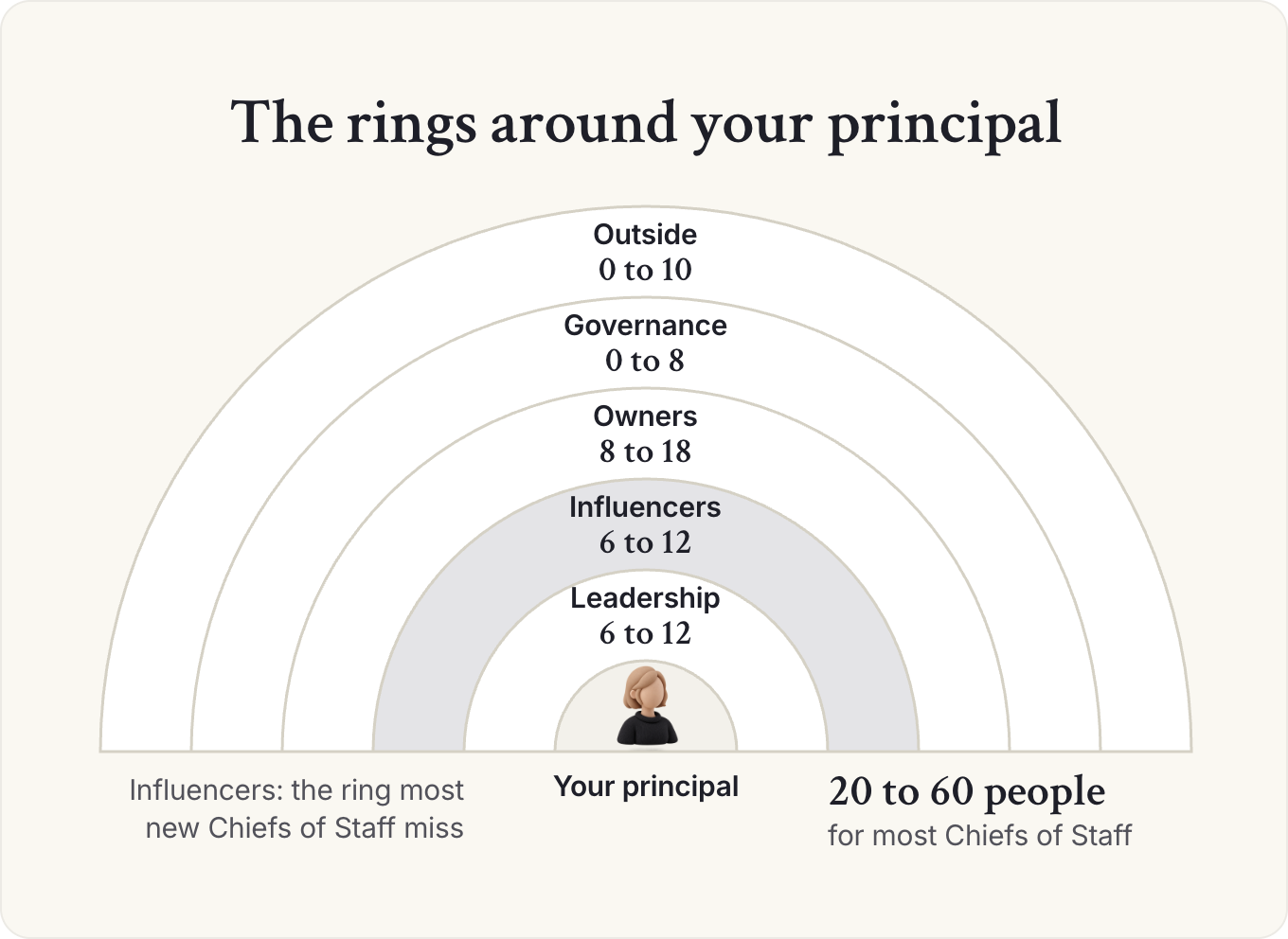
Put the people on the map whose decisions, support or resistance change whether your principal's priorities happen: your principal's peers and direct reports, the people who shape their views from outside the org chart, the owners of the work your priorities depend on, and, through your principal, the board and the most important outside relationships. For most Chiefs of Staff that's 20 to 60 people.
Fewer than twenty usually means you've only mapped the org chart; more than sixty and you can't keep it current. The test for each name: if this person changed their mind about something this quarter, would your principal's plan change? Group the names in rings, ordered by how often each relationship needs attention.
The rings of a Chief of Staff stakeholder map
| Ring | Who | Typical size | How often to touch base | What you need from them |
|---|---|---|---|---|
| 1. Leadership | Your principal's direct reports and peers on the leadership team | 6 to 12 | Every 2 to 4 weeks, one to one | Early read on decisions, honest pushback, delivery on priorities |
| 2. Influencers | Deputies, chiefs of staff to other leaders, executive assistants, long-tenured people the leadership team listens to | 6 to 12 | Monthly | How decisions really get made, early warning |
| 3. Owners | People who own the work your priorities depend on: program leads, finance partner, people partner, legal | 8 to 18 | When work is in flight | Delivery, capacity, blockers |
| 4. Governance | Board members, major investors (through your principal) | 0 to 8 | Around board cycles | Context for your principal's prep |
| 5. Outside | Major customers, partners, advisors (usually from VP level up) | 0 to 10 | As your principal needs | Signal from outside the building |
Ring 2 is the one most new Chiefs of Staff miss: the deputy whose opinion a VP always asks for, the executive assistant who knows which meetings matter, the engineer whose skepticism sinks projects. BreeAnne Yek, then Chief of Staff at a Series A medtech startup, saw senior stakeholders in her public-sector work set processes that suited them and hardly considered the people who had to run them. The people who carry out a decision are stakeholders in it, even when they'll never be in the meeting.
Build in waves. Crystelle Desnoyer, former Chief of Staff to the CEO at Techstars, started with the close circle around her principal and only then widened her stakeholder mapping across the company. Your principal's direct reports come first, because they can make or break your first 90 days. If you support a functional leader, start with that leader's team and the peers whose work collides with theirs, and put the other Chiefs of Staff in ring 2: they're the fastest route to knowing what the rest of the leadership team is about to decide. If you have a new principal, start again from their direct reports and peers, even if you know the company well.
Draft your rings, then ask your principal: "Who's missing from this list whose opinion you'd want before a big decision?" The names they add are the ones you'd never have found on the org chart. A first-90-days plan shared in our member community adds three questions to ask yourself as you meet people: who does your principal go to informally, who holds the company's history outside the leadership team, and whose influence is bigger than their title?
What should you record about each stakeholder?
Record what each person owns, what they're measured on, what they're working on this quarter, how they like to work, who they trust, where they stand on the decisions in flight, and when you last and next talked. Keep each entry to a few lines; anything longer starts to read like a file on someone.
The field that does the most work is "measured on." If you know the head of sales is paid on new bookings this year, you can predict their reaction to a pricing change before the meeting and shape the proposal so it helps them too. The second is "how they like to work": some leaders want a document two days ahead, others need ten minutes on a call.
Template: Stakeholder map
Stakeholder map: [principal's name], [quarter]
Last reviewed: [date] · Owner: [your name] · Shared with: [principal's name] only
| Name and role | Ring | Owns | Measured on | This quarter | How they like to work | Trusts / listens to | Last touch | Next touch | Health |
|---|---|---|---|---|---|---|---|---|---|
| [Name, role] | [1 to 5] | [What they own] | [The number they're measured on] | [Their main work this quarter] | [How and when they want information] | [Names] | [date] | [date, purpose] | [Good, building or strained] |
Where people stand on decisions in flight
| Decision | Supports | Open | Skeptical | Not yet asked | What would move each skeptic |
|---|---|---|---|---|---|
| [Decision] | [Names] | [Names] | [Names] | [Names] | [Name: what would move them] |
Notes
- [Date, name: two lines from the conversation. Facts and positions only.]
Ring: 1 leadership, 2 influencers, 3 owners, 4 governance, 5 outside.
Health of the relationship: good, building or strained. Every strained row gets a next touch with a purpose.
In the decisions table, list only the people the decision touches.
Rules: facts, roles and positions only. Nothing about anyone's health, family, performance or personal life. If you wouldn't read a line aloud to the person it's about, it doesn't go here.
# Stakeholder map: [principal's name], [quarter]
Last reviewed: [date] · Owner: [your name] · Shared with: [principal's name] only

| Name and role | Ring | Owns | Measured on | This quarter | How they like to work | Trusts / listens to | Last touch | Next touch | Health |
| --- | --- | --- | --- | --- | --- | --- | --- | --- | --- |
| [Name, role] | [1 to 5] | [What they own] | [The number they're measured on] | [Their main work this quarter] | [How and when they want information] | [Names] | [date] | [date, purpose] | [Good, building or strained] |

## Where people stand on decisions in flight
| Decision | Supports | Open | Skeptical | Not yet asked | What would move each skeptic |
| --- | --- | --- | --- | --- | --- |
| [Decision] | [Names] | [Names] | [Names] | [Names] | [Name: what would move them] |

## Notes
- [Date, name: two lines from the conversation. Facts and positions only.]

Ring: 1 leadership, 2 influencers, 3 owners, 4 governance, 5 outside.

Health of the relationship: good, building or strained. Every strained row gets a next touch with a purpose.

In the decisions table, list only the people the decision touches.

Rules: facts, roles and positions only. Nothing about anyone's health, family, performance or personal life. If you wouldn't read a line aloud to the person it's about, it doesn't go here.
Example: Stakeholder map for a Series B CEO (illustration)
Stakeholder map: CEO, Q2
Last reviewed: June 1 · Owner: Chief of Staff · Shared with: CEO only
| Name and role | Ring | Owns | Measured on | This quarter | How they like to work | Trusts / listens to | Last touch | Next touch | Health |
|---|---|---|---|---|---|---|---|---|---|
| Dana, VP Sales | 1 | Pricing input | New bookings | Hiring 4 AEs | Short calls, hates long docs | Her two top AEs, the CFO | May 27 | June 3, pricing | Good |
| Tom, CFO | 1 | Budget and forecast | Gross margin and runway | Q3 forecast | Wants data two days ahead | Lead investor | May 29 | June 5, forecast | Good |
| Ana, Head of Customer Success | 1 | Renewals and support | Net retention | Platform migration | Prefers written updates | Her support leads | May 12 | June 4, migration and pricing | Strained |
| Jo, EA to the CFO | 2 | CFO's calendar | n/a | Board prep logistics | Slack, same day | CFO | May 30 | June 6, board prep | Good |
| Sam, Finance partner | 3 | Budget reporting | Budget accuracy | Q3 forecast | Wants data two days ahead | CFO | May 20 | June 9, Q3 forecast | Building |
Where people stand on decisions in flight
| Decision | Supports | Open | Skeptical | Not yet asked | What would move each skeptic |
|---|---|---|---|---|---|
| 12% list price increase from Q3 | Tom | None | Dana | Ana | Dana: open quotes keep their price |
| Second sales manager | Dana | None | Tom | None | Tom: a hiring plan tied to Q4 bookings |
Notes
- May 27, Dana: a dozen late-stage deals were quoted at the old price; worried about win rate
- May 29, Tom: wants the increase live before the Q3 forecast locks
# Stakeholder map: CEO, Q2
Last reviewed: June 1 · Owner: Chief of Staff · Shared with: CEO only

| Name and role | Ring | Owns | Measured on | This quarter | How they like to work | Trusts / listens to | Last touch | Next touch | Health |
| --- | --- | --- | --- | --- | --- | --- | --- | --- | --- |
| Dana, VP Sales | 1 | Pricing input | New bookings | Hiring 4 AEs | Short calls, hates long docs | Her two top AEs, the CFO | May 27 | June 3, pricing | Good |
| Tom, CFO | 1 | Budget and forecast | Gross margin and runway | Q3 forecast | Wants data two days ahead | Lead investor | May 29 | June 5, forecast | Good |
| Ana, Head of Customer Success | 1 | Renewals and support | Net retention | Platform migration | Prefers written updates | Her support leads | May 12 | June 4, migration and pricing | Strained |
| Jo, EA to the CFO | 2 | CFO's calendar | n/a | Board prep logistics | Slack, same day | CFO | May 30 | June 6, board prep | Good |
| Sam, Finance partner | 3 | Budget reporting | Budget accuracy | Q3 forecast | Wants data two days ahead | CFO | May 20 | June 9, Q3 forecast | Building |

## Where people stand on decisions in flight
| Decision | Supports | Open | Skeptical | Not yet asked | What would move each skeptic |
| --- | --- | --- | --- | --- | --- |
| 12% list price increase from Q3 | Tom | None | Dana | Ana | Dana: open quotes keep their price |
| Second sales manager | Dana | None | Tom | None | Tom: a hiring plan tied to Q4 bookings |

## Notes
- May 27, Dana: a dozen late-stage deals were quoted at the old price; worried about win rate
- May 29, Tom: wants the increase live before the Q3 forecast locks
Record where people stand on each decision separately. In the example, the VP of Sales is skeptical about the price increase and backs the second sales manager. Label someone a "blocker" in general and you turn one disagreement into a relationship problem you created.
Anna Aden, then Chief of Staff to the Managing Director for Asia Pacific at the Tony Blair Institute for Global Change, saw the same thing in her work with governments. When sustainability language went out of favor, many initiatives carried on under a new name. Supporting local industry and local food became a matter of national security. Her advice: start from the outcome you want, work out who's involved, and align the outcome with what they care about.
Start by filling in "measured on" for everyone in ring 1. Where you don't know, the gap is your agenda for your next one-to-one with them.
How do you map stakeholders for one decision or initiative?
For any decision that crosses teams, list who decides, who shapes it, who has to carry it out and who just needs to hear about it; write down where each person stands today and what would move them; then talk to them one to one, in the right order, before the group meeting.
People defend positions they've taken in public. A one-to-one before the meeting lets a leader raise a concern while it's still a question, and lets you change the proposal before anyone has to win or lose. Once you and your principal agree who talks to whom, start with the person most likely to object, because their concerns improve the proposal and they'll notice if they were asked last. Then the people whose work changes most. Then the decision-maker, with a summary of what everyone said.
If that's your principal, give them the summary in your Monday one-to-one, before the agenda and pre-reads go out for Tuesday's leadership meeting. If someone else decides, get it to them before the agenda is set. Our guide to the operating rhythm calls these one-to-ones pre-wiring.
Template: Decision plan
Decision plan: [decision or initiative]
Decision needed by: [date] · Forum: [meeting, date]
Decides: [name] · Recommends: [name]
| Person | Role in this decision | Where they stand | What they care about here | What would move them | Who talks to them | By when |
|---|---|---|---|---|---|---|
| [Name] | Decides | [Supports / open / skeptical / not yet asked] | [What they're measured on, and what this decision does to it] | [The evidence or change they need] | [Principal, Chief of Staff or owner] | [date] |
| [Name] | Shapes | [Supports / open / skeptical / not yet asked] | [Their concern] | [For example, a pilot first] | [Principal, Chief of Staff or owner] | [date] |
| [Name] | Carries it out | [Supports / open / skeptical / not yet asked] | [Their team's capacity and timing] | [For example, more time or headcount] | [Principal, Chief of Staff or owner] | [date] |
| [Name] | Hears about it | n/a | [How it affects them] | n/a | [Who tells them], after the decision | [date] |
Order of conversations
- [Principal's name]: agree who talks to whom
- [Name], most likely to object
- [Name], most affected
- [Name], the decision-maker, with a summary of what everyone said
What changed in the proposal after the one-to-ones
- [Change] ([who asked for it])
# Decision plan: [decision or initiative]
Decision needed by: [date] · Forum: [meeting, date]

Decides: [name] · Recommends: [name]

| Person | Role in this decision | Where they stand | What they care about here | What would move them | Who talks to them | By when |
| --- | --- | --- | --- | --- | --- | --- |
| [Name] | Decides | [Supports / open / skeptical / not yet asked] | [What they're measured on, and what this decision does to it] | [The evidence or change they need] | [Principal, Chief of Staff or owner] | [date] |
| [Name] | Shapes | [Supports / open / skeptical / not yet asked] | [Their concern] | [For example, a pilot first] | [Principal, Chief of Staff or owner] | [date] |
| [Name] | Carries it out | [Supports / open / skeptical / not yet asked] | [Their team's capacity and timing] | [For example, more time or headcount] | [Principal, Chief of Staff or owner] | [date] |
| [Name] | Hears about it | n/a | [How it affects them] | n/a | [Who tells them], after the decision | [date] |

## Order of conversations
1. [Principal's name]: agree who talks to whom
2. [Name], most likely to object
3. [Name], most affected
4. [Name], the decision-maker, with a summary of what everyone said

## What changed in the proposal after the one-to-ones
- [Change] ([who asked for it])
Example: Decision plan for a price increase (illustration)
Decision plan: 12% list price increase for new customers from Q3
Decision needed by: June 15 · Forum: leadership meeting, June 15
Decides: CEO · Recommends: CFO
| Person | Role in this decision | Where they stand | What they care about here | What would move them | Who talks to them | By when |
|---|---|---|---|---|---|---|
| CEO | Decides | Supports | Margin before the next raise | n/a | Chief of Staff, with summary | June 14 |
| Dana, VP Sales | Shapes | Skeptical | New bookings and win rate | Open quotes keep their price | Chief of Staff | June 3 |
| Tom, CFO | Shapes | Supports | Margin | n/a | CEO | June 5 |
| Ana, Head of Customer Success | Carries it out | Not yet asked | Account managers' time | An FAQ and two weeks to brief them | Chief of Staff | June 4 |
| Head of marketing | Hears about it | n/a | Pricing page and launch emails | n/a | CFO, after decision | June 16 |
Order of conversations
- CEO: agree who talks to whom
- Dana (most likely to object)
- Ana (most affected)
- Tom, from the CEO
- CEO, with a one-page summary
What changed in the proposal after the one-to-ones
- Quotes issued before June 30 keep the old price (Dana)
- Launch moves two weeks so account managers get an FAQ and time to brief customers (Ana)
# Decision plan: 12% list price increase for new customers from Q3
Decision needed by: June 15 · Forum: leadership meeting, June 15

Decides: CEO · Recommends: CFO

| Person | Role in this decision | Where they stand | What they care about here | What would move them | Who talks to them | By when |
| --- | --- | --- | --- | --- | --- | --- |
| CEO | Decides | Supports | Margin before the next raise | n/a | Chief of Staff, with summary | June 14 |
| Dana, VP Sales | Shapes | Skeptical | New bookings and win rate | Open quotes keep their price | Chief of Staff | June 3 |
| Tom, CFO | Shapes | Supports | Margin | n/a | CEO | June 5 |
| Ana, Head of Customer Success | Carries it out | Not yet asked | Account managers' time | An FAQ and two weeks to brief them | Chief of Staff | June 4 |
| Head of marketing | Hears about it | n/a | Pricing page and launch emails | n/a | CFO, after decision | June 16 |

## Order of conversations
1. CEO: agree who talks to whom
2. Dana (most likely to object)
3. Ana (most affected)
4. Tom, from the CEO
5. CEO, with a one-page summary

## What changed in the proposal after the one-to-ones
- Quotes issued before June 30 keep the old price (Dana)
- Launch moves two weeks so account managers get an FAQ and time to brief customers (Ana)
Some conversations should come from your principal, especially with peers who'd resent hearing a decision from their colleague's Chief of Staff. Others are better from you, because a leader will tell you a concern they'd soften in front of your principal. If you work for a functional leader, the likeliest objector is often one of those peers, so that first talk is your principal's. The last section, what changed after the one-to-ones, is the one I'd show the room, because it tells everyone their input moved the proposal.
Andrea Mayendia, then Chief of Staff to the Chief Product and Technology Officer at Dow Jones, did a version of this at company scale. Her team worked out its short list of "big rocks" together with stakeholders across the business, posted it where everyone could see it, and reviewed it with them weekly. My read is that the list held because the people who could have fought it had helped write it.
A decision can still come apart after the meeting. Juhi Kabra, former Chief of Staff to the CEO at Redesign Health, said leaders can agree in the room, then each tells their team their own interpretation: "And if you hear all of those, you'd think they were all in different meetings." Her lesson was that agreement in the room isn't enough until the leaders also agree the talk track. Our method is to read back each decision before the meeting closes and agree the two or three sentences every leader will tell their team. Then send those sentences with the decisions, owners and dates within two hours, as our leadership team meeting agenda recommends.
Judgment calls on a decision plan
Sometimes the one-to-one shows the skeptic is right. Tell your principal before the meeting and move the item; your credibility with the skeptic is worth more than one meeting slot. Watch the line between preparing a decision and staging it. If every change is settled in private and the meeting only signs off, the people you talked to last feel the room was rigged. So show the changes in the pre-read, and leave real choices for the group.
If a leader won't engage before the meeting, ask the decision-maker to invite them to speak first. Don't use the "where they stand" column to keep score of who was right, or people will start guarding what they tell you.
Before the one-to-one with the person most likely to object, spend ten minutes on what they're measured on and what they need to hear. This prompt helps.
Prompt: Prepare for a conversation with a skeptical stakeholder
I'm a Chief of Staff preparing for a one-to-one with a leader who is skeptical about a decision my principal is proposing. Help me prepare.

Here is what I know (facts and positions only):
- Their role and what they're measured on: [paste]
- What they've said about this decision so far: [paste]
- The decision and our current proposal: [paste]

Give me:
1. The two or three concerns they most likely have, including ones they haven't said out loud, tied to what they're measured on.
2. Three open questions I can ask to understand their position before I respond to it.
3. What we could change in the proposal that would address their concerns without losing what matters to us, and what we shouldn't change.
4. One sentence I can use to open the conversation that shows I understand their side.

Keep it practical and short. Don't write a script.
When two leaders want opposite things
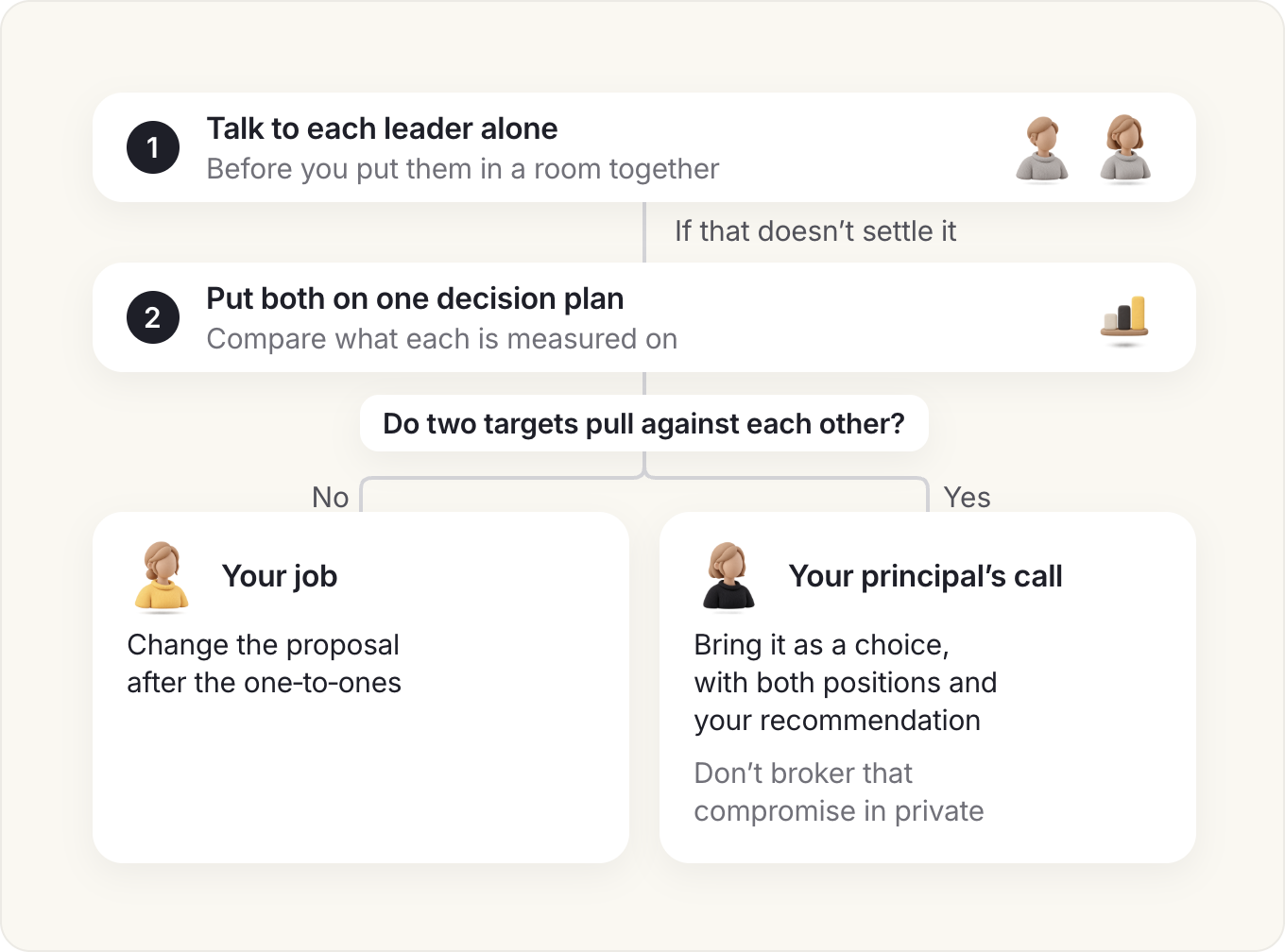
Talk to each one alone before you put them in a room together. Lu Borko, Chief of Staff at Manychat, said two people at odds "might not be as open" in a room together, while one to one they open up. In any conversation like this, she starts by asking what the other person is trying to achieve. Sometimes one side didn't know about the competing priority on the other.
Then put both on one decision plan and compare what each is measured on. If the disagreement traces back to two targets that pull against each other, such as new bookings against gross margin, the two of them rarely settle it alone, because neither wants to give up their own number. Take it to your principal as a choice between those targets, with both positions in their own words and your recommendation. Changing a proposal after the one-to-ones is your job. Trading one leader's target against another's is your principal's call. Don't broker that compromise in private. A deal struck through you leaves you answerable for it.
Pick the next decision on your principal's list that crosses two or more teams. Fill in the plan above, agree the "who talks to them" column with your principal, and book the first conversation with the person most likely to object.
How do you keep a stakeholder map current without it going stale?
Capture two lines after each conversation that matters, let a weekly summary of your notes update the map, and spend thirty minutes once a month reviewing the whole thing with fresh eyes. Re-map from scratch when something big changes: a reorg, a new executive, a new top priority or a new principal.
Most maps die the same way: a careful spreadsheet in month one, two updates, then the daily work takes over. The fix is to update the map from notes you already take, as our guide to context management describes. Weekly, you add facts. Monthly, you ask questions of the whole map: who haven't I talked to in six weeks, whose health has slipped, which decision has a skeptic nobody has talked to, and who's missing. Hold the monthly review on a Friday, when you write your weekly update, so what it turns up reaches Monday's one-to-one.
New priorities bring new stakeholders. If your principal's top priority this year involves AI, your rings 2 and 3 probably look different from last year's, even if the org chart hasn't changed.
AI tools help with the weekly part. Keep the map in one file, add your notes for the week, and ask for proposed updates you approve line by line. I'd use Claude for this.
Prompt: Update my stakeholder map from this week's notes
Below is my stakeholder map (a markdown file) and my notes from this week's conversations and meetings.

Propose updates to the map. For each change, show: the person, the field, the old value, the new value, and the line in my notes it comes from.

Look for:
- New facts about what someone owns, is measured on or is working on this quarter
- Changes in where someone stands on a decision in the "decisions in flight" table (which column their name goes in)
- Last-touch dates to update, and anyone I haven't talked to in 6+ weeks
- People mentioned in my notes who aren't on the map but may belong on it (say which ring and why)

Rules:
- Facts, roles and positions only. Ignore anything about a person's health, family, performance or personal life, and tell me if my notes contain any so I can remove it.
- Don't guess. If a note is ambiguous, list it as a question for me.

Stakeholder map:
[paste]

This week's notes:
[paste]
What should stay out of a stakeholder map, and who should see it?
Keep the map to facts, roles, interests and positions on decisions, and share it only with your principal. Anything about health, family, personal lives, performance or your private read on someone's motives stays out of writing entirely, and out of AI tools.
The test I'd use: if you wouldn't read a line aloud to the person it's about, it doesn't go in the file. The same test covers a shared document, a meeting recording and an AI prompt. Files get shared by accident, and in many countries notes about named people count as personal data your company is responsible for. In the UK and the EU, a colleague can ask for a copy of the personal data your company holds about them, and notes in a work file, including your opinions about them, can fall within that request.
Tell people when a meeting is recorded, and use the consent rules in our meetings guide. Ask legal how long notes should be kept, because some become company records. Your read on people still matters, so say it out loud. Your principal needs to know the head of product feels sidelined, even though it never goes in the written brief.
Leaders talk to a Chief of Staff because they believe it helps them, and they stop the day they think you're keeping a file on them for the boss. Elyse Levine held two roles at once at the University of Southern California: deputy Chief of Staff to the president and Chief of Staff to the chair of the board of trustees. She describes how the person between two leaders can't be pulled into keeping one side's secrets from the other. Decide the sharing rule up front:
- Your principal sees the whole map, and should. It's their relationships you're tracking.
- The leadership team never sees the map. They can see decision plans for work they're part of, without the "where they stand" and "what would move them" columns.
- Your successor gets a cleaned version, so relationships survive your move. Tell them your read on people in person. Our context guide covers the rest of the handover.
- AI tools get the facts-and-positions version only, and only if they're approved for internal company information.
When a leader sees you as the CEO's spy
Sooner or later, a leader will treat you as the CEO's eyes and ears, which is a fair assumption from where they sit. Nick Greif, former Chief of Staff at InStride, said he wouldn't automatically trust a Chief of Staff himself. He was explicit up front about how he'd handle what people told him, and when something needed to go higher without a name on it, he'd raise it as if he'd noticed it himself. He says people quickly saw that nothing leaked.
I'd make that explicit with every ring 1 leader in your first month: what you'll keep between the two of you, what you'll take to your principal with their name on it, and what you'll raise without it. Then keep to it every time. If a leader routes everything around you straight to the CEO, ask your principal to send those requests back through the agreed process. If they're actively working against you, that's a conversation with your principal about the leader, and the map won't solve it.
The suspicion can start before any of this, when you ask to shadow a leader or start a listening tour. After waves of layoffs, people wonder whether cuts are coming or their work is under review. So say why you're asking. Tell them you want to spot their roadblocks early and help them look good to your principal.
How do you build relationships when you have no authority?
Influence without authority starts with being useful to each leader on the map before you need anything from them. Carry their concerns to your principal accurately, bring your principal's reasoning back, and close every loop you open. Keep a short list of what you're waiting on from each person, and check it before your next touch.
Then go and listen. This week, pick the ring 1 stakeholder you know least well, ask what would make their quarter easier, and do one thing about it before Friday.
New to working without authority? Our Fundamentals email course has short lessons on working with your principal, leading without authority and building relationships across the leadership team.
Start the courseKeep reading
 Context management for Chiefs of StaffToolkit
 How to brief your principal: briefing memos, decision memos and pre-readsToolkit
- The Chief of Staff toolkit: tools and templates for the daily workToolkit
Toolkit
- The Chief of Staff toolkit: tools and templates for the daily work
- How to brief your principal: briefing memos, decision memos and pre-reads
- Executive communications for Chiefs of Staff: writing for the CEO and running internal comms
- Leadership team meeting agenda: how to run the meeting, take notes and follow up
- Executive calendar management: how a Chief of Staff runs the calendar and inbox
- Context management for Chiefs of Staff
- Stakeholder management for Chiefs of Staff: how to map and track the people your principal depends on
- How Chiefs of Staff research decisions, with and without AI
- How a Chief of Staff runs board meetings and investor relations
Take this guide with you
The full guide as a PDF: every section, template and chart, ready to print or share with your team.
Your PDF is ready.
Download the PDFFree. We may email you new guides; unsubscribe anytime.
Frequently asked questions
How many stakeholders should a Chief of Staff track?
Usually 20 to 60. Fewer than twenty often means you've mapped only the org chart and missed the influencers around it. More than sixty means you're tracking everyone you've met, and the map becomes too heavy to keep current. Ask of each name whether a change in their view would change your principal's plan.
Should I use a CRM to track internal stakeholders?
Usually not. A CRM is built for sales pipelines and adds overhead that internal relationships don't need. A single document or table, updated from your meeting notes and reviewed monthly, is enough for most Chiefs of Staff. Use whatever your principal can open and your company has approved for internal information.
How can a Chief of Staff help with stakeholder management?
A Chief of Staff keeps a short map of what the leaders around the principal own, what they're measured on and where they stand on the decisions in flight. Before a decision that crosses teams, they agree with the principal who talks to whom. Then they hold the first one-to-one with the likeliest objector, so concerns change the proposal before the meeting and the principal isn't surprised in the room. They carry those concerns accurately to the principal, bring the principal's reasoning back, and close every loop they open.
How do you answer "How do you build relationships with stakeholders?" in a Chief of Staff interview?
Tell one real story about a decision that crossed teams. Say who decided, who was skeptical and what they were measured on, who you spoke to first and why, what changed in the proposal because of those conversations, and how the decision held afterwards. For a question about a difficult stakeholder, add what you agreed with them about how you'd handle what they told you. Interviewers listen for whether you worked through other people's interests or around them, and whether your principal was ever surprised.
- Leveling Framework, Chief of Staff Network, and its survey of 200+ Chiefs of Staff.
- Chief of Staff Pathways Report 2026, Chief of Staff Network. 1,819 job postings (June to October 2026).
- Chief of Staff Network podcast: BreeAnne Yek, Crystelle Desnoyer, Anna Aden, Andrea Mayendia, Juhi Kabra, Lu Borko, Elyse Levine, Nick Greif.
- Chief of Staff Network member community: a first-90-days plan shared with members.
- Right of access, UK GDPR and EU GDPR Article 15; EDPB Guidelines 01/2022 on the right of access.
- Rings, map size and the methods on this page are the Chief of Staff Network's recommendations. The examples are illustrations.
Learn the job with people who do it
Membership gets you the Power Skills program, member events and a private community of working Chiefs of Staff.
Land your first Chief of Staff role
Launchpad helps you prepare, position yourself and interview for the role.
Starting out in the role?
The Fundamentals email course walks you through scoping the mandate, setting the cadence and earning trust.
Lead AI adoption from the Chief of Staff seat
The Chief of AI Fellowship is for operators turning AI into how the company runs.
Hiring a Chief of Staff?
Post the role on the Chief of Staff job board, or browse open roles.
Get your resume ready for the role
Get feedback on your Chief of Staff resume before you apply.
Let the right roles find you
Join the talent network and hear about Chief of Staff roles first.
The Chief of Staff newsletter
What Chiefs of Staff are reading, hiring for and building.
Get the full report
Every chart and cut from our latest salary research, sent to your inbox.
Using AI with sensitive data?
Learn the legal side of using AI at work.
Keep going in this series