

A day in the life of a Chief of Staff
What a Chief of Staff does all day and all week, hour by hour, with real schedules from startup, enterprise and fractional Chiefs of Staff.

Ask AI
 Share

A Chief of Staff's day usually has three parts: a short priorities check with the principal and a protected writing block early, a middle of meetings that run the company's operating rhythm, and closing follow-ups that turn decisions into owners and dates. It works best when each day hangs off a weekly list of priorities agreed with the principal.
- Plan the week before the day. Agree three to five priorities with your principal at your weekly 1:1, review them on Friday, and tie every block on your calendar to that list.
- Write first. Keep 90 minutes early in the day for pre-reads and decision memos, and send the decisions, owners and dates within two hours of the leadership meeting.
- Book time for work nobody planned. Escalations and same-day requests will take part of every day, so hold a block for them or they eat your focus time.
- Check your calendar against the job. 61% of Chief of Staff postings ask for the operating rhythm and only 20% for guarding the executive's time. If your day is mostly inbox and scheduling, ask your principal for a mandate conversation.
- Keep the week sustainable. Hand one process a quarter to the team that should own it, and keep a one-page coverage plan so you can take a real week off.
On paper, a Chief of Staff's calendar looks like any senior operator's: meetings from early morning to six. The work that matters rarely appears on it. It's the decision made on time, the conflict that never reached the CEO and the deadline nobody missed.
The calendar still decides whether that work gets done, and the Chiefs of Staff who protect it use small, fixed routines: a call on the CEO's drive to the gym, a ranked text before the workday starts, a Friday review. Each one below comes from a guest on the Chief of Staff Podcast.
What does a Chief of Staff do all day, hour by hour?
A typical day runs from a short priorities check with the principal, the executive you work for, through a writing block and the leadership meetings, to follow-ups that turn decisions into owners and dates. Each block serves one of the four core responsibilities: priorities and decisions, running the operating rhythm, communication up and down, and cross-functional projects.
A sample Tuesday: Chief of Staff to the CEO of a 150-person Series B software company (composite)
| Time | What happens | Core responsibility |
|---|---|---|
| 7:15 | 15-minute call with the CEO: what each of you is prioritizing today | Priorities |
| 7:30 to 9:00 | Protected block: read the pre-reads for the leadership meeting and write a one-page decision memo | Rhythm |
| 9:00 to 10:15 | Weekly leadership team meeting, 75 minutes. The CEO chairs; you run the agenda, keep time and capture decisions | Rhythm |
| 10:15 to 10:30 | Send the decisions, each with an owner and a date | Rhythm |
| 10:30 to 11:30 | One-to-one with the head of sales on a pricing change that touches three teams | Projects |
| 11:30 to 12:30 | Working session with finance on the board deck | Rhythm |
| 12:30 to 1:30 | Lunch with a team lead two levels down. Mostly listening | Communication |
| 1:30 to 2:30 | Final-round interview for a director hire the CEO cares about | Priorities |
| 2:30 to 3:30 | The escalation nobody owns: a customer issue stuck between support and product | Projects |
| 3:30 to 4:30 | Triage: the asks that need a decision go on tomorrow's list, the rest get routed | Communication |
| 4:30 to 5:00 | Short review with the CEO: two decisions needed, one risk, tomorrow's prep | Communication |
| 5:00 to 6:00 | Close loops, then write tomorrow's top three | Priorities |
In the sample day, the operating rhythm takes the most time. It is also what employers ask for most: 61% of Chief of Staff postings ask for OKRs, KPIs or the operating rhythm, and only 20% mention guarding the executive's time. The other three responsibilities fill the rest of the day: one-to-ones, quick calls and the afternoon escalation that has no owner.
If you're an executive assistant thinking about this job, that is the biggest change from the day you have now. A Chief of Staff's day centers on the leader's priorities, and much less on the leader's calendar.
Three blocks matter more than the rest. The first is the morning call. At beehiiv, Chief of Staff Brian Schneider and his CEO talk every weekday at around seven, on the CEO's drive to the gym, to compare priorities for the day. A 15-minute daily call survives busy weeks better than a long weekly meeting that keeps getting moved.
If a call won't fit, write it. Remi Guarini, founding Chief of Staff at Neon, sends her principal a text every morning with the principal's priorities for the day, six items or fewer in order, and her principal replies in the thread. It saves them a daily or weekly stand-up. She had sent it every day for two years. She also clears her inbox first thing and last thing, so whatever is left in it is her to-do list.
The second is the block before nine, the only part of the day nobody else wants. Use it for the writing that makes the rest of the day go faster: pre-reads, memos, the board narrative and the drafts your principal sends under their own name, such as the all-hands note or a hard email. Executive communications is the second most common ask in Chief of Staff postings, at 46%.
Before your principal's two or three biggest meetings, send a short meeting brief: the ask, who's in the room, what they want and the decision you need.
The third is the two hours after the leadership meeting. Decisions get lost between the meeting and the follow-up. Send them within two hours, each with an owner and a date, while the discussion is still fresh. Then record them in the decision log.
How much of a Chief of Staff's day is unplanned?
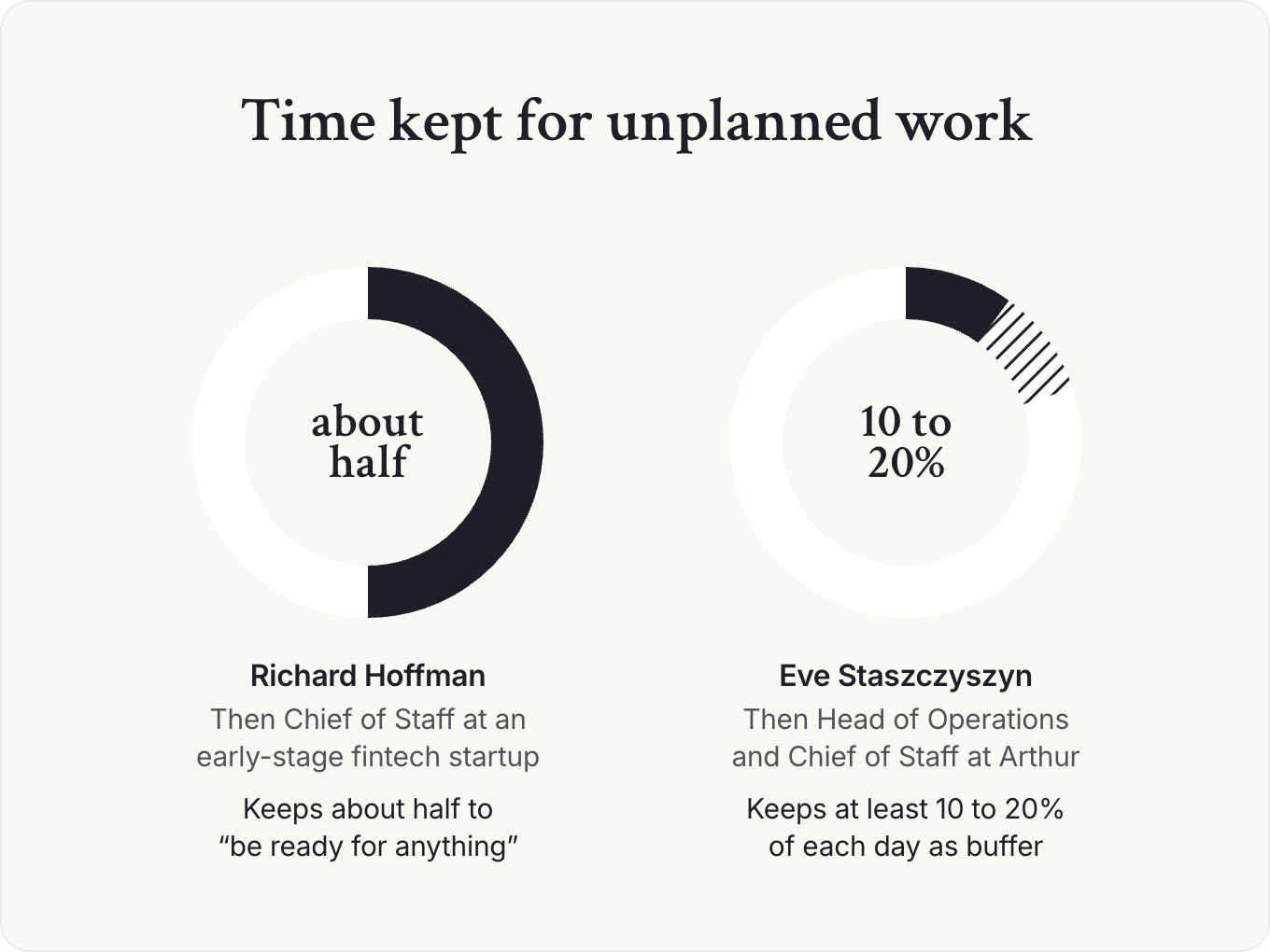
Two Chiefs of Staff on our podcast leave between 10% and 50% of their time for work nobody scheduled: escalations, customer issues and same-day requests.
Richard Hoffman, then Chief of Staff at an early-stage fintech startup, spends about half his time moving long-running work forward, such as the finance function and product marketing, and keeps the other half to "be ready for anything", like a new prospect to go after that afternoon. Eve Staszczyszyn, then Head of Operations and Chief of Staff at Arthur, keeps at least 10 to 20% of each day as buffer. Early in the role, Eve hadn't realized how much time the unexpected would need. Both were about a year into the role when they compared notes on our podcast.
Some of it sits far outside any job description. In one month of 2023, members asked each other in the Chief of Staff Network's #ask-for-help Slack channel how to get SOC 2 compliance, run an executive-level CRM, plan a leadership offsite, set a return-to-office policy, document a sales process and roll out large language models.
In the sample day, the 2:30 to 4:30 blocks hold that buffer, so on a busy day the unplanned work lands there and not in your morning writing block.
How to handle the escalation nobody owns
The 2:30 block is where an afternoon usually goes. Escalations sit between two teams, so neither team's leader can close them without the other, and you're the one person who works for both. Here's how that hour can run, using the stuck customer issue from the table.
- Spend ten minutes finding the decision. The customer wants a fix by Friday. Support says it's a product bug; product says it's a configuration problem. The real decision is who owns the diagnosis, and who tells the customer what by when.
- Name an owner for each half. Product owns the diagnosis by Wednesday noon. Support owns the customer update by end of day today, with a holding message you help draft.
- Write it down where both teams see it, four lines: the issue, the two owners, the two dates and the point at which it comes back to you.
- Decide whether the CEO hears about it. Tell them only if the customer is large enough to show up in the board deck, or if the fix needs a trade-off between the two teams' roadmaps. Otherwise it goes in your Friday update as resolved.
Fix it yourself only when there's no plausible owner, the customer risk lands inside a day and the fix takes you under an hour. If you solve every escalation, teams learn that the fastest path to a decision is your inbox, and by month three you've become the company's help desk. If the same two teams keep appearing in your escalations, the fix is a conversation about who owns that seam.
How does a Chief of Staff's week run?
A Chief of Staff's week usually runs on two fixed points with the principal: the weekly 1:1 at the start of the week and a review at the end. Everything else, from the leadership meeting to the metrics review to board prep, hangs between those two points.
Plan by the week. Your principal can change priorities once a week without chaos. Every day is too often, and every month is too slow. If I could protect only one meeting in the week, I'd protect the end-of-week review with the principal.
The start of the week needs a written list. For his first few months as Chief of Staff for Google Search Ads, Eric Nehrlich didn't send a weekly plan, and his principal kept asking why he was working on the wrong things.
My to-do list became eight pages long as a chief of staff.
Eric Nehrlich, former Chief of Staff, Google Search Ads · Listen on the podcast
His fix was a Monday-morning email with the top three things he'd get done that week, which his principal signed off on. When a request for a CEO presentation landed on Wednesday, the question became "which of the three can wait?"
Here's a week for a Chief of Staff to a single principal. Adjust the days to your company's rhythm.
Template: Chief of Staff weekly calendar template
Weekly calendar: Chief of Staff to [principal]
Every day
- 15 min: check-in with [principal] (same time daily)
- 90 min: protected focus block (writing, analysis, decisions)
- 2 x 10 min: buffers after your longest meetings
- 30 min: close loops (decision log, follow-ups, tracker)
Monday
- 30 to 45 min: weekly 1:1 with [principal]: agree this week's top 3 to 5 priorities
- After the 1:1: send the leadership meeting agenda and pre-reads
Tuesday
- Leadership team meeting, 75 min (you own the agenda, the pre-read deadline and the decision log)
- Send decisions, owners and dates within 2 hours
- Focus block for the biggest deliverable of the week
- 1:1s with 2 to 3 functional leaders on cross-team work
Wednesday
- Metrics or OKR review
- Midweek check: what new request landed, and what moves to make room?
Thursday
- Agenda requests close for Tuesday's leadership meeting
- Board, investor or exec-review prep
- Prep [principal] for next week: key meetings, decisions, risks
Friday
- Send your weekly update for Monday's 1:1: decisions needed, what moved, what's coming, one topic for the 1:1
- 30 min: review with [principal] (done / slipped)
- Plan next week's focus blocks before you log off
# Weekly calendar: Chief of Staff to [principal]

## Every day
- 15 min: check-in with [principal] (same time daily)
- 90 min: protected focus block (writing, analysis, decisions)
- 2 x 10 min: buffers after your longest meetings
- 30 min: close loops (decision log, follow-ups, tracker)

## Monday
- 30 to 45 min: weekly 1:1 with [principal]: agree this week's top 3 to 5 priorities
- After the 1:1: send the leadership meeting agenda and pre-reads

## Tuesday
- Leadership team meeting, 75 min (you own the agenda, the pre-read deadline and the decision log)
- Send decisions, owners and dates within 2 hours
- Focus block for the biggest deliverable of the week
- 1:1s with 2 to 3 functional leaders on cross-team work

## Wednesday
- Metrics or OKR review
- Midweek check: what new request landed, and what moves to make room?

## Thursday
- Agenda requests close for Tuesday's leadership meeting
- Board, investor or exec-review prep
- Prep [principal] for next week: key meetings, decisions, risks

## Friday
- Send your weekly update for Monday's 1:1: decisions needed, what moved, what's coming, one topic for the 1:1
- 30 min: review with [principal] (done / slipped)
- Plan next week's focus blocks before you log off
Keep the touchpoints short and fixed, so they survive busy weeks, and put the focus blocks on the calendar before anyone else can, because a Chief of Staff's open time is everyone's open time. If your company already has an operating rhythm, the week should mirror it: your metrics review lands where the business reviews its numbers.
At the 1:1, ask your principal for a yes, a no or a swap on each priority. Do this four weeks in a row before you decide whether it works. The prompt below turns the agreed list into a calendar.
Prompt: Plan next week from my principal's priorities
I'm a Chief of Staff to [principal, title] at a [size, stage] company.

Here are my principal's priorities for next week: [paste the priorities you agreed at the 1:1]
Here is my calendar for next week: [paste calendar export: titles, durations, attendees]
Here are the deliverables due: [list]

1. Match every meeting to one of the priorities, or mark it "unrelated".
2. Propose which unrelated meetings I should decline, shorten or send a delegate to, with a one-line reason I can send.
3. Place a 90-minute focus block each day where it protects the biggest deliverable.
4. Add prep slots before the three meetings that matter most, and say what I should prepare.
5. Draft a two-line note to my principal confirming the plan and flagging any priority that has no time against it.
Treat the output as a draft: you know which declined meeting will cause a problem.
When the week breaks, what gives first
Most weeks, something urgent displaces part of the plan. Protect the rhythm first, because the rest of the company plans around it: if the decisions go out two days late, a dozen people lose a week of clarity, and if your project work slips a day, one project does.
- Keep: the leadership meeting, the decisions, owners and dates within two hours, and the weekly update. Shorten them if you must.
- Keep: anything with a date someone outside the company sees, like a board update or a customer commitment.
- Move: your project working sessions, with a message to the people involved and a new date.
- Drop: the focus block and the admin, this week only.
If the focus block disappears three weeks running, the problem is the plan, so take something off it in your next one-to-one. During a fundraise or a board week, external dates outrank internal ones. A functional Chief of Staff adds the CEO's own operating rhythm to the keep list, because a missed input costs your principal credibility with their peers.
To see where last week actually went, run the prompt below on your calendar.
Prompt: Map my week to the four core responsibilities
I'm a Chief of Staff. Below is my calendar and task list from last week.

Classify every block into one of five buckets:
1. Priorities and decisions (deciding what reaches my principal, what gets delegated, what gets declined, and preparing decisions)
2. Running the operating rhythm (leadership meetings, planning, OKRs, board and business reviews)
3. Communication up and down (carrying honest information up to my principal and turning decisions into messages the company acts on)
4. Cross-functional projects (cross-team projects that have no other owner)
5. Admin (scheduling, logistics, inbox, travel)

Then give me:
- The share of my hours in each bucket, as a table
- The three blocks that should have gone to someone else, and who
- One change to next week's calendar that would move at least two hours from Admin into the four core responsibilities

My calendar and tasks:
[paste here]
How does the day change by company and role?
The shape of the day changes with who you support and how big the company is. Emily Sander, a coach who was a Chief of Staff herself, says she felt she was "porpoising" in and out of strategy and operations. Early on, she says, a company keeps its Chief of Staff mostly in operations. As it matures and puts processes in place, you lift out toward strategy.
Where Chief of Staff postings name the principal, only 44% say the CEO, founder or president. If you're choosing between offers, I'd pick the setting whose week you'd happily repeat 50 times, because its shape barely changes once you're in it.
A startup CEO's Chief of Staff: Kyle Hagge's week at Morning Brew
Kyle Hagge, Chief of Staff to the CEO at Morning Brew, runs his week off three fixed points. On Sunday, for one to two hours, he turns a running list of objectives into three to five priorities for the week and emails them to his CEO, which he says helps him avoid the "Sunday scaries". On Monday at 10am they meet to confirm the list. On Friday they review what got done and what slipped.
At a startup, the CEO's priorities can shift weekly, sometimes daily. Protect one focus block a day, even if it's 60 minutes.
A fractional Chief of Staff: Zoe Jakubowich's day
Zoe Jakubowich runs a fractional practice with several clients at once. She's up around 5:00, does heads-down client work from 5:30 to 7:00 before anyone can call, walks outside until 8:00, keeps late morning for coffees and business development, and runs client calls from about 11:00 to 5:00. Evenings go to proposals when there are any, and Friday keeps time for learning. With several clients, no single principal sets your calendar, so the structure has to come from you.
A large company: Eric Nehrlich's planning year at Google
In a big company, the day is often one step of a long cycle. Eric Nehrlich ran the annual planning process for Google Search Ads. It started in July with strategic questions and position papers, moved through an offsite and a month of budget and headcount requests, and ended with a final budget in December, so a week in October looked very different from a week in March.
A technical leader's Chief of Staff: Sarah Kislak's two-by-two at Box
Sarah Kislak was Chief of Staff to the head of engineering at Box. She ran a weekly "two-by-two" with a peer Chief of Staff: both Chiefs of Staff and both principals met in one room to review deliverables and pressure-test anything that cut across both teams, like a new planning process.
A remote Chief of Staff: Karly Gelardi at Zapier
Karly Gelardi, then Chief of Staff to the Chief People Officer at Zapier, saw her principal, Brandon Sammut, in person maybe twice a year. Early on, they synced every Monday morning: she reviewed his calendar and asked to join the meetings that mattered to her priorities. A second hour later in the week covered what had come up. Later, they kept one weekly one-to-one of at least an hour. Brandon's channel was pinned in Karly's Slack so his messages never got lost.
Remote work removes the hallway, so the information you'd overhear in an office has to come to you on purpose, through skip-levels on video, team channels and the decision log. If your leadership team spans more than a few time zones, put your focus block in the hours when nobody else is online, and write the decision log for readers who weren't in the room.
How the week differs by setting
| Startup CEO | Technical or functional leader | Enterprise business unit | Fractional | |
|---|---|---|---|---|
| Touchpoints with principal | Daily, informal | Two to three a week | Weekly, scheduled | Weekly per client |
| Rhythm you run | Weekly leadership meeting, board prep | Planning cycles, roadmap reviews | Annual plan, quarterly reviews, steering meetings | Each client's weekly update |
| Where deep work fits | Early morning, defended | Between planning cycles | Between review cycles | Before client hours |
| Typical crunch | Board meetings, fundraising, reorgs | Planning season, launches | Annual planning, quarter close | Two clients peaking at once |
| Biggest risk | Becoming the default owner of everything | Becoming a project manager | Becoming the meeting scheduler | Overcommitting hours |
Why are Chief of Staff calendars back to back, and how do you fix it?
Chief of Staff calendars fill up because every process you build tends to stay with you. You set up the leadership meeting, the planning cycle and the intake for new initiatives, and a year later you're still running all three, with a one-to-one that has shrunk to 20 minutes of fire drills. The four habits below give that time back.
Replace the triage one-to-one with a weekly note
Send your weekly update the day before your 1:1. That is Friday when the 1:1 is on Monday, as in the template above. Put your recommendation and a date next to each decision you need. Many principals answer the decisions in writing before you meet, which frees the meeting for the forecast, the risks and, once in a while, your own path. Our guide to the weekly update shows each part with an example.
Give processes away once they run
The first time you run a process, you're the designer. The third time, you should be training its owner. Pick one process a quarter, write down how it works, and hand it to the function that should own it, with you as backup for one cycle: planning to finance or strategy, initiative intake to the PMO or the most relevant leader. You keep the design and the review, and hand over the weekly chasing.
Expect the handoff to dip for a cycle, and the first time something slips your principal may ask you to take it back. Agree with your principal beforehand what "good enough" looks like and how long the new owner gets to settle in, then hold that line. Taking a process back after one bad week tells every leader that work handed over from your desk isn't really theirs. If there's truly no one to hand work to, that's a staffing case to make to your principal.

Leave the meetings you don't own
A Chief of Staff gets invited to everything, because your presence tells people the principal is paying attention. That is why declining feels risky. Mark each recurring meeting "own", "learn" or "signal". In your first 90 days, "learn" meetings earn their place. After that, keep the "own" meetings, drop most "learn" ones, and replace every "signal" meeting with a two-line written summary from its owner. Tell each organizer why you're stepping out and ask them to flag anything that needs your principal.
Around week six, someone will escalate something you'd have caught in a meeting you dropped. Ask that owner to add a "needs the principal" line to the summary, and don't rejoin unless it happens again.
Build recovery into the day
Carrie McMahon, Chief of Staff at Horizon3.ai and a breathwork teacher, told us that time blocking alone only got her so far. She built two- or three-minute resets into the day, like breathwork before a call, and matched tasks to her natural energy.
Alex Craig, Chief of Staff at PortSwigger, handed his easier tasks to AI and found his week stacked with hard decisions back to back, without the lighter work that used to let him recharge in between. If AI has taken your easy work, put the breaks on the calendar yourself.
Melinda Munroe, then Chief of Staff at Nexla, works out her working hours and when she works best, and tells people. When something comes up that she can't control, she gives herself some grace and over-communicates. Put your working hours in your calendar and chat status, and say in your weekly update when you'll be offline.
Hear it from Chiefs of Staff. New episodes of the Chief of Staff Podcast every week.
Listen to the podcastHow do you take time off as a Chief of Staff?
You take real time off by making yourself unnecessary for a week before you leave: write a coverage plan that says who handles each part of your job and what they can decide, tell your principal and the leadership team, and set an out-of-office reply that routes people to the right owner. If nobody can cover for you, that's the risk to fix first.
New Chiefs of Staff, especially in small companies, often say their hours crept from a normal workday to most of the evening, and that they work through their time off. Hours are low on the list of what would make them leave: when we asked, work-life balance was 9.4% of the answers, behind bad management, pay, lack of advancement and team culture. The bigger risk is to the business. If one person holds the whole rhythm and nobody can step in, it has a single point of failure.
A one-page coverage plan for time off
| Part of your job | Who covers | What they can decide | Escalate to principal when |
|---|---|---|---|
| Leadership team meeting | [Peer leader or EA] | Run the agenda, capture decisions | A decision changes a priority or budget |
| Decision log and follow-ups | [EA or ops lead] | Chase owners and dates | Something is late by more than a week |
| Board or investor prep | [Finance lead] | Draft and gather inputs | Any number or narrative changes |
| Escalations with no owner | [Named leader] | Assign an owner | It touches a customer or legal risk |
| Principal's priorities | [Principal directly] | Everything | n/a |
Then write an out-of-office reply with one line per topic: "For the leadership meeting, contact [name]. For board prep, [name]. For anything urgent, [principal's EA]." Add three lines to the plan: who applies your principal's calendar and inbox rules while you're out, how to reach you for something urgent and what counts as urgent, and 30 minutes with your cover on your first morning back to hand everything back. For more on boundaries, see our post on creating work-life balance as a Chief of Staff.
Before Friday, draft your coverage plan even if you have no time off booked, and share it with your principal. The parts of your job only you can do are your next handoff.
What does a good day look like for a Chief of Staff?
A good day for a Chief of Staff is one where the right decisions got made on time, nothing important waited on you, and the principal walked into every meeting prepared. Your list may not be finished.
That makes the job easy to undervalue, including by the person doing it. If you're an executive assistant or an operator deciding whether you want this job, ask yourself if you'd enjoy days judged that way. If you would, our guide on how to become a Chief of Staff covers the routes in, and your first 90 days covers the start. Most next moves out of the role go to operations and strategy or to functional leadership.
This Friday, start an outcomes log: two or three lines a week, each naming a decision that got made, a conflict that got resolved or a plan that shipped. After a quarter you'll have the evidence for your review, your next salary conversation or your next role.
Keep reading
 Chief of Staff skills: what the job demands at every levelBasics
 Chief of Staff vs executive assistant: what's the difference?Basics
 Chief of Staff salary (2026): pay by level, company size and cityBasics
Basics
- The Chief of Staff handbook
- What does a Chief of Staff do?
- Chief of Staff vs COO: what's the difference?
- Chief of Staff vs executive assistant: what's the difference?
- A day in the life of a Chief of Staff
- Chief of Staff skills: what the job demands at every level
- Chief of Staff salary (2026): pay by level, company size and city
- How to become a Chief of Staff
Take this guide with you
The full guide as a PDF: every section, template and chart, ready to print or share with your team.
Your PDF is ready.
Download the PDFFree. We may email you new guides; unsubscribe anytime.
Frequently asked questions
What are the daily tasks of a Chief of Staff?
Most days include a priorities check with the principal, preparing or running a leadership or planning meeting, following up on decisions with owners and dates, one-to-ones with functional leaders, unblocking cross-team work, and preparing the principal for upcoming meetings.
How many hours does a Chief of Staff work?
Long weeks are common, and they run longest at startups and during planning, board and fundraising seasons. Your principal's hours set the floor, so agree the norms early. On Sofia Badalamenti's first day as Chief of Staff to Nihal Mehta, co-founder of Eniac Ventures, he told her he wouldn't email her after 6pm. He schedules late emails to arrive at 8am, as they told our podcast.
Does a Chief of Staff attend all of the CEO's meetings?
No. A Chief of Staff attends the meetings where they run the rhythm or carry follow-up, like the leadership team meeting, planning sessions and board prep, and skips the rest. Sitting in on everything is a sign the role hasn't been scoped. Our guide to Chief of Staff job descriptions shows how to define the scope.
Does a Chief of Staff manage the CEO's inbox?
Usually not. Inbox, calendar and travel are executive assistant work. A Chief of Staff triages the asks that need the leader's decision and routes the rest to the right owner. Without an executive assistant, the Chief of Staff often covers some of it, which is worth naming in the mandate. With one, some members run the two as an "Office of the CEO", with each role written down and a standing check-in, anywhere from a 15-minute daily stand-up to a weekly one.
Is a Chief of Staff just a glorified assistant?
No. An executive assistant's day centers on the executive's time: calendar, travel, inbox and logistics. A Chief of Staff's day centers on the executive's priorities and the company's operating rhythm. Only 20% of Chief of Staff postings mention gatekeeping executive time, against 61% that ask for the operating rhythm, according to the Chief of Staff Network's Pathways Report. See Chief of Staff vs executive assistant.
Is Chief of Staff a high-paying role?
Yes. In US job postings, Chief of Staff is the best-paid operator role outside AI leadership. The median advertised salary was $180,000, against $156,000 for business operations and $155,000 for COO or VP of Operations roles. In our 2025 Salary Report, which surveys Chiefs of Staff worldwide, the median base salary was $160,000, the North American average about $176,000 and the London average about $161,000 (in US dollars). Our Chief of Staff salary guide breaks pay down by level, company size and city.
- Chief of Staff Pathways Report 2026, Chief of Staff Network. 1,819 job postings (June to October 2026), 741 of them naming the principal, and 1,992 next moves from career histories. Salaries are from US postings that state pay.
- Chief of Staff Salary Report 2025, Chief of Staff Network (n=479).
- The Chief of Staff Podcast: Kyle Hagge, Brian Schneider, Sarah Kislak, Eric Nehrlich, Zoe Jakubowich, Alex Craig, Carrie McMahon, Melinda Munroe, Emily Sander, Karly Gelardi and Brandon Sammut, Remi Guarini, Richard Hoffman and Eve Staszczyszyn, Sofia Badalamenti and Nihal Mehta.
- Chief of Staff Network member community: #ask-for-help Slack themes (May 2023) and members' notes on working with executive assistants. Member-only.
- The sample day and the escalation steps are composites of routines Chiefs of Staff described to us.
Learn the job with people who do it
Membership gets you the Power Skills program, member events and a private community of working Chiefs of Staff.
Land your first Chief of Staff role
Launchpad helps you prepare, position yourself and interview for the role.
Starting out in the role?
The Fundamentals email course walks you through scoping the mandate, setting the cadence and earning trust.
Lead AI adoption from the Chief of Staff seat
The Chief of AI Fellowship is for operators turning AI into how the company runs.
Hiring a Chief of Staff?
Post the role on the Chief of Staff job board, or browse open roles.
Get your resume ready for the role
Get feedback on your Chief of Staff resume before you apply.
Let the right roles find you
Join the talent network and hear about Chief of Staff roles first.
The Chief of Staff newsletter
What Chiefs of Staff are reading, hiring for and building.
Get the full report
Every chart and cut from our latest salary research, sent to your inbox.
Using AI with sensitive data?
Learn the legal side of using AI at work.
Keep going in this series