


How to write a Chief of Staff mandate
A Chief of Staff mandate names 3 outcomes, the decisions the role owns and what it won't do. Use our one-page template and agree it in four weeks.

Ask AI
 Share

A Chief of Staff mandate is the one-page agreement between a Chief of Staff and their principal: why the role exists now, the priorities for the role (ranked), three outcomes for six months, decision rights, how you work together, and a review date. It sets what you own, what you decide, and what isn't your job.
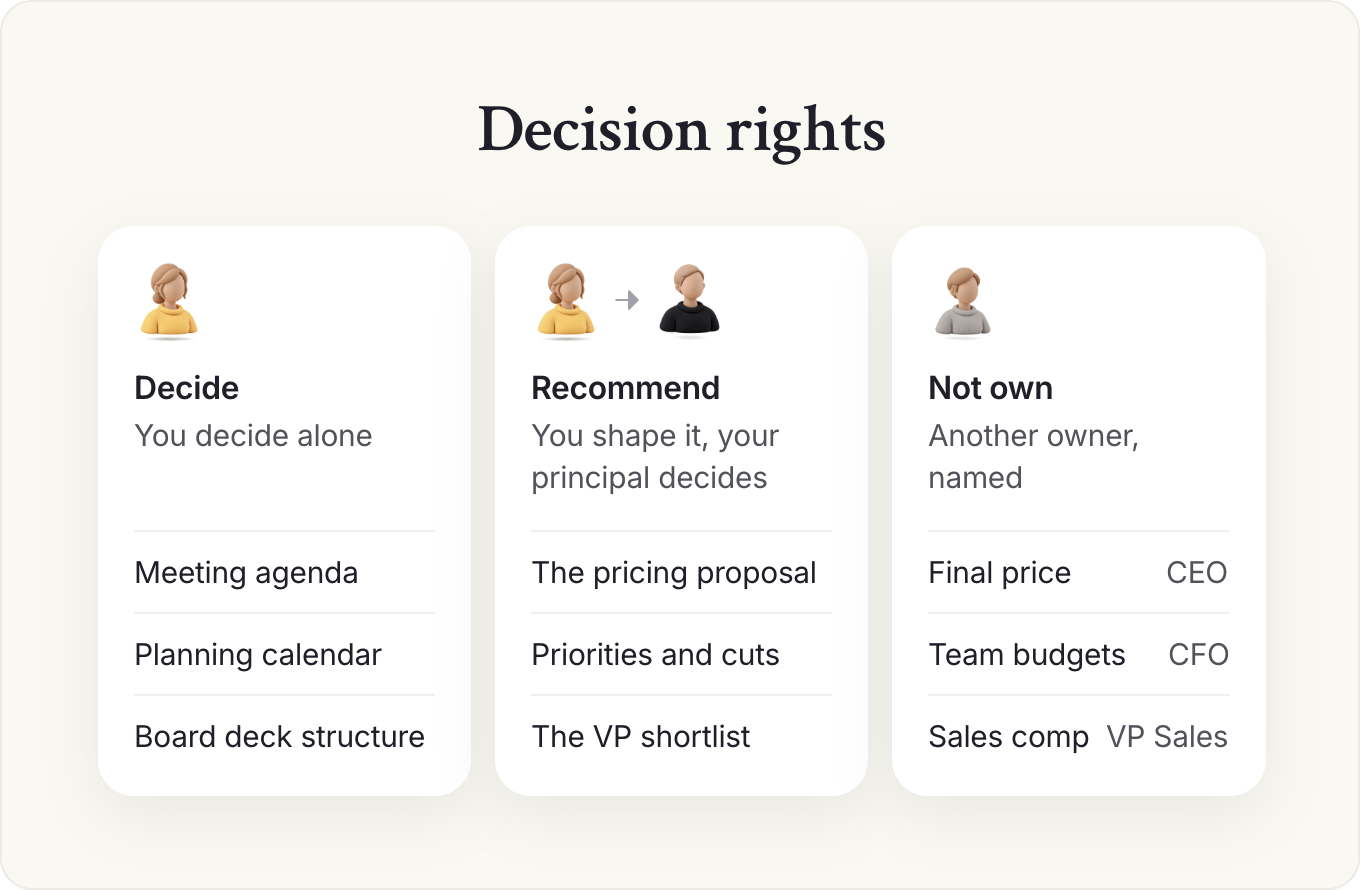
- Put most of your effort into decision rights, in three tiers: Decide (you decide alone), Recommend (you shape it, your principal decides) and Not own (another owner, named).
- Draft the page yourself by the end of week 3, agree it with your principal in one 60-minute session in week 4, and have them introduce it at the next leadership meeting.
- Run every new request through the page: take it, take it with an exit date, route it to its owner, or decline it.
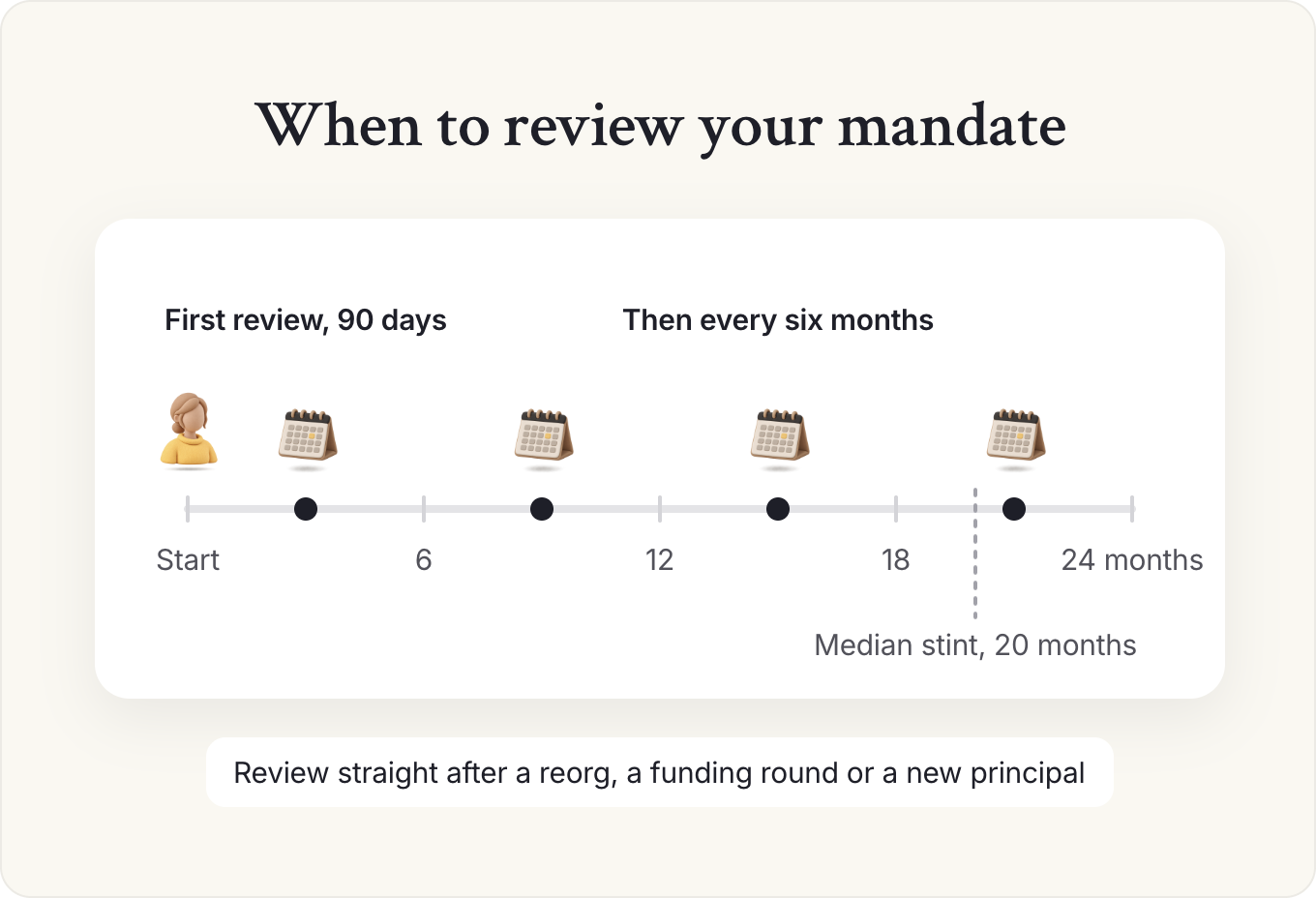
- Review it at 90 days and every six months after, and straight after a reorg, a funding round or a new principal.
- To grow the role, bring your principal a rewritten mandate with evidence before you look elsewhere.
Many Chiefs of Staff get conflicting signals about their scope in the first six months. They're praised for keeping things moving, told to focus on their own work, then blamed for passing on something that was apparently theirs all along, often by the same person in the same month.
Usually nobody wrote the role down. A mandate turns the broad job in our Chief of Staff handbook into one page for your role. It takes an afternoon to draft from the template below and an hour to agree, and it becomes the record you'll point to when you ask for a bigger role.
What is a Chief of Staff mandate?
A Chief of Staff mandate is the one-page agreement between a Chief of Staff and their principal: why the role exists now, the priorities for the role (ranked), three outcomes for six months, decision rights, how you work together, and a review date.
It's the written version of the authority you borrow from your principal. You act for them inside limits you both agreed. Many Chiefs of Staff have the authority without the limits written down.
Mandate vs job description vs OKRs
| Job description | Mandate | OKRs | |
|---|---|---|---|
| Purpose | Attract and select candidates | Define how the role works once filled | Set goals for the quarter |
| Audience | Candidates, recruiters | Your principal and the leadership team | The team or company |
| Time frame | Until hired | Six months; first review at 90 days | One quarter |
| Core content | Duties, requirements, pay | Priorities, outcomes, decision rights, what you don't own | Objectives and measurable results |
| Who writes it | Principal or recruiter | The Chief of Staff, agreed with the principal | Leadership team |
A job description is written to attract people, so it lists everything the role might touch. A mandate lists what the role will own and what it won't. Your OKRs sit inside the mandate as the quarter's version of its outcomes; our post on OKRs and KPIs covers those.
Most roles start without one because a leader feels stretched before they can say what's missing. The new Chief of Staff says yes to everything, each favor becomes a standing task, and by month six the role is a pile of inherited work nobody would have designed. Taraneh Ansari, who moved from HR into the role at OpenSponsorship, summed up the early-stage ethos as "nothing is not my job", and at a small company that's often true. Even a generalist needs a short list of what they won't own.
of Chief of Staff job postings don't say who the role supports Pathways Report 2026
My read: a posting that can't name the principal rarely names the decisions. The cost shows up at your performance review. Your principal can't see which outcomes were yours, so the review rewards the meetings you ran and the fires you put out. The feedback says "be more strategic" and doesn't say what that would look like.
If you're the principal, your part is short. Read the draft your Chief of Staff sends, spend 60 minutes on it together in week 4, then introduce the page at your next leadership meeting. If you're hiring, write the mandate before you post the role; our guide on how to hire a Chief of Staff shows where it fits.
In the draft, push back on an empty Decide list and on any Not own item without a name. Later, when someone brings you work the page routes elsewhere, back the routing. If you don't, people learn to bring their requests to you, and the decisions land back on your desk. If you agree in the room but won't put the page in writing, your Chief of Staff will read it as a sign to plan an exit.
What goes in a Chief of Staff mandate?
A Chief of Staff mandate has six parts: why the role exists now, ranked priorities, three outcomes, decision rights, how you work together, and a review date. A top line names the principal and your level. It all fits on one page.
- The top line: the principal and the level. Who you support, and the level of the role on our Leveling Framework, from Analyst to Executive. The level matters later when you talk about pay and title.
- Why the role exists now. Two sentences on what changed in the business, such as a funding round, a reorg or a CEO who now spends half the week fundraising. When the trigger ends, the mandate should change too.
- Priorities for this role, ranked. Rank the four core responsibilities from 1 to 4: priorities and decisions, the operating rhythm, communication up and down, and cross-functional projects. The ranking tells you what to protect when everything is urgent. Job postings ask most for the operating rhythm and much less for a thought partner on decisions. Don't copy their order. Let your why-now line set yours.
- Three outcomes for the next six months, each with a measure. "The weekly leadership meeting runs without the principal chairing it." "Annual planning closes on time with an owner for every priority."
- Decision rights in three tiers. Decide: what you decide alone. Recommend: what you shape while your principal decides. Not own: work that belongs to someone else, with their name.
- How you work together. The 1:1 cadence, the written update, the access you need, the date your principal introduces the mandate to the leadership team, and where you can speak for your principal versus only relay context.
- A review date. First review at 90 days, then every six months. Put it in both calendars now.
Decision rights come in three tiers
Outcomes and decision rights do most of the work in a mandate.
Decide
What you decide alone, without asking first.
Where the hours come back.
Recommend
What you shape while your principal makes the call.
Where your judgment shows.
Not own
Work that belongs to someone else, with their name.
Often the most useful row on the page.

Template: Chief of Staff mandate, one page
Chief of Staff mandate
- Principal: [name, title]
- Chief of Staff: [name] · Level: [Analyst to Executive, from the Leveling Framework]
- Start date: [date] · First review: [date, 90 days on] · Then: every 6 months
Why this role exists now
[Two sentences. What changed in the business that created the need?]
Priorities for this role (rank 1 to 4)
- ☐ Priorities and decisions: what reaches the principal, what gets delegated or declined, which decisions you prepare
- ☐ Rhythm: leadership meetings, planning, OKRs, board and business reviews
- ☐ Communication: honest information up, clear decisions down
- ☐ Projects: cross-functional projects without a home, each with an exit date
Three outcomes for the next six months
- [Outcome with a measure, e.g. the weekly leadership meeting runs without the principal chairing it]
- [Outcome with a measure, e.g. annual planning closes on time with an owner for every priority]
- [Outcome with a measure]
Meetings and processes the Chief of Staff runs
- [e.g. Weekly leadership meeting: agenda, notes, follow-ups]
- [e.g. Monthly business review, board prep]
Decision rights
- Decide (I decide alone): [e.g. leadership meeting agenda; which requests reach the principal's calendar]
- Recommend (I shape it, the principal decides): [e.g. quarterly priorities; executive hiring]
- Not own (owner named): [e.g. calendar and travel (EA); expense approvals (finance)]
How we work together
- 1:1: [e.g. 45 minutes weekly, with a written update the day before]
- Access: [inbox, calendar, board materials, compensation data]
- Introduction: the principal introduces this mandate to the leadership team at [forum, date]
- Speaking for [principal]: [forums where I can state a decision vs. only share context]
- Information: [what [principal] shares with me by default; what I share with the leadership team]
- Support: [analyst, EA time, budget, if any]
At each review
What moved, what we stop, and what changes in scope, level or title.
# Chief of Staff mandate

- Principal: [name, title]
- Chief of Staff: [name] · Level: [Analyst to Executive, from the Leveling Framework]
- Start date: [date] · First review: [date, 90 days on] · Then: every 6 months

## Why this role exists now
[Two sentences. What changed in the business that created the need?]

## Priorities for this role (rank 1 to 4)
- [ ] Priorities and decisions: what reaches the principal, what gets delegated or declined, which decisions you prepare
- [ ] Rhythm: leadership meetings, planning, OKRs, board and business reviews
- [ ] Communication: honest information up, clear decisions down
- [ ] Projects: cross-functional projects without a home, each with an exit date

## Three outcomes for the next six months
1. [Outcome with a measure, e.g. the weekly leadership meeting runs without the principal chairing it]
2. [Outcome with a measure, e.g. annual planning closes on time with an owner for every priority]
3. [Outcome with a measure]

## Meetings and processes the Chief of Staff runs
- [e.g. Weekly leadership meeting: agenda, notes, follow-ups]
- [e.g. Monthly business review, board prep]

## Decision rights
- **Decide** (I decide alone): [e.g. leadership meeting agenda; which requests reach the principal's calendar]
- **Recommend** (I shape it, the principal decides): [e.g. quarterly priorities; executive hiring]
- **Not own** (owner named): [e.g. calendar and travel (EA); expense approvals (finance)]

## How we work together
- 1:1: [e.g. 45 minutes weekly, with a written update the day before]
- Access: [inbox, calendar, board materials, compensation data]
- Introduction: the principal introduces this mandate to the leadership team at [forum, date]
- Speaking for [principal]: [forums where I can state a decision vs. only share context]
- Information: [what [principal] shares with me by default; what I share with the leadership team]
- Support: [analyst, EA time, budget, if any]

## At each review
What moved, what we stop, and what changes in scope, level or title.
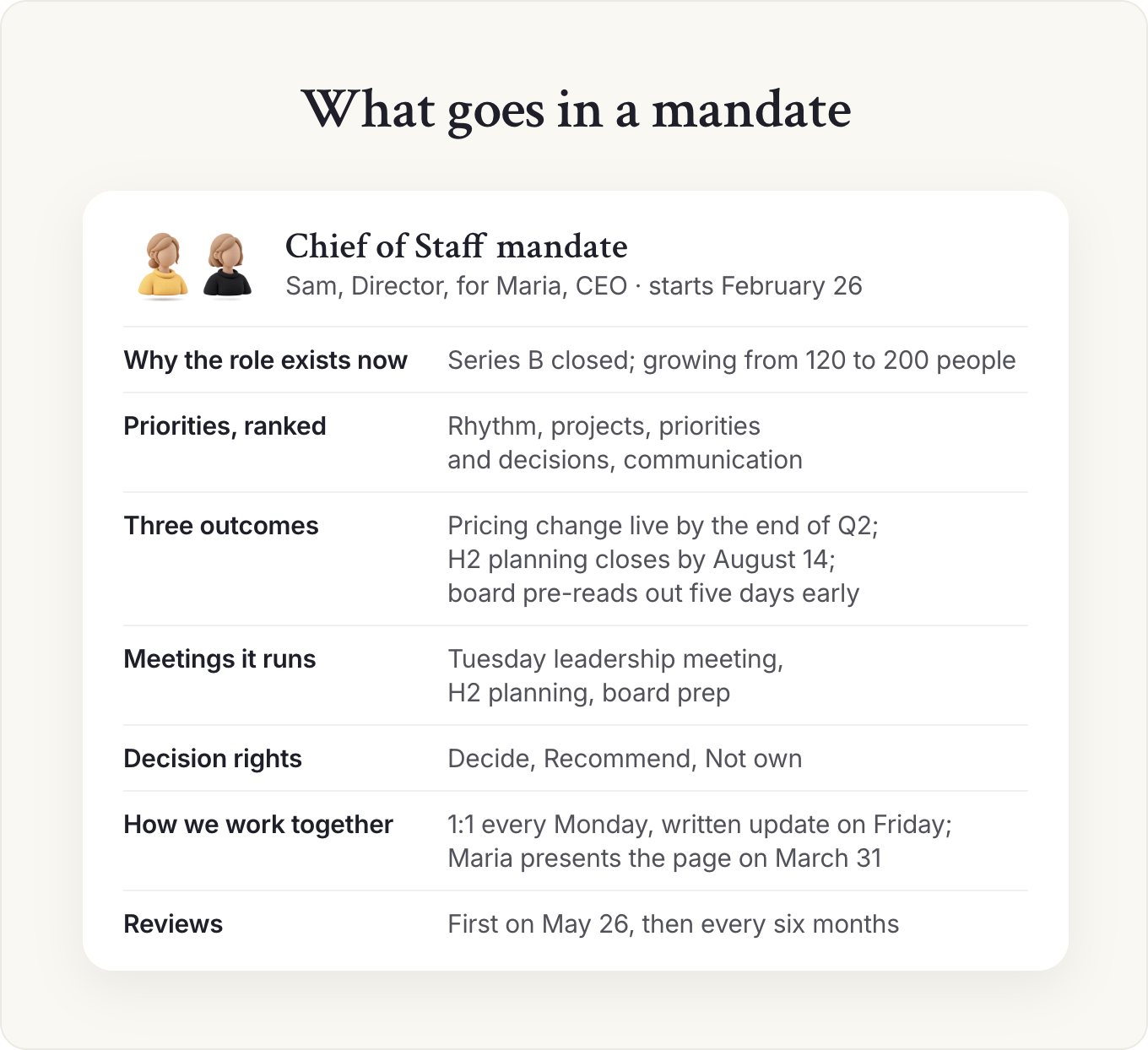
Example: mandate for a Chief of Staff to a Series B CEO, 120 people (illustration)
Chief of Staff mandate
- Principal: Maria, CEO
- Chief of Staff: Sam · Level: Director
- Start date: February 26 · First review: May 26 · Then: every 6 months
Why this role exists now
We closed our Series B in January and plan to grow from 120 to 200 people this year. Maria now spends two days a week on hiring and the board, so pricing and planning decisions wait on her.
Priorities for this role (ranked)
- Rhythm: leadership meeting, H2 planning, board
- Projects: new pricing, hiring two VPs
- Priorities and decisions
- Communication
Three outcomes for the next six months
- The pricing change is live by the end of Q2
- H2 planning closes by August 14, with one owner per priority
- Every board pre-read goes out five days early
Meetings and processes the Chief of Staff runs
- Tuesday leadership meeting: agenda, decision log, follow-ups
- H2 planning calendar and templates; board prep
Decision rights
- Decide: leadership meeting agenda; planning calendar, templates and deadlines; board deck structure; VP interview loop design
- Recommend: the pricing proposal; company priorities and cuts; the VP shortlist
- Not own: final price and offer decisions (Maria); team budgets (CFO); sales comp (VP Sales); the office move (Head of People)
How we work together
- 1:1: 45 minutes every Monday, with a written update on Friday
- Access: Maria's inbox and calendar, board materials, compensation data
- Introduction: Maria presents this page at the leadership meeting on March 31
- Speaking for Maria: I can state decisions at the leadership meeting and planning reviews; with the board, I share context only
# Chief of Staff mandate

- Principal: Maria, CEO
- Chief of Staff: Sam · Level: Director
- Start date: February 26 · First review: May 26 · Then: every 6 months

## Why this role exists now
We closed our Series B in January and plan to grow from 120 to 200 people this year. Maria now spends two days a week on hiring and the board, so pricing and planning decisions wait on her.

## Priorities for this role (ranked)
1. Rhythm: leadership meeting, H2 planning, board
2. Projects: new pricing, hiring two VPs
3. Priorities and decisions
4. Communication

## Three outcomes for the next six months
1. The pricing change is live by the end of Q2
2. H2 planning closes by August 14, with one owner per priority
3. Every board pre-read goes out five days early

## Meetings and processes the Chief of Staff runs
- Tuesday leadership meeting: agenda, decision log, follow-ups
- H2 planning calendar and templates; board prep

## Decision rights
- **Decide:** leadership meeting agenda; planning calendar, templates and deadlines; board deck structure; VP interview loop design
- **Recommend:** the pricing proposal; company priorities and cuts; the VP shortlist
- **Not own:** final price and offer decisions (Maria); team budgets (CFO); sales comp (VP Sales); the office move (Head of People)

## How we work together
- 1:1: 45 minutes every Monday, with a written update on Friday
- Access: Maria's inbox and calendar, board materials, compensation data
- Introduction: Maria presents this page at the leadership meeting on March 31
- Speaking for Maria: I can state decisions at the leadership meeting and planning reviews; with the board, I share context only
Why decision rights do the work
Every leader asks one question before acting on your request: can this person decide, or do I need to check with the boss? When the answer isn't written down, careful leaders check, and every check puts a decision back on your principal's desk. So the Decide list is the part of the page that gives your principal hours back. A mandate with an empty Decide list describes a coordinator, however senior the title.
Be concrete. "Owns the leadership meeting agenda" is a decision right; "supports the leadership team" describes nothing anyone could check. Write the speaking-for-your-principal line carefully too: a leader who hears you state a decision your principal hasn't made will start checking everything you say. "Speaks for the CEO as needed" can't be checked. "I can state decisions at the leadership meeting and planning reviews; with the board, I share context only" can.
Turning an initiatives list into a mandate
Many new Chiefs of Staff get handed a list of initiatives instead of a mandate, and become the person who asks everyone for updates.
From an initiatives list to decision rights (illustration)
| Initiative handed over | Outcome in the mandate | Decide | Recommend | Not own |
|---|---|---|---|---|
| New pricing | Pricing change live by end of Q2 | Working group, timeline, meeting cadence | The pricing proposal | Final price (CEO); sales comp (VP Sales) |
| H2 planning | Plan closes by August 14, one owner per priority | Planning calendar, templates, deadlines | Company priorities and cuts | Team budgets (CFO) |
| Board meetings | Pre-read out five days early | Deck structure, internal deadlines | Narrative and asks | Board relationships (CEO) |
| Hiring two VPs | Not one of the three outcomes; shortlist and loop only | Interview loop design and scheduling | Shortlist | Offer decisions (CEO) |
| Office move | Not in the mandate | None | None | Head of People, by name |
The last row is the most useful on the page: an item that moved off your list on day one, with an owner. If every initiative already has an owner and you only chase them, you're running a program office, so take one to own outright.
How many Decide items is right?
The level gives you a guide. Our Leveling Framework describes Manager and Director-level Chiefs of Staff as giving meaningful input on strategic decisions, and VP and Executive-level ones as key influencers, so items move from Recommend to Decide as your level rises. An Associate-level role might have two or three Decide items, mostly about process. A Director should decide the meeting agenda, the planning calendar and which requests reach the principal. At VP level and above, some company decisions move into Decide, such as resolving a cross-team trade-off when the principal is away.
When your principal won't put anything in Decide, ask for one decision for 30 days, such as which requests reach their calendar, and review it together at day 30: the decisions you made, and any your principal would have made another way. A trial is easier to grant than a permanent right. For the Not own list, name the owner every time: calendar and travel (the executive assistant), line management (the functional leader), expenses (finance). Our Chief of Staff vs executive assistant guide shows where the EA line usually falls.
How do you write a mandate with your principal?
Draft the mandate yourself by the end of week 3, then agree it with your principal in one 60-minute working session in week 4. Your principal is unlikely to write it, and if you wait for them, they'll read the wait as passivity.
- Weeks 1 to 3: map before you write. Meet every leader your principal works with, and a few people one level down. Ask what they need from the principal that they aren't getting, and learn who owns which decisions. Our guide to your first 90 days has a listening tour kit.
- End of week 3: draft the page with your best guesses. A concrete draft your principal can cross out beats an open question.
- Week 4: one 60-minute session. Expect your principal to move items between Decide and Recommend. Every item they move now is one you won't argue about in month five.
- Next leadership meeting: the introduction. Leaders act on a Chief of Staff's asks faster once they've heard the principal say what the role owns.
Expect one leader to read the page as a land grab, often a COO or head of operations whose work overlaps yours. Show them the draft before the introduction, ask what they'd change, and name them as owner of anything you hand their team.
Drift starts early, even with a principal who wants the role to work. A few weeks into the job, Brian Schneider, then Chief of Staff at beehiiv, messaged his CEO: "Yeah, I kinda feel like I'm not really being your Chief of Staff right now." The CEO agreed: he was used to working without one and hadn't yet started sharing context. What helped was a short call every weekday morning to compare priorities. Write touch points like that into the "How we work together" part of your draft, next to the weekly 1:1.
Running the 60-minute session
Send the draft with this agenda two days ahead.
- Minutes 0 to 5: why now. Read the two sentences aloud and ask whether they're still true. If the trigger has changed, everything below it will too.
- Minutes 5 to 15: the ranking. Ask your principal to rank the four responsibilities before showing yours. Where the rankings differ, you've found the misunderstanding that would have surfaced in month five.
- Minutes 15 to 45: decision rights. Go line by line. For each Decide item, ask "If I made this call without you, when would you be upset?" The answer tells you the real limit, and it often becomes a line in Recommend.
- Minutes 45 to 55: Not own. Confirm every name. Your principal usually knows of an owner you don't.
- Minutes 55 to 60: the introduction and the review date. Leave with both in the calendar.
Expect three kinds of pushback. Some principals add everything, so ask them to rank the additions against the three outcomes. Some move every Decide item to Recommend; accept it and ask for the 30-day trial on one. And some say "just do whatever you think is right", the most dangerous answer, because it gives you every decision and no protection. Write down what you'd do in the five most likely situations and get a yes on each.
If your principal resists writing anything down, ask for decisions one at a time: "When a leader asks me to chase their team on a deadline, do I do it, or do I bring it to you?" Write up the answers and send them as "here's what I heard".
This week, book the 60-minute session for the end of your first month. If you'd rather start from your notes than a blank page, this prompt turns them into a first draft.
Prompt: Draft my Chief of Staff mandate from my notes
I'm a Chief of Staff (or about to hire one). Draft a one-page Chief of Staff mandate from my notes below.

Use exactly these sections: Why this role exists now; Priorities for this role (rank priorities and decisions, the operating rhythm, communication up and down, and cross-functional projects from 1 to 4); Three outcomes for the next six months, each with a measure; Meetings and processes the Chief of Staff runs; Decision rights (Decide / Recommend / Not own, with the owner named for every Not own item); How we work together (1:1 cadence, written update, access, introduction to the leadership team); At each review.

Rules:
- Keep it to one page.
- Make every decision right specific enough that two people would agree whether it was followed.
- Put anything that belongs to an executive assistant, a functional leader or finance on the Not own list, with the owner.
- After the draft, list 5 questions I should ask my principal to settle anything you had to guess.

My notes:
- Principal and their role:
- Company stage and size:
- What changed that created this role:
- What I've been asked to do so far:
- What I've taken on that I think someone else should own:
- What my principal complains about most:
What does a Chief of Staff mandate look like in different settings?
A Chief of Staff mandate looks the same in every setting. What goes on it depends on the principal. A startup CEO's Chief of Staff usually ranks cross-functional projects or the rhythm first, a functional executive's Chief of Staff the operating rhythm, and an investor's Chief of Staff priorities and decisions.
At a startup, the mandate changes fastest. Richard Hoffman joined a fintech fresh off its seed round, with a mandate in partnerships and new sales. Ten months in, it was turning more operational as the customer base grew. In a functional role, list the company processes you run and the ones you only feed, and name the BizOps or PMO work you never touch. Karly Gelardi, then Chief of Staff to Zapier's Chief People Officer, Brandon Sammut, had this kind of role.
Chief of Staff mandates by setting
| Setting | Why now (typical) | Outcomes that fit | Decide | Not own |
|---|---|---|---|---|
| Startup CEO, 30 to 150 people | Founder stretched by fundraising and hiring | First real planning cycle; board pack on time; two cross-team launches handed off | Leadership meeting agenda; which asks reach the CEO | Running a function long term |
| Functional executive in a large company (CTO, CPO, CFO) | New leader, reorg or a scaling org | Monthly business review in place; headcount plan agreed; one org-wide program delivered | Org-wide comms drafts; the operating calendar | People management of the functional teams |
| Venture, private equity or family office | Partner or principal overloaded by deal flow | Pipeline triage process; portfolio reporting rhythm; fundraise materials | Which inbound reaches the partner | Investment decisions |
| Fractional, part-time | Company not ready for a full-time hire | Three outcomes for the engagement, each with a measure | Within the agreed scope only | Anything outside the engagement scope |
In an investment firm, the word mandate already means something. Alexa Gellman, then Chief of Staff at Inspired Capital, described the VC Chief of Staff's job as including triage of her managing partner's inbound against the fund's investment mandate. For part-time roles, the engagement scope is the mandate with hours added; our fractional Chief of Staff guide has a one-page scope to adapt.
How do you handle scope creep as a Chief of Staff?
To handle scope creep, run every new request through a scope check: which core responsibility does it belong to, which outcome does it serve, and who owns it after you? If it fits the mandate, take it. If it doesn't, route it to an owner or take it with an exit date. I'd choose the exit date over a flat no almost every time: it keeps goodwill and still protects the mandate.
You're the person who notices work with no owner, so work with no owner finds you. The trouble starts when temporary favors become permanent and the role turns into what our community calls the chief of stuff. A routing rule agreed in advance means a no doesn't land as a personal judgment.
How to route a new request
| The request | What to do | What to say |
|---|---|---|
| Fits a core responsibility and an outcome in your mandate | Take it | "On it. It's part of [outcome]." |
| Important, no owner, crosses teams | Take it with an exit date and a named future owner | "I'll run it for 8 weeks, then hand it to [team]." |
| Belongs to an existing team that's slow or stuck | Route it to the owner and unblock them | "This sits with [owner]. I'll get them what they need by Friday." |
| Your principal's admin (calendar, travel, expenses) | Hand to the executive assistant | "Looping in [EA], who owns this." |
| A favor someone could do themselves | Decline, kindly | "I can't take this one, but here's who can." |
When the creep comes from your principal
The hardest scope creep comes from the person who signed the mandate. Separate what moves from what doesn't: the three outcomes and the decision rights stay fixed between reviews, and the weekly priority list underneath them moves as often as it needs to. Each change gets one question: which outcome does this serve, and what drops to make room?
Keep a record of the changes. Richard Hoffman recapped his biggest accomplishments, pain points and frustrations every three months. Over time, he said, that built a paper trail of whether he was tracking the work he said mattered.
One week of requests, routed with the table above (an illustration):
- Monday, the CEO asks for a competitor teardown before Thursday's board call. It serves the board outcome, so take it.
- Monday, the VP of Sales asks you to clean up the CRM. Route it to revenue operations and unblock them with a deadline.
- Tuesday, the CEO wants a new hiring dashboard. No owner, crosses teams: take it for six weeks, then hand it to the recruiting lead.
- Wednesday, the CFO asks you to chase late expense reports. Decline, kindly, and point to the finance process.
- Thursday, the CEO asks you to plan the offsite. It's on your Not own list under the EA. Raise it in your update, since the principal may want to move it.
- Friday, two leaders ask you to referee a launch date. That's a cross-team decision, so write both positions and bring a recommendation.
You took on two, one with an exit date, and wrote one recommendation. The other three went to their owners or back to the principal. Record all six in the scope check line of your weekly update, so the next review is a conversation about evidence. By month three, the people you routed elsewhere either stop asking or ask better questions; if they go to your principal instead, your principal needs to back the routing.
This week, pick the two requests on your list that fit no outcome. Route one to an owner and put an exit date on the other.
How do you renegotiate your mandate after a few years?
Bring your principal a rewritten mandate, with the evidence for each change. Show what the role owns today against the original page, propose fewer doing items and more decisions, name the support you need, and tie the new scope to a level and a date. I'd bring it a month before the annual performance review, so you discuss the role first and your rating second.
Three or four years in, the usual story is that the principal has been promoted, the scope has doubled, and the title and level haven't moved. Your performance review says you're an excellent executor but not yet a strategic partner, while back-to-back meetings leave no time to become one. David Kirby, former Chief of Staff at Ford, calls this the doer trap: the way out is moving from doing the work to orchestrating it.
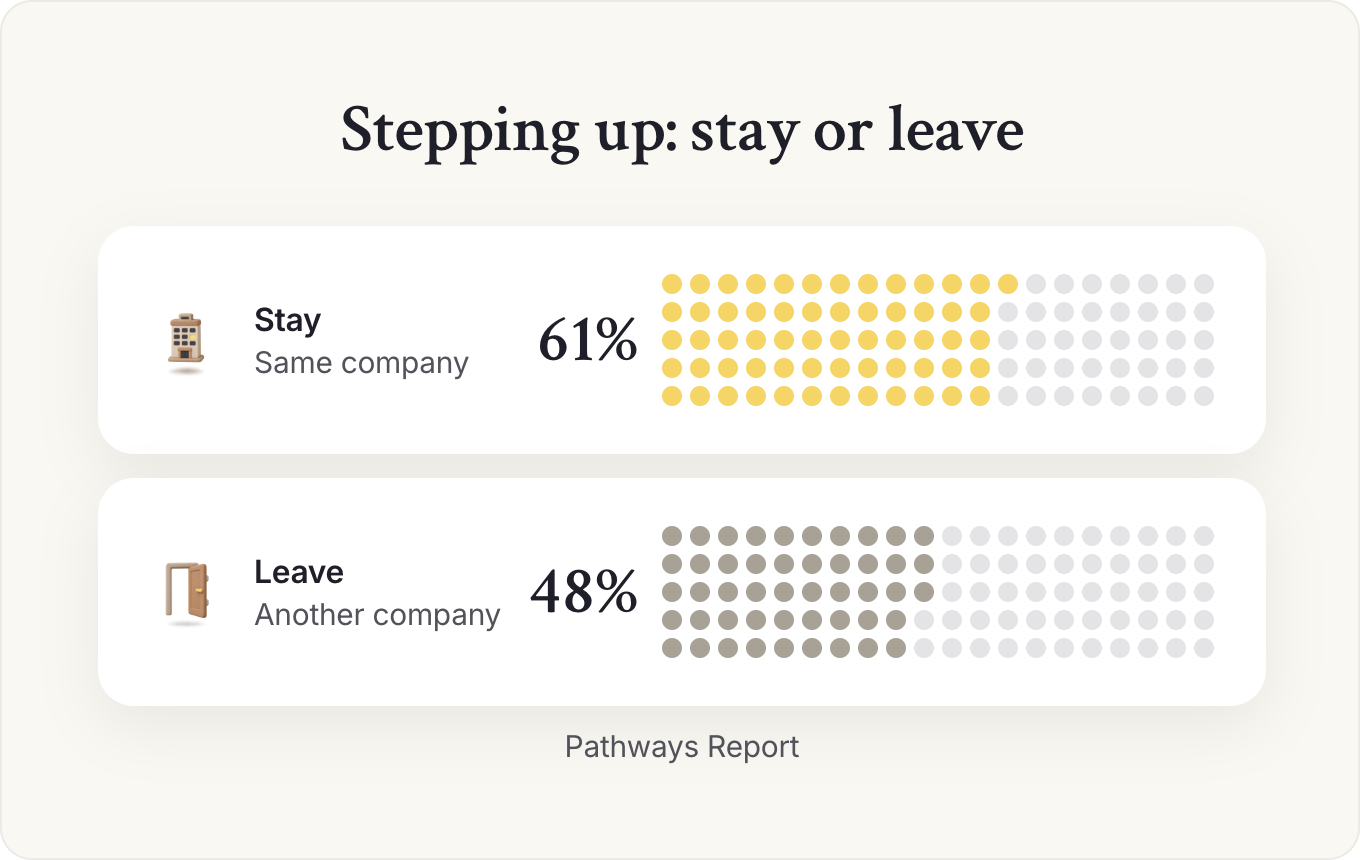
More than a third of Chiefs of Staff (37%) want to stay and expand their role. A move inside the company is more often a step up. 61% of next moves at the same company are a step up, and 48% of moves to another company are. About 8% of completed stints end with a bigger Chief of Staff title at the same company. My read is that most of those were asked for, with evidence on the table.
Before you write the new page, have the conversation with yourself about what you want the role to become. Then bring four things:
- The inventory: everything you own today, sorted into the original mandate's sections, with what each item returned where you can name it (executive hours given back, decisions closed, revenue protected, a launch shipped). The difference between the two pages is your evidence.
- A new page with fewer process items and more decision rights. Hand off the steady machinery and keep the decisions.
- The support it needs: an analyst, a deputy, more EA time, or a process another team takes over. Juhi Kabra, a former Chief of Staff to the CEO at Redesign Health, grew her role into an office of the CEO with a deputy reporting to her.
- A level and a date. Map the new decision rights to the Leveling Framework and ask when level and title will match. Average base pay runs from about $91,000 at Analyst or Associate level to about $194,000 at Executive level (worldwide averages); check yours in our salary guide.
If you win new decision rights, ask your principal to announce them to the leadership team, because if you announce them yourself, peers read it as a land grab. In the month after, the work you handed back will drift back to you, so redirect it every time. By month three, check whether decisions you now own are still being reopened in the leadership meeting.
Renegotiate when the trouble is at the edges of the role and your principal still wants it to work. Three signs tell you which situation you're in.
Renegotiate or leave: three signs
| Sign | Fixable: renegotiate | Probably not: plan your exit |
|---|---|---|
| Your principal's response to a written scope | Edits it and agrees a review date | Agrees in the room, then won't put it in writing |
| What the extra work is | Bigger than agreed, but valued | Calendar and errands under a bigger title |
| Who decides about your role | Your principal, with you in the room | Someone else, or it changes without you |
If you ask when level and title will match and hear "not this year" twice, your principal has made a choice. Decide whether you'll stay.
A new principal also means a new mandate: draft it in their first two weeks, before they define the role around someone else's habits. That is sooner than a new hire's week 3, because you already know the company. If you support two principals, keep one mandate with both names and a tie-break rule.
Juhi runs an energy audit every six months: she exports a few weeks of her calendar, sorts it into buckets and checks which work gives energy and which drains it. This week, do the same with your last three weeks and sort what you find into keep, hand off and stop. That list is the first draft of your new mandate.
Renegotiating your role is easier with people who've done it. Join the Chief of Staff Network for peer groups, events and the Power Skills program on influence and negotiation.
See membershipKeep reading
 How to write a Chief of Staff weekly updateExcel in the role
 How to build an operating rhythmExcel in the role
 Your first 90 days as a Chief of StaffFirst role
Excel in the role
Take this guide with you
The full guide as a PDF: every section, template and chart, ready to print or share with your team.
Your PDF is ready.
Download the PDFFree. We may email you new guides; unsubscribe anytime.
Frequently asked questions
What does mandate mean for a Chief of Staff?
A mandate is the authority to act on someone else's behalf, within agreed limits. For a Chief of Staff, it's the written agreement with your principal that says why the role exists, what it should achieve in the next six months, which decisions you make alone, which you recommend on, and what you don't own. It makes borrowed authority visible to the leadership team.
Is a Chief of Staff mandate the same as a job description?
No. A job description is written to attract candidates, so it lists everything the role might touch. A mandate is written after you're hired, fits on one page, and lists what the role owns, the decisions it can make and what it won't do. Project detail belongs in your plans and OKRs. You review the mandate every six months.
Does a Chief of Staff have any power?
Yes, but most of it is borrowed from the principal. It sits in two tiers of the mandate: Decide, the calls a Chief of Staff makes alone, and Recommend, the calls they shape before the principal makes them. The Decide list grows with level. On our Leveling Framework, more items move from Recommend to Decide as the level rises. Where decision rights aren't written down, leaders check each call with the principal, and the role shrinks to coordination.
Who does a Chief of Staff report to?
Usually the principal named on the mandate. That's often the CEO, but less often than people assume: only 44% of Chief of Staff postings that name a principal say CEO, founder or president. See what a Chief of Staff does for the full picture.
How often should you review your mandate?
Review it at 90 days and then every six months, or straight after a big change like a reorg, a funding round, your principal's promotion or a new principal. Startups often need a quarterly review because the business changes faster. Each review should end with a decision on what to stop and what changes in scope, level or title.
How long does a Chief of Staff mandate last?
The first version runs to the 90-day review, and each version after it runs six months, to the next review. The median completed Chief of Staff stint is 20 months, so expect several versions and use each review to grow the mandate.
- Chief of Staff Pathways Report 2026, Chief of Staff Network. 1,819 job postings, June to early October 2026, and 2,869 career histories.
- 2025 Salary Report, Chief of Staff Network. 479 respondents.
- Leveling Framework, Chief of Staff Network.
- The Chief of Staff Podcast: Richard Hoffman, Taraneh Ansari, Karly Gelardi and Brandon Sammut, Brian Schneider, David Kirby, Juhi Kabra (who leads sessions in our Launchpad program) and Alexa Gellman.
Learn the job with people who do it
Membership gets you the Power Skills program, member events and a private community of working Chiefs of Staff.
Land your first Chief of Staff role
Launchpad helps you prepare, position yourself and interview for the role.
Starting out in the role?
The Fundamentals email course walks you through scoping the mandate, setting the cadence and earning trust.
Lead AI adoption from the Chief of Staff seat
The Chief of AI Fellowship is for operators turning AI into how the company runs.
Hiring a Chief of Staff?
Post the role on the Chief of Staff job board, or browse open roles.
Get your resume ready for the role
Get feedback on your Chief of Staff resume before you apply.
Let the right roles find you
Join the talent network and hear about Chief of Staff roles first.
The Chief of Staff newsletter
What Chiefs of Staff are reading, hiring for and building.
Get the full report
Every chart and cut from our latest salary research, sent to your inbox.
Using AI with sensitive data?
Learn the legal side of using AI at work.
Keep going in this series