


How a Chief of Staff runs board meetings
How a Chief of Staff runs board prep: a 4-week work-back plan, the pre-read memo, CEO question prep, follow-ups and monthly investor updates. 4 templates.

Ask AI
 Share

A Chief of Staff runs the system around the board so meetings become working sessions. The CEO owns the relationship with each director. The Chief of Staff owns the board calendar, a four-week work-back plan, the written pre-read, the CEO's question prep, follow-ups within 48 hours and the monthly investor update between meetings.
- Agree your part with your CEO first, then run board prep as a four-week system set against the finance close: section owners at T-28, numbers locked at T-14 and the pre-read in directors' hands at T-7.
- Send a written memo with every off-plan number and the board's asks on page one, so no director hears bad news for the first time in the room.
- Before the meeting, have the CEO speak with each director for 15 minutes, and build the CEO's brief around the hardest questions those calls surface.
- Within 48 hours, send directors and executives the action list, and treat every director's offer of help as a commitment with an owner and a date.
- Between meetings, send a monthly investor update with the same metrics every time and lowlights first, so directors arrive current.
Every executive writes a section of the board pack, finance has to close the books early, and legal drafts the resolutions. With no single owner, the CEO ends up stitching the pack together at the last minute.
Run it as a system and the CEO walks in with no surprises, directors spend the meeting on the questions where they can help, and their offers turn into introductions and hires.
What does a Chief of Staff do for the board?
The Chief of Staff runs the system around the board: the meeting calendar, the preparation process, the pre-read, the CEO's preparation, the follow-ups and the updates between meetings. The CEO owns the relationship with each director, the CFO owns the numbers, and counsel or a corporate secretary owns the legal record.
of Chief of Staff job postings mention board and investor work, about one in three. Source: Pathways Report 2026
Our Leveling Framework lists board meetings among the recurring meetings a Chief of Staff manages at every level. Direct relationships with investors start to appear at the VP and executive levels.
Who your principal is changes your part. Of the postings that name the principal, only 44% say CEO, founder or president. A Chief of Staff to a CFO may own the whole finance section, and one to a CTO may write one slide, so agree your part in your mandate.
Who owns what in board work (our recommended split)
| Board work | CEO | Chief of Staff | CFO or finance lead | Counsel or corporate secretary | Executives |
|---|---|---|---|---|---|
| Relationship with each director | Owns | Supports with notes and prep | Talks numbers with the director who leads on audit | Governance questions | When invited |
| Board calendar and agenda | Approves | Owns, agrees with the lead director's office | Input on timing of close | Input on required items | Input |
| Pre-read memo | Writes the opening letter, approves | Owns the process, drafts and edits | Owns financials and forecast | Reviews resolutions | Write their sections |
| CEO preparation | Rehearses | Owns question bank and brief | Briefs on numbers | Briefs on legal risk | Briefs on their areas |
| Minutes and resolutions | Reviews the draft | Tracks actions only | Owns; the board approves | ||
| Follow-ups and investor updates | Sends | Drafts and tracks | Provides metrics | Deliver actions |
If you're the CEO, the plan asks you for six things before the meeting: the one or two questions you want the board's help on (T-28), your opening letter (T-14), a 60-minute review of the full draft (T-10), a two-line cover note for the pre-read (T-7), a 15-minute call with each director three to five days out, and a 30-minute rehearsal of the hardest answers. After the meeting, the follow-up note goes out in your name within 48 hours, and you hold a short debrief in the same two days. Your Chief of Staff runs the rest.
Most Chiefs of Staff work for management, and should stay on management's side of the board. I'd stay out of building your own relationships with directors unless the CEO asks, because directors notice when someone other than the CEO is managing them. Some Chiefs of Staff work for the board side directly: Elyse Levine was hired at the University of Southern California as deputy Chief of Staff to the president and Chief of Staff to the chair of the board of trustees. On our podcast, she said the person in that seat can't be caught in the middle, with the president asking her to keep something from the chair, or the other way round. She spent her first 30 to 60 days learning where she played for each before changing anything.
Board and investor work appears in one in three Chief of Staff job postings. See what else employers ask for, and where the role leads next, in the Pathways Report.
Download the full reportHow far ahead should you start preparing for a board meeting?
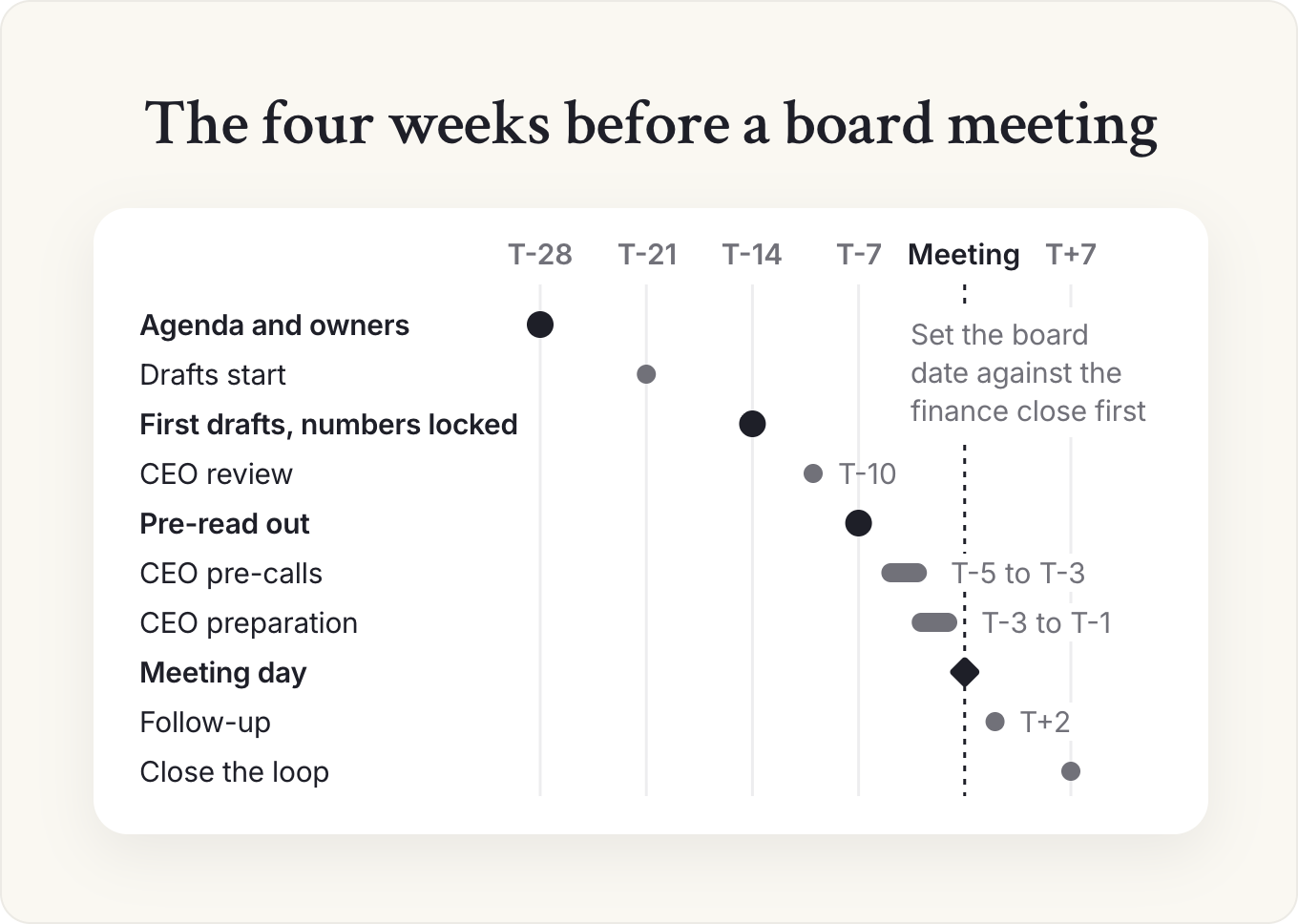
Start four weeks out. A board meeting needs locked numbers, sections drafted by several executives, time for the CEO to shape the story, and a pre-read in directors' hands about a week before the meeting, and each of those steps waits on the one before it.
The critical path is almost always the month-end close and the executives' drafts. If finance closes on the 10th and the meeting is on the 14th, no amount of late-night editing will produce a pre-read directors can read in advance, so set the board date against the close calendar first. The plan below assumes a pre-read a week out, our recommendation for most boards.
Template: Board meeting work-back plan
Board meeting work-back plan: [meeting date]
Owner: [Chief of Staff] · Approver: [CEO] · Finance lead: [name] · Counsel: [name]
T-numbers are calendar days. If a step lands on a weekend or a public holiday, do it on the working day before.
T-28 days: agenda and owners
- Agree with the CEO the 1 or 2 questions we want the board's help on
- Confirm agenda and timing with the lead director (or their assistant)
- Name an owner and a due date for every pre-read section
- Ask counsel which resolutions and approvals are needed
- Hold CEO pre-call slots with each director for T-5 to T-3
T-21 days: drafts start
- Section owners get the template and last meeting's version
- Finance confirms the close date and the metrics list (same as last time)
- Collect open actions from the last meeting and their status
T-14 days: first drafts in
- All sections drafted; Chief of Staff edits for one voice and one story
- Finance locks numbers; any restatement is flagged now
- CEO drafts the opening letter from the locked numbers
T-10 days: CEO review
- 60-minute working session with the CEO on the full draft
- Leadership team walks through the strategic topic together
T-7 days: pre-read out
- Send the pre-read, resolutions and the CEO's cover note to directors and observers
- Content freeze: later changes go into the CEO's opening remarks
- Confirm the CEO pre-calls with each director for T-5 to T-3
- Confirm who attends, in person or by video, and quorum with counsel; send each executive their block time
- Draft a first one-page brief and the question bank by director, and send the CEO a two-line note on what each director cares about
T-3 to T-1: CEO preparation
- Update the question bank and the one-page brief (numbers to know cold) with what the pre-calls raised
- 30-minute rehearsal of the three hardest answers and the strategic topic; the updates are in the pre-read
Meeting day
- Open session; Chief of Staff tracks actions and reads them back before the closed session; closed session as the board decides
T+2 days: follow-up
- Action list with owners and dates to directors and executives
- Director offers (intros, references, reviews) logged as commitments
- Debrief with the CEO: what landed, what surprised us, what changes next time
T+7 days: close the loop
- Counsel circulates draft minutes
- Open actions go into the operating rhythm and the next pre-read
# Board meeting work-back plan: [meeting date]

Owner: [Chief of Staff] · Approver: [CEO] · Finance lead: [name] · Counsel: [name]

T-numbers are calendar days. If a step lands on a weekend or a public holiday, do it on the working day before.

## T-28 days: agenda and owners
- Agree with the CEO the 1 or 2 questions we want the board's help on
- Confirm agenda and timing with the lead director (or their assistant)
- Name an owner and a due date for every pre-read section
- Ask counsel which resolutions and approvals are needed
- Hold CEO pre-call slots with each director for T-5 to T-3

## T-21 days: drafts start
- Section owners get the template and last meeting's version
- Finance confirms the close date and the metrics list (same as last time)
- Collect open actions from the last meeting and their status

## T-14 days: first drafts in
- All sections drafted; Chief of Staff edits for one voice and one story
- Finance locks numbers; any restatement is flagged now
- CEO drafts the opening letter from the locked numbers

## T-10 days: CEO review
- 60-minute working session with the CEO on the full draft
- Leadership team walks through the strategic topic together

## T-7 days: pre-read out
- Send the pre-read, resolutions and the CEO's cover note to directors and observers
- Content freeze: later changes go into the CEO's opening remarks
- Confirm the CEO pre-calls with each director for T-5 to T-3
- Confirm who attends, in person or by video, and quorum with counsel; send each executive their block time
- Draft a first one-page brief and the question bank by director, and send the CEO a two-line note on what each director cares about

## T-3 to T-1: CEO preparation
- Update the question bank and the one-page brief (numbers to know cold) with what the pre-calls raised
- 30-minute rehearsal of the three hardest answers and the strategic topic; the updates are in the pre-read

## Meeting day
- Open session; Chief of Staff tracks actions and reads them back before the closed session; closed session as the board decides

## T+2 days: follow-up
- Action list with owners and dates to directors and executives
- Director offers (intros, references, reviews) logged as commitments
- Debrief with the CEO: what landed, what surprised us, what changes next time

## T+7 days: close the loop
- Counsel circulates draft minutes
- Open actions go into the operating rhythm and the next pre-read
Example: Board work-back plan for a Series B company (illustration)
Board meeting work-back plan: Mon, Feb 22
Owner: Chief of Staff · Approver: CEO · Finance lead: VP Finance · Counsel: outside counsel
Board: five directors and one observer · Q4 close: Feb 5
| Step | Date | What | Owner |
|---|---|---|---|
| T-28 | Jan 25 | Agree the two questions for the board: enterprise pricing and the CFO search | CEO, Chief of Staff |
| T-28 | Jan 25 | Confirm agenda with the lead director's assistant; ask counsel which approvals are needed (option grants, annual budget); hold CEO pre-call slots for Feb 17 to 18 | Chief of Staff |
| T-21 | Feb 1 | Section owners get the template and last meeting's version | Chief of Staff |
| T-18 | Feb 4 | VP Sales draft in; leadership team walks through enterprise pricing with her | VP Sales, leadership team, Chief of Staff |
| T-14 | Feb 8 | Other drafts in; Q4 numbers locked; CEO letter drafted from them | Section owners, VP Finance, CEO |
| T-11 | Feb 11 | 60-minute review of the full draft | CEO, Chief of Staff |
| T-10 | Feb 12 | Pre-read, resolutions and CEO cover note to directors; content freeze; attendance and quorum confirmed; question bank and first brief drafted | Chief of Staff |
| T-5 to T-4 | Feb 17 to 18 | CEO pre-calls with each director | CEO |
| T-3 | Feb 19 | Question bank and one-page brief updated with what the pre-calls raised; 30-minute rehearsal | Chief of Staff, CEO |
| T+2 | Feb 24 | Action list to directors and executives; CEO debrief | Chief of Staff, CEO |
| T+7 | Mar 1 | Draft minutes circulated | Counsel |
At risk
- Sales section: VP Sales is at a customer event the week of Feb 8, so her draft is due Feb 4 on flash Q4 numbers, and the leadership walk-through of enterprise pricing moves to that day. VP Finance replaces the flash numbers at the Feb 8 lock. Flagged to the CEO on Jan 25.
- Feb 15 (T-7) is Presidents' Day in the US, so the pre-read goes out Fri, Feb 12, and the CEO review moves up to Thu, Feb 11.
# Board meeting work-back plan: Mon, Feb 22

Owner: Chief of Staff · Approver: CEO · Finance lead: VP Finance · Counsel: outside counsel

Board: five directors and one observer · Q4 close: Feb 5

| Step | Date | What | Owner |
| --- | --- | --- | --- |
| T-28 | Jan 25 | Agree the two questions for the board: enterprise pricing and the CFO search | CEO, Chief of Staff |
| T-28 | Jan 25 | Confirm agenda with the lead director's assistant; ask counsel which approvals are needed (option grants, annual budget); hold CEO pre-call slots for Feb 17 to 18 | Chief of Staff |
| T-21 | Feb 1 | Section owners get the template and last meeting's version | Chief of Staff |
| T-18 | Feb 4 | VP Sales draft in; leadership team walks through enterprise pricing with her | VP Sales, leadership team, Chief of Staff |
| T-14 | Feb 8 | Other drafts in; Q4 numbers locked; CEO letter drafted from them | Section owners, VP Finance, CEO |
| T-11 | Feb 11 | 60-minute review of the full draft | CEO, Chief of Staff |
| T-10 | Feb 12 | Pre-read, resolutions and CEO cover note to directors; content freeze; attendance and quorum confirmed; question bank and first brief drafted | Chief of Staff |
| T-5 to T-4 | Feb 17 to 18 | CEO pre-calls with each director | CEO |
| T-3 | Feb 19 | Question bank and one-page brief updated with what the pre-calls raised; 30-minute rehearsal | Chief of Staff, CEO |
| T+2 | Feb 24 | Action list to directors and executives; CEO debrief | Chief of Staff, CEO |
| T+7 | Mar 1 | Draft minutes circulated | Counsel |

## At risk
- Sales section: VP Sales is at a customer event the week of Feb 8, so her draft is due Feb 4 on flash Q4 numbers, and the leadership walk-through of enterprise pricing moves to that day. VP Finance replaces the flash numbers at the Feb 8 lock. Flagged to the CEO on Jan 25.
- Feb 15 (T-7) is Presidents' Day in the US, so the pre-read goes out Fri, Feb 12, and the CEO review moves up to Thu, Feb 11.
Put every date into each owner's calendar the day the board date is set, with the section template attached, and set the whole year's dates at once so the close and holidays get planned around them. When an executive misses the T-14 draft, tell the CEO which section is at risk and what it will cost the meeting; the escalation comes from the plan, which keeps you out of the role of hall monitor.
Ben Darfler, Chief of Staff at Honeycomb, told us he looks a month or two ahead and works back with the executive team: "if we've got a board meeting here, we've got a dry run here, we should get our slides locked in here." His team had usually built the presentation on the fly, and done a good job of it. The work-back gives them calendar time to build the presentation together, time he said would otherwise be "swallowed up by everything else that's always important."
Judgment calls on the timeline
When the close can't move and the meeting can't either, send the pre-read on time with flash numbers labeled as preliminary, and send final financials as a one-page supplement. It is the one thing that goes out after the freeze. Directors plan their reading around the date you gave them. CEOs often want to change the story at T-3, so agree a content freeze at T-7; anything that changes after it goes into the CEO's opening remarks. And let an executive present live only on the strategic topic, and only if their written section went out with the pre-read.
How the plan changes with the board
The four weeks above suit a venture-backed company with five to seven directors. Scale it to the board you have:
- An early-stage board of three, often two founders and a lead investor, can run on two weeks. The monthly investor update does most of the work, and the meeting can be a two-hour working session.
- A larger board with independent directors and committees needs committee pre-meetings, usually audit and compensation, scheduled inside the work-back, with counsel more involved in the timeline.
- A private-equity-owned company usually has an operating partner who wants a monthly KPI pack in their own format. Build your scorecard to match it, so the board pack reuses it.
- A nonprofit or university board works through the chair's office, which is the seat Elyse Levine described at USC. Expect longer lead times and agree the timeline with the chair's office first.
- A public company adds disclosure rules and a bigger role for counsel. The Chief of Staff's part narrows to the process and the CEO's preparation.
After two or three cycles, the T-14 deadline gets easier and the pre-read starts to grow because writing it got easier. Cut it back every cycle. This week, get the next two board dates and the finance close calendar for those months. If a meeting falls less than two weeks after the close that feeds its numbers, raise it with your CEO now.
Should the board get a deck or a written pre-read?
Send a written pre-read memo, with charts in an appendix, for most boards. Directors read it on their own time before the meeting, so the meeting goes to discussion and decisions, and writing it forces the company to state a position on one page.
Slides break one argument into fragments, the presenter fills the gaps out loud, and the meeting turns into a walkthrough of material directors could have read in twenty minutes. A memo has to hold together on the page, and if it doesn't, you find out at T-10 in a working session with your CEO. Jenna Parker, then Chief of Staff at Healthie, told us her company doesn't make fancy presentations because there isn't time:
We just do Google Docs and tell our board to read the Google Doc.
Jenna Parker, then Chief of Staff, Healthie · Listen on the podcast
Some directors, often investors who sit on many boards, expect slides anyway. If that's your board, I'd send the memo as the pre-read and keep a short deck only for the strategic topic.
If the board insists on a full deck, hold it to the memo's rules. Write each slide title as the conclusion ("Two enterprise deals slipped to Q3; revenue is behind plan"), make every slide readable without a presenter, and keep the memo's order: the CEO letter, the off-plan numbers and the asks come first, and function detail goes to the appendix.
Directors need three things from the memo: where the company stands against the plan they approved, what management is worried about, and what management wants from them. Put the asks on the first page, next to the bad news, because a director reads page one first.
Template: Board pre-read memo
Board pre-read: [meeting date]
1. CEO letter (one page)
- The three things the board should know since we last met
- What we want the board's help on in this meeting (1 or 2 questions)
- Lowlights first: what's behind plan, and what we're doing about it
2. Scorecard vs plan
- Same 8 to 10 metrics every meeting, actual vs plan vs last quarter
- One line of explanation for every metric off plan (owner named)
3. Decisions and asks for the board
- Decisions needed today (with management's recommendation)
- Help wanted: intros, hires, customers, expertise (be specific)
4. Strategic topic for discussion
- The question, the options we see, our current view, what would change it
- Length: 2 to 3 pages
5. Function updates (one half-page each, read-only)
- What moved, what's at risk, what's next quarter
6. Status of actions from last meeting
- Each action, owner, done / in progress / dropped (and why)
7. Approvals (from counsel)
- Resolutions, option grants, policies
Appendix
- Financials and forecast, pipeline, hiring plan, charts
# Board pre-read: [meeting date]

## 1. CEO letter (one page)
- The three things the board should know since we last met
- What we want the board's help on in this meeting (1 or 2 questions)
- Lowlights first: what's behind plan, and what we're doing about it

## 2. Scorecard vs plan
- Same 8 to 10 metrics every meeting, actual vs plan vs last quarter
- One line of explanation for every metric off plan (owner named)

## 3. Decisions and asks for the board
- Decisions needed today (with management's recommendation)
- Help wanted: intros, hires, customers, expertise (be specific)

## 4. Strategic topic for discussion
- The question, the options we see, our current view, what would change it
- Length: 2 to 3 pages

## 5. Function updates (one half-page each, read-only)
- What moved, what's at risk, what's next quarter

## 6. Status of actions from last meeting
- Each action, owner, done / in progress / dropped (and why)

## 7. Approvals (from counsel)
- Resolutions, option grants, policies

## Appendix
- Financials and forecast, pipeline, hiring plan, charts
Function updates are where length creeps in; cap them at half a page each and push detail to the appendix, because a pre-read past 20 pages before the appendix gets skimmed. I'd put every number that's off plan on page one, in the CEO's own words. Directors forgive bad news. They don't forgive hearing it for the first time in the room, or finding it on page 23.
Send the pre-read with a two-line cover note from the CEO that names the one or two questions for the meeting and asks directors to send their own questions before their pre-call. Whatever comes back goes into the CEO's brief. Share it through a board portal or a folder with named access, so you can withdraw access when a director or observer leaves; an email attachment can be forwarded.
How do you prepare the CEO and predict the board's questions?
Build a question bank by director, set up short pre-calls between the CEO and each director a few days before the meeting, and give the CEO a one-page brief with the numbers to know cold and a prepared answer to the three hardest questions. The goal is a meeting with no surprises in either direction.
Each director asks from their own seat: the investor who led the last round watches burn and the next raise, the operator asks about hiring and execution, the independent director asks about governance and risk. After two or three meetings you can write down each director's usual questions and how they reacted last time. Keep that file with your notes from mapping stakeholders, and keep anything personal out of it. A surprise in the room tells a director that management either didn't see the problem coming or saw it and didn't say, and either makes every later number harder to trust.
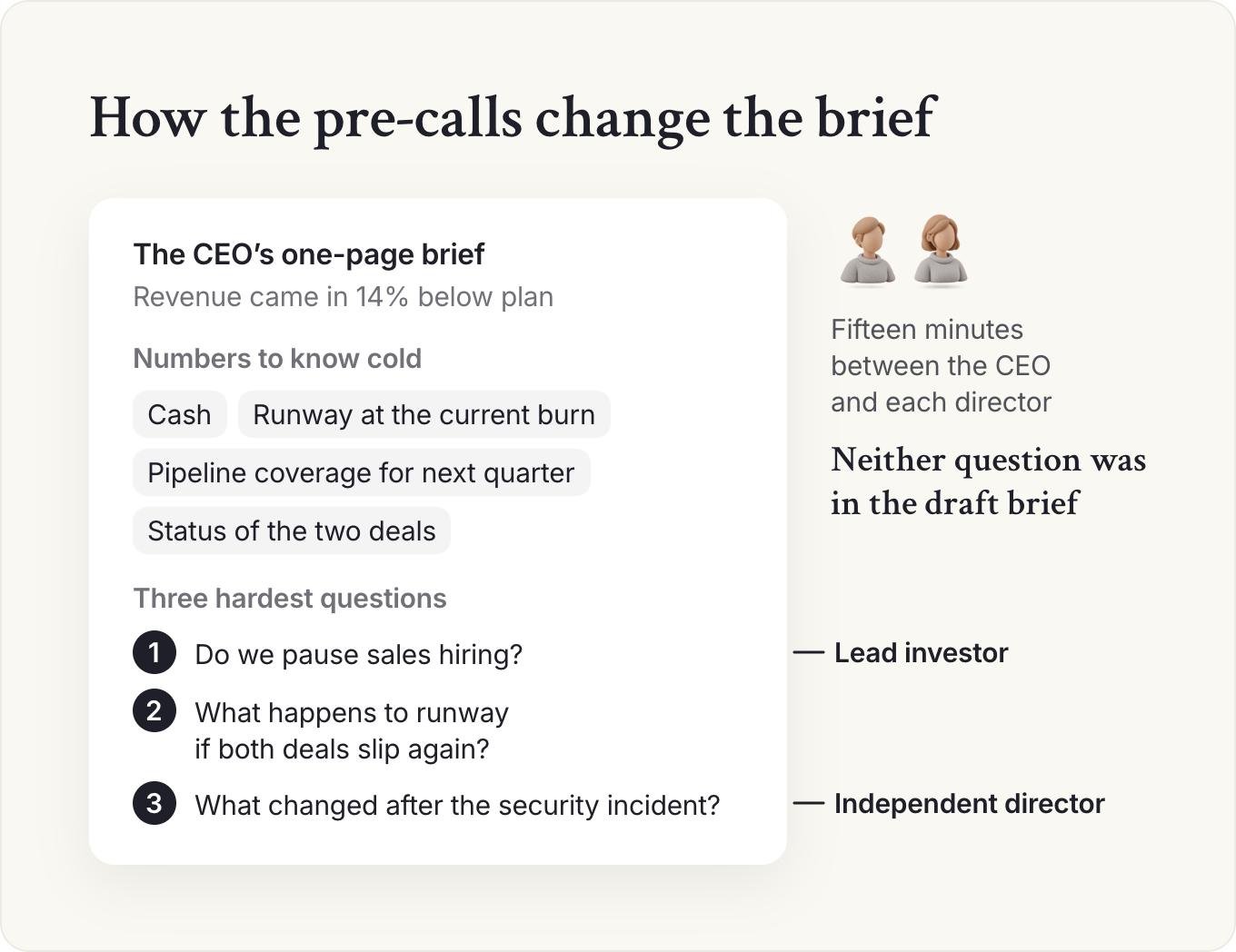
Pre-calls are worth more than another draft of the pre-read. Fifteen minutes between the CEO and each director surfaces objections while there's still time to answer them. Your part is booking the calls, sending the CEO a two-line reminder of what each director cares about, and capturing what they said.
Book fifteen-minute pre-calls between your CEO and each director three to five days before every board meeting, and bring what you hear into the brief.
Then write the CEO's one-page brief. Use the meeting brief from our guide to briefing your principal: the ask and your recommendation, the context, who's in the room and the risks. For a board meeting, add the numbers the CEO must know without looking (cash, runway, the metric that's off plan and why), the three hardest questions with a short answer for each, and anything from the pre-calls that changes the plan.
A worked example: preparing for a missed quarter (illustration)
Revenue came in 14% below plan, mostly because two enterprise deals slipped into next quarter. The pre-read says so on page one, in the CEO's words, with what the company is doing about it.
On the pre-calls, the lead investor asks whether the sales hiring plan still makes sense if the deals slip again. The independent director asks nothing about revenue and a lot about a security incident from the summer. Neither question was in your draft brief.
So the brief changes. The numbers to know cold become cash, runway at the current burn, pipeline coverage for next quarter and the status of the two deals. The three hardest questions become: do we pause sales hiring, what happens to runway if both deals slip again, and what changed after the security incident. You rehearse those answers out loud with the CEO the working day before the meeting. In the meeting, revenue takes ten minutes because every director already knew, and most of the discussion goes to the hiring question.
Judgment calls on preparation
Bad news always goes before the meeting, in the pre-read or on a pre-call; which director hears it first is the CEO's call. If your CEO resists pre-calls, start with the two directors most likely to raise something hard and show what came back. When one director dominates every meeting, have the CEO raise it with the chair on the chair's pre-call. Give the CEO the agenda times to show the chair. A presenter at one of our member sessions on board management had advice for a director who stays quiet meeting after meeting: have the CEO make one specific ask, one to one, that fits their experience, such as a reference call or a look at the pricing model. Track it like any other offer. And when a director contacts you directly, answer the factual request, send anything involving judgment back to the CEO, and tell your CEO the same day.
AI is good at the question bank. Give it the pre-read and your notes on each director's interests, and ask it to argue against the plan from each seat. Use only a tool your company has approved for confidential data.
Prompt: Predict the board's questions
You are helping me prepare my CEO for a board meeting. Below are (1) the pre-read we sent to the board and (2) short notes on each director: their background, what they usually ask about, and how they reacted at the last meeting.

Do three things:
1. For each director, list the 3 questions they are most likely to ask about this pre-read, in their voice, and the page or number that would trigger each one.
2. List the 3 hardest questions overall, the ones that would be most uncomfortable to answer in the room, and explain why each is hard.
3. Point out any number, claim or chart in the pre-read that contradicts another one, or that a skeptical director could read differently than we intend.

Be direct. Don't soften the questions, and don't answer them for me.

Pre-read:
[paste]

Director notes (no personal information, roles and interests only):
[paste]
Then sit with the CEO for thirty minutes and rehearse the three hardest answers out loud, because answers that sound fine on paper often fall apart when spoken. Start the question bank this week: for each director, write the two questions they asked at the last meeting and what they were really worried about.
What should the board meeting agenda look like, and what's your role in the room?
Spend most of the meeting on one or two questions where the company wants the board's help, keep updates to questions on the pre-read, and end with a closed session for directors only. The Chief of Staff usually attends the open session to track actions and timing, then leaves when the board goes into closed session unless the chair asks you to stay.
If directors have read the pre-read, the update portion shrinks to the questions they bring, and the time goes to the topic where their experience is worth the most: a pricing change, a hiring plan, a fundraise.
A three-hour board meeting (our recommended shape)
| Block | Time | What happens | Who leads |
|---|---|---|---|
| Opening and approvals | 10 min | Minutes from last meeting, consent items, resolutions | Chair or CEO, counsel |
| CEO headline and pre-read questions | 30 min | Three things since last meeting; directors ask about the pre-read | CEO |
| Strategic topic 1 | 60 min | The question, options, discussion, what the board advises | CEO with the owning executive |
| Strategic topic 2 or a function review | 30 to 40 min | A second question, or a function the board hasn't seen in a while | Owning executive |
| Read-back of actions | 10 min | Actions, owners, dates, director offers | Chief of Staff or CEO |
| Closed session | 20 to 30 min | Directors only, sometimes with the CEO; feedback, compensation, governance | Chair or lead director |
Meeting logistics are yours too. When the pre-read goes out, confirm which directors, observers and executives will attend, in person or by video, and check with counsel that you will have a quorum, the minimum number of directors the company's rules require. Send each invited executive their block time. In a hybrid meeting, ask the chair to call on remote directors by name in each block, so the discussion doesn't run only around the table.
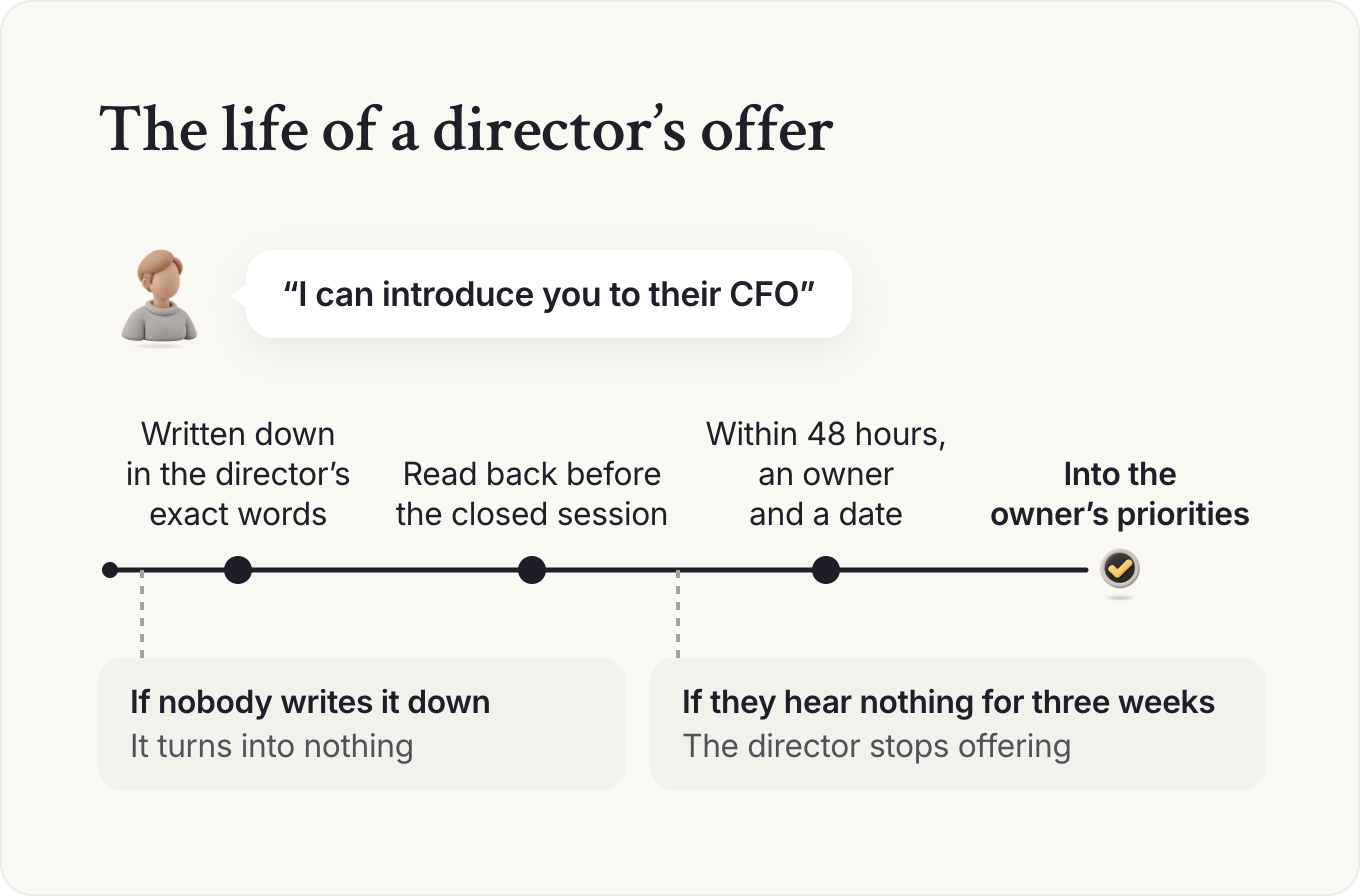
In the room, keep time against the agenda and give the CEO a quiet signal when a block runs long. Write down every action and offer of help as it happens, in the director's exact words, because "I can introduce you to their CFO" turns into nothing if nobody writes it down. Read the actions back before the closed session, then leave without being asked. If the chair wants you to stay and take notes, agree beforehand what you'll write down and who sees it.
The legal record isn't yours. Counsel or a corporate secretary drafts the minutes; your action list is a working document, kept separate from anything that could be read as the official record. Minutes record who attended, that a quorum was present, each decision and resolution, and any conflict of interest a director declared; they are not a transcript of the discussion. Don't record board meetings with a notetaker either: board discussions are on the never-record list in our guide to running leadership meetings.
In the UK, every company must record minutes of directors' meetings and keep them for at least ten years (Companies Act 2006, section 248), and a private company doesn't have to appoint a company secretary (section 270). At a startup with no secretary, the minutes often land with the Chief of Staff in practice. Agree with the chair and counsel who keeps them, and if it's you, keep the minutes apart from your action list.
What should happen after the board meeting?
Send the action list to directors and executives within 48 hours, treat every director's offer of help as a commitment with an owner and a date, log the decisions, and feed what the board asked for into the operating rhythm so the next pre-read answers it.
Most of a board's value arrives as small offers made in the room: an introduction to a customer, a reference call on a candidate, a look at the pricing model. A director who offered an introduction on Thursday and hears nothing for three weeks assumes you didn't need it, and stops offering. The CEO sends the note below, and you draft it the same day while the notes are fresh.
Template: Follow-up after the board meeting
Subject: [Company] board meeting [date]: actions and next steps
Thank you all for [date]. Below are the actions we agreed, who owns them and when. Counsel will circulate draft minutes separately.
Decisions and advice
- [Decision or advice in one line] (management will [next step] by [date])
Actions for management
- [Action] · [owner] · [date]
- [Action] · [owner] · [date]
Offers from the board (thank you)
- [Director]: intro to [person/company] for [purpose] · our contact: [name] · we'll send context by [date]
- [Director]: reference call on [candidate] · our contact: [name]
Next meeting: [date]. Pre-read will reach you on [date]. If there's a topic you'd like on the agenda, reply by [date].
[CEO name]
Then the open items go where the company already looks every week: management actions into the leadership meeting's action list, director offers into the owner's priorities, and anything the board asked to see into the next pre-read. Decisions and advice go into the decision log described in our guide to context management.
Hold a short debrief with the CEO within two days: what landed, what surprised us, and what we change in the next pre-read. Write the answers at the top of the next work-back plan, and on the next round of pre-calls have the CEO ask each director what would make the next meeting more useful than the last.
Send the board action list within 48 hours, with an owner and a date next to every offer of help a director made.
How do you write investor updates between board meetings?
Send a short update to your board and investors every month: the same five to eight metrics each time, lowlights, highlights, what the company is deciding, and two or three specific asks. It keeps directors current so board meetings start from shared facts, and it turns every investor on the list into a source of introductions, candidates and advice.
Once the template exists, it takes a couple of hours a month. Three monthly updates side by side give you most of the pre-read scorecard. Investors who hear about a missed quarter in month two aren't shocked in month three, and an ask like "do you know anyone who has hired a head of sales in fintech?" reaches every investor at once. Writing it also forces you to understand the numbers and the risks at the level the CEO does.
Template: Monthly investor update
Subject: [Company] update, [month year]
The headline
[Two sentences: the most important thing that happened this month, and how we feel about it.]
Metrics (same every month)
| Metric | This month | Last month | Plan |
|---|---|---|---|
| [Revenue or ARR] | |||
| [Growth metric] | |||
| [Cash and runway] | |||
| [Burn] | |||
| [Headcount] |
Lowlights
- [What went wrong or is behind, and what we're doing about it]
Highlights
- [Wins, launches, hires, customers]
What we're deciding
- [Decision in progress, our current view, when we'll decide]
Asks
- [Specific ask: intro to X at Y for Z / candidates for role / advice on topic]
Thank you, [CEO name]
Subject: [Company] update, [month year]

## The headline
[Two sentences: the most important thing that happened this month, and how we feel about it.]

## Metrics (same every month)
| Metric | This month | Last month | Plan |
| --- | --- | --- | --- |
| [Revenue or ARR] | | | |
| [Growth metric] | | | |
| [Cash and runway] | | | |
| [Burn] | | | |
| [Headcount] | | | |

## Lowlights
- [What went wrong or is behind, and what we're doing about it]

## Highlights
- [Wins, launches, hires, customers]

## What we're deciding
- [Decision in progress, our current view, when we'll decide]

## Asks
- [Specific ask: intro to X at Y for Z / candidates for role / advice on topic]

Thank you, [CEO name]
Lowlights go before highlights on purpose: investors read updates from many companies, and they trust the ones that lead with the problem. Keep the metrics list identical month to month, even when one looks bad, because a metric that disappears is the first thing an experienced investor notices. Agree a send day with your CEO and keep it.
In a board month, the update still goes out on its normal day. The pre-read is where you ask for decisions. If both would reach the same people in the same week, keep the update short and let the pre-read carry the asks.
Drafting from your notes is a good job for AI, as long as the numbers come from finance and you check every one before the CEO sees the draft.
Prompt: Draft the monthly investor update
Draft this month's investor update for our CEO to edit and send. Use the structure below exactly: headline (2 sentences), metrics table, lowlights, highlights, what we're deciding, asks.

Rules:
- Use only the numbers I give you. Don't calculate new metrics or fill gaps; mark anything missing as [MISSING].
- Put lowlights before highlights, and give each lowlight one line on what we're doing about it.
- Asks must be specific: who, for what, and why it matters now.
- Plain, direct sentences in the CEO's voice. No superlatives. Under 400 words.

Last month's update (for tone and continuity):
[paste]

This month's metrics from finance:
[paste]

My notes on what happened this month:
[paste]
How can AI help with board prep, and what has to stay out of it?
AI is useful for three board jobs: predicting the board's questions, drafting the monthly update, and checking the pre-read for numbers that don't match. Keep board materials inside tools approved for confidential data, never put a notetaker in a board meeting, and keep personal notes about directors out of AI tools entirely.
70% of the 1,200+ senior leaders who took our AI Readiness Diagnostic have used AI for board decks or executive briefings. I'd use it hardest on the consistency check: does the scorecard on page 3 match the appendix, does the CEO letter promise something the hiring plan can't deliver, which of last meeting's actions isn't mentioned. Two different revenue numbers in one pre-read cost the CEO more credibility than a good letter wins back.
A board pack holds cash, plans, compensation and sometimes acquisitions, and at a public company much of it is material non-public information. Write these rules into your AI setup before you need them:
- Use only the AI tools your company has approved for confidential data, signed into the company account. Never paste a board pack into a personal account.
- Set any AI tool that can act on its own to ask you before it sends, shares or deletes anything, so no board material goes out without approval.
- Keep director notes to roles and interests. Anything personal stays out of writing and out of AI.
If your company hasn't approved any tool for this, start that conversation with IT and counsel. Our guide to AI for Chiefs of Staff has a one-page AI policy you can start from. Then run your last board pack through your approved tool with one instruction: list every number that appears more than once, and flag any that don't match.
Keep reading
 How to brief your principal: briefing memos, decision memos and pre-readsToolkit
- Stakeholder management for Chiefs of Staff: how to map and track the people your principal depends onToolkit
 Context management for Chiefs of StaffToolkit
Toolkit
- The Chief of Staff toolkit: tools and templates for the daily work
- How to brief your principal: briefing memos, decision memos and pre-reads
- Executive communications for Chiefs of Staff: writing for the CEO and running internal comms
- Leadership team meeting agenda: how to run the meeting, take notes and follow up
- Executive calendar management: how a Chief of Staff runs the calendar and inbox
- Context management for Chiefs of Staff
- Stakeholder management for Chiefs of Staff: how to map and track the people your principal depends on
- How Chiefs of Staff research decisions, with and without AI
- How a Chief of Staff runs board meetings and investor relations
Take this guide with you
The full guide as a PDF: every section, template and chart, ready to print or share with your team.
Your PDF is ready.
Download the PDFFree. We may email you new guides; unsubscribe anytime.
Frequently asked questions
Does a Chief of Staff attend board meetings?
Usually yes, for the open session. The Chief of Staff tracks actions and timing and supports the CEO, then leaves when the board goes into closed session unless the chair asks them to stay. Some boards limit attendance to directors and the CEO; agree your role with the CEO and the chair before the first meeting.
Who takes the minutes at a board meeting?
The company secretary or general counsel usually takes the minutes, and the board approves them, normally at its next meeting. The Chief of Staff doesn't take or send the minutes unless the chair and counsel ask. They keep a separate action list, with an owner and a date for each item, and send it to directors and executives within 48 hours. If your company has no secretary (UK private companies don't need one), agree before the meeting who keeps the minutes.
How far in advance should the board pre-read go out?
About a week before the meeting is our recommendation for most boards, so directors can read it properly and the meeting can go to discussion. That means starting preparation about four weeks out, with numbers locked two weeks before and the CEO's review ten days before.
What's the difference between a board update and an investor update?
A board pre-read prepares directors for a specific meeting and asks for decisions and advice. An investor update is a short monthly note to the board and all investors that keeps them current between meetings. A good monthly update makes the board pre-read much faster to write. In a board month, send the update on its normal day. If both land in the same week, keep the update short and leave the asks to the pre-read.
Can a Chief of Staff present to the board?
Yes, when the CEO asks them to, usually on a project they lead, such as a planning process or an operating change. It's a sign of trust, and a good reason to keep your section short. Day to day, the CEO and executives present, and the Chief of Staff makes sure they're ready.
I've just been handed board prep. Where do I start?
Read the past 12 months of board materials: the packs, the minutes and the action lists. Then ask the CEO which one or two questions they want the board's help on next time, ask finance for the close calendar, and ask counsel which approvals are due. Build the work-back plan from the next board date, and agree your part in your mandate before the cycle starts.
- Pathways Report 2026, Chief of Staff Network, 2026. 1,819 job postings, June to October 2026; 741 name the principal.
- Leveling Framework, Chief of Staff Network (survey of 200+ Chiefs of Staff).
- AI Readiness Diagnostic, Chief of Staff Network, 2026 (1,200+ senior leaders).
- Chief of Staff Network podcast episodes: Elyse Levine, Jenna Parker, Ben Darfler.
- UK Companies Act 2006, section 248 and section 270 (legislation.gov.uk).
- Chief of Staff Network member resources (members only): the 30/60/90 day plan template, and a member session on board management (the quiet-director advice).
- The Series B plan and the missed quarter are illustrations. The work-back plan, the ownership split, the agenda, the deck rules and the board-type changes are our recommendations.
Learn the job with people who do it
Membership gets you the Power Skills program, member events and a private community of working Chiefs of Staff.
Land your first Chief of Staff role
Launchpad helps you prepare, position yourself and interview for the role.
Starting out in the role?
The Fundamentals email course walks you through scoping the mandate, setting the cadence and earning trust.
Lead AI adoption from the Chief of Staff seat
The Chief of AI Fellowship is for operators turning AI into how the company runs.
Hiring a Chief of Staff?
Post the role on the Chief of Staff job board, or browse open roles.
Get your resume ready for the role
Get feedback on your Chief of Staff resume before you apply.
Let the right roles find you
Join the talent network and hear about Chief of Staff roles first.
The Chief of Staff newsletter
What Chiefs of Staff are reading, hiring for and building.
Get the full report
Every chart and cut from our latest salary research, sent to your inbox.
Using AI with sensitive data?
Learn the legal side of using AI at work.
Keep going in this series