

How to write a Chief of Staff weekly update
A weekly update in 4 parts turns your 1:1 from triage into strategy. Get our template, a 1:1 agenda and a worked example to send this week.

Ask AI
 Share

A Chief of Staff weekly update is a short written note to your principal, sent the day before your 1:1. It has four parts: the decisions you need, each with your recommendation and a date; what moved; what's coming, with its risks; and one topic for the 1:1. With status handled in writing, the 1:1 can go to strategy.
- Move status out of the 1:1 and into a note your principal reads the day before, sent on the same day every week in the same format.
- Make the calls your mandate allows, and ask your principal only for the rest, each with a recommendation and a date.
- Tell your principal bad news live first, then confirm it in writing. Keep people issues out of the update and discuss them live.
- Open the 1:1 with any decision still unanswered, then spend the time on one risk and one strategic topic.
- Keep every update, and each quarter turn them into a one-page recap you can show when you ask for a bigger role.
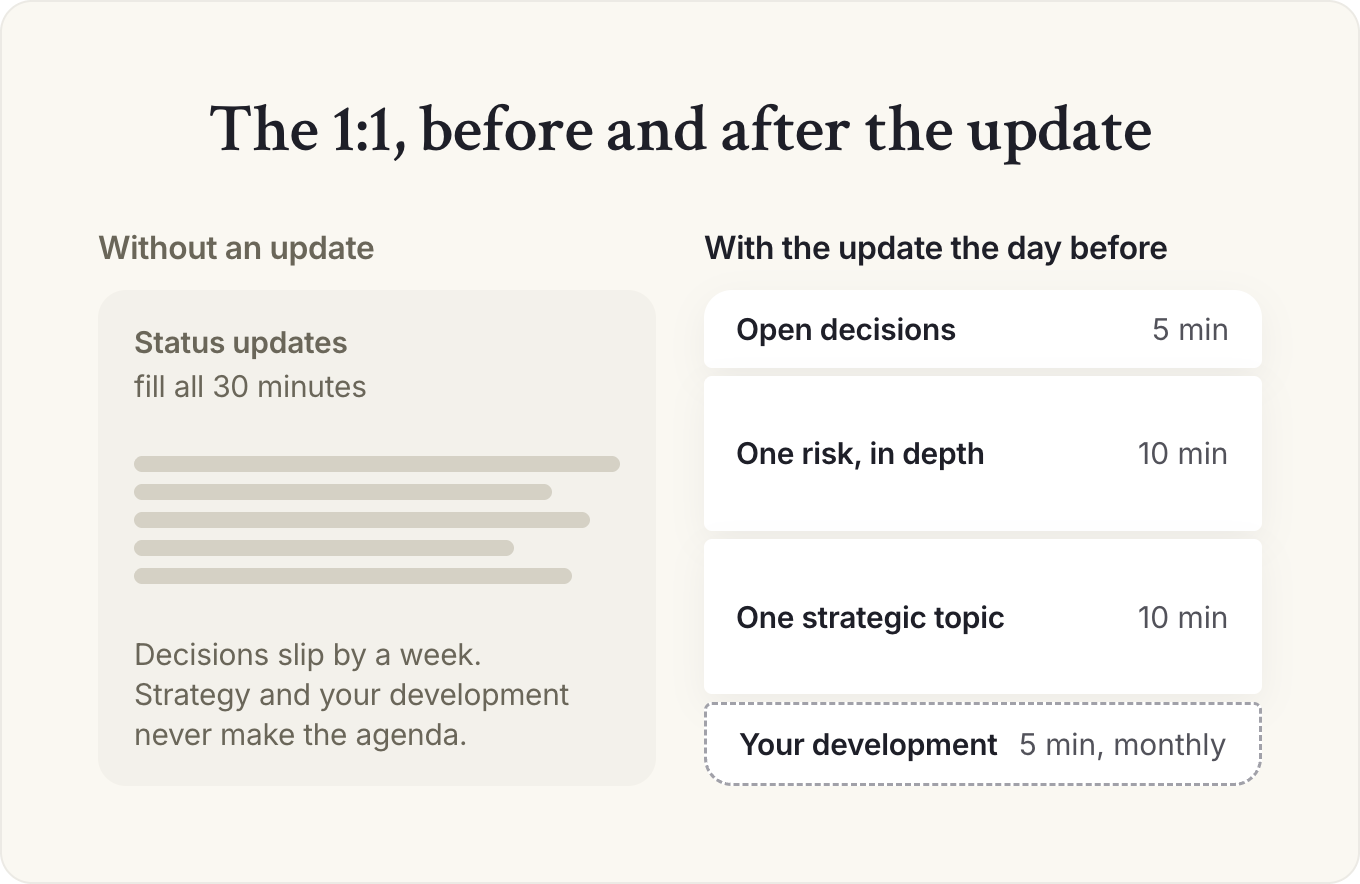
When status updates fill your 1:1 with your principal (the executive you work for), the decisions you need slip by a week, and strategy and your development never make the agenda.
The fix is one short note with one reader that gets things decided before the 1:1. It isn't a company-wide note, an investor update or a briefing for one meeting.
What goes in a Chief of Staff weekly update?
Four parts, in this order: decisions you need, what moved, what's coming, and one topic for the 1:1. Three optional sections can follow when you need them: numbers (the same 3 to 5 every week), your week ahead and a scope check. Keep it short enough to read on a phone, roughly 250 to 400 words.
A weekly update has four parts, in this order
Send it the day before your 1:1. Aim for 250 to 400 words, short enough to read on a phone.
Weekly update
Post it where your principal already reads: a DM, a pinned thread or a shared doc.
1Decisions I need from you
Three at mostEach with your recommendation and the day you need an answer. This part does most of the work.
2What moved this week
Outcomes, with numbers"Q1 plan approved by all five leaders" beats "ran four planning sessions".
3What's coming
The next two to four weeksRisks, deadlines and surprises, each with your next step.
4For our 1:1
One strategic topicPlus one about your own development, once a month.

Copy the template, then read the notes on each part below it.
Template: Chief of Staff weekly update
First line: Week of [date]: [N] decisions, [N] risks
Decisions I need from you (reply inline)
- [Decision]. My recommendation: [option], because [one line]. Need by [day].
- [Decision]. My recommendation: [option]. Need by [day].
- [Decision]. Unless you object by [day], I'll go with [option].
What moved this week (no action needed)
- [Outcome, with a number. e.g. "Q1 plan approved by all five leaders."]
- [Outcome]
- [Outcome]
What's coming (next 2 to 4 weeks)
- [Risk or event]: why it matters, what I'm doing about it.
- [Risk or event]: why it matters, what I'm doing about it.
For our 1:1
- [One strategic topic to think through together]
- [Monthly: one development or career topic]
Numbers (optional, same 3 to 5 every week)
- [Metric]: [this week] ([change vs last week])
Your week ahead (optional)
- Meetings that need your prep: [meeting, what you need to decide or say]
- What you owe others: [item, to whom, by when]
Scope check (optional)
- New requests this week: [request, from whom, fits our mandate? yes / no / proposing an owner]
First line: Week of [date]: [N] decisions, [N] risks

## Decisions I need from you (reply inline)
1. [Decision]. My recommendation: [option], because [one line]. Need by [day].
2. [Decision]. My recommendation: [option]. Need by [day].
3. [Decision]. Unless you object by [day], I'll go with [option].

## What moved this week (no action needed)
- [Outcome, with a number. e.g. "Q1 plan approved by all five leaders."]
- [Outcome]
- [Outcome]

## What's coming (next 2 to 4 weeks)
- [Risk or event]: why it matters, what I'm doing about it.
- [Risk or event]: why it matters, what I'm doing about it.

## For our 1:1
- [One strategic topic to think through together]
- [Monthly: one development or career topic]

## Numbers (optional, same 3 to 5 every week)
- [Metric]: [this week] ([change vs last week])

## Your week ahead (optional)
- Meetings that need your prep: [meeting, what you need to decide or say]
- What you owe others: [item, to whom, by when]

## Scope check (optional)
- New requests this week: [request, from whom, fits our mandate? yes / no / proposing an owner]
- Decisions I need from you. Three at most, each with your recommendation, the reason in one line and the day you need an answer. Ask for inline replies. This is the part that keeps triage out of the meeting. It's also where your principal sees your judgment.
- What moved this week. Outcomes with numbers: "Q1 plan approved by all five leaders" beats "ran four planning sessions". Tie items to your mandate and your quarter's OKRs, and keep any weekly numbers in the same order so changes jump out. Name the person behind each result, so your principal knows whom to thank. Link to the plan or deck instead of pasting it in.
- What's coming. Risks, deadlines and possible surprises in the next two to four weeks, each with what you're already doing about it. In my view, being ahead of events is most of what principals mean when they ask for a more strategic Chief of Staff.
- For our 1:1. One strategic topic, plus one about your development once a month. Writing it down makes it much harder to bump.
The optional scope check lists new requests and whether they fit the role, which keeps scope creep visible without making it a complaint. "Your week ahead" covers the meetings your principal must prepare for and what they owe others.
If you're the principal reading it, answer each decision inline before you meet. One word is enough: yes, no or the option you prefer. A default needs no reply unless you object by its date. If you disagree with a recommendation, say so in your reply or bring it to the 1:1. Over time, the calls you overrule show you both where your judgment and your Chief of Staff's differ.
If the update isn't working, tell your Chief of Staff what you need: a shorter note, a recommendation and a date on every decision, and bad news live first. If you just hired a Chief of Staff, agree this format in their first week, as our guide on how to hire a Chief of Staff recommends.
Writing a decision line your principal can answer in one word
An open question asks your principal to do the thinking. A recommendation with a deadline asks them to check your thinking, which takes seconds, so they answer it between calls. Three weak decision lines, rewritten (illustration):
- Weak: "When should we do the all-hands?" Strong: "All-hands: I recommend moving it to the 14th, the day after the pricing announcement, so we answer the questions once. Need by Wednesday to send the invite."
- Weak: "Sales wants two more SDRs. Thoughts?" Strong: "SDR hires: I recommend approving one now and one in May, because pipeline coverage is 2.8x against a 3x target and the May number tells us whether we need the second. Need by Friday for the req to open."
- Weak: "FYI, the vendor contract renews soon." Strong: "Vendor renewal: I'll renew for one year at the same price unless you object by Thursday. I checked two alternatives; neither saves more than 5%."
Each strong line has the decision, your recommendation, the one fact that drives it, and the day it's needed with the reason. The third is a default, which turns a decision into a notification. Use it for anything you'd bet your principal will approve.
Judgment calls on the decisions section
If your mandate lets you decide, don't ask. Make the call and report it under "What moved". Asking for decisions you're allowed to make teaches your principal that you need permission. Itamar Melamed, Chief of Staff at Empathy, said one measure he holds himself to is how many decisions he took off his CEO's plate.
When you have no recommendation, say what would help you form one: "I don't have a view yet; I need the CFO's Q2 forecast, which lands Tuesday." An invented recommendation you can't defend costs more than an open question. And track the recommendations your principal overrules. If they overrule you on hiring but never on process, you've found where your judgment and theirs differ, and that's the next 1:1 topic.
Fill in the template now, even if you don't send it. The empty sections tell you where you're light.
What does a good weekly update look like?
This fictional update is from a Chief of Staff to the CEO of a 120-person startup in the middle of planning. It goes out on Friday, March 13, for the Monday 1:1.
Template: Example weekly update to a startup CEO (fictional)
First line: Week of March 9: 2 decisions, 2 risks
Decisions I need from you (reply inline)
- Pricing change go-live. My recommendation: move from April 1 to April 15, because support needs the new macros and two enterprise renewals land on the 3rd. Need by Wed.
- Offsite format. My recommendation: one day, leadership team only, with Q2 planning as the single goal. The drafts are in, so one day is enough. Need by Monday, so the invites go out Wednesday.
What moved this week (no action needed)
- Q2 plan drafts are in from all five leaders. Two have owners missing on one priority each; I'm closing that with them Monday.
- The board pack is done except final numbers, which land Thursday.
- Hiring: the VP Sales shortlist is down to three; your interviews are booked for the 18th and 19th.
What's coming (next 2 to 4 weeks)
- Engineering headcount: the plan assumes four hires by June; only one is in final rounds. I've asked the CTO for a fallback plan by the 20th.
- Customer renewal: our second-largest customer's champion is leaving. CS has a meeting with her successor on the 16th; I'll send you a two-line brief before it.
For our 1:1
- Should Q2 have three company priorities or two? I lean two.
- Development (monthly): I'd like to run Q3 planning end to end. What would you need to see from me this quarter?
First line: Week of March 9: 2 decisions, 2 risks

## Decisions I need from you (reply inline)
1. Pricing change go-live. My recommendation: move from April 1 to April 15, because support needs the new macros and two enterprise renewals land on the 3rd. Need by Wed.
2. Offsite format. My recommendation: one day, leadership team only, with Q2 planning as the single goal. The drafts are in, so one day is enough. Need by Monday, so the invites go out Wednesday.

## What moved this week (no action needed)
- Q2 plan drafts are in from all five leaders. Two have owners missing on one priority each; I'm closing that with them Monday.
- The board pack is done except final numbers, which land Thursday.
- Hiring: the VP Sales shortlist is down to three; your interviews are booked for the 18th and 19th.

## What's coming (next 2 to 4 weeks)
- Engineering headcount: the plan assumes four hires by June; only one is in final rounds. I've asked the CTO for a fallback plan by the 20th.
- Customer renewal: our second-largest customer's champion is leaving. CS has a meeting with her successor on the 16th; I'll send you a two-line brief before it.

## For our 1:1
- Should Q2 have three company priorities or two? I lean two.
- Development (monthly): I'd like to run Q3 planning end to end. What would you need to see from me this quarter?
Every decision has a recommendation and a date, every "what moved" line is an outcome, and every risk has an owner and a next step. Only the two 1:1 lines need the meeting. Compare two of its lines with weak versions (illustration):
- What's coming. Weak: "Hiring is behind." Strong: "Engineering headcount: the plan assumes four hires by June; only one is in final rounds. I've asked the CTO for a fallback plan by the 20th."
- For our 1:1. Weak: "Q2 planning." Strong: "Should Q2 have three company priorities or two? I lean two."
Each weak line names a topic. Each strong line adds the fact, your next step or your view, so your principal can answer without asking a question.
For a Chief of Staff to a functional executive in a large company, the shape stays the same. Decisions involve trade-offs with other functions, "what moved" ties to the department's business review, and "what's coming" includes company processes the principal has to feed. Here's a shorter fictional version for a Chief of Staff to the CTO of a 2,000-person company.
Template: Example weekly update to a CTO (fictional)
First line: Week of March 9: 2 decisions, 1 risk
Decisions I need from you (reply inline)
- Platform team headcount. My recommendation: move one open role from Platform to Security for the rest of H1, because the audit findings land in April. Need by Tue.
- Architecture review. My recommendation: move it to monthly; the last four had no decisions. Need by Tue.
What moved this week (no action needed)
- The Q2 engineering plan is in the company planning tool, three days early.
- Finance agreed the cloud cost target; teams have their budgets.
What's coming (next 2 to 4 weeks)
- Performance cycle opens on the 23rd. Two managers haven't finished calibration training; I've booked them for Thursday.
For our 1:1
- The CPO wants two engineers for the pricing project. Do we lend them, and on what terms?
Numbers (same every week)
- Uptime 99.94% (flat) · Deploys 212 (+8%) · P1 incidents 1 (-2)
First line: Week of March 9: 2 decisions, 1 risk

## Decisions I need from you (reply inline)
1. Platform team headcount. My recommendation: move one open role from Platform to Security for the rest of H1, because the audit findings land in April. Need by Tue.
2. Architecture review. My recommendation: move it to monthly; the last four had no decisions. Need by Tue.

## What moved this week (no action needed)
- The Q2 engineering plan is in the company planning tool, three days early.
- Finance agreed the cloud cost target; teams have their budgets.

## What's coming (next 2 to 4 weeks)
- Performance cycle opens on the 23rd. Two managers haven't finished calibration training; I've booked them for Thursday.

## For our 1:1
- The CPO wants two engineers for the pricing project. Do we lend them, and on what terms?

## Numbers (same every week)
- Uptime 99.94% (flat) · Deploys 212 (+8%) · P1 incidents 1 (-2)
If you work part-time, our fractional Chief of Staff guide has a version that adds the hours worked.
What should you leave out of a weekly update?
Leave out activity logs, problems without a recommendation, and anything your principal should hear live first.
What goes in, what stays out
| Put it in | Leave it out |
|---|---|
| Decisions with your recommendation | Questions with no proposed answer |
| Outcomes, with numbers | A list of meetings you attended |
| Risks you see coming, and your plan | Risks your principal hasn't heard about that will upset them (say it live first) |
| One strategic topic for the 1:1 | Sensitive people issues: performance, pay, exits (discuss live) |
| New asks and whether they fit the role | Complaints about workload with no proposal attached |
If something would surprise or upset your principal, tell them in person or on a call, then confirm in writing. Bad news by email reads as self-protection. People issues stay out because weekly notes get forwarded, searched and kept, so write each line as if your principal might forward it to the person it's about.
Live first, then in writing: a worked example
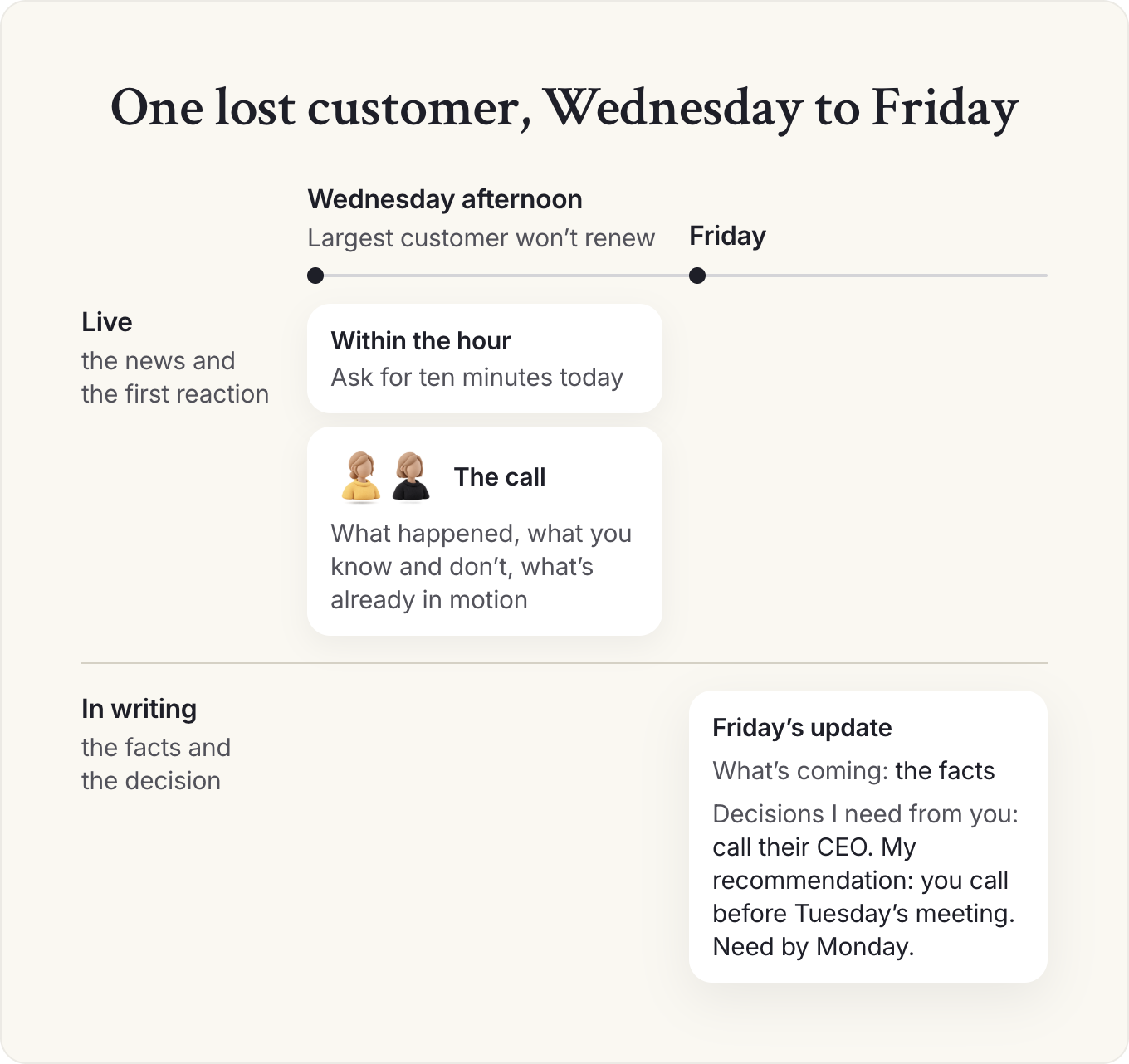
On Wednesday afternoon, you learn that the company's largest customer has told the account team it won't renew. Your update goes out on Friday (illustration).
- Wednesday, within the hour: a two-line message asking for ten minutes today. "Need ten minutes before end of day on [customer]. Not a fire for tonight, but you'll want to hear it from me."
- The call: what happened, what you know and don't, and what's already in motion. "They told the account lead this morning. The stated reason is price; I don't believe that's the whole story. CS is meeting their COO on Tuesday, and I've asked for the usage data by tomorrow."
- Friday's update: the facts under "What's coming", and the decision under "Decisions I need from you". "Call with their CEO. My recommendation: you call before Tuesday's meeting, because their CEO signed the original deal. Need by Monday, before CS meets their COO."
The call carries the news and your principal's first reaction; the written line carries the facts, the next step and the decision. A slipped internal deadline doesn't need a call, while a lost customer, a leadership resignation or a board concern does. When unsure, ask whether your principal would be embarrassed to hear it first from someone else.
When should you send a weekly update to your CEO?
Send it on the same day every week, the day before your 1:1, in the place your principal already reads. I'd rather you send a short update every week than a polished one every other week.
Richard Hoffman, then Chief of Staff at an early-stage fintech, found the role had no clear metrics, so he emailed his CEO every Friday, "religiously", with pain points, what was on his mind and what he'd get done next.
In the survey behind our Leveling Framework, 72% of Chiefs of Staff run their own work and check in with their principal regularly or now and then. The update makes that check-in written and predictable.
- Use the channel your principal already lives in: a direct message or pinned thread in Slack or Teams for most leaders, a shared doc if they review in writing, and email only if that is still where they read.
- Keep the first line predictable. "Week of [date]: 3 decisions, 2 risks" tells your principal how much attention it needs.
- If your principal is skeptical, propose a four-week trial, then ask whether the 1:1s got better.
- When every reply is "let's discuss", take those to the 1:1, then rewrite each as a default next week: "Unless you object by Wednesday, I'll go with option B."
- When your principal replies inline, close the loop in writing within a day.
- With two principals, send one update to each, with a shared "what's coming" section.
This week, pick your send day and put a 30-minute recurring block in your calendar to write it.
How should your 1:1 change once you send a weekly update?
The 1:1 stops being a status meeting. Spend the first few minutes on any decision that wasn't answered in writing, then use the rest for the risks ahead, one strategic topic and, once a month, your development.
That leaves room for the conversations a Chief of Staff is hired for: the trade-offs behind a hard call, the risk nobody has named, the disagreement you'd never raise in a full leadership meeting. Some pairs get more time: Karly Gelardi, then Chief of Staff to Zapier's Chief People Officer, had a weekly one-on-one of at least an hour. Most won't, so the written update has to carry the routine work.
Template: 1:1 agenda that pairs with the weekly update
1:1, [date] (30 minutes)
1. Open decisions from the update (5 min)
- Anything not answered in writing. Decide or set a date.
2. What's coming: one risk, in depth (10 min)
- The risk most likely to cost us in the next month, and what we do now.
3. Strategic topic (10 min)
- [Topic from the update]. What I think, what I'm unsure about, what I need from you.
4. Development (5 min, monthly; otherwise more time for item 3)
- One skill or scope change I'm working toward, and how you can help.
Follow-ups
- [Owner]: [action], by [date]
# 1:1, [date] (30 minutes)

## 1. Open decisions from the update (5 min)
- Anything not answered in writing. Decide or set a date.

## 2. What's coming: one risk, in depth (10 min)
- The risk most likely to cost us in the next month, and what we do now.

## 3. Strategic topic (10 min)
- [Topic from the update]. What I think, what I'm unsure about, what I need from you.

## 4. Development (5 min, monthly; otherwise more time for item 3)
- One skill or scope change I'm working toward, and how you can help.

## Follow-ups
- [Owner]: [action], by [date]
Example: 1:1 on Monday, March 16, after the startup CEO update (illustration)
1:1, Monday, March 16 (30 minutes)
1. Open decisions from the update (5 min)
- Offsite format: not answered yet. Decide today so the invites go out Wednesday.
2. What's coming: one risk, in depth (10 min)
- Engineering headcount: one of four planned hires is in final rounds. Do we cut a Q2 priority now, or wait for the CTO's fallback plan on the 20th?
3. Strategic topic (10 min)
- Two company priorities for Q2 or three. I lean two. I'm unsure whether dropping the partner program puts the two enterprise renewals at risk.
4. Development (5 min, monthly)
- I'd like to run Q3 planning end to end. What would you need to see from me this quarter?
Follow-ups
- Me: offsite invites, Wednesday
- Me: CTO's fallback plan to you, by the 20th
# 1:1, Monday, March 16 (30 minutes)

## 1. Open decisions from the update (5 min)
- Offsite format: not answered yet. Decide today so the invites go out Wednesday.

## 2. What's coming: one risk, in depth (10 min)
- Engineering headcount: one of four planned hires is in final rounds. Do we cut a Q2 priority now, or wait for the CTO's fallback plan on the 20th?

## 3. Strategic topic (10 min)
- Two company priorities for Q2 or three. I lean two. I'm unsure whether dropping the partner program puts the two enterprise renewals at risk.

## 4. Development (5 min, monthly)
- I'd like to run Q3 planning end to end. What would you need to see from me this quarter?

## Follow-ups
- Me: offsite invites, Wednesday
- Me: CTO's fallback plan to you, by the 20th
Send the follow-ups in writing the same day: each decision in one sentence, each action with an owner and a date, and anything deferred with the day you'll come back to it.
Skip the status round. If you find yourself reading the update aloud, it's too long or your principal hasn't read it, and both are worth a direct conversation.
At quarter end, use the strategic slot to reset the role: Where am I most useful to you right now? What should I do less of? What's coming next quarter that we should redesign around?
The first month of the switch
The change rarely sticks on the first try, because your principal's habit is to use the 1:1 for status. The first four updates often go like this (illustration).
- First update. Your principal skims it, answers one decision inline, and opens the 1:1 with "So, where are we on everything?" Answer briefly, then point to the update and move to the risk.
- Second update. Two of three decisions come back answered. The 1:1 starts with the third. You get ten minutes on a strategic topic for the first time.
- Third update. Your principal forgets to read it before a busy day. Open the 1:1 by giving them two minutes to read it, in silence. It feels awkward once, and it teaches the habit.
- Fourth update. Ask the direct question: "Are the 1:1s more useful than a month ago?" Change the format based on the answer, and keep the habit.
Keep asking a version of that question after the first month. Jessica Li, a former Chief of Staff at Beacons, said her one-on-ones with her CEO covered urgent items and how they worked together, such as "do we feel like we're communicating enough?"
When it doesn't take
Some principals never read written updates. Keep writing it, try a two-minute voice note with the text underneath, and use the first five minutes of the 1:1 for the decisions section only. The record still builds. Others read it and still want a status round, often because they process by talking. Give them five minutes and put the strategic topic first.
If you work remotely, the update matters more, because there's no hallway to catch your principal. By month two, other leaders may ask how to get items into your update. Add their items only when a decision crosses teams. Otherwise, send them to your principal directly.
How does a weekly update help your career?
It puts your writing and your judgment in front of your principal every week, before the decisions are made. Employers want the same work: 46% of more than 1,800 Chief of Staff job postings list executive communications as part of the job, and 37% ask for a thought partner on decisions. Once a quarter, turn your updates into a one-page recap of the outcomes, the risks you caught and the decisions you shaped, and bring it when you ask for the next level on our Leveling Framework.
How can AI help you write a weekly update?
AI is good at the first draft: turning your notes, meeting summaries and project tracker into the four sections. It's bad at deciding what matters, so the recommendations and the risk calls stay yours.
Paste your notes into the prompt below, then edit the draft hard, because a draft that sounds like everyone else's won't carry your judgment.
At Section, where Ana Flávia Silva is Chief of Staff, the leaders' user manuals sit in a shared AI workspace, so anyone can ask it how to position an idea for them. Give the tool your principal's user manual too, and ask what they'd want to see first.
Prompt: Draft my weekly update from these notes
I'm a Chief of Staff. Draft my weekly update to my principal from the notes below.

Format, in this order:
1. "Decisions I need from you": at most 3. For each: the decision, my recommendation, a one-line reason and the day I need an answer. If my notes don't contain a recommendation, write [YOUR RECOMMENDATION?] instead of inventing one.
2. "What moved this week (no action needed)": outcomes only (no activity lists), with numbers where my notes have them. Max 5 bullets.
3. "What's coming (next 2 to 4 weeks)": risks and deadlines, each with what I'm doing about it.
4. "For our 1:1": one strategic topic.
5. "Numbers": the same metrics as last week, in the same order, with the change.
6. "Your week ahead": meetings my principal needs to prepare for, and anything they owe other people.
7. "Scope check": new requests from the notes, and whether they fit my mandate (below).

Rules: under 400 words. Include 5 to 7 only when my notes have something for them. Plain language. No people or performance issues; list any you find under "Raise live first". First line format: "Week of [date]: [N] decisions, [N] risks".

My mandate's three outcomes:
-
My notes from this week:
-
Use a tool your company has approved. If an assistant drafts the update on a schedule, let it read and draft only. You edit and send it.
If you're new to the role, start sending it in your second week; our guide to your first 90 days shows where it fits. Otherwise, this week, paste your notes into the prompt above, edit the draft, and send your first update the day before your next 1:1.
New to the role or to your principal? Our Fundamentals email course covers running the operating rhythm, communicating upward and earning trust early.
Start the courseKeep reading
 How to write a Chief of Staff mandateExcel in the role
 How to build an operating rhythmExcel in the role
 Chief of Staff skills: what the job demands at every levelBasics
Excel in the role
Take this guide with you
The full guide as a PDF: every section, template and chart, ready to print or share with your team.
Your PDF is ready.
Download the PDFFree. We may email you new guides; unsubscribe anytime.
Frequently asked questions
What day should you send a weekly update to your CEO?
The day before your 1:1, on the same day every week. Many Chiefs of Staff send it on Friday for a Monday 1:1, as in the sample week in our day in the life guide. Pick one day and keep it, so your principal learns when to expect it and where to look.
What metrics should a weekly update to the CEO include?
Three to five numbers your principal already tracks, in the same order every week, each with the change since last week. No commentary unless something moved. If a number moved enough to need a decision, it belongs in the decisions section instead, with your recommendation and the day you need an answer.
Should anyone else get my weekly update?
Usually not. It's a working note between you and your principal, and it often contains early views you wouldn't share widely. If the leadership team needs the same information, send a separate, shorter note built for them, or use the leadership meeting. If you support two principals, send one to each.
When should a new Chief of Staff start sending one?
In your second week. You won't have much to report, but the decisions section works from day one, and the habit is easier to start than to introduce later. Executives who hire a Chief of Staff can agree the format in the first week.
Do executive assistants or fractional Chiefs of Staff need one too?
A fractional Chief of Staff needs one even more, because they're not in the building between calls; add the hours you worked. Executive assistants moving toward a Chief of Staff role can use the same format to show judgment on decisions as well as logistics.
How do I send weekly updates to my manager?
Send a short note on the same day every week, in the channel your manager already reads, with the same headings each time. Lead with what you need from them, each item with your recommendation and a date. Then list results rather than activity, and the risks you see coming with your plan for each. End with one topic for your next 1:1. Link to detail. The template above works for any manager.
What should be on a 1:1 agenda with your CEO?
Any decision your CEO didn't answer in writing, one risk in depth, one strategic topic and, once a month, your development. If you run the leadership meeting, agree its agenda in the 1:1 before it goes out. Status belongs in the weekly update you send the day before. Send the follow-ups in writing the same day. The 30-minute agenda above has timings and a filled example.
- Chief of Staff Pathways Report 2026, Chief of Staff Network. 1,819 job postings (June to October 2026).
- Leveling Framework, Chief of Staff Network, and its survey of 200+ Chiefs of Staff.
- The Chief of Staff Podcast: Itamar Melamed, Jessica Li, Karly Gelardi and Brandon Sammut, Ana Flávia Silva, Richard Hoffman.
- The examples on this page are illustrations.
Learn the job with people who do it
Membership gets you the Power Skills program, member events and a private community of working Chiefs of Staff.
Land your first Chief of Staff role
Launchpad helps you prepare, position yourself and interview for the role.
Starting out in the role?
The Fundamentals email course walks you through scoping the mandate, setting the cadence and earning trust.
Lead AI adoption from the Chief of Staff seat
The Chief of AI Fellowship is for operators turning AI into how the company runs.
Hiring a Chief of Staff?
Post the role on the Chief of Staff job board, or browse open roles.
Get your resume ready for the role
Get feedback on your Chief of Staff resume before you apply.
Let the right roles find you
Join the talent network and hear about Chief of Staff roles first.
The Chief of Staff newsletter
What Chiefs of Staff are reading, hiring for and building.
Get the full report
Every chart and cut from our latest salary research, sent to your inbox.
Using AI with sensitive data?
Learn the legal side of using AI at work.
Keep going in this series