

How to build an operating rhythm
An operating rhythm is the set of meetings and reviews a company runs on. How to design one at 50, 200 or 2,000 people, with 4 copyable templates.

Ask AI
 Share

An operating rhythm is the fixed set of meetings, reviews and written updates a company runs on, from annual planning to the weekly leadership meeting. Each of its five layers exists to make one kind of decision. A Chief of Staff often designs and runs it. 61% of Chief of Staff job postings mention operating cadence, OKRs or KPIs.
- Give each of the five layers (annual, quarterly, monthly, weekly, daily or async) one decision to make. A forum that can't name its decision is a reporting ritual, so turn it into a written update.
- Start a reset with an inventory of every recurring meeting and the hours it costs each leader. Cut, merge or convert before you add anything, and make every new forum name the one it replaces.
- Size the rhythm for the company you are now and for the next doubling: two or three forums and a weekly note at 50 people, layered reviews at 2,000.
- Let the CEO chair and decide. The Chief of Staff owns the system around the chair: the agenda, the pre-reads, the clock and the read-back. Pre-wire every contested decision one to one, and send the decisions, owners and dates within two hours of the meeting.
- Each quarter, put leadership hours in recurring meetings next to the decisions made, ask the leadership team what to keep and cut, and change no more than two things.
Every leadership team says it wants fewer meetings, and the count still rises. A bad quarter adds a weekly sync to "get visibility", nobody removes the old ones, and executives spend more of their week reporting on the business than running it.
Design the rhythm around decisions instead. Every forum names the decision it exists for, and status moves into writing. The weekly leadership meeting agenda is in our meetings guide. The templates here cover the rest of the rhythm.
What is an operating rhythm?
An operating rhythm is the fixed set of meetings, reviews and written updates a company runs on, from annual planning to the weekly leadership meeting. It turns the annual plan into weekly decisions. People also call it an operating cadence, a business rhythm or the rhythm of the business. Each layer looks at a different time horizon and should exist to make a specific kind of decision.
The five layers of an operating rhythm
| Layer | The question it answers | Typical forum | What it produces |
|---|---|---|---|
| Annual | Where are we going this year, and what will we fund? | Annual planning, budget, leadership offsite | Strategy, annual goals, budget |
| Quarterly | Are we on track, and what changes next quarter? | Quarterly business review, OKR scoring | Delivered vs committed, next quarter's priorities |
| Monthly | How is each part of the business performing? | Monthly business or performance review | Metric review, resourcing decisions |
| Weekly | What is blocked, and what do we decide now? | Leadership team meeting, weekly business review | Decisions, owners, dates |
| Daily or async | What does everyone need to know without a meeting? | Written updates, leader's weekly note, dashboards | Shared context |
Jamie Dalton, then a Chief of Staff at Adobe, described the same shape on our podcast: the annual operating plan breaks into quarterly commitments, then monthly or six-week cycles, then weekly check-ins, and the plan rolls forward a quarter at a time.
At Honeycomb, Ben Darfler, Chief of Staff, lined the layers up: strategy actions mapped almost one-to-one onto annual goals, team goals tied to those, and he was setting up metrics reviews every week or two.
Who owns what: the CEO or the Chief of Staff?
The CEO owns direction and the final call. The Chief of Staff owns the system that gets decisions made on time. Functional leaders own their goals, their numbers and the decisions inside their teams. When those lines blur, the CEO starts running agendas, or the Chief of Staff starts making calls nobody gave them.
Who owns what in the operating rhythm
| Role | Owns | Doesn't own |
|---|---|---|
| CEO (or principal) | Direction, priorities, the final call on contested decisions, chairing the leadership meeting | The calendar, agendas, pre-read deadlines, follow-up |
| Chief of Staff | The design of the rhythm, agendas, pre-reads, the clock, the decision log, the read-back, chasing open actions | The decisions themselves, unless the mandate says so |
| Functional leaders | Their goals and metrics, explaining their variances, the decisions inside their teams, delivering on time | Status updates in the leadership meeting (those go in writing) |
If you're the CEO or COO who owns the rhythm, your part is short. Approve the one-page rhythm, chair the leadership meeting and make the contested calls. Then ask your Chief of Staff for two numbers each quarter, side by side: leadership hours in recurring meetings and the decisions made.
Expect two things back. If you like a meeting that's pure status, your Chief of Staff will propose a four-week trial of a written version. Before a contested decision, they'll pre-wire you too, because one offhand reaction from a CEO can sink a recommendation.
Running the operating rhythm is one of the four core responsibilities of the role. No functional leader owns the whole calendar, so it falls to the Chief of Staff. Under about 50 people, a founder or an ops lead can run two or three forums and a weekly note. A dedicated owner becomes hard to avoid between 100 and 200 people, when the leadership team can no longer see everything in one room.
Employers ask for this work more than anything else. It tops the list in Chief of Staff job postings, well ahead of strategy, communications and board work.
How do you build an operating rhythm from scratch?
Build it in six steps: take an inventory, name the decision for each layer, cut what has no decision, set the calendar a quarter ahead, publish it on one page, and review it after one quarter. Plan on four to six weeks for the first version, with the backing of your principal, the executive you work for.
Most Chiefs of Staff inherit something half-built, and it's usually overgrown: every problem got a meeting and nobody removed the old ones. Alexis Summit, then Chief of Staff at Kroll, a company of about 6,000 people, said on our podcast about resetting Kroll's rhythm that monthly CEO reviews plus separate meetings for every investment and launch left leaders without enough "time to actually run the business instead of reporting on it."
Before you take the inventory, ask each leader to name the company's top three priorities. If the answers differ, settle the priorities with your principal first, because a new meeting schedule can't align a team that disagrees on what matters.
- Take an inventory. List every recurring meeting, report and review your leadership team attends, with the hours each costs per leader per month. Shelby Sly, then Chief of Staff at Ridgeline, started her reset here, with where managers, directors and executives were spending their time.
- Name the decision for each layer. For annual, quarterly, monthly, weekly and async, write the one decision or output that layer must produce.
- Cut, merge and convert. Remove any meeting that can't name its outcome, merge two that serve the same layer, and turn pure status meetings into written updates. Shelby called the first round the quick wins.
- Set the calendar a quarter ahead. Fix board meetings, the quarterly review week, planning windows and the weekly leadership slot, sequenced so inputs flow upward: the weekly business review before the leadership meeting, monthly reviews before the quarterly one. Planning usually starts in the third quarter, and each quarterly review lands two to three weeks before the board meeting.
- Publish it on one page: purpose, chair, owner, attendees, inputs due, decisions made and where the output goes, for each forum.
- Run it for a quarter, then hold a retro. Ask the leadership team what to keep, cut and change. Make up to two changes, then leave the rhythm alone until the next retro.
This week, pull your principal's recurring meetings for the next month and mark each one decision, status or relationship. The count of status meetings is your opening argument for a reset.
Template: Operating rhythm on one page
Operating rhythm: [company], [year]
- Owner: [Chief of Staff] · Approved by: [principal] · Reviewed: end of each quarter
| Forum | Layer | Purpose (the decision it makes) | Chair | Owner (runs it) | Attendees | Inputs due | Output and where it goes | Frequency and length |
|---|---|---|---|---|---|---|---|---|
| Annual planning | Annual | Strategy, annual goals, budget | CEO | Chief of Staff + finance | Leadership team | Function plans: [date] | Annual plan, budget, goals doc | Once a year, kicks off Q3 |
| Quarterly business review | Quarterly | Next quarter's priorities and trade-offs | CEO | Chief of Staff | Leadership team + team leads | Pre-reads due 3 days before, out 2 days before | Priorities, decisions, board deck inputs | Quarterly, 2 to 4 hours |
| Monthly performance review | Monthly | Resourcing and course corrections by function | Function leader | Chief of Staff | Function leader + their leads | Metrics frozen: [day] | Actions, escalations to leadership | Monthly, 60 to 90 min |
| Weekly business review | Weekly | Which reds need leadership help | Chief of Staff or COO | Chief of Staff | Metric owners | Data frozen: [day, time] | Escalations to the leadership meeting | Weekly, 45 min, Wednesday |
| Leadership team meeting | Weekly | Two decisions and one issue | CEO | Chief of Staff | Leadership team only | Pre-reads with the agenda, 24 hours before | Read-back in the room; decisions, owners and dates out within two hours | Weekly, 75 min |
| Leader's weekly note | Async | Shared context without a meeting | CEO | Chief of Staff drafts | Whole company or org | Inputs from leaders: [day] | Sent [Friday] | Weekly, written |
Rules
- Every forum names the decision it exists for. No decision, no meeting.
- Inputs flow up: weekly before monthly before quarterly.
- Change the rhythm once a quarter, at the retro.
# Operating rhythm: [company], [year]

- Owner: [Chief of Staff] · Approved by: [principal] · Reviewed: end of each quarter

| Forum | Layer | Purpose (the decision it makes) | Chair | Owner (runs it) | Attendees | Inputs due | Output and where it goes | Frequency and length |
|-------|-------|---------------------------------|-------|-----------------|-----------|------------|--------------------------|----------------------|
| Annual planning | Annual | Strategy, annual goals, budget | CEO | Chief of Staff + finance | Leadership team | Function plans: [date] | Annual plan, budget, goals doc | Once a year, kicks off Q3 |
| Quarterly business review | Quarterly | Next quarter's priorities and trade-offs | CEO | Chief of Staff | Leadership team + team leads | Pre-reads due 3 days before, out 2 days before | Priorities, decisions, board deck inputs | Quarterly, 2 to 4 hours |
| Monthly performance review | Monthly | Resourcing and course corrections by function | Function leader | Chief of Staff | Function leader + their leads | Metrics frozen: [day] | Actions, escalations to leadership | Monthly, 60 to 90 min |
| Weekly business review | Weekly | Which reds need leadership help | Chief of Staff or COO | Chief of Staff | Metric owners | Data frozen: [day, time] | Escalations to the leadership meeting | Weekly, 45 min, Wednesday |
| Leadership team meeting | Weekly | Two decisions and one issue | CEO | Chief of Staff | Leadership team only | Pre-reads with the agenda, 24 hours before | Read-back in the room; decisions, owners and dates out within two hours | Weekly, 75 min |
| Leader's weekly note | Async | Shared context without a meeting | CEO | Chief of Staff drafts | Whole company or org | Inputs from leaders: [day] | Sent [Friday] | Weekly, written |

## Rules
- Every forum names the decision it exists for. No decision, no meeting.
- Inputs flow up: weekly before monthly before quarterly.
- Change the rhythm once a quarter, at the retro.
The template comes pre-filled with six standard forums. Delete the ones you don't need before you add any.
A worked example: the inventory and the cut
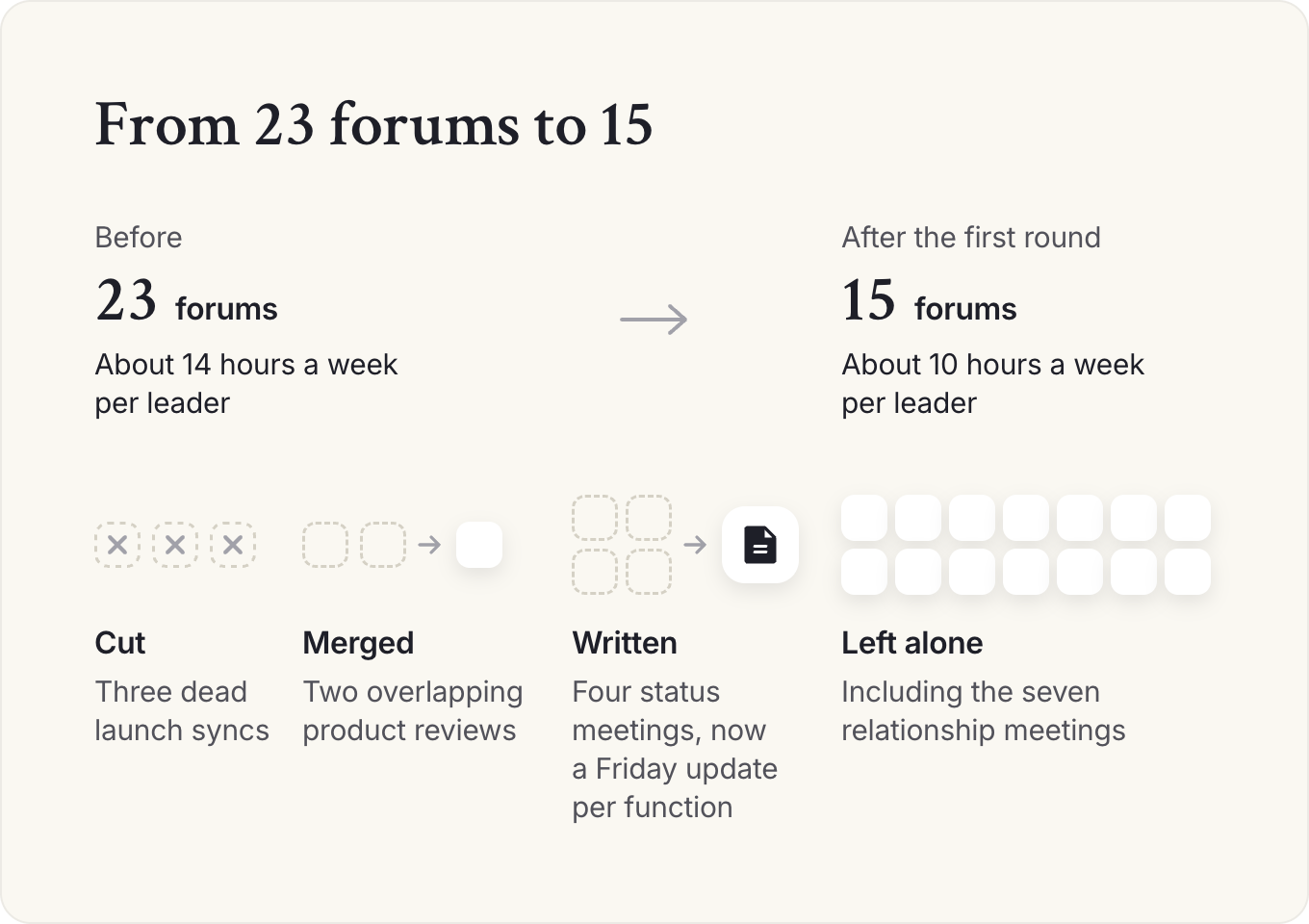
Here's an illustration of steps 1 to 3 at a 200-person company with eight leaders. The inventory finds 23 recurring forums plus four weekly reports: about 14 hours a week per leader in recurring meetings and three more preparing reports.
Seven forums make a real decision: the leadership meeting, the monthly metrics review, two hiring committees, a pricing council, the product roadmap review and quarterly planning. Nine are pure status, including three launch syncs for launches that shipped. Seven are relationship meetings, mostly one-to-ones, which the reset leaves alone.
The first round cuts the three dead launch syncs, merges two overlapping product reviews, and turns four status meetings into a written Friday update per function. That leaves 15 forums and about 10 hours a week per leader. No decision moves to a worse forum, and four hours a week go back to running teams.
Judgment calls in the reset
If the CEO likes a meeting that's pure status, don't propose killing it. Propose a four-week trial with a written version, and let the CEO judge whether anything was lost. Cut the obviously dead meetings in week one, and wait on anything with a senior owner until you've talked to them. A recurring meeting is often how a leader stays visible to the CEO, so offer them a slot in the written update or a standing item on the leadership agenda.
Cutting status meetings creates an information gap for about a month. If the written updates arrive late or thin, someone will propose a new sync, and you're back where you started. Chase the first four updates personally, then adopt a one-in, one-out rule: any new recurring forum names the one it replaces. Don't launch with a big announcement either. Change two forums, show they save time, then change the rest.
A functional Chief of Staff, say to a CTO, can only reset the function's forums, so mark which meetings the company owns. Where Chief of Staff postings name who the role supports, only 44% say the CEO, founder or president. More than half of these roles support someone else. A remote company needs fewer live forums and stricter written ones.
If you'd rather react to a first draft than start from the template, paste this prompt into your AI tool with your own details. Treat the output as a draft to take to your principal. The tool doesn't know which leader will skip the new meeting.
Prompt: Design my operating rhythm
I'm Chief of Staff to [principal, title] at [company]. Help me design an operating rhythm.

Context:
- Company: [stage, headcount, remote/hybrid/in-office, time zones]
- My principal: [title] and their direct reports: [list roles]
- Current recurring meetings: [name, frequency, attendees, length, what it's for]
- Planning and goals today: [annual plan? OKRs? KPIs? board meeting dates?]
- Biggest pain: [e.g. decisions stall, too many meetings, surprises at quarter end]

Do this:
1. Map my current meetings onto five layers: annual, quarterly, monthly, weekly, async. Flag gaps and overlaps.
2. For each layer, name the one decision or output it should produce.
3. Propose a new rhythm: forums to keep, cut, merge or convert to written updates, with frequency, length, owner and attendees.
4. Sequence it so inputs flow upward (weekly before monthly before quarterly).
5. Estimate hours per month for each leader before and after.
6. List the 3 changes I should make first, and how I'd explain them to my principal.
Ask me up to 5 questions first if anything important is missing.
How do you size an operating rhythm for your company?
Design the rhythm for the company you are now and for the next doubling. A 50-person startup needs two or three forums and a strong written habit. A 2,000-person company needs layered reviews where each level filters what goes up to the next.
A starting operating rhythm by company size (our recommendation)
| Layer | About 50 people | About 200 people | About 2,000 people |
|---|---|---|---|
| Annual | Founder-led plan and budget, one offsite | Planning cycle with function plans, one leadership offsite | Annual operating plan with business unit plans and budget rounds |
| Quarterly | Goal reset and a simple scorecard review | Quarterly business review with function leads, OKR scoring | Quarterly deep dives per business unit rolling up to a CEO review |
| Monthly | Usually none; fold into the weekly | Monthly metrics review by function | Monthly performance reviews per business or service line |
| Weekly | One leadership meeting, decisions only | Leadership meeting plus a weekly business review of key metrics | Leadership meeting, weekly business review, steering groups on major programs |
| Async | Founder's weekly note, shared priorities doc | Leader's weekly note, written function updates | Written updates, dashboards, a decision log people can search |
| Who runs it | A Chief of Staff or ops lead, part-time | A Chief of Staff | A Chief of Staff to the CEO plus Chiefs of Staff in business units |
Shelby Sly explained on her episode about moving from meeting-heavy to async that a biweekly all-staff worked when the company was 20 or 30 people and fit in one room. Past 300 people, it got much harder. Three things change as you move right across the table.
The number of filters grows. At 2,000 people, each layer decides what goes up and what stays down. After Kroll moved to two business units, its 11 service line leaders kept their monthly performance meetings. CEO reviews moved from monthly to quarterly, with a deep dive on each of the 11 businesses first. Leadership committees on sales, technology and employee experience meet monthly in between.
Rooms get smaller. Jamie Dalton ran Adobe's quarterly business reviews as open sessions, but her steering committees, every four to six weeks, were a limited group with a set agenda and an expected outcome. Everyone else got the output.
More runs on writing. At Ridgeline, Shelby's leader started a Friday note to the whole company, and decision meetings required a one-pager in advance.
If you're a fractional Chief of Staff or the first operator at a small company, resist building the 2,000-person version. I also wouldn't run a daily leadership standup above about 50 people: at that size a daily status call takes leaders away from running their teams, so use a written async update for the daily layer.
Where does the leadership team meeting fit in the operating rhythm?
The weekly leadership team meeting is where decisions that need the whole leadership team get made. The weekly business review on Wednesday sends it the reds, and its decisions, owners and dates go out to the leadership team within two hours. The CEO chairs it, and the Chief of Staff runs everything around the chair: the agenda, the pre-reads, the clock and the read-back.
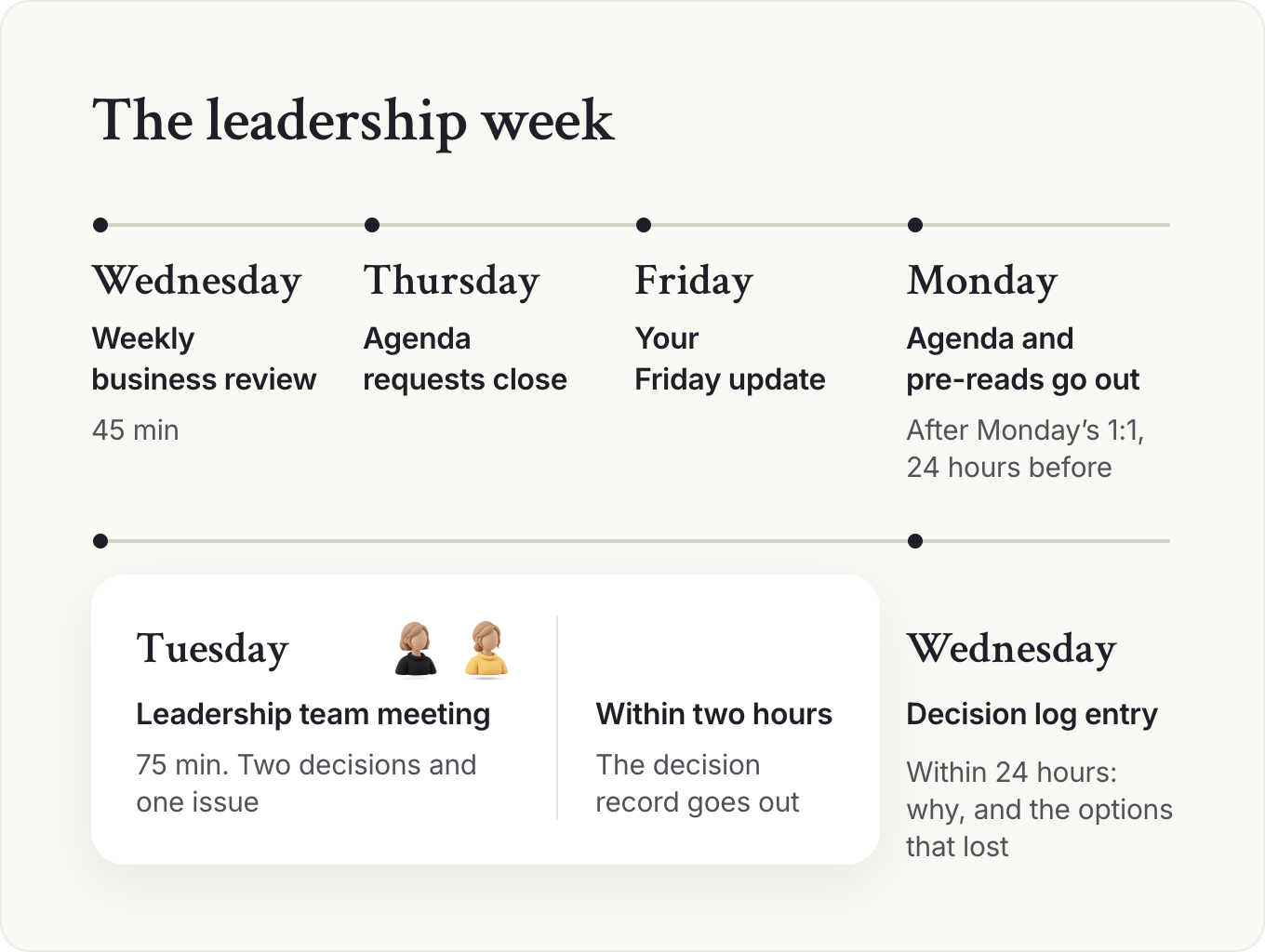
Run the meeting on decisions and shared goals, and keep departmental updates in writing. Jamie Dalton answered any invite without context by asking for the objective and the agenda. A leadership meeting that can't answer those two questions shouldn't happen that week. The Chief of Staff sends the pre-reads with the agenda 24 hours before. Before the meeting closes, the Chief of Staff reads back the decisions, owners and dates, and anyone who disagrees with the record says so then. The decision log entry, with the reasoning, follows within 24 hours.
Our leadership team meeting agenda template has the full run of show: late actions, red metrics, two decisions and one issue, the read-back, and what the company will hear.
Round-robin updates are the clearest sign a meeting has no decision attached. Jamie White, then Chief of Staff for marketing at Notion, told me on our podcast that she never runs them, because they reinforce siloed thinking. Her agendas are built around company goals and the programs that serve them.
She also built an agent at Notion that collates team documents, workstreams and Slack threads into one update per project, which cut her prep for the marketing leadership team. Check your company's AI policy before a tool reads board materials. Our guide to AI and the Chief of Staff covers the rest.
My take: fix the design before you automate anything. An AI summary of a meeting that made no decisions arrives faster and still contains no decisions.
One decision, start to finish
An illustration: one decision through one weekly cycle at a 300-person company, with the leadership meeting on Tuesday.
- Thursday: the Chief of Staff pre-wires. The question is whether to delay a product launch by three weeks to fix an onboarding problem. She talks to the heads of product, sales and customer success one to one. Sales is against it, because two big deals were promised the launch date.
- Monday: the one-page pre-read goes out with the agenda, 24 hours before the meeting. It holds the question, the options, a recommendation (delay two weeks and ship the fix behind a flag), and sales' concern in sales' own words, checked by the head of sales.
- Tuesday, the first decision slot, 15 minutes into the meeting: ten minutes on this decision. The head of sales proposes calling both customers personally. The CEO agrees to the two-week delay on that condition.
- Tuesday, near the close: the read-back. "Launch moves to the 24th. Product owns the fix by the 20th. Sales calls both customers by Wednesday. Revisit if the fix slips past the 20th."
- Tuesday, within two hours: the decision record goes out to the leadership team, with the decision, the owners and the dates.
- Wednesday, within 24 hours: the decision log entry adds why, the options that lost and the revisit trigger.
It works because sales' objection was heard on Thursday, and because the read-back gave the CEO's condition an owner and a date.
Hear it from Chiefs of Staff. Guests on the Chief of Staff Podcast explain how they run leadership meetings, business reviews and planning cycles.
Listen to the podcastHow do you get leaders aligned before a decision?
Build alignment before the meeting. Talk to every key stakeholder one-to-one before a contested decision, send a one-page pre-read, ask each leader to name what must be true for the plan to work, and log the reasoning within 24 hours, so nobody can reopen the decision in week three without cause.
You've seen the pattern: every executive nods at the kickoff, and by week three engineering says the date assumed people it doesn't have and finance hasn't released the budget. Nobody wants to slow things down in a room full of peers, so the objections exist on day one and don't get said. Shelby Sly connects one-to-one with each attendee before a decision meeting, even if only over Slack, to understand where they stand.
My goal is to never surprise anybody in these conversations.
Shelby Sly, then Chief of Staff, Ridgeline · Listen on the podcast
Pre-wire, test, log
Before any contested decision, have the one-to-one conversations, then send the one-pager with the question, options, recommendation and trade-offs. If a leader's concern changes the recommendation, change it before the meeting. Our post on data-driven decision-making covers the evidence side of a good pre-read.
In the pre-wire, or as a reply to the pre-read, ask each leader for two lines: the one thing that has to be true for this to work, and the one thing that would make them want to stop it. If someone says "sounds good", ask for the two lines anyway.
After the meeting, the decision, owner and date go out in the record within two hours. Within 24 hours, the log entry adds why, the options that lost, who disagreed and what would make you revisit it. When someone tries to reopen the decision later, point to the revisit trigger.
Judgment calls on pre-wiring
If the meeting only rubber-stamps what you settled in private, the people you didn't call feel the decision was made around them. Talk to everyone the decision affects, including the leader you expect to agree, and bring the strongest disagreement into the room in its owner's words.
When a leader won't engage beforehand, send the pre-read with one question, "What would make you vote against this?", and a deadline. If they object in the room anyway, log it as a late objection. After two or three, it's a pattern your principal should raise.
CEOs often need pre-wiring most. If yours has already decided, say so in the pre-read, because a decision dressed up as a debate teaches leaders the meeting is theater.
This is the leadership-meeting version of the decision log. It adds an owner, a due date and a status, so someone follows up on each decision.
Template: Decision log
Decision log: [team or program]
- Owner: [Chief of Staff] · Updated: within 24 hours of each decision (the record goes out within two hours)
| # | Date | Decision (one sentence) | Options considered | Why this one | Owner | Due | Must-be-true | Disagreed (and commits?) | Revisit if | Status |
|---|---|---|---|---|---|---|---|---|---|---|
| 1 | Open / Done / Reopened |
Rules
- Log each decision within 24 hours, after the decision record goes out.
- Every row names one person as owner.
- "Revisit if" is a condition, e.g. "pipeline below $X by week 6".
- Reopening a decision needs the revisit condition to be met, or the principal's call.
# Decision log: [team or program]

- Owner: [Chief of Staff] · Updated: within 24 hours of each decision (the record goes out within two hours)

| # | Date | Decision (one sentence) | Options considered | Why this one | Owner | Due | Must-be-true | Disagreed (and commits?) | Revisit if | Status |
|---|------|------------------------|--------------------|--------------|-------|-----|--------------|--------------------------|-----------|--------|
| 1 | | | | | | | | | | Open / Done / Reopened |

## Rules
- Log each decision within 24 hours, after the decision record goes out.
- Every row names one person as owner.
- "Revisit if" is a condition, e.g. "pipeline below $X by week 6".
- Reopening a decision needs the revisit condition to be met, or the principal's call.
Example: leadership team decision log at a 300-person company (illustration)
Decision log: leadership team
- Owner: Chief of Staff · Updated: within 24 hours of each decision (the record goes out within two hours)
| # | Date | Decision (one sentence) | Options considered | Why this one | Owner | Due | Must-be-true | Disagreed (and commits?) | Revisit if | Status |
|---|---|---|---|---|---|---|---|---|---|---|
| 15 | Jun 1 | Annual planning starts July 6 | July 6; July 20 | The plan is set before the August 19 board meeting | Chief of Staff | Jul 6 | Finance closes H1 actuals by July 2 | None | The board date moves | Open |
| 14 | Jun 1 | The launch moves from June 10 to June 24, with the onboarding fix behind a flag | Ship on time; delay two weeks; delay three weeks | Fixes the step 3 drop-off without losing two promised deals | Head of Product | Jun 20 | Sales reaches both customers by Wednesday | Head of Sales (commits; she calls both customers) | The fix slips past June 20 | Open |
| 13 | May 18 | New mid-market deals sign annual contracts only | Annual only; monthly and annual | Cash runway for H2 | VP of Sales | Jun 1 | Discounts stay at 15% or less | Head of Customer Success (commits) | Mid-market win rate under 20% for a full month | Done |
# Decision log: leadership team

- Owner: Chief of Staff · Updated: within 24 hours of each decision (the record goes out within two hours)

| # | Date | Decision (one sentence) | Options considered | Why this one | Owner | Due | Must-be-true | Disagreed (and commits?) | Revisit if | Status |
| --- | --- | --- | --- | --- | --- | --- | --- | --- | --- | --- |
| 15 | Jun 1 | Annual planning starts July 6 | July 6; July 20 | The plan is set before the August 19 board meeting | Chief of Staff | Jul 6 | Finance closes H1 actuals by July 2 | None | The board date moves | Open |
| 14 | Jun 1 | The launch moves from June 10 to June 24, with the onboarding fix behind a flag | Ship on time; delay two weeks; delay three weeks | Fixes the step 3 drop-off without losing two promised deals | Head of Product | Jun 20 | Sales reaches both customers by Wednesday | Head of Sales (commits; she calls both customers) | The fix slips past June 20 | Open |
| 13 | May 18 | New mid-market deals sign annual contracts only | Annual only; monthly and annual | Cash runway for H2 | VP of Sales | Jun 1 | Discounts stay at 15% or less | Head of Customer Success (commits) | Mid-market win rate under 20% for a full month | Done |
Over a year, the log is the best record of how the leadership team decides. Hand it to the next Chief of Staff on day one.
What should a weekly business review cover?
A weekly business review is a 30 to 60 minute look at the same small set of metrics every week, presented by the people who own them. It should cover where each metric is against target, why the reds are red, what the owner is doing about it, and what needs leadership help. Keep it separate from the leadership meeting, and keep slides out of it.
When the same eight to twelve numbers appear in the same order every week, leaders start to see patterns, such as a lead indicator that always dips before a bad month. Three rules keep it honest. The metric's owner explains the variance, even if an analyst built the chart. Green metrics get no airtime. And every red ends in a fix with a date or an escalation to the leadership meeting.
Hold it on Wednesday, before agenda requests for the next leadership meeting close on Thursday. Its reds reach your Friday update, Monday's 1:1 and Tuesday's metrics slot. A red that needs a decision goes into the decision queue with a date. Our post on OKRs and KPIs explains how the two differ, and our post on tracking KPIs and benchmarking goes deeper on measurement.
Template: Weekly business review
Weekly business review: week of [date]
- Owner: [Chief of Staff] · 45 minutes · Wednesday, before agenda requests close on Thursday
- Data frozen: [day, time] · Pre-read sent: [day, time]
Scorecard
Same 8 to 12 metrics, same order, every week. Use your weekly KPI scorecard; paste only the reds and ambers below.
Reds and ambers (owner explains)
[Metric]
- What happened: [ ]
- Why: [root cause]
- Fix and date: [ ]
- Help needed from leadership: [none / decision / resources]
Escalations
- Reds for the leadership meeting's metrics slot: [metric] · Owner: [ ]
- Decisions for the queue: [decision needed] · Owner: [ ] · Needed by: [date]
Watch list (not red yet)
- [Lead indicator moving the wrong way]
# Weekly business review: week of [date]

- Owner: [Chief of Staff] · 45 minutes · Wednesday, before agenda requests close on Thursday
- Data frozen: [day, time] · Pre-read sent: [day, time]

## Scorecard
Same 8 to 12 metrics, same order, every week. Use your weekly KPI scorecard; paste only the reds and ambers below.

## Reds and ambers (owner explains)
### [Metric]
- What happened: [ ]
- Why: [root cause]
- Fix and date: [ ]
- Help needed from leadership: [none / decision / resources]

## Escalations
- Reds for the leadership meeting's metrics slot: [metric] · Owner: [ ]
- Decisions for the queue: [decision needed] · Owner: [ ] · Needed by: [date]

## Watch list (not red yet)
- [Lead indicator moving the wrong way]
If you can't fill the scorecard from your systems in under an hour each week, fix the data before you add the meeting. A review that runs on numbers rebuilt by hand on Wednesday morning trains everyone to distrust them.
How do you run a quarterly business review?
A quarterly business review compares what each team committed to with what it delivered, explains the misses, and agrees on next quarter's priorities and trade-offs. Send a written pre-read two to three days before, use the meeting for discussion and decisions, and look two quarters ahead.
At Adobe, Jamie Dalton's teams reported against last quarter's commitments (delivered, or not delivered and why), then looked two quarters out. At Kroll, Alexis Summit's team ran deep dives on all 11 businesses, which rolled up into a shorter review with the CEO. The common mistake is a 60-slide deck presented live. Put the numbers in the pre-read and spend the meeting on three or four decisions. Our post on implementing QBRs and OKRs covers the goal side.
If your principal reports to a board, land the QBR two to three weeks before the board meeting, so the deck is built from decisions already made. The fourth-quarter review feeds next year's plan. Our post on why annual planning and budgeting is hard for midsize companies covers that side.
Template: Quarterly business review pre-read
QBR pre-read: [team / business unit], Q[ ] [year]
- Owner: [team lead] · Due to Chief of Staff: [date, 3 days before] · Max 3 pages
1. Headline (3 sentences)
What we committed, what we delivered, the one thing leadership should know.
2. Commitments vs delivery
| Commitment last quarter | Delivered? (Yes / Partly / No) | If not, why | What we learned |
|---|
3. Metrics
| Metric | Target | Actual | Trend | Comment |
|---|
4. Next quarter: our 3 priorities
- [Priority] · Success looks like: [measurable] · Owner: [ ]
- [Priority] · Success looks like: [measurable] · Owner: [ ]
- [Priority] · Success looks like: [measurable] · Owner: [ ]
5. Two quarters out
- What we expect to need, start or stop by then: [ ]
6. Risks and dependencies
- [Risk] · Likelihood / impact · Who we depend on: [team]
7. Decisions and asks for leadership
- [Decision or resource ask] · Options · Our recommendation
# QBR pre-read: [team / business unit], Q[ ] [year]

- Owner: [team lead] · Due to Chief of Staff: [date, 3 days before] · Max 3 pages

## 1. Headline (3 sentences)
What we committed, what we delivered, the one thing leadership should know.

## 2. Commitments vs delivery
| Commitment last quarter | Delivered? (Yes / Partly / No) | If not, why | What we learned |
|-------------------------|--------------------------------|-------------|-----------------|
| | | | |

## 3. Metrics
| Metric | Target | Actual | Trend | Comment |
|--------|--------|--------|-------|---------|
| | | | | |

## 4. Next quarter: our 3 priorities
1. [Priority] · Success looks like: [measurable] · Owner: [ ]
2. [Priority] · Success looks like: [measurable] · Owner: [ ]
3. [Priority] · Success looks like: [measurable] · Owner: [ ]

## 5. Two quarters out
- What we expect to need, start or stop by then: [ ]

## 6. Risks and dependencies
- [Risk] · Likelihood / impact · Who we depend on: [team]

## 7. Decisions and asks for leadership
- [Decision or resource ask] · Options · Our recommendation
The QBR tests the whole rhythm. If the weekly and monthly layers work, nothing in it should surprise the leadership team.
How do you know your operating rhythm is working?
Measure the rhythm like any other system: count the decisions it produces, how fast they happen, how reliably actions close, and how much leadership time it costs. Review those numbers once a quarter in a short retro with the leadership team, and change the rhythm only when the data or the company's shape says so.
Operating rhythm health check (our rules of thumb)
| Signal | How to measure | Healthy | Warning sign |
|---|---|---|---|
| Decisions per leadership meeting | Count decisions in the read-back | 2 or more most weeks | Weeks with none |
| Pre-reads on time | Share sent by the deadline | Most of them | Pre-reads arriving in the meeting |
| Actions closed on time | From the decision log | Most of them | The same items carried for 3+ weeks |
| Decisions reopened | Rows marked "Reopened" | Rare, and only when the trigger fires | Reopened because someone wasn't consulted |
| Leader hours in recurring meetings | Calendar audit per quarter | Flat or falling as the company grows | Rising every quarter |
| Surprises at the quarterly review | Ask leaders after each QBR | None that matter | A miss nobody flagged in the weekly review |
These thresholds are my judgment. Set your own after the first quarter. Report two numbers to your principal every quarter, side by side: leadership hours in recurring meetings and the decisions made. If hours fall while decisions hold steady, the rhythm is giving leaders time back.
In the quarterly retro, ask three questions: which forum helped you decide something, which could you have skipped, and where did you hear something too late? Change no more than two things each time. Shelby Sly reset Ridgeline's rhythm through a handful of small changes over time. Save big resets for big changes, such as a reorg or a new CEO, as Alexis Summit did when Kroll moved to two business units.
The test I care about most is a week off. If agendas still go out, the decision log stays current and the weekly review still runs, the rhythm works without you. If everything stops, you've built a dependency on yourself, and that limits your next step too.
This week, start a tracker with the six signals above, fill in this week's numbers, and put a 30-minute rhythm retro on the leadership calendar for the last week of the quarter.
Keep reading
 How to write a Chief of Staff mandateExcel in the role
 How to write a Chief of Staff weekly updateExcel in the role
 What does a Chief of Staff do?Basics
Excel in the role
Take this guide with you
The full guide as a PDF: every section, template and chart, ready to print or share with your team.
Your PDF is ready.
Download the PDFFree. We may email you new guides; unsubscribe anytime.
Frequently asked questions
Is an operating rhythm the same as an operating cadence or a business rhythm?
Yes, in practice. All three describe the schedule of recurring forums a leadership team runs the business on. Some teams use cadence for the timing (weekly, monthly, quarterly) and rhythm for the whole system, including written updates and dashboards. Pick one term, define it on one page, and use it consistently.
What is an example of an operating rhythm?
A 200-person company might run annual planning that starts in the third quarter, a quarterly business review two to three weeks before each board meeting, a monthly metrics review by function, a weekly business review on Wednesday, ahead of the weekly leadership meeting, and a leader's weekly note every Friday. Each forum names the decision it makes, and inputs flow up from weekly to monthly to quarterly.
Should the Chief of Staff run the leadership team meeting?
Usually, no. The CEO or principal chairs it and makes the final call. The Chief of Staff owns everything around the chair: building the agenda, collecting pre-reads, keeping time, reading back decisions, owners and dates near the close, and chasing the actions afterwards. Some Chiefs of Staff facilitate parts of the meeting, but the chair stays with the leader.
How many recurring meetings should a leadership team have?
As few as still make every decision on time. A 50-person company can run on one weekly leadership meeting, a quarterly reset and a written weekly note. A 2,000-person company needs layered weekly, monthly and quarterly reviews. If leaders' hours in recurring meetings rise every quarter, the rhythm is growing faster than it should.
How long should a quarterly business review be?
Plan two to four hours for a leadership-level QBR, with a written pre-read sent two to three days before. The meeting should focus on missed commitments and next quarter's priorities and trade-offs, with the slides left in the pre-read. At large companies, team-level deep dives happen first and roll up into a shorter review with the CEO.
How do I stop round-robin updates in leadership meetings?
Move status into a written weekly update and build the leadership agenda around decisions and shared goals. Put decisions near the top, show only red metrics, and finish with the read-back and what the company will hear. Note-taking tools that summarize and share the meeting also remove much of the reason for round-robins.
- 2026 Chief of Staff Pathways Report, Chief of Staff Network, 2026 (1,819 job postings; 741 name who the Chief of Staff supports).
- Chief of Staff Podcast episodes with Jamie Dalton (Adobe), Alexis Summit (Kroll), Shelby Sly (Ridgeline), Jamie White (Notion) and Ben Darfler (Honeycomb).
- Building Your Operating Cadence, Chief of Staff Network member playbook (members only, not linked).
Learn the job with people who do it
Membership gets you the Power Skills program, member events and a private community of working Chiefs of Staff.
Land your first Chief of Staff role
Launchpad helps you prepare, position yourself and interview for the role.
Starting out in the role?
The Fundamentals email course walks you through scoping the mandate, setting the cadence and earning trust.
Lead AI adoption from the Chief of Staff seat
The Chief of AI Fellowship is for operators turning AI into how the company runs.
Hiring a Chief of Staff?
Post the role on the Chief of Staff job board, or browse open roles.
Get your resume ready for the role
Get feedback on your Chief of Staff resume before you apply.
Let the right roles find you
Join the talent network and hear about Chief of Staff roles first.
The Chief of Staff newsletter
What Chiefs of Staff are reading, hiring for and building.
Get the full report
Every chart and cut from our latest salary research, sent to your inbox.
Using AI with sensitive data?
Learn the legal side of using AI at work.
Keep going in this series