


What is a fractional Chief of Staff?
What a fractional Chief of Staff does, what 15 hours a week costs, and how to become one. Fractional moves rose from about 1% to nearly 4% since 2020.

Ask AI
 Share

A fractional Chief of Staff works part time, often for several companies, on the four core responsibilities of the role: priorities and decisions, running the operating rhythm, communication up and down, and cross-functional projects. It suits work with a clear output, because a part-time operator holds less context.
- Hand a fractional Chief of Staff work with a clear output: the weekly leadership meeting, the planning cycle, board prep or two named projects. Keep the daily judgment calls with people who are in the room.
- If you're hiring, write the work in one sentence, choose the shape (embedded, project or interim) and give full access in week one. Review the engagement at six to eight weeks.
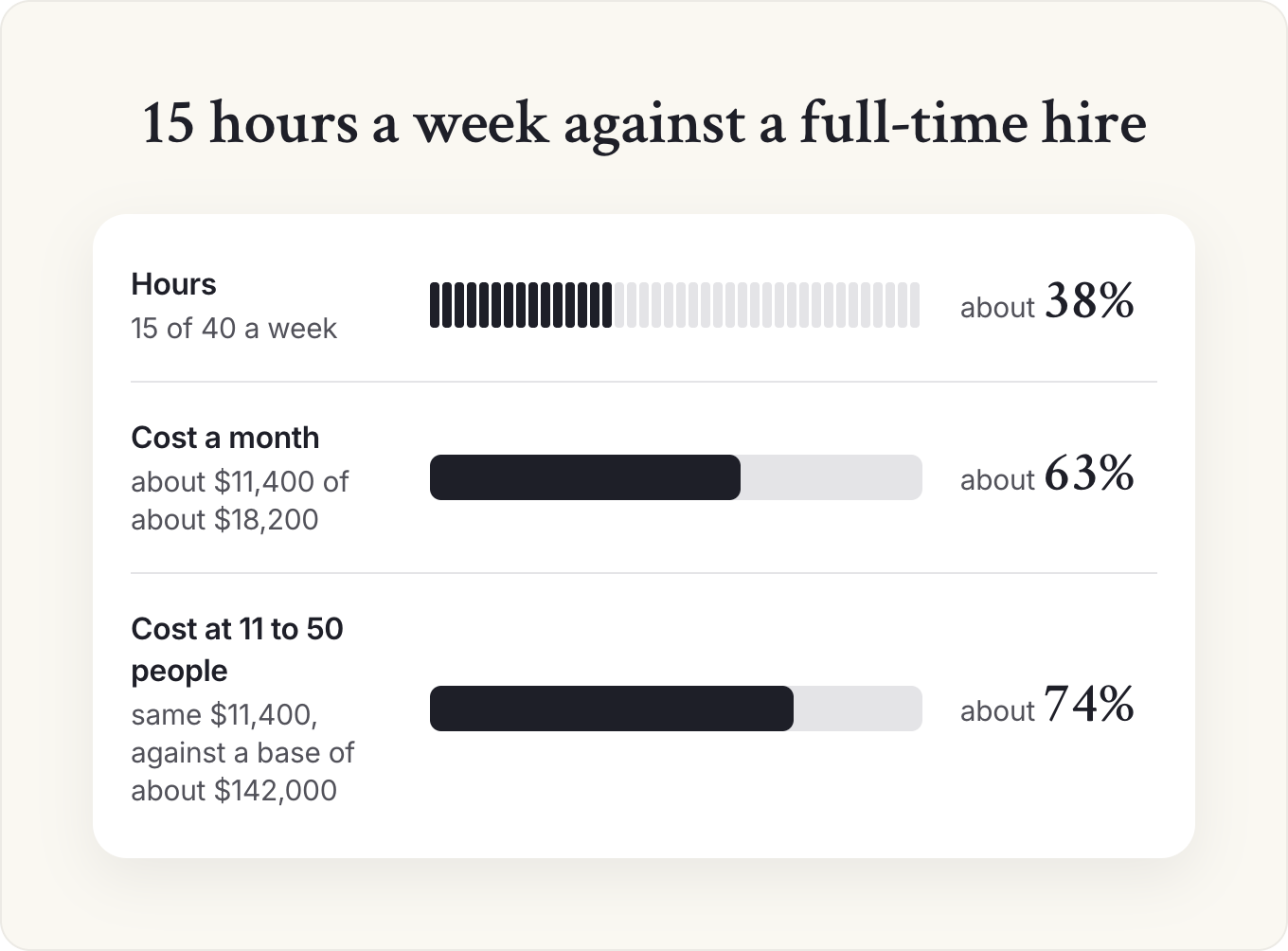
- Compare quotes by the hours they include. On our illustration, 15 hours a week comes to about $11,400 a month, about 63% of a full-time hire's cost for about 38% of the hours.
- If you're going fractional, do the full-time job first, then sell one narrow offer to the people who have already seen your work.
- Agree at the start on what would open a conversation about going full-time, such as hours running more than 25% over scope for two months.
Most companies that need a Chief of Staff can't hire one yet. The founder is the bottleneck for every decision and three projects are stuck, but a full-time hire means a posted US salary around $140,000 even at a company of 11 to 50 people, plus the risk of hiring for a role nobody has defined.
So more companies rent the role first, and both sides tend to get it wrong the same way: the company expects a full-time Chief of Staff for a third of the price, the fractional one tries to deliver it, and the engagement ends at month three with nobody sure what it was for. If you're a Chief of Staff thinking of going fractional, start at how to become one, and use the cost section to set your price.
What does a fractional Chief of Staff do?
A fractional Chief of Staff takes on the four core responsibilities of the role (priorities and decisions, running the operating rhythm, communication up and down, and cross-functional projects) for a set number of hours or a defined project.
Structured work with a clear output transfers well. A part-time operator can run a weekly leadership meeting, build the quarterly planning cycle, stand up a metrics review, run an executive search, prepare a board meeting or a fundraise, and drive two or three stuck projects to done, in 15 hours a week if the leader gives access and decisions on time.
Work that depends on being in the building transfers badly. A full-time Chief of Staff hears the hallway version of every problem; a fractional one gets the version people bring to a scheduled call. So the strongest engagements are built around rhythm and follow-through, and leave the political judgment calls to people who are there every day. If you're the fractional Chief of Staff, say this in the first call.
Most engagements take one of three shapes.
Three shapes of fractional Chief of Staff engagement
| Shape | Typical time | What the client buys | Works best when |
|---|---|---|---|
| Embedded | Set days or hours each week, for months | An operating rhythm that runs without the founder chasing it | The company has a leadership team of 3 to 8 and no one running the rhythm |
| Project | A defined deliverable with an end date | One outcome: a planning cycle, a fundraise or board prep, a key hire, a reorg | The need is one event with an end date |
| Interim | Near full-time cover for a fixed period | Continuity while a full-time Chief of Staff or COO is hired, on leave or replaced | The company already knows it needs the full-time role |
Zoe Jakubowich, a fractional Chief of Staff, mixes them. When she came on our podcast, her five client projects ranged from interim operations for a skincare brand to recruiting for a luxury brand and investor preparation for a B2B marketing technology company. A founder who asks for "a fractional Chief of Staff" usually hasn't decided which shape they need. Asking "is this a rhythm, an event or temporary cover?" in the first conversation saves weeks.
How is a fractional Chief of Staff different from a full-time Chief of Staff, a consultant or an EA?
A fractional Chief of Staff runs the same kind of work as a full-time one, with less context, fewer hours and a narrower mandate. A consultant advises and leaves, while a fractional Chief of Staff runs the operating work across the team for as long as the engagement lasts. An executive assistant runs the leader's calendar, inbox and travel, so a fractional Chief of Staff whose hours go mostly there is doing EA work under a senior title.
Fractional Chief of Staff vs full-time Chief of Staff and consultant
| Fractional Chief of Staff | Full-time Chief of Staff | Consultant | |
|---|---|---|---|
| Time | Part of the week, often several clients | Full-time, one principal | Project-based |
| Owns | The same four, weighted to the operating rhythm and named projects | The four core responsibilities: priorities and decisions, running the operating rhythm, communication up and down, and cross-functional projects | A recommendation |
| Context held | Partial, from scheduled access | Full, from being in the room | Narrow, for one question |
| Decision rights | Delegated for named areas | Broad, agreed with the principal | Usually none |
| Output | Running processes and finished projects | A company that runs without the leader chasing it | A deck or plan |
| Pay basis | Hourly, retainer or project fee | Salary, bonus, often equity | Project or day rate |
| Best for | Early-stage teams and interim cover | Companies that know they need the role | One hard question |
If the engagement ends with a deck and nothing running, it was a consulting project.
Who hires a fractional Chief of Staff, and when?
The classic buyer is an early-stage founder, somewhere between the first leadership hires and the point where a full-time Chief of Staff is affordable. Larger companies hire them too, mostly for interim cover or for a functional leader who doesn't yet have budget for a full-time role.
At startups, the founder has hired three to six leaders and the company has outgrown the founder's head. Look for signals a part-time operator can fix without being there every day:
- No operating rhythm: no weekly leadership agenda, no quarterly plan, no metrics review that happens on time.
- The founder is the router. Every cross-team question goes through one inbox, and the answer arrives late.
- A big event is coming: a fundraise, a board meeting, a reorg, the first annual plan or a run of senior hires.
- Projects stall at the handoff, because work that needs two teams sits between them.
- The budget covers 10 to 20 hours of senior help, but a full salary plus equity is still a year away.
My advice to founders: if you can't name the work you want handed over, don't hire a full-time Chief of Staff yet. A fractional one will show you what that work is, sooner and with less risk. That's how it went at Taxwire: CEO Andrew Rea told our podcast there was no job description, and David Moon came in as a contractor. David told us he worked about 20 hours a week for two weeks, then joined full time.
When fractional is the wrong answer
Some problems need someone in the room every day, usually because the answer depends on who trusts whom.
- The leadership team is in open conflict. Co-founders who disagree on strategy, or a VP the CEO is about to replace, need a full-time Chief of Staff or a coach. A fractional one gets pulled into a side.
- The company is in a crisis. A cash crunch or a key departure needs daily decisions, and the team won't wait for Tuesday afternoon.
- The founder wants a thought partner on everything. That's the full-time job, and part-time hours will feel like rationing.
- The real gap is one function. If sales is broken, hire a sales leader.
Fractional can still take a narrow project inside one of these, such as board prep during a crisis.
This week, if you're a founder, count the hours you spent last week chasing follow-ups, preparing meetings and routing questions between leaders. That number is roughly the size of your first engagement.
How much does a fractional Chief of Staff cost?
In November 2026, published rates ran from about $140 to $200 an hour. On our illustration, 15 hours a week comes to about $11,400 a month. You pay by the hour, by project, or as a monthly retainer for a set band of hours.
Published offers are usually priced by the days or hours a week they include, so compare quotes per hour. To test a quote, or set your own price, work from full-time pay. The average full-time base, across all company sizes, is about $168,000, or about $81 an hour before benefits, payroll taxes, bonus and equity. An independent carries all of that, plus the unpaid hours spent finding clients, invoicing and waiting between engagements.
What a fractional Chief of Staff costs, worked from the full-time average
| Step | Figure | How we got it |
|---|---|---|
| Full-time base, per hour | about $81 | $167,954 ÷ 2,080 hours (40 hours x 52 weeks; 2025 Salary Report) |
| Add employer costs (benefits, payroll tax) | about $105 | x1.3, our assumption |
| Cover unbilled time (selling, admin, gaps) | about $175 | ÷0.6, our assumption that 60% of working hours are billable |
| Embedded retainer, 15 hours a week | about $11,400 a month | 15 hours x 52 weeks ÷ 12 = 65 hours, x $175 |
| Full-time hire, base and employer costs only | about $18,200 a month | $167,954 x 1.3 ÷ 12 |
On these assumptions, the client pays about 63% of a full-time hire's cost for about 38% of the hours, and the fractional Chief of Staff earns more per billed hour than an employee would. If you set your rate from a salary, as this table does, the share comes out the same at any level. A founder who compares a quote with their own full-time cost sees it move. At companies of 11 to 50 employees, the 2025 Salary Report's average base is about $142,000, so the same $11,400 retainer is about 74% of a full-time hire's cost. The salary guide has the full-time anchor by level and company size.
Read $175 as the break-even rate: what independent work has to charge to match the average base plus benefits. Bonus and equity are not in it. $175 sits inside the published range. At $140, 24 billed hours a week pays about the base alone. Some providers price larger blocks of hours lower. When you compare quotes, divide each one by the hours it includes, and ask how work beyond the scope gets priced.
If you're selling, price against the hours and decisions you give back to the founder, which is easier to defend than a market rate. I'd default to a retainer for any engagement longer than two months. Project fees suit events with a clear end, and hourly caps your income at your calendar.
In the UK, fractional work is often quoted as a day rate. If you work through your own limited company, check before you sign who decides whether the off-payroll rules (IR35) apply. That decides whether the fee is taxed like a salary.
How do you hire a fractional Chief of Staff?
Name the work first, choose the shape of engagement, then hire for judgment and for references from past principals, the executives they worked for. Put the scope on one page, give access from day one, and review the engagement at six to eight weeks. The full-time process in our guide on how to hire a Chief of Staff applies too, with a shorter runway.
Write the work in one sentence. "I need someone to run our weekly leadership meeting and quarterly planning so I stop chasing people" is a brief a candidate can answer; "I need a right hand" describes a feeling. Then match the person to the shape: embedded work needs someone who builds trust fast and runs meetings they didn't create, a project needs someone who has delivered that exact project, and interim cover needs someone senior enough to step in without a ramp.
Post the engagement on our Chief of Staff job board and ask your investors for referrals. Interview as you would for a full-time hire, with one rule that matters more here: at least one reference should be a former principal.
The fastest way to waste a fractional engagement is part-time access. Add them to the leadership channel, the planning docs and the weekly meeting in week one, and read their written update. A weekly update is how a part-time operator stays useful between calls.
What the first eight weeks look like
A fractional Chief of Staff has to collect context on purpose, in writing. Here's an illustration of an embedded engagement at 15 hours a week, for a Series A founder with five leaders.
- Weeks 1 and 2. Forty-five minutes with each leader, asking what's stuck, what they wish the founder knew and which meeting wastes the most time. Sit in on the leadership meeting without changing it, and map every recurring meeting on one page.
- Weeks 3 and 4. A new agenda for the weekly leadership meeting: metrics first, then two decisions, then owners and dates. A shared action log the team updates before the meeting. The first written update goes to the founder on Thursday.
- Weeks 5 and 6. The planning cycle for next quarter: a calendar, a one-page template per team and a date when priorities close. One stuck cross-team project gets an owner and a ship date.
- Weeks 7 and 8. The first review. Is the meeting running without the founder chasing it? Is the plan on schedule? Does the scope still match the hours?
The plan leaves out a reorg, new tools and a strategy deck, because those need context the fractional Chief of Staff doesn't have yet.
What goes wrong, and what to watch
The founder stops coming to the meeting the fractional Chief of Staff now runs, and leaders read that as a sign it doesn't matter. Leaders treat the fractional Chief of Staff as a contractor and route around them, so the founder has to redirect questions to them in public for the first month. And by month three the team depends on one part-time person for the rhythm, so ask from the start who inside will own it afterwards.
Watch the written update in week six. If it's mostly "waiting on" items, the access or the decision rights are too thin, and that's your fix to make.
Template: Weekly update from a fractional Chief of Staff
Weekly update: [Company], week of [date]
Hours this week: [X] of [Y] · Engagement: [shape], month [N] of [N]
Decisions I need from you (by [day])
- [Decision, options, my recommendation]
- [Decision, options, my recommendation]
What moved
- [An outcome. Example: "Q1 plan approved by all five leaders."]
- [Outcome]
| Item | Owner | Status | Next step | Due |
|---|---|---|---|---|
| [Project] | [Name] | On track / At risk | [Step] | [Date] |
What's coming (next 2 to 4 weeks)
- [Event or deadline, and the risk I'm watching: why it matters, what I'm doing about it]
One topic for our check-in
- [The one thing worth talking through live]
My hours next week (optional)
- [Top 3 things I'll spend my hours on]
Scope check (optional)
[Anything new that was asked of me this week, and whether it fits the agreed scope.]
# Weekly update: [Company], week of [date]

**Hours this week:** [X] of [Y] · **Engagement:** [shape], month [N] of [N]

## Decisions I need from you (by [day])
1. [Decision, options, my recommendation]
2. [Decision, options, my recommendation]

## What moved
- [An outcome. Example: "Q1 plan approved by all five leaders."]
- [Outcome]

| Item | Owner | Status | Next step | Due |
| --- | --- | --- | --- | --- |
| [Project] | [Name] | On track / At risk | [Step] | [Date] |

## What's coming (next 2 to 4 weeks)
- [Event or deadline, and the risk I'm watching: why it matters, what I'm doing about it]

## One topic for our check-in
- [The one thing worth talking through live]

## My hours next week (optional)
- [Top 3 things I'll spend my hours on]

## Scope check (optional)
[Anything new that was asked of me this week, and whether it fits the agreed scope.]
Example: week 6 update to a Series A founder, 15 hours a week (illustration)
Weekly update: week of April 6
Hours this week: 15 of 15 · Engagement: embedded, month 2 of 6
Decisions I need from you (by Wednesday)
- Q3 planning close date: May 29 or June 5. I recommend May 29, so the board sees the plan on June 12.
- Partner integration owner: product or sales. I recommend the Head of Product, with sales as the customer contact.
What moved
- The new leadership meeting ran for the second time: 52 minutes, three decisions logged, none reopened.
- All five leaders now update the action log before Tuesday.
| Item | Owner | Status | Next step | Due |
|---|---|---|---|---|
| Q3 planning templates | Me | On track | Send to the five leaders | Apr 10 |
| Partner integration | Unassigned | At risk | Owner decision above | Apr 8 |
What's coming (next 2 to 4 weeks)
- Planning kickoff on April 13: two leaders are away that week, so I've booked their sessions for the 20th.
One topic for our check-in
- Whether the Head of Operations takes over the leadership meeting from me in month five.
Scope check (optional)
- The Head of People asked me to run the engineering offsite. It's outside our scope; I suggest she runs it with your EA.
# Weekly update: week of April 6

**Hours this week:** 15 of 15 · **Engagement:** embedded, month 2 of 6

## Decisions I need from you (by Wednesday)
1. Q3 planning close date: May 29 or June 5. I recommend May 29, so the board sees the plan on June 12.
2. Partner integration owner: product or sales. I recommend the Head of Product, with sales as the customer contact.

## What moved
- The new leadership meeting ran for the second time: 52 minutes, three decisions logged, none reopened.
- All five leaders now update the action log before Tuesday.

| Item | Owner | Status | Next step | Due |
| --- | --- | --- | --- | --- |
| Q3 planning templates | Me | On track | Send to the five leaders | Apr 10 |
| Partner integration | Unassigned | At risk | Owner decision above | Apr 8 |

## What's coming (next 2 to 4 weeks)
- Planning kickoff on April 13: two leaders are away that week, so I've booked their sessions for the 20th.

## One topic for our check-in
- Whether the Head of Operations takes over the leadership meeting from me in month five.

## Scope check (optional)
- The Head of People asked me to run the engineering offsite. It's outside our scope; I suggest she runs it with your EA.
How do you become a fractional Chief of Staff?
Do the full-time job first, pick a narrow offer you can describe in one sentence, price it from a full-time anchor, and sell it through people who have already seen your work.
More Chiefs of Staff are taking this path. Fractional and advisory titles rose from about 1% of next moves in 2020 to nearly 4% in 2025.
Step 1: Do the full-time job first
I'm wary of fractional Chiefs of Staff who have never worked directly for a principal, and experienced buyers are too. The title promises you can make one leader more effective across a whole company; if you've only run projects, you're selling project management under a different name. If you haven't held the role, our guide to becoming a Chief of Staff covers the routes in.
Zoe looks for three things in any Chief of Staff: organization, "a hunger for ambiguity," and emotional intelligence. At an early-stage client you may be the only organized person in the building, and only on scheduled days.
Haven't held the full-time role yet? Launchpad helps you position your background for a first Chief of Staff role, prepare for interviews and plan your first 90 days.
Explore LaunchpadStep 2: Pick an offer you can say in one sentence
"I'm a fractional Chief of Staff" gives a buyer nothing to say yes to. "I set up the operating rhythm for Series A founders with a new leadership team, two days a week for six months" is an offer a buyer can accept or decline in one call.
Narrow by client or by problem. Lauren Werner, a fractional Chief of Staff who also works with our team on member growth, focuses on mission-driven companies and nonprofits. On our podcast, she said she measures her value by how much faster her leaders reach their goals. Zoe is the counterexample, with clients across consumer and B2B, and it works because her pipeline runs on referrals from people who know her range.
Prompt: Package my fractional Chief of Staff offer
I want to package my experience as a fractional Chief of Staff offer. Ask me up to 8 questions first, one at a time, about my background, the leaders I've worked for, results I can prove, the kind of company I want to work with and how many hours a week I want to sell.

Then write:
1. A one-sentence offer: what I do, for whom, in what shape (embedded, project or interim).
2. Three example engagements with a clear outcome, a time frame and the hours a week each needs.
3. The 5 signals a founder would notice that mean they need this offer.
4. Three questions I should ask in a first call to qualify the client.
5. What I should NOT offer, based on my background.

Keep it plain and specific. No buzzwords. Flag anything I claim that I can't back with a result.
Step 3: Price it and find clients through people who know your work
Price from the full-time anchor in the cost section above. Then sell through referrals. Zoe's first client was a former colleague, then CEO of a data consulting company, who wanted help getting ready to scale. At events she skips the pitch and makes introductions for other people instead. Her first plan set aside about 10 hours a week for business development.
Start with a list of 20 people who have seen you run something: former principals, peers on leadership teams, investors on boards you supported. Send each a short note about what you're doing now, without an ask. Fractional Chiefs of Staff with different lanes also refer work to each other.
Step 4: Set the terms before you start
Agree on a one-page scope before day one: the principal, the outcome, the hours and availability, what you own and don't, how you report and when you review. It's a shorter version of the full-time Chief of Staff mandate. Zoe sets explicit availability with embedded clients, such as fixed afternoons across three days, so the team knows when they can book her.
Your contract also needs confidentiality, ownership of work product, notice period, payment terms and what happens if the scope grows. Have a lawyer review your first template once, then reuse it.
Template: Fractional Chief of Staff engagement scope (one page)
Engagement scope: Fractional Chief of Staff
- Client: [Company] · Principal: [Name, title]
- Fractional Chief of Staff: [Name] · Start: [date] · First review: [date, 6 to 8 weeks in]
Why now
[Two sentences. What changed in the business that created the need?]
Priorities for this role (rank 1 to 4)
- ☐ Priorities and decisions: what reaches the principal, what gets delegated or declined, which decisions you prepare
- ☐ Rhythm: leadership meetings, planning, OKRs, board and business reviews
- ☐ Communication: honest information up, clear decisions down
- ☐ Projects: cross-functional projects without a home, each with an exit date
Three outcomes for the engagement
- [Outcome the principal can check. Example: "The weekly leadership meeting and monthly metrics review run on time without the CEO chasing them."]
- [Outcome]
- [Outcome]
Processes or projects I run: [list]
Decision rights
- Decide (I decide alone): [Example: meeting agendas, project timelines inside agreed scope]
- Recommend (I shape it, the principal decides): [Example: hiring decisions; I run the process, the principal decides]
- Not own (owner named): [Example: calendar and travel (EA)]
How we work together
- Shape: [Embedded / Project / Interim]
- Hours: [X] hours a week, or [X] days a month · Availability: [days and hours the team can book me]
- Weekly written update every [day], plus a [30]-minute check-in with the principal every [day]
- Access I need: [tools, channels, meetings]
Review
- First review on the date above, then every [X] weeks. Length: [X] months, then review
- New work beyond this page gets added in writing, with hours and fee agreed first
Terms
- Fee: [retainer / project fee / hourly] · Invoicing: [monthly, net X]
- Confidentiality, ownership of work product and notice period: see contract
# Engagement scope: Fractional Chief of Staff

- Client: [Company] · Principal: [Name, title]
- Fractional Chief of Staff: [Name] · Start: [date] · First review: [date, 6 to 8 weeks in]

## Why now
[Two sentences. What changed in the business that created the need?]

## Priorities for this role (rank 1 to 4)
- [ ] Priorities and decisions: what reaches the principal, what gets delegated or declined, which decisions you prepare
- [ ] Rhythm: leadership meetings, planning, OKRs, board and business reviews
- [ ] Communication: honest information up, clear decisions down
- [ ] Projects: cross-functional projects without a home, each with an exit date

## Three outcomes for the engagement
1. [Outcome the principal can check. Example: "The weekly leadership meeting and monthly metrics review run on time without the CEO chasing them."]
2. [Outcome]
3. [Outcome]

Processes or projects I run: [list]

## Decision rights
- **Decide** (I decide alone): [Example: meeting agendas, project timelines inside agreed scope]
- **Recommend** (I shape it, the principal decides): [Example: hiring decisions; I run the process, the principal decides]
- **Not own** (owner named): [Example: calendar and travel (EA)]

## How we work together
- Shape: [Embedded / Project / Interim]
- Hours: [X] hours a week, or [X] days a month · Availability: [days and hours the team can book me]
- Weekly written update every [day], plus a [30]-minute check-in with the principal every [day]
- Access I need: [tools, channels, meetings]

## Review
- First review on the date above, then every [X] weeks. Length: [X] months, then review
- New work beyond this page gets added in writing, with hours and fee agreed first

## Terms
- Fee: [retainer / project fee / hourly] · Invoicing: [monthly, net X]
- Confidentiality, ownership of work product and notice period: see contract
Example: engagement scope for a Series A founder, 40 people (illustration)
Engagement scope: Fractional Chief of Staff
- Client: Series A software company, 40 people · Principal: CEO and co-founder
- Fractional Chief of Staff: Sam · Start: March 2 · First review: April 24
Why now
We raised the Series A in January and hired five leaders in four months. Every decision still runs through the CEO, and the leadership meeting has no agenda.
Priorities for this role (ranked)
- Rhythm: leadership meeting, quarterly planning, monthly metrics review
- Projects: the partner integration, until it has an owner
- Priorities and decisions
- Communication
Three outcomes for the engagement
- The weekly leadership meeting and monthly metrics review run on time without the CEO chasing them.
- The Q3 plan closes on the date we agree by week 6, with one owner per priority.
- The Head of Operations runs the rhythm without me by month six.
Processes or projects I run: leadership meeting, quarterly planning, partner integration until handoff
Decision rights
- Decide: meeting agendas, the planning calendar and templates, project timelines inside this scope
- Recommend: Q3 company priorities, the owner for the partner integration
- Not own: calendar and travel (EA), hiring decisions (CEO), budgets (finance lead)
How we work together
- Shape: Embedded
- Hours: 15 a week · Availability: Tuesday to Thursday afternoons
- Weekly written update every Thursday, plus a 30-minute check-in with the CEO every Friday
- Access I need: Slack, the leadership drive, the metrics dashboard, the Tuesday meeting
Review
- First review on April 24, then every 6 weeks. Length: 6 months, then review
- New work beyond this page gets added in writing, with hours and fee agreed first
Terms
- Fee: monthly retainer of $11,400 for 15 hours a week · Invoicing: monthly, net 15
- Confidentiality, ownership of work product and notice period: see contract
# Engagement scope: Fractional Chief of Staff

- Client: Series A software company, 40 people · Principal: CEO and co-founder
- Fractional Chief of Staff: Sam · Start: March 2 · First review: April 24

## Why now
We raised the Series A in January and hired five leaders in four months. Every decision still runs through the CEO, and the leadership meeting has no agenda.

## Priorities for this role (ranked)
1. Rhythm: leadership meeting, quarterly planning, monthly metrics review
2. Projects: the partner integration, until it has an owner
3. Priorities and decisions
4. Communication

## Three outcomes for the engagement
1. The weekly leadership meeting and monthly metrics review run on time without the CEO chasing them.
2. The Q3 plan closes on the date we agree by week 6, with one owner per priority.
3. The Head of Operations runs the rhythm without me by month six.

Processes or projects I run: leadership meeting, quarterly planning, partner integration until handoff

## Decision rights
- **Decide:** meeting agendas, the planning calendar and templates, project timelines inside this scope
- **Recommend:** Q3 company priorities, the owner for the partner integration
- **Not own:** calendar and travel (EA), hiring decisions (CEO), budgets (finance lead)

## How we work together
- Shape: Embedded
- Hours: 15 a week · Availability: Tuesday to Thursday afternoons
- Weekly written update every Thursday, plus a 30-minute check-in with the CEO every Friday
- Access I need: Slack, the leadership drive, the metrics dashboard, the Tuesday meeting

## Review
- First review on April 24, then every 6 weeks. Length: 6 months, then review
- New work beyond this page gets added in writing, with hours and fee agreed first

## Terms
- Fee: monthly retainer of $11,400 for 15 hours a week · Invoicing: monthly, net 15
- Confidentiality, ownership of work product and notice period: see contract
Step 5: Decide how many clients you can carry
Start with two: one embedded engagement and one project, enough to test your systems, pricing and tolerance for context switching. Zoe first planned one embedded client at 10 to 15 hours a week plus two or three shorter projects, and found it impractical, because a recruiting project, a financial model and interim operations need different kinds of time. She now plans capacity by project type as well as hours.
This week, list the last three things you ran for a principal that you'd be proud to show a stranger. If you can't name three with a result attached, you're not ready to sell the role yet.
I'm the strictest boss I've ever had.
Zoe Jakubowich, fractional Chief of Staff and early-stage investor, VHS Ventures · Listen on the podcast
When should a fractional Chief of Staff become full-time?
A fractional engagement should become a full-time role when the work no longer fits in its hours, when the missing context starts costing the company, or when the principal wants this person in every meeting. If the work is still project-shaped, keep it fractional.
The reason is context. Every week, a fractional Chief of Staff spends part of their hours catching up, which is why the good ones are obsessive about notes and preparation. While the work is structured, that cost is small. As the role takes on judgment calls, people issues and decisions in motion, the catch-up grows until it eats the hours the company is paying for.
A worked example: Cher Murphy at Sydecar
Cher Murphy told our podcast that Sydecar's COO first asked her for contract work at about 20 hours a week across the COO and the CEO. Soon she needed more than 20, then more than 25, then it passed 30, with big projects on her plate while the company raised its Series A. She started in September and became Chief of Staff officially in January.
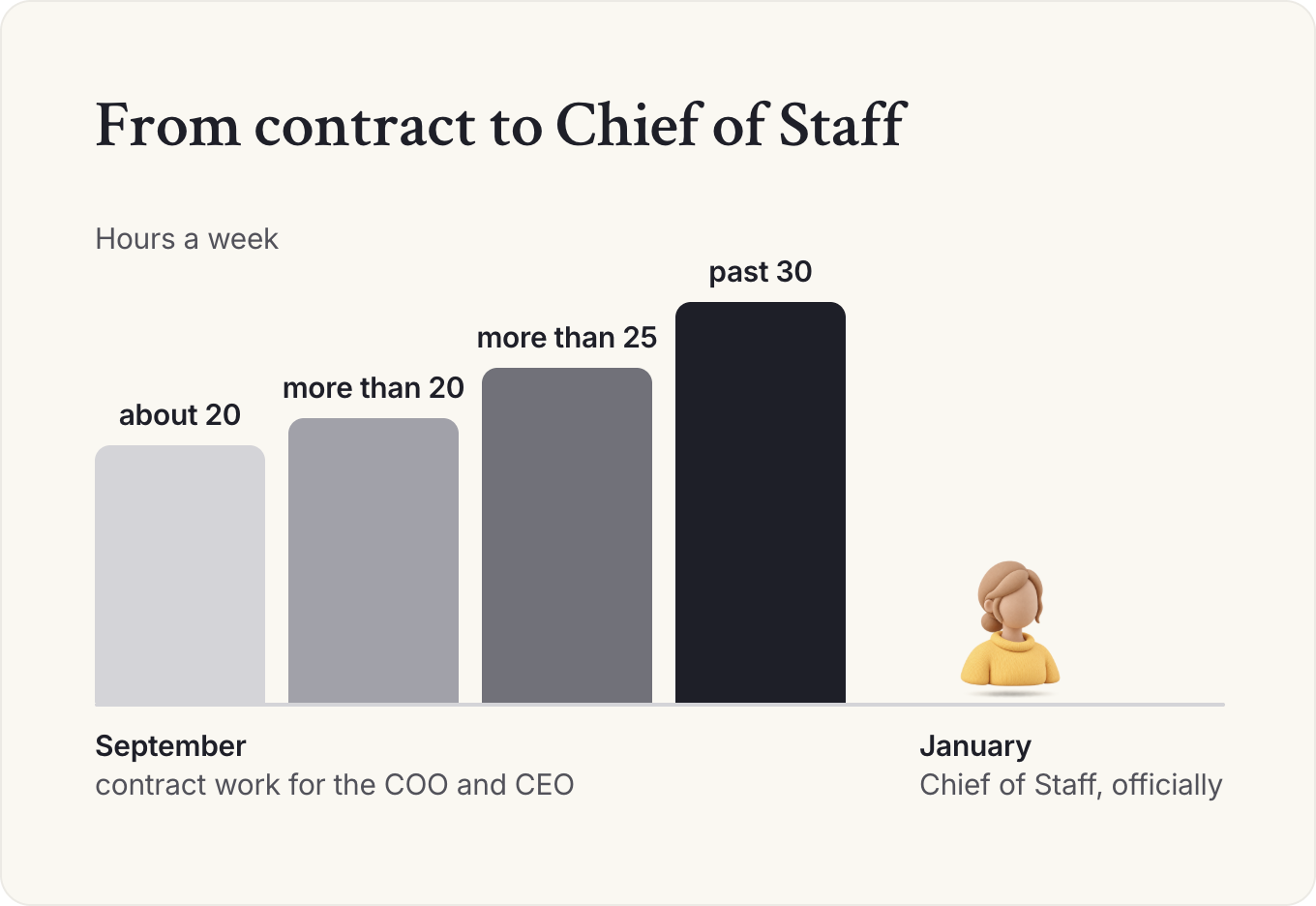
The hours rose three times in a few months, and a fundraise added work that couldn't wait for scheduled days. By then she was doing the full-time job. Only the title was missing. Quieter signals: the fractional Chief of Staff keeps learning about decisions after they're made, or the team waits for their scheduled days to move.
Three ways it can end
- Convert. The person and the company both want it, and the work fills the week. Set the full-time offer from the benchmarks for its level and company size, and leave the fractional rate out of the conversation. Use the Leveling Framework to agree the level from the decision rights.
- Hire someone else full-time. The company needs the role, but the fractional Chief of Staff doesn't want it or isn't the right fit. Their last project is writing the job description and helping run the search.
- Hand off and leave. The rhythm runs, the projects shipped, and the company doesn't need a Chief of Staff yet. Name the internal owner for each process a month before the end date.
If you're the Chief of Staff, decide what you want before the offer arrives. Zoe started out hoping a client would excite her enough to go full-time. A year and a half in, she says that less often, because she's happy learning across many businesses at once. Converting also means other clients need notice, so build a notice period into every contract.
If you're in an engagement now, add up last month's hours against the hours agreed. If you're more than 25% over for two months running, raise scope or conversion before it turns into resentment.
Keep reading
 What does a Chief of Staff do?Basics
 How to write a Chief of Staff mandateExcel in the role
 The Chief of Staff handbookBasics
Role
Take this guide with you
The full guide as a PDF: every section, template and chart, ready to print or share with your team.
Your PDF is ready.
Download the PDFFree. We may email you new guides; unsubscribe anytime.
Frequently asked questions
How many hours a week does a fractional Chief of Staff work?
It depends on the shape of the engagement. Embedded work usually means a fixed block of hours or days each week, project work runs until a deliverable is done, and interim cover can be close to full-time for a set period. The fractional Chiefs of Staff on our podcast described starting points of about 10 to 20 hours a week per client.
How much does a fractional Chief of Staff make?
On our illustration, about $218,000 a year: $175 an hour for 24 hours a week (60% of a 40-hour week), for 52 weeks. That matches the average full-time base plus the benefits and payroll taxes an employer pays. Bonus and equity are not in it. Published rates in November 2026 ran from about $140 to $200 an hour, so the same hours can earn less or more. Each 4 hours a week you don't bill costs about $36,000 a year (4 hours x 52 weeks x $175).
What's the difference between a fractional and an interim Chief of Staff?
An interim Chief of Staff provides cover for a fixed period, usually close to full-time, while a company hires a permanent person or someone is on leave. A fractional Chief of Staff works part time on an ongoing basis, often for several companies. Many fractional Chiefs of Staff also take interim work, which is closer to full-time and has a fixed end date.
What's the difference between a fractional COO and a fractional Chief of Staff?
A fractional COO owns part of the operation and answers for its results, usually with a team and a budget. A fractional Chief of Staff owns how the leader and the leadership team run: priorities, the operating rhythm and projects between teams. Rent a COO to hand off a function, and a Chief of Staff when you're the bottleneck. More in Chief of Staff vs COO.
What is a virtual Chief of Staff?
"Virtual Chief of Staff" usually means a remote, part-time Chief of Staff, so in practice it's the same as a remote fractional Chief of Staff. Some services use the term for executive assistant work with a senior title. Check what the hours go to before you buy or sell it.
Where can I find fractional Chief of Staff jobs?
Most fractional work comes through referrals from people who have seen you work, so start with former principals and colleagues. Some part-time and contract roles are posted on our Chief of Staff job board, and joining the talent network lets companies looking for help find you.
- Chief of Staff Pathways Report, Chief of Staff Network, 2026 (next moves n=1,992; typical routes and the yearly trend from 2,158 moves; 1,819 job postings, with pay from US postings that state it).
- 2025 Chief of Staff Salary Report, Chief of Staff Network, 2025 (n=479).
- The Chief of Staff Podcast: Zoe Jakubowich, Lauren Werner, Cher Murphy, David Moon and Andrew Rea.
- Cost model: our arithmetic from the 2025 average base, with the two assumptions shown in the table.
- Market rates: public pricing from a fractional-talent marketplace and two fractional-executive firms, checked November 2026.
Learn the job with people who do it
Membership gets you the Power Skills program, member events and a private community of working Chiefs of Staff.
Land your first Chief of Staff role
Launchpad helps you prepare, position yourself and interview for the role.
Starting out in the role?
The Fundamentals email course walks you through scoping the mandate, setting the cadence and earning trust.
Lead AI adoption from the Chief of Staff seat
The Chief of AI Fellowship is for operators turning AI into how the company runs.
Hiring a Chief of Staff?
Post the role on the Chief of Staff job board, or browse open roles.
Get your resume ready for the role
Get feedback on your Chief of Staff resume before you apply.
Let the right roles find you
Join the talent network and hear about Chief of Staff roles first.
The Chief of Staff newsletter
What Chiefs of Staff are reading, hiring for and building.
Get the full report
Every chart and cut from our latest salary research, sent to your inbox.
Using AI with sensitive data?
Learn the legal side of using AI at work.
Keep going in this series