

How to become a Chief of Staff
The median Chief of Staff starts with about 11 years of experience, and operations is the top route in, 3x consulting. Steps and routes by background.

Ask AI
 Share

To become a Chief of Staff, build a record of running work across teams, get close to how your leaders make decisions, and earn one principal's trust, usually through people who already know your work. The median Chief of Staff starts after about 11 years of work, and the most common background is operations.
- Find the principal before the job. Principals hire people they, or someone they trust, have watched work, so pick five leaders you'd want to support and find a reason to work with each in the next six months.
- Build one cross-team result you can state in a sentence with a number. It becomes your resume line, your outreach note and your interview answer.
- Close the gap your background is judged on. Consultants need proof they've moved work through people who don't report to them; executive assistants need scope beyond support.
- Pick your route: a promotion, a role you propose, a backfill or an open application. If your leader keeps naming a problem nobody owns, propose the role in one page.
- Early in your career, aim for an associate or founder's associate role at a smaller company, and choose it by the principal you'll learn from.
Many Chief of Staff roles go to someone the principal already knows, or to someone a colleague they trust vouches for. So the work of becoming a Chief of Staff starts a year or more before you apply, with the leaders who will vouch for how you run things. If you already work with leaders who could use a Chief of Staff, start there. Inside, you can be promoted into a role created for you, or propose one.
Your background is probably fine. The largest group of Chiefs of Staff came from operations, followed by sales, marketing and program management. If you're in one of those seats, you're the usual kind of candidate.
How do you become a Chief of Staff, step by step?
In six steps: decide why you want it, build cross-functional proof, get close to the leadership rhythm, find the principal before the job, pick your route, then package yourself and interview like a Chief of Staff.
- Decide why you want it. Most stints last under two years, so want it for the general-management view it gives you. Chief of Staff is a bad fallback role, and principals can tell within one conversation. If you're unsure what the job involves, read what a Chief of Staff does or our Chief of Staff handbook, then write down what you want to be doing three years after the role ends.
- Build cross-functional proof. Volunteer for the project nobody owns: the planning cycle, the reorg, the system migration that touches four teams. Write the outcome in one sentence with a number. That sentence becomes your resume bullet and your interview answer.
- Get close to the leadership rhythm. Offer to run the offsite logistics, draft the quarterly business review or prep the board deck. You learn how decisions get made, and senior people see you do it.
- Find the principal before the job. Make a list of five leaders you'd want to work for, and find a real reason to work with each of them in the next six months.
- Pick your route. There are four that work, covered below. Three of them start with a relationship.
- Package and interview like a Chief of Staff. Rewrite your resume around decisions you shaped and teams you aligned, and bring a one-page view of your first 90 days.
Adaeze Okoli's story shows why step 4 matters more than any application. She came to Rethink Food through a short externship, applied for another role there and never heard back. When the organization started hiring a Chief of Staff, she already knew her future principal. Her pitch was one line, "Hey, I hear you're looking for a chief of staff. Look no further," and it worked because, as she put it, most of the work had been done before she asked.
Why the relationship steps carry the most weight
A principal is about to hand someone their calendar, their board materials and their half-formed opinions about every leader on the team. An interview can test judgment and writing. It can't test whether you'll keep a confidence in month eight, so principals fall back on the one signal that does: they, or someone they trust, have watched you work.
When Aria Finger, Chief of Staff to Reid Hoffman, asks rooms of Chiefs of Staff whether they knew their principal first, she hears "about 50/50". It's an informal poll, but the hiring stories on our podcast match it.
A worked example: twelve months from an operations seat
Here's a composite illustration. Priya is a senior operations manager at a 400-person software company, eight years into her career, aiming for a Chief of Staff role in about a year.
- Month 1. She writes her three-year answer: "Run operations for a company of a few hundred people." That gives her a reason a principal will believe.
- Months 1 to 4. She volunteers to run quarterly planning, which nobody owns. Her proof sentence: "Ran Q3 planning for 9 teams; priorities closed two weeks earlier than Q2, with one owner per goal."
- Months 3 to 6. She drafts the board deck's operating section, so the CFO and CEO see her work every quarter.
- Months 4 to 9. Her five leaders are her CEO, the COO and three founders she met at events. She sends two outreach notes a month. By month 9 she has had a real conversation with all five.
- Months 9 to 12. Her CEO mentions decisions piling up before the next round. Priya proposes the role in writing and applies to two posted roles in parallel.
Stay or go?
Most people should try inside first, because you already hold the trust an outsider would spend months earning. Go outside when your company is under about 30 people with no leadership team yet, when the leaders you'd support are leaving, or when you've asked for cross-team scope twice and been told no.
If you're already a director, treat the move as lateral and pick it for the principal. A director who takes a manager-level role to get in usually spends the first year arguing to be re-leveled.
Which backgrounds lead to a Chief of Staff role?
Operations and strategy is the largest feeder, at 21% of Chiefs of Staff. After that, no single function supplies more than 10%.
Consulting is the background hiring managers think they want: 27% of postings ask for it, against 7% of Chiefs of Staff who came straight from it.
The core skill, running work across teams for a senior leader, can be learned in almost any seat. What differs is the gap you'll be judged on.
Backgrounds that lead to the Chief of Staff role
| Background | Share of Chiefs of Staff | What you bring | Gap to close | First move |
|---|---|---|---|---|
| Operations, BizOps, strategy & ops | 21% | Cadence, planning, cross-team delivery | Exposure to the CEO and board | Own the planning cycle or QBR |
| Sales and customer success | 10% | Commercial sense, customer truth | Structured writing, company-wide view | Run a cross-functional deal review or churn analysis |
| Program or project management | 7% | Timelines, dependencies, follow-through | Strategy and prioritization calls | Run an exec-sponsored initiative end to end |
| Consulting | 7% | Problem framing, analysis, exec-ready decks | Execution and influence without authority | Join a company in an ops or strategy seat first |
| Executive support (EA) | 6% | The principal's trust, discretion, the calendar | Owning outcomes beyond logistics | Take one strategic project off the principal's plate |
| Founder | 5% | Ownership, range, startup pace | Supporting someone else's decisions | Target founder-CEOs who want a partner |
| People / HR | 4% | Org design, hiring, sensitive conversations | Commercial and operating rhythm | Own internal operations alongside people work |
| Finance | 4% | Numbers, planning, board materials | Breadth beyond the model | Own the operating plan as well as the budget |
| Product | 4% | Domain depth, prioritization, cross-team work | Moving beyond one product area | Volunteer for company planning or a launch |
Source: Pathways Report 2026
From consulting
Principals say consultants recommend well and then struggle to make things happen through people who don't report to them. Close that gap with a year or two in an operating seat before you apply. The payoff shows afterwards: former consultants see the biggest step up after the role, at 78%.
From executive support
Executive assistants have the trust most candidates spend months earning, and the step up is large: among US postings that list pay, EA roles advertise a median $95k against $180k for Chief of Staff. The trap is being too good at support to be moved. Cher Murphy, then Chief of Staff at Sydecar, got out through contract work for a COO who'd noticed her. Ask for one strategic project with a clear outcome before you ask for the title, and hand off enough support work that nobody can pull you back. See Chief of Staff vs executive assistant for the full move.
From investing
Investors know how companies are built and often have the network to find unposted roles. Sharlene Guiriba asked her VC friends which portfolio companies they had high conviction in and were hiring, and was introduced to the founders of Coverdash. She still had to win a full interview process with a case study.
From product, finance, people, founding and the public sector
Product managers should show they care about finance, people and sales problems as much as the roadmap. Finance people know the numbers the leadership team argues about. People and HR leaders should add commercial work and the operating rhythm. Founders have to learn to advise while someone else decides. From government or the military, lead with the operating work and keep the rank to one line; Sue Broderick compares the two worlds on our podcast.
Prompt: Map my background to a Chief of Staff role
I want to become a Chief of Staff. Below is my resume and a short note on what I want next.

Using these facts about how people enter the role (from the Chief of Staff Network's Pathways Report):
- The most common prior function is operations and strategy (21%), then sales and customer success (10%), marketing and communications (9%), program management (7%), consulting (7%) and executive support (6%).
- The median Chief of Staff starts with about 11 years of experience; 12% have five years or fewer.
- Hiring executives look for cross-functional delivery, judgment about priorities, clear writing and discretion.

Give me:
1. Which background bucket I fit, and the gap I'm most likely to be judged on
2. My three strongest proof points for a Chief of Staff role, rewritten as one sentence each with a number
3. The two experiences I'm missing, and a realistic project at my current job that would fill each in the next six months
4. Which of the four routes in (internal promotion, proposing the role, a backfill, an open application) suits me best, and why

My resume and note:
[paste here]
How much experience do you need to become a Chief of Staff?
About a decade. The median Chief of Staff starts the role with around 11 years of work experience, and only 12% start with five years or fewer.
Manager is the most common rank going in (27%), followed by director (17%).
About one in three arrive at director level or above: the 17% who were directors, plus 17% who held head-of-function, VP or C-level titles. For them, the role is often a lateral move to work next to the top.
Pay tracks the experience asked for. Among US postings that list pay, roles asking for 1 to 5 years advertise a median of $155k, and roles asking for 11 or more advertise $221k. US Chief of Staff postings with a VP, Director or Head title advertise a $230k median. Our salary guide and Leveling Framework break it down by level.
Starting early
It's possible, and uncommon. People who start with five years or fewer gain the most from the role: 61% stepped up in seniority afterwards, and about one in eight went on to found a company.
Outcomes after the role, by experience at the start
| Experience at start | Stepped up | VP or above next | Executive next | Founded a company |
|---|---|---|---|---|
| 0 to 5 years | 61% | 22% | 6% | 12% |
| 6 to 10 years | 54% | 23% | 9% | 8% |
| 11 to 15 years | 48% | 26% | 10% | 6% |
| 16+ years | 40% | 31% | 14% | 5% |
Source: Pathways Report 2026
Early in a career, the role shows you how a whole company runs, years before you'd see it from inside one team. Later, it's a way into the executive team.
Early roles cluster at smaller companies and pay less. Analyst and Senior Associate Chiefs of Staff don't appear at companies above 10,000 people. US postings tell the same story: companies with 11 to 50 employees advertise a median of $140k, against $215k at 5,001 to 10,000. Some early "Chief of Staff" jobs are EA roles with a bigger title, so read the posting for its real level.
Aim for an associate Chief of Staff or founder's associate role at a smaller company, where a principal will take a bet on range.
Where does the Chief of Staff career path lead?
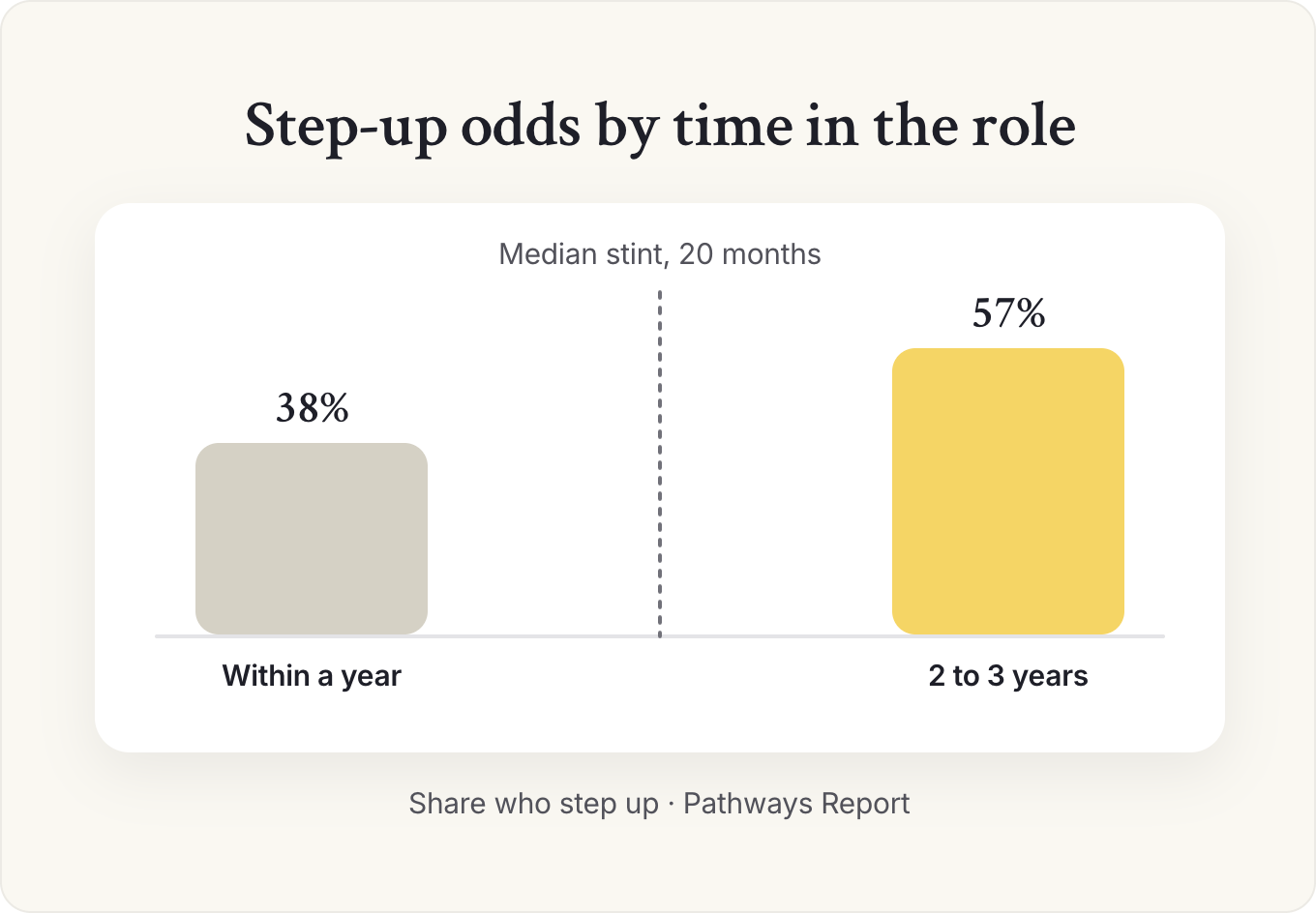
Up, for about half. 53% of Chiefs of Staff hold a more senior title after the role than before it. The most common next moves are into operations and strategy, and into functional leadership such as sales or marketing. People who stay two to three years step up most often (57%).
Bryan Silverman went from an entry-level sales role at Suzy to Chief of Staff there, then COO, and became its CEO in September 2026. He calls the role "the ultimate career accelerant", because it exposed him to every part of the business.
Once you're in, plan for two to three years. Chiefs of Staff who leave within a year are the least likely to step up (38%), and the odds peak at two to three years. The median completed stint is 20 months, so many people leave just before the payoff. On our podcast, Tom Guthrie, our co-founder, and I walk through why two to three years in the seat is the sweet spot.
What qualifications do you need to become a Chief of Staff?
None that are formal: no degree, certificate or license is required. Hiring executives look at what you've done, then for proof of the skills the job needs that they can check.
What counts as proof:
- A result that needed three or more teams to move, in one sentence with a number. "Ran the move to annual contracts across sales, finance and legal; 40% of renewals converted in two quarters."
- A project you stopped or chose not to start, and why.
- A memo or update that made a decision easier. Many interview loops ask for a writing sample.
- A reference who brings up your discretion before anyone asks about it.
None of these is tied to a function. Taraneh Ansari joined OpenSponsorship as its first HR hire, kept absorbing internal operations work, and became Chief of Staff when she and her CEO agreed the title should match the job she was already doing.
This week, write three one-line proof sentences, one each for a cross-team result, a call you made and a piece of writing. If you can't write one, that's the gap to close first.
Do you need an MBA to become a Chief of Staff?
No. Most Chiefs of Staff hold a bachelor's (44%) or master's (41%) degree, and the pay gap between those two groups is modest. Chiefs of Staff with only a high school diploma still averaged about $147,000 in base pay in our 2025 survey.
I treat the MBA as a tie-breaker. It helps most when you're changing industries or resetting after a narrow early career, and it won't make up for never having run anything. A course can teach you the work. What gets you hired is a principal who has seen you do it.
How do you get a Chief of Staff job?
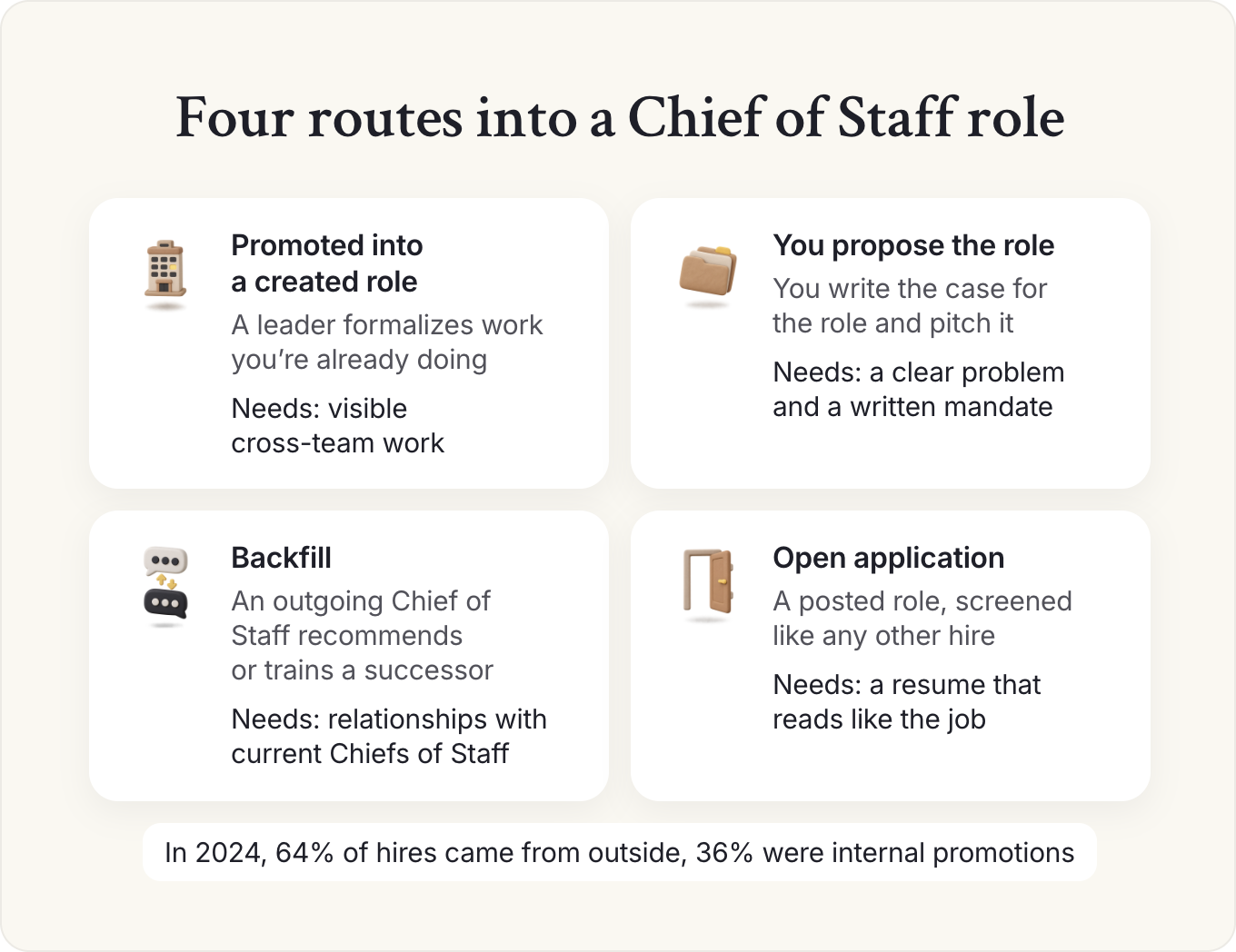
Through one of four routes: a promotion into a role created for you, a role you propose, a backfill when a Chief of Staff moves on, or an open application. Your route decides who you talk to, what you send and whether a resume matters at all.
Four routes into a Chief of Staff role
| Route | How it works | What it takes | Example from our podcast |
|---|---|---|---|
| Promoted into a created role | A leader formalizes work you're already doing | Visible cross-team work and a principal who notices | Taraneh Ansari, HR manager to Chief of Staff at OpenSponsorship |
| You propose the role | You write the case for the role and pitch it | A clear problem the role would fix, a written mandate and nerve | Ryan Kelly, who pitched the role at Veremark, then won it in an open process |
| Backfill | An outgoing Chief of Staff recommends or trains a successor | Relationships with current Chiefs of Staff | Ada Madigan, associate Chief of Staff at Trust & Will, who stepped up when her predecessor moved to head of operations |
| Open application | A posted role, screened like any other hire | A resume that reads like the job, a strong case study | Sharlene Guiriba, introduced by her VC network, hired after a case study at Coverdash |
In 2024, 64% of Chief of Staff hires came from outside the company and 36% were internal promotions. External rarely means cold. For an internal move, raise it with your manager first, then your manager's manager, framed around a problem you want to own. Let the title come later.
Every route needs outreach. Keep it under 150 words, make the first line about them, and send a few every month. Our guide to landing a Chief of Staff role has a template and an example.
Proposing the role
This is the route people underuse most. Pitch it to your CEO when you can name a problem the leader already feels and show why a Chief of Staff fixes it more cheaply than the alternatives. Most leaders feel the problem long before they name the role, and a proposal does the connecting for them. You also write the job description before anyone else sees it.
Ryan Kelly met Veremark's CEO, Daniel, at a vendor event and later quoted him for consulting work on post-merger integration, which Veremark decided to handle internally. Five months later, Ryan emailed: "Hey, I think you need this chief of staff role based on what I learned from the quoting process." Daniel replied that he'd been thinking the same.
His case was specific, as he told our podcast: three founders had scaled to about 300 people and just raised a Series B, and a Chief of Staff would let them keep their structure without adding a COO or CFO layer. Then Veremark's investors asked for a full process. The ad drew about a thousand applicants, Daniel did 34 interviews, and A couple of months later, Ryan won the job he had pitched.
Keep the proposal to one page, written for the principal and readable by their board.
- The problem in the principal's words: two or three signals they've mentioned, such as decisions waiting on them, projects with no owner or a board meeting that eats a week.
- Why now: the stage change behind it, like a funding round, a new leadership team or a merger.
- What the role would own in its first six months, and what it wouldn't. Our guide to the Chief of Staff mandate has a structure you can borrow.
- Why this beats the alternatives: an executive assistant, a COO or doing nothing.
- How the principal would know it worked at six months, in three checkable outcomes.
- Why you, in two sentences, ending with the proof sentence from step 2.
When to pitch, and when not to
Pitch when the leader has mentioned the problem in front of you at least once, and you can describe it without blaming anyone on their team. Hold off during a crisis that needs a functional fix, such as a cash problem, or when the only way to the principal is around your own manager. Going around your manager can win you the role and cost you your first ally in it.
Expect one of three answers. A yes often comes with an open process, as Ryan's did. A "not yet" means the principal agrees with the problem, so ask what would have to be true in six months. A no still leaves a senior leader who has seen how you think, which is step 4 done. At a large company, aim the proposal at a functional leader, where a new role needs fewer approvals.
Backfills and associate roles
Founders and recruiters often ask current Chiefs of Staff who they'd recommend, as David Nebinski, our community lead, points out in his ten tips. Some companies formalize it: Ada Madigan joined Trust & Will as an associate Chief of Staff, got face time with the board and stepped into the full role about a year and a half later.
Posted roles
Posted roles are the most crowded route: Veremark's drew about a thousand applicants, and 400 to 500 new Chief of Staff roles a month appeared in the postings we tracked from June to September 2026. New York and the SF Bay Area had the most, and London was third. So first tell three senior people you trust that you want a Chief of Staff role and what kind of principal you want. Then use the Chief of Staff job board to see titles and pay in your market, and join our talent network so companies hiring through us can find you.
How do you write a Chief of Staff resume?
Write it like the job. A Chief of Staff resume shows decisions you shaped, teams you aligned and outcomes with numbers, with responsibilities cut to a line per role. The reader is a busy executive asking one question: can this person run work across my company without me?
Your success can't be anecdotal, and it has to be quantifiable.
Anna Buckley, former Chief of Staff, Barstool Sports · Listen on the podcast
Anna Buckley, a two-time Chief of Staff at Barstool Sports, documents her wins as they happen and maps each one to the company's strategy, so the case for her next step is already written.
The most common resume mistake is describing support. "Supported the CEO with board meeting preparation" says you were near the work; the rewrites below say you did it.
Template: Resume bullet rewrites for a Chief of Staff role
Resume bullets: before and after
| Before | After |
|---|---|
| Supported the CEO with board meeting preparation. | Ran board prep for 4 quarterly meetings; cut deck turnaround from 2 weeks to 5 days and owned follow-ups on 30+ board actions. |
| Managed cross-functional projects. | Led the move to annual contracts across sales, finance and legal; 40% of renewals converted within 2 quarters. |
| Responsible for OKRs. | Designed and ran the quarterly OKR process for 6 teams (120 people); leadership reviews moved from ad hoc to a fixed monthly cadence. |
| Coordinated the company offsite. | Designed the annual leadership offsite agenda; left with 5 company priorities, named owners and a decision log the CEO still uses. |
| Executive assistant to the CEO. | Executive assistant to the CEO; also owned hiring operations for 3 leadership roles, from scorecard to offer. |
| Worked closely with the leadership team. | Ran the weekly leadership meeting for 8 executives; sent decisions and owners within two hours, and cut open action items by half in a quarter. |
# Resume bullets: before and after

| Before | After |
| --- | --- |
| Supported the CEO with board meeting preparation. | Ran board prep for 4 quarterly meetings; cut deck turnaround from 2 weeks to 5 days and owned follow-ups on 30+ board actions. |
| Managed cross-functional projects. | Led the move to annual contracts across sales, finance and legal; 40% of renewals converted within 2 quarters. |
| Responsible for OKRs. | Designed and ran the quarterly OKR process for 6 teams (120 people); leadership reviews moved from ad hoc to a fixed monthly cadence. |
| Coordinated the company offsite. | Designed the annual leadership offsite agenda; left with 5 company priorities, named owners and a decision log the CEO still uses. |
| Executive assistant to the CEO. | Executive assistant to the CEO; also owned hiring operations for 3 leadership roles, from scorecard to offer. |
| Worked closely with the leadership team. | Ran the weekly leadership meeting for 8 executives; sent decisions and owners within two hours, and cut open action items by half in a quarter. |
The numbers above are illustrations. If you don't have a number, use scale: how many teams, how many people, how much money. One in four Chief of Staff postings ask for AI skills, so put one result from your own AI use on your resume.
See our Chief of Staff resume examples for more, and our cover letter examples when a role asks for one. The same rewrites work on a UK or European CV.
Rewriting your resume for a Chief of Staff role? Have it reviewed by someone who reads Chief of Staff resumes every week, before a principal sees it.
Get a reviewWhat do Chief of Staff interviews test?
Whether you can think like the principal and get things done without authority. Expect a prioritization exercise, a writing test or case study, and a long conversation with the principal about how you'd work together. That conversation decides the hire, and it runs both ways.
The first conversation tests why you want this role now and whether you'll tell them the truth. The case study tests how you think with partial information. A leadership team round tests whether the people you'd align will take your call, and references test discretion. Our 33 Chief of Staff interview questions with sample answers cover each stage.
The question behind every question
Almost every interview circles back to influence without authority. When Ryan Kelly interviewed at Veremark, the head of talent at the private equity investor called it a "beg, borrow, and steal type role" with no team reporting in, and asked how he'd manage that. He had examples ready.
Have two stories ready, each under two minutes. In one, you moved work through a team that didn't report to you, and you can name who resisted and what you traded. In the other, you told a senior person something unwelcome, and you can say what they did next. If your examples all end with "and the leadership team aligned", find the moment someone said no.
Working the case study
Sharlene Guiriba did a case study for Coverdash despite the warm introduction, and used the readout to test whether she could be honest with her opinions and be heard. She wanted "rigorous discourse" and leaders who wouldn't need a yes person. A case readout is the closest you'll get to a week-three meeting before you sign.
Ask one or two clarifying questions before you start, and say which assumptions you made. Recommend something, because a balanced list of options reads as consulting. If the case would take more than an evening, ask whether a shorter version works, and end the readout with what you'd do first on Monday.
Interview the principal back
Ask what they'll stop doing once you start. If they can't answer, your first job will be designing the role. Ask who on the leadership team was most skeptical about hiring a Chief of Staff, and what the next twelve months look like on funding and headcount, because your role grows or shrinks with them.
The best thing you can bring to a final round is a one-page draft of your first 90 days. It turns the interview into a working session. Say it's a draft, because you don't know enough yet to be right.
Template: 90-day plan for a Chief of Staff final interview
My first 90 days as your Chief of Staff (draft for discussion)
What I heard: [2 to 3 sentences on the problems the principal described: decisions waiting on them, projects without owners, a rhythm that isn't working]
Days 1 to 30: Listen and map
- 1:1s with every member of the leadership team and five people one level down
- Map the operating rhythm as it runs today: each meeting, owner, inputs, decisions, follow-ups
- List the cross-team projects that have no clear owner
- From week 2, send you a weekly update the day before our 1:1: decisions I need, what moved, what's coming, one 1:1 topic
- Agree a one-page mandate with you by week 4: what I decide, what I recommend, what I don't own
Days 31 to 60: Fix one thing in the rhythm
- [One specific fix, e.g. a leadership meeting agenda with a decision log and owners sent within two hours]
- Take on one cross-functional project: [the one they mentioned], with a handoff date
Days 61 to 90: Prove it and hand off
- [Measurable outcome 1, e.g. leadership meeting decisions tracked to closure]
- [Measurable outcome 2, e.g. the project from month two handed to an owner]
- 90-day review with you: what to keep, what to change, what I should own next
What I'd need from you: access to [calendar, board materials, planning docs], 30 minutes a week, and an introduction of the role to the leadership team in week one.
# My first 90 days as your Chief of Staff (draft for discussion)

**What I heard:** [2 to 3 sentences on the problems the principal described: decisions waiting on them, projects without owners, a rhythm that isn't working]

## Days 1 to 30: Listen and map
- 1:1s with every member of the leadership team and five people one level down
- Map the operating rhythm as it runs today: each meeting, owner, inputs, decisions, follow-ups
- List the cross-team projects that have no clear owner
- From week 2, send you a weekly update the day before our 1:1: decisions I need, what moved, what's coming, one 1:1 topic
- Agree a one-page mandate with you by week 4: what I decide, what I recommend, what I don't own

## Days 31 to 60: Fix one thing in the rhythm
- [One specific fix, e.g. a leadership meeting agenda with a decision log and owners sent within two hours]
- Take on one cross-functional project: [the one they mentioned], with a handoff date

## Days 61 to 90: Prove it and hand off
- [Measurable outcome 1, e.g. leadership meeting decisions tracked to closure]
- [Measurable outcome 2, e.g. the project from month two handed to an owner]
- 90-day review with you: what to keep, what to change, what I should own next

**What I'd need from you:** access to [calendar, board materials, planning docs], 30 minutes a week, and an introduction of the role to the leadership team in week one.
Example: 90-day draft for a final interview with a Series B CEO, 120 people (illustration)
My first 90 days as your Chief of Staff (draft for discussion)
What I heard: hiring and pricing decisions wait about a week for you, the enterprise launch has no single owner, and the Tuesday meeting is mostly status updates.
Days 1 to 30: Listen and map
- 1:1s with your seven direct reports and five people one level down
- Map the Tuesday meeting, the monthly metrics review and the board cycle as they run today
- Weekly update to you from week 2, the day before our 1:1
- One-page mandate agreed with you by week 4
Days 31 to 60: Fix one thing in the rhythm
- Tuesday meeting: decisions first, status in a pre-read, decision log sent within two hours
- Take on the enterprise launch, with a handoff to the VP of Sales by day 75
Days 61 to 90: Prove it and hand off
- Fewer than 1 in 10 Tuesday decisions reopened within 30 days
- Enterprise launch live and handed to the VP of Sales
- 90-day review with you: what to keep, what to change, what I should own next
What I'd need from you: access to your calendar, the board materials and the FY plan, 30 minutes a week, and an introduction of the role at the Tuesday meeting in week one.
# My first 90 days as your Chief of Staff (draft for discussion)

**What I heard:** hiring and pricing decisions wait about a week for you, the enterprise launch has no single owner, and the Tuesday meeting is mostly status updates.

## Days 1 to 30: Listen and map
- 1:1s with your seven direct reports and five people one level down
- Map the Tuesday meeting, the monthly metrics review and the board cycle as they run today
- Weekly update to you from week 2, the day before our 1:1
- One-page mandate agreed with you by week 4

## Days 31 to 60: Fix one thing in the rhythm
- Tuesday meeting: decisions first, status in a pre-read, decision log sent within two hours
- Take on the enterprise launch, with a handoff to the VP of Sales by day 75

## Days 61 to 90: Prove it and hand off
- Fewer than 1 in 10 Tuesday decisions reopened within 30 days
- Enterprise launch live and handed to the VP of Sales
- 90-day review with you: what to keep, what to change, what I should own next

**What I'd need from you:** access to your calendar, the board materials and the FY plan, 30 minutes a week, and an introduction of the role at the Tuesday meeting in week one.
Once you have the job, our guide to your first 90 days turns this draft into the plan you'll run.
Keep reading
 Chief of Staff job description (template and examples)Hiring
 Chief of Staff salary (2026): pay by level, company size and cityBasics
 Chief of Staff skills: what the job demands at every levelBasics
Basics
- The Chief of Staff handbook
- What does a Chief of Staff do?
- Chief of Staff vs COO: what's the difference?
- Chief of Staff vs executive assistant: what's the difference?
- A day in the life of a Chief of Staff
- Chief of Staff skills: what the job demands at every level
- Chief of Staff salary (2026): pay by level, company size and city
- How to become a Chief of Staff
Take this guide with you
The full guide as a PDF: every section, template and chart, ready to print or share with your team.
Your PDF is ready.
Download the PDFFree. We may email you new guides; unsubscribe anytime.
Frequently asked questions
How do you become a Chief of Staff in the UK or Europe?
The same routes and proof work there. London is the third-largest market for Chief of Staff postings in our data, after New York and the SF Bay Area. In our 2025 survey, London Chiefs of Staff averaged about $161,000 in base pay, Berlin $128,000 and Paris $100,000, all in US dollars. Few people answered from each city, so treat these as rough; our salary guide compares cities.
Is consulting the best path to Chief of Staff?
It's a good path, and a smaller one than most people assume. 27% of postings ask for consulting experience, but only 7% of Chiefs of Staff came straight from consulting. Operations is three times more common. Consultants do gain the most from the role afterwards, so it's worth it if you can show you've made things happen through people who don't report to you.
Can an executive assistant become a Chief of Staff?
Yes. Executive support makes up 6% of Chiefs of Staff in our Pathways data. Ask for one strategic project with a clear outcome before asking for the title, and hand off enough support work that nobody pulls you back. Principals give the title once they've seen you do the work.
Can you create your own Chief of Staff role?
Yes. Find a leader with a clear need, such as decisions waiting on them or projects nobody owns, and write one page on what the role would own in its first six months and how they'd know it worked. Some companies will still run an open process after you pitch. That's fine: you defined the job, which puts you ahead.
- 2026 Chief of Staff Pathways Report, Chief of Staff Network. 2,869 career histories, 1,992 moves out of the role and 1,819 job postings.
- 2025 Chief of Staff Salary Report, Chief of Staff Network. 479 respondents.
- The State of Chief of Staff Jobs, Chief of Staff Network, 2024.
- The Chief of Staff Podcast: Adaeze Okoli, Aria Finger, Cher Murphy, Sharlene Guiriba, Sue Broderick, Tom Guthrie, Bryan Silverman, Taraneh Ansari, Ryan Kelly, David Nebinski, Ada Madigan and Anna Buckley.
Learn the job with people who do it
Membership gets you the Power Skills program, member events and a private community of working Chiefs of Staff.
Land your first Chief of Staff role
Launchpad helps you prepare, position yourself and interview for the role.
Starting out in the role?
The Fundamentals email course walks you through scoping the mandate, setting the cadence and earning trust.
Lead AI adoption from the Chief of Staff seat
The Chief of AI Fellowship is for operators turning AI into how the company runs.
Hiring a Chief of Staff?
Post the role on the Chief of Staff job board, or browse open roles.
Get your resume ready for the role
Get feedback on your Chief of Staff resume before you apply.
Let the right roles find you
Join the talent network and hear about Chief of Staff roles first.
The Chief of Staff newsletter
What Chiefs of Staff are reading, hiring for and building.
Get the full report
Every chart and cut from our latest salary research, sent to your inbox.
Using AI with sensitive data?
Learn the legal side of using AI at work.
Keep going in this series