

How to manage up as a Chief of Staff
What to agree with your principal before your first disagreement, how to push back once, and how to back the call. With a template for managing up.


Ask AI
 Share
To manage up as a Chief of Staff, agree with your principal how you'll handle disagreement, bad news and feedback before the first hard conversation. Push back one time, in private, before a decision is public. When it's made, back it. Managing up means working with the person you report to so their decisions are better because of you.
- Book one conversation this month on how you'll handle the hard moments, write down your principal's answers, and check them each quarter and whenever their job changes.
- Pick your fights by what a decision costs to undo. Raise a hire, a price change or a public commitment the same day, bring a reversible call to the Monday 1:1, and let matters of taste go.
- When your principal decides against you, agree one revisit trigger, a date or a number, and back the decision with the team until it fires.
- Give feedback on one moment you saw yourself, within a day or two, and say what it did to the room. When a leader asks you to carry a complaint, ask them to raise it first, and carry it with no name unless they agree to one.
- If a decision crosses an ethical line for you, tell your principal first, once, and say plainly that it's a line you won't cross.
Most advice on managing up is written for people who report on their own work. A Chief of Staff also hears what other leaders won't say to the principal, and then has to back whatever the principal decides, in front of those same leaders.
If you're the executive, our guide for executives covers your side.
What does managing up mean for a Chief of Staff?
Managing up means working with the person you report to so their decisions are better because of you. It also means getting what you need from them to do your job, and often telling them what they'd rather not hear. It's the day-to-day part of the wider partnership with your principal.
If you're not a Chief of Staff, the moves below work with any manager. Read "principal" as your manager. With leaders who don't manage you, you need influence without authority instead. In the Chief of Staff seat, the person you report to is your principal, the executive whose priorities you carry. How much say you have in their decisions depends on your level in our Leveling Framework.
Managing up at each level of the Leveling Framework
| Level | Part in strategic decisions | What managing up asks of you (our read) |
|---|---|---|
| 1 and 2. Analyst / Associate, Senior Associate / Junior Manager | Not involved at Level 1; implements them at Level 2 | Ask what good looks like before you start, and flag a slipping date the day you see it |
| 3 and 4. Manager / Senior Manager, Director | Gives meaningful input | Bring a recommendation before the decision, with what it costs and what would change your mind |
| 5 and 6. Vice President, CXO / Executive | A key influencer | Shape decisions before they're made, tell your principal how they land with people, and make calls in their name within the limits you've agreed |
Your level also sets when to give your view. At Levels 1 and 2 you mostly meet a decision after it's made, so you raise problems with how it's carried out. From Level 3, your view belongs before the decision.
What should you agree with your principal before you first disagree?
Agree how they want to hear disagreement, bad news and feedback about themselves, and what happens after they decide against you. Have the conversation in a calm week: the first hard conversation is the worst time to learn how your principal takes one.
KJ (Kartikeya Jaiswal), who joined Bifrost AI as its Chief of Staff and went on to lead strategy and operations, suggests asking your founders directly: "Listen, if I ever disagree with you, what's the best way for me to do it?" He told our podcast that the question gives you room to disagree and keep the relationship. His own hiring covered it on purpose: across eight interview rounds, he and the CEO talked through how they'd disagree, and how they'd decide if they simply couldn't agree. If you're interviewing, raise it yourself.
Your user manual from your first week says how you each give and want feedback day to day. This conversation covers the harder cases: disagreement, bad news, feedback on your principal's own behavior, and what happens after you lose. The calls you make on your own belong in your mandate.
For this conversation, talk it through before you send a page. Then write up the answers yourself and send them back to check. I'd have it in your first month, once you've watched your principal make a few decisions.
Template: How we'll handle the hard moments
How we'll handle the hard moments: [principal] and [me]
Agreed: [date] · Next check: [date, one quarter out]
Disagreeing
| Question | Their answer | What it settles |
|---|---|---|
| When I disagree with you, how do you want to hear it? | [answer] | Live or written; one-to-one or with others there |
| Where, if anywhere, do you want me to disagree in the room? | [answer] | The meetings where open debate helps |
| How will I know a decision is final? | [answer] | When I stop arguing and start backing it |
Bad news
| Question | Their answer | What it settles |
|---|---|---|
| What should I interrupt you for, at any hour? | [answer] | The short list that justifies a call |
| What can wait for Friday's update? | [answer] | Everything else |
Feedback on you
| Question | Their answer | What it settles |
|---|---|---|
| Can I tell you how something you did landed with people? | [answer] | Permission, given once, in advance |
| When and where do you want to hear it? | [answer] | The slot, so it never comes as an ambush |
When someone goes around me
| Question | Their answer | What it settles |
|---|---|---|
| If a leader comes to you about something I've handled, what will you say? | [answer] | Whether leaders learn to come to me first |
After you decide against me
| Question | Their answer | What it settles |
|---|---|---|
| If I still see a risk, how do I raise it again? | [answer] | A revisit trigger, agreed when you decide |
| What should I do if I can't support a decision? | [answer] | Who hears it first, and how |
# How we'll handle the hard moments: [principal] and [me]

Agreed: [date] · Next check: [date, one quarter out]

## Disagreeing
| Question | Their answer | What it settles |
| --- | --- | --- |
| When I disagree with you, how do you want to hear it? | [answer] | Live or written; one-to-one or with others there |
| Where, if anywhere, do you want me to disagree in the room? | [answer] | The meetings where open debate helps |
| How will I know a decision is final? | [answer] | When I stop arguing and start backing it |

## Bad news
| Question | Their answer | What it settles |
| --- | --- | --- |
| What should I interrupt you for, at any hour? | [answer] | The short list that justifies a call |
| What can wait for Friday's update? | [answer] | Everything else |

## Feedback on you
| Question | Their answer | What it settles |
| --- | --- | --- |
| Can I tell you how something you did landed with people? | [answer] | Permission, given once, in advance |
| When and where do you want to hear it? | [answer] | The slot, so it never comes as an ambush |

## When someone goes around me
| Question | Their answer | What it settles |
| --- | --- | --- |
| If a leader comes to you about something I've handled, what will you say? | [answer] | Whether leaders learn to come to me first |

## After you decide against me
| Question | Their answer | What it settles |
| --- | --- | --- |
| If I still see a risk, how do I raise it again? | [answer] | A revisit trigger, agreed when you decide |
| What should I do if I can't support a decision? | [answer] | Who hears it first, and how |
Example: Chief of Staff to the CEO of a 180-person software company (illustration)
How we'll handle the hard moments: Elena Park (CEO) and Marcus Lee
Agreed: February 3 · Next check: May 5
Disagreeing
| Question | Their answer | What it settles |
|---|---|---|
| When I disagree with you, how do you want to hear it? | "Live. A call or the Monday 1:1. Never a long Slack." | Live, one-to-one |
| Where, if anywhere, do you want me to disagree in the room? | "At the planning offsite, push hard. In the Tuesday leadership meeting, come to me after, unless we're about to commit on wrong numbers." | Offsite yes; leadership meeting only on a factual error |
| How will I know a decision is final? | "When I say decided and it's in the decision log." | The log entry ends the debate |
Bad news
| Question | Their answer | What it settles |
|---|---|---|
| What should I interrupt you for, at any hour? | "A top-ten customer at risk, a leader resigning, anything legal or in the press." | Four cases, by phone |
| What can wait for Friday's update? | "The rest." | Friday |
Feedback on you
| Question | Their answer | What it settles |
|---|---|---|
| Can I tell you how something you did landed with people? | "Yes, always." | Standing permission |
| When and where do you want to hear it? | "The same day, just us, one thing at a time." | Same day, in private |
When someone goes around me
| Question | Their answer | What it settles |
|---|---|---|
| If a leader comes to you about something I've handled, what will you say? | "What did Marcus say?" | Leaders come to Marcus first |
After you decide against me
| Question | Their answer | What it settles |
|---|---|---|
| If I still see a risk, how do I raise it again? | "Name the trigger when I decide. If it happens, bring it to the next 1:1." | Trigger agreed at the time |
| What should I do if I can't support a decision? | "Tell me before you tell anyone else." | Elena hears it first |
# How we'll handle the hard moments: Elena Park (CEO) and Marcus Lee

Agreed: February 3 · Next check: May 5

## Disagreeing
| Question | Their answer | What it settles |
| --- | --- | --- |
| When I disagree with you, how do you want to hear it? | "Live. A call or the Monday 1:1. Never a long Slack." | Live, one-to-one |
| Where, if anywhere, do you want me to disagree in the room? | "At the planning offsite, push hard. In the Tuesday leadership meeting, come to me after, unless we're about to commit on wrong numbers." | Offsite yes; leadership meeting only on a factual error |
| How will I know a decision is final? | "When I say decided and it's in the decision log." | The log entry ends the debate |

## Bad news
| Question | Their answer | What it settles |
| --- | --- | --- |
| What should I interrupt you for, at any hour? | "A top-ten customer at risk, a leader resigning, anything legal or in the press." | Four cases, by phone |
| What can wait for Friday's update? | "The rest." | Friday |

## Feedback on you
| Question | Their answer | What it settles |
| --- | --- | --- |
| Can I tell you how something you did landed with people? | "Yes, always." | Standing permission |
| When and where do you want to hear it? | "The same day, just us, one thing at a time." | Same day, in private |

## When someone goes around me
| Question | Their answer | What it settles |
| --- | --- | --- |
| If a leader comes to you about something I've handled, what will you say? | "What did Marcus say?" | Leaders come to Marcus first |

## After you decide against me
| Question | Their answer | What it settles |
| --- | --- | --- |
| If I still see a risk, how do I raise it again? | "Name the trigger when I decide. If it happens, bring it to the next 1:1." | Trigger agreed at the time |
| What should I do if I can't support a decision? | "Tell me before you tell anyone else." | Elena hears it first |
Two answers in the example do most of the work later. Elena's rule for a final decision tells Marcus when to stop arguing. The revisit trigger gives him a way back to the decision that doesn't reopen it with the team.
For bad news, the interrupt list decides how you deliver it. If the news is on the list, call the same day and open with what you're already doing about it: "The Acme renewal slipped to March. I've booked their CFO for Thursday, and I need one call from you on price." Everything else goes in Friday's update, in the same order: what happened, what you've done, what you need from your principal.
Check the answers each quarter, and again when your principal's job changes. KJ says it's a conversation that always needs a refresh, whether you're already in the role or still interviewing.
How do you push back on your principal?
From Level 3, push back once, in private, before the decision is public. Say what you'd do instead, what their option costs, and what would change your mind, then stop. A second push needs a new fact.
In the leadership meeting, the room reads your view as the principal's, so raise it one-to-one first. Timing depends on what the decision costs to undo.
When to raise a disagreement
| The decision | When to raise it | How |
|---|---|---|
| Hard to undo: a hire, a price change, a public commitment | The same day, before anyone announces it | Ask for ten minutes and say it live |
| Easy to undo: a pilot, a meeting format, an internal date | At the Monday 1:1 | Bring a recommendation and a date to look again |
| Taste: the look of a deck, the wording of a note | Only if the team will notice | Mention it once, then drop it |
| Ethics or safety | At once | Say it's a line for you, live, then confirm it in writing |
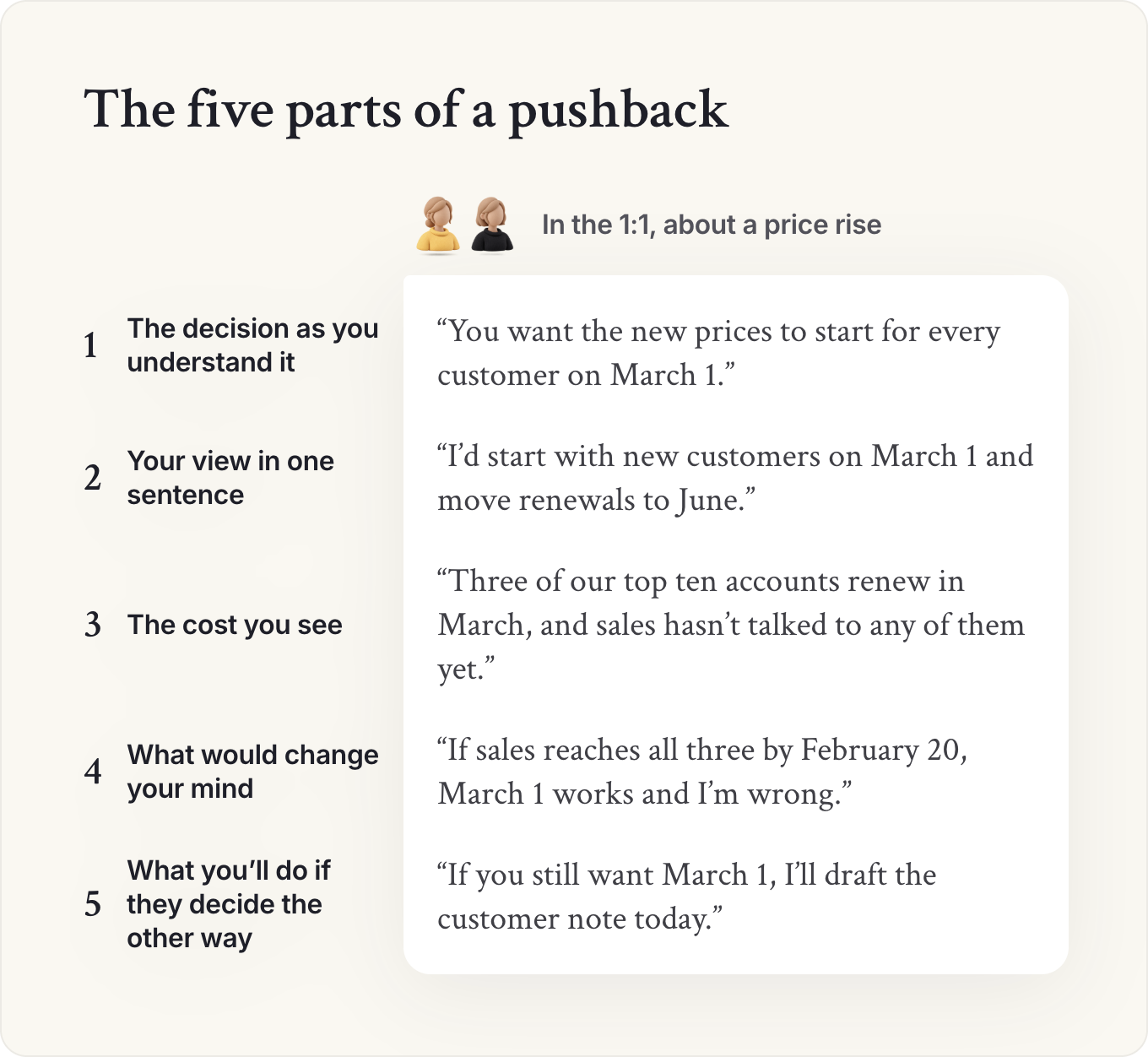
A pushback that works has five parts, in this order: the decision as you understand it, your view in one sentence, the cost you see, what would change your mind, and what you'll do if they decide the other way. Here is one about a price rise (illustration):
- "You want the new prices to start for every customer on March 1."
- "I'd start with new customers on March 1 and move renewals to June."
- "Three of our top ten accounts renew in March, and sales hasn't talked to any of them yet."
- "If sales reaches all three by February 20, March 1 works and I'm wrong."
- "If you still want March 1, I'll draft the customer note today."
The last line tells your principal you'll back the decision either way, so the argument stays about the prices. The fourth names the test that would settle it, so either of you can change your mind without backing down in front of the other. If your principal takes your view, tell the leader who owned the March 1 plan before it's announced.
Bring the view from the ground, which a principal hears least. Asked how he handles knowing about a layoff before it's announced, Zen Foo, Chief of Staff at Aspire, said he has pushed back with "Look, I don't think what you're doing here is the right thing to do," followed by his reasons and a question: "These are how people on the ground are going to be affected. Have you thought about that?"
Check your standing on the subject before you push. Kendall Wallace, who designed corporate offsites, led a member workshop on managing up for us in 2023. She has people pick where their standing comes from: the relationship, their knowledge of the plan and the reasons behind it, or their own expertise. Then she has them ask whether the principal respects them on this topic. If you're pushing back from a weaker place, she says, being honest about that makes you more effective. So name the gap and what you bring. For example: "I haven't run pricing before, but I've talked to all three accounts."
If you're a chief of staff or in a related position, I think it is your responsibility to try to speak directly, especially when no one else does.
KJ (Kartikeya Jaiswal), then Head of Strategy and Operations, Bifrost AI · Listen on the podcast
What do you do when your principal decides against you?
Back it in public as a decision you share, and don't reopen it with the team. If you still see the risk, agree one revisit trigger: a date or a number that would bring the decision back.
Say your principal keeps March 1. The trigger might be: "If sales hasn't reached all three accounts by February 20, we look again at moving their renewals to June." Write it in the "Revisit if" column of the decision log, so reopening the decision needs the trigger and not anyone's memory. I'd set it in the same conversation, while everyone still remembers why the date was chosen. If you didn't, agree it at the next 1:1, once.
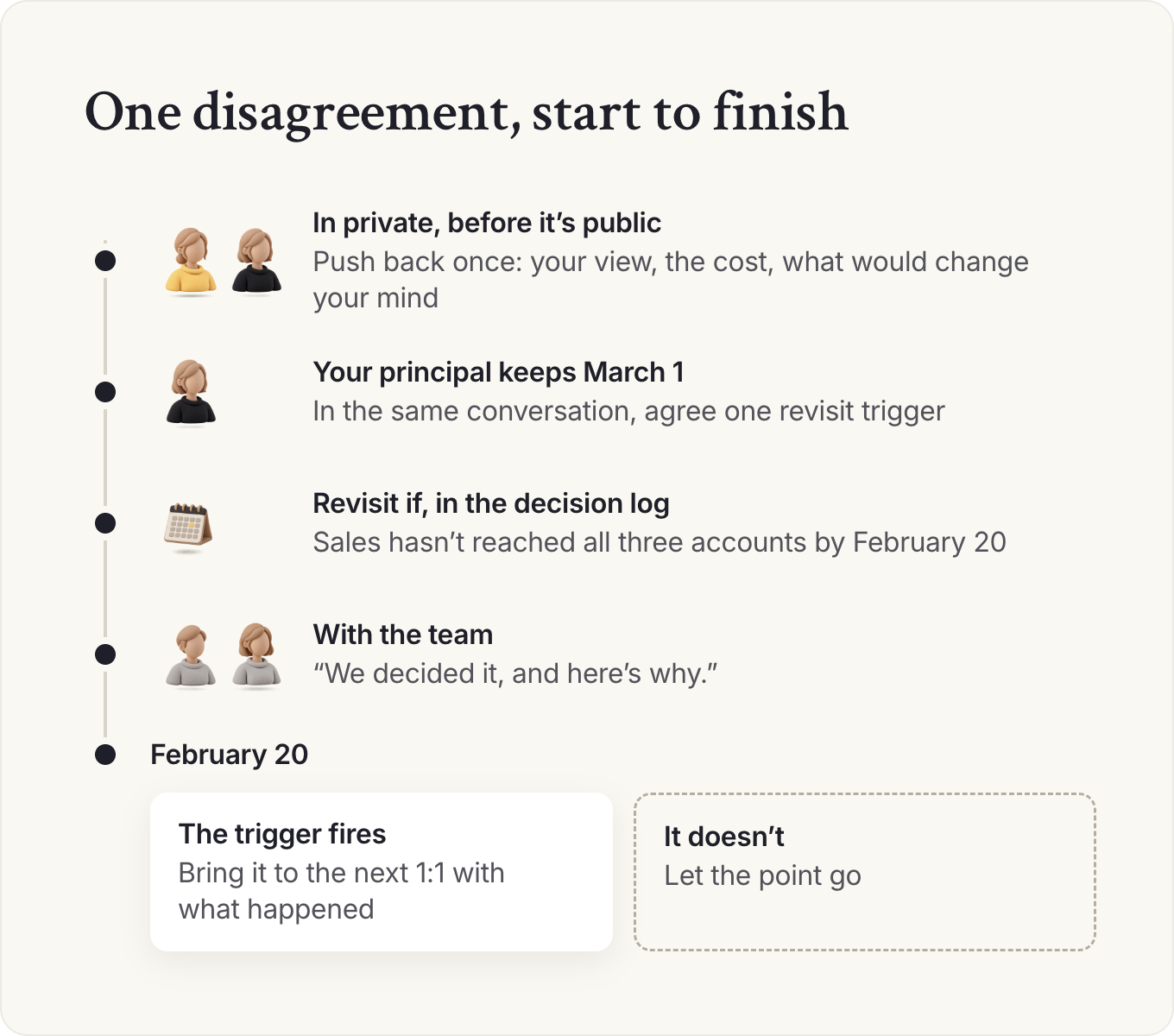
If the trigger fires, bring it to the next 1:1 with what happened. If it doesn't, let the point go. When a leader asks whether you agreed, say "We decided it, and here's why." Telling them you argued the other side spends your credibility as your principal's voice.
Keep a private note of the recommendations your principal overrules, and look for the pattern by topic. The weekly update guide has you bring that pattern to a 1:1.
Zen Foo also said he won't go behind his principal's back. He tells his principal that the final call is theirs, and that he still doesn't agree. He also said you can put the company ahead of your principal in some situations and keep their trust, depending on the situation and how upfront you are with them.
The one exception to backing a decision is one you think is wrong on ethical grounds. If you reach that point, I'd tell your principal first, once, that this is a line you won't cross.
Pushing back on your principal, then backing the decision? Membership includes Power Skills, our program on influence, communication and judgment, and a private community of working Chiefs of Staff to practice with.
See membershipHow do you give your principal feedback?
Ask first, then describe one moment you saw and what it did, within a day or two and in private. Feedback on how your principal lands with people is part of managing up, because few people close to them will give it. KJ says founders often hear hard truths only from a well-wisher, such as an early angel investor, because employees and prospects tend to soften what they say.
Describe what happened in terms anyone in the room would agree on, then what it did. Compare two versions (illustration):
- Weak: "You were a bit harsh in the leadership meeting."
- Strong: "On Tuesday you answered Priya's pricing question before she'd finished. She didn't speak again, and neither did the two leaders after her. Can we talk about it?"
The strong version names a moment your principal can check against their own memory. The weak one is a judgment they can only accept or reject. I'd keep it to one moment per conversation, at the time and place you agreed. If your principal gets defensive, stop after the one example and come back to it at the next 1:1.
Leaders will also ask you to carry their complaints up. Ask first whether they've said it to the principal themselves, and offer to help them say it. If they won't, agree whether it goes up with their name or without it. Without a name, carry it only as a pattern, and keep out anything told to you in confidence. The briefing guide has the rule for what your principal hears with a name and without one. If a leader starts to treat you as your principal's spy, the stakeholder map guide covers what to agree with them.
How do you manage up when priorities keep changing?
Put the new idea next to the plan you both agreed, and ask what drops to make room. For a new idea, the plan is usually your strongest ground, because your principal agreed to it. Kendall Wallace built her workshop around this problem: a boss's new idea that pulls the team off goals set weeks earlier.
One line in the 1:1 or the Friday update does it: "The partner program would take the two people on onboarding. Do we pause onboarding until June, or start the partner program in Q3?" Your principal answers with a choice, and the team hears about one change.
What if managing up isn't working?
If you keep bringing the same issue with new facts and nothing moves, you'll see these signs:
- You hear about decisions after the team does.
- Your principal reverses you in front of the leadership team.
- You've stopped raising things because it doesn't help.
Name the pattern once, at your next review, with one question: "What would you need from me to bring me in earlier?" Before that conversation, write down what you want from the role, separate from what the company needs. Tristan Lim, one of our Fellows, makes that case in his post.
If nothing changes after the review, plan the next move with the career path guide.
This week, put the hard-moments conversation on the agenda of your next 1:1, and bring the template.
Take this guide with you
The full guide as a PDF: every section, template and chart, ready to print or share with your team.
Your PDF is ready.
Download the PDFFree. We may email you new guides; unsubscribe anytime.
Frequently asked questions
What's the difference between managing up and sucking up?
Sucking up means agreeing with your principal to please them. Managing up gives them what they need to decide well, including the views they won't like, at a time and in a way they can act on. One test: look back at last month's decisions and find one where you had a different view. If you kept it to yourself, ask why.
What is an example of managing up?
Your manager (your principal, if you're a Chief of Staff) has said yes to nine customer calls this week, and the hiring plan is due Friday. Managing up is saying so with a fix: "You have nine customer calls and the hiring plan is due Friday. I'd move four calls to next week and block Thursday morning for the plan. OK?" (illustration). They can answer in one word.
What do you do when your principal won't make a decision?
Ask what they need to decide it, agree a date, and put the choice on that week's 1:1 agenda. If it's a call you're confident they'd approve, turn it into a default instead: "Unless you object by Thursday, the board deck keeps last quarter's format." A default needs only an objection, so it moves even in a busy week.
Should you manage up for your own career?
Yes. Tell your principal early what you want the role to lead to. In our career data, 61% of next moves at the same company are a step up, against 48% of moves to another company. If you want that inside move, your principal is the first person to tell.
- Chief of Staff Pathways Report 2026, Chief of Staff Network. 2,869 member career histories; step-up shares from 1,222 moves with rank stated before and after.
- Leveling Framework, Chief of Staff Network.
- The Chief of Staff Podcast: KJ (Kartikeya Jaiswal), Zen Foo.
- Chief of Staff Network member sessions (recordings not linked): "How To Manage Up with Kendall Wallace", 2023; "Relationship Building with your Principal", CoS Summit 2022.
- The third column of the levels table is our read. The timing table, the five-part pushback and the template are our recommendations. The examples are illustrations.
- Podcast quotes are lightly edited for clarity.
Learn the job with people who do it
Membership gets you the Power Skills program, member events and a private community of working Chiefs of Staff.
Land your first Chief of Staff role
Launchpad helps you prepare, position yourself and interview for the role.
Starting out in the role?
The Fundamentals email course walks you through scoping the mandate, setting the cadence and earning trust.
Lead AI adoption from the Chief of Staff seat
The Chief of AI Fellowship is for operators turning AI into how the company runs.
Hiring a Chief of Staff?
Post the role on the Chief of Staff job board, or browse open roles.
Hiring a Chief of Staff?
Post the role on our job board, or have our team source and screen candidates with you.
Get your resume ready for the role
Get feedback on your Chief of Staff resume before you apply.
Let the right roles find you
Join the talent network and hear about Chief of Staff roles first.
The Chief of Staff newsletter
What Chiefs of Staff are reading, hiring for and building.
Get the full report
Every chart and cut from our latest salary research, sent to your inbox.
Using AI with sensitive data?
Learn the legal side of using AI at work.
Keep going in this series