

How do you set up decision rights on a leadership team?
A one-page matrix that names one Approver for each call your leadership team keeps reopening, with RACI and DACI compared and a template you can copy.


Ask AI
 Share

You set up decision rights by listing the calls that cross two leaders' areas and keep landing on the CEO, then naming one Approver for each, plus who drives, who gives input and who is told. The Chief of Staff drafts the page and keeps it current. The CEO signs and announces it, and the leadership meeting follows it.
- Never write "the leadership team" as the Approver. A group can't make the call, so it drifts back to the CEO.
- Build the first draft from evidence: the decisions your log shows the CEO made, and the items parked twice on the leadership meeting agenda.
- Use DACI letters on the matrix, because DACI has a Driver to get each call made by a date. Keep RACI for the project plan after the decision.
- Put your own name in the Driver column far more often than the Approver column, and agree with your CEO how they'll answer the first request that skips the page.
- Each quarter, compare who actually decided each call in the log with the Approver on the page, and fix every row that differs.
A leadership team that keeps reopening decisions usually has a question nobody has answered out loud: who makes this call? At one of our member sessions on decision protocols, the session leader described the common version. The CEO believes a call is delegated, and the leaders are all waiting for the CEO to make it.
If you're the CEO, you have three jobs here: sign the page, announce it at the leadership meeting, and answer any call on it with "Who's the Approver on that?" The decisions to hand your own Chief of Staff are in our guide to working with one.
What are decision rights on a leadership team?
Decision rights say who makes each recurring decision, who shapes it and who only hears the result. On a leadership team you write them as one row per decision, with one person who has the final say.
Your mandate already holds your own decision rights in three tiers: Decide, Recommend and Not own. The mandate guide covers those. The team's version applies the same idea to everyone at the table, and the DACI framework gives each part a letter. Your letter on a row tells you its tier in your mandate: A is Decide, D or C on your principal's call is Recommend, and I is Not own.
The four DACI letters on a leadership team
| Letter | Who it is | How many per decision | If it's you, the mandate tier |
|---|---|---|---|
| Approver (A) | The person who makes the call | One | Decide |
| Driver (D) | Frames the decision, gathers input and gets it decided by a date | One | Recommend, when your principal is the Approver |
| Contributors (C) | Give input before the call, with no vote | As few as the decision allows | Recommend, when your principal is the Approver |
| Informed (I) | Hear the decision in the record after it's made | Everyone who has to act on it | Not own: the call is someone else's |
The rows that need writing down are the decisions that cross two leaders' areas: moving budget between teams, a launch date a customer was promised, a role outside the headcount plan. Inside one function, the leader usually decides already. Between functions, nobody wrote it down, so the call goes to the CEO, or to whoever pushes hardest.
How do you build a decision rights matrix?
Build it from decisions your team has already argued about, and keep it to one page. Five steps:
- Collect the evidence. From your decision log, pull last quarter's entries where the "Decided by" column says the CEO. Add every item parked twice on the leadership meeting agenda, and every "who decides this?" a leader brought you in a one-on-one. Mark the calls where the CEO approved the proposal exactly as it came in. Those are the first to move to the person who proposed them, with a new Driver named.
- Write each one as a decision with its limit. Write a decision someone can make, such as "Change list prices", in place of a topic such as "Pricing". If you can't phrase it as a choice to approve, pause, fund or assign something, it isn't ready for a row. Where a limit changes who decides, write it in: a dollar amount, a team, a customer commitment.
- Fill in the letters. One Approver, one Driver, the Contributors whose areas the decision changes, and the people who need to hear it. If two names compete for Approver, leave the row open. The rollout below settles it.
- Say where each one is decided. Use the rule from our leadership meeting guide: a decision that crosses functions or changes budget, headcount or a company priority gets a decision slot, and one that stays inside a function and its approved budget goes to that leader, who notes it in the written update.
- Take the draft to your CEO in your Monday one-on-one. The rollout comes after the CEO has marked it up.
A good first page has more rows marked "owner, written update" than you expect. Each one is a call that was reaching the CEO and now stays with one leader, so the decision slots go to the calls that need the whole team.
Template: Decision rights matrix
Decision rights: [team], [quarter]
Kept by: [Chief of Staff] · Approved by: [CEO], [date] · Next review: [first week of next quarter, or after a reorg or a new leader]
How to read this page
- A = Approver: the one person who makes the call.
- D = Driver: frames the decision, gathers input and gets it decided by the date.
- C = Contributors: give input before the call. They don't vote.
- I = Informed: hear the decision in the record after it's made.
- One name in A. A group is never the Approver.
- A decision inside one function and its approved budget belongs to that function's leader, who notes it in the written update. It gets a row only when it has been reaching the CEO anyway.
- A new decision that crosses functions goes to the leadership meeting's decision queue, and [Chief of Staff] adds a row.
- Stand-in when the Approver is away: [name], for [rows].
- Decisions go out in the record within two hours of the meeting, and into the decision log within 24 hours.
The matrix
| Decision (with its limit) | A | D | C | I | Where it's decided |
|---|---|---|---|---|---|
| [Decision] | [one name] | [name] | [names] | [names or group] | [leadership meeting / owner, written update / quarterly review] |
| [Decision] | [one name] | [name] | [names] | [names or group] | [where] |
| [Decision] | [one name] | [name] | [names] | [names or group] | [where] |
Rows still open
- [Decision]: [the two names who both claim A] · Goes to: [CEO] by [date]
Changes since the last review
| Date | Row | Change | Why | Agreed by |
|---|---|---|---|---|
| [date] | [decision] | [what moved, from whom to whom] | [evidence from the decision log] | [CEO] |
# Decision rights: [team], [quarter]

Kept by: [Chief of Staff] · Approved by: [CEO], [date] · Next review: [first week of next quarter, or after a reorg or a new leader]

## How to read this page
- A = Approver: the one person who makes the call.
- D = Driver: frames the decision, gathers input and gets it decided by the date.
- C = Contributors: give input before the call. They don't vote.
- I = Informed: hear the decision in the record after it's made.
- One name in A. A group is never the Approver.
- A decision inside one function and its approved budget belongs to that function's leader, who notes it in the written update. It gets a row only when it has been reaching the CEO anyway.
- A new decision that crosses functions goes to the leadership meeting's decision queue, and [Chief of Staff] adds a row.
- Stand-in when the Approver is away: [name], for [rows].
- Decisions go out in the record within two hours of the meeting, and into the decision log within 24 hours.

## The matrix
| Decision (with its limit) | A | D | C | I | Where it's decided |
| --- | --- | --- | --- | --- | --- |
| [Decision] | [one name] | [name] | [names] | [names or group] | [leadership meeting / owner, written update / quarterly review] |
| [Decision] | [one name] | [name] | [names] | [names or group] | [where] |
| [Decision] | [one name] | [name] | [names] | [names or group] | [where] |

## Rows still open
- [Decision]: [the two names who both claim A] · Goes to: [CEO] by [date]

## Changes since the last review
| Date | Row | Change | Why | Agreed by |
| --- | --- | --- | --- | --- |
| [date] | [decision] | [what moved, from whom to whom] | [evidence from the decision log] | [CEO] |
Example: Decision rights for a CEO's leadership team at a 150-person software company (illustration)
Decision rights: CEO's leadership team, Q1
Kept by: Chief of Staff · Approved by: CEO, January 6 · Next review: first week of April
How to read this page
- A = Approver: the one person who makes the call.
- D = Driver: frames the decision, gathers input and gets it decided by the date.
- C = Contributors: give input before the call. They don't vote.
- I = Informed: hear the decision in the record after it's made.
- One name in A. A group is never the Approver.
- A decision inside one function and its approved budget belongs to that function's leader, who notes it in the written update. It gets a row only when it has been reaching the CEO anyway.
- A new decision that crosses functions goes to the leadership meeting's decision queue, and the Chief of Staff adds a row.
- Stand-in when the Approver is away: the CFO, for the CEO's budget rows. Other rows wait for the Approver, with a date in the record.
- Decisions go out in the record within two hours of the meeting, and into the decision log within 24 hours.
The matrix
| Decision (with its limit) | A | D | C | I | Where it's decided |
|---|---|---|---|---|---|
| Company priorities for next quarter | CEO | Chief of Staff | Leadership team | All staff | Quarterly review |
| Move budget between teams inside the annual plan | CEO | CFO | The two VPs affected | Leadership team | Leadership meeting |
| Spend under $50,000 inside a team's approved budget | That team's VP | That team's VP | Finance partner | Leadership team | Owner, written update |
| Open a role outside the headcount plan | CEO | Head of People | CFO, hiring VP | Leadership team | Leadership meeting |
| Backfill a role inside the plan | Hiring VP | Hiring VP | Head of People | Leadership team | Owner, written update |
| Move a launch date a customer was promised | VP Product | Product lead | VP Sales, VP Engineering, Head of Support | Leadership team, account owners | Leadership meeting |
| Change list prices | CEO | VP Product | VP Sales, CFO | All staff | Leadership meeting |
| Leadership meeting agenda and order | Chief of Staff | Chief of Staff | CEO | Leadership team | Chief of Staff, Monday after the CEO one-on-one |
Rows still open
- Customer contracts with non-standard terms: VP Sales and CFO both claim A · Goes to: CEO by the next Monday one-on-one
Changes since the last review
| Date | Row | Change | Why | Agreed by |
|---|---|---|---|---|
| January 6 | Move a launch date a customer was promised | A moved from CEO to VP Product | Last quarter the CEO approved all three date moves as the VP proposed them | CEO |
# Decision rights: CEO's leadership team, Q1

Kept by: Chief of Staff · Approved by: CEO, January 6 · Next review: first week of April

## How to read this page
- A = Approver: the one person who makes the call.
- D = Driver: frames the decision, gathers input and gets it decided by the date.
- C = Contributors: give input before the call. They don't vote.
- I = Informed: hear the decision in the record after it's made.
- One name in A. A group is never the Approver.
- A decision inside one function and its approved budget belongs to that function's leader, who notes it in the written update. It gets a row only when it has been reaching the CEO anyway.
- A new decision that crosses functions goes to the leadership meeting's decision queue, and the Chief of Staff adds a row.
- Stand-in when the Approver is away: the CFO, for the CEO's budget rows. Other rows wait for the Approver, with a date in the record.
- Decisions go out in the record within two hours of the meeting, and into the decision log within 24 hours.

## The matrix
| Decision (with its limit) | A | D | C | I | Where it's decided |
| --- | --- | --- | --- | --- | --- |
| Company priorities for next quarter | CEO | Chief of Staff | Leadership team | All staff | Quarterly review |
| Move budget between teams inside the annual plan | CEO | CFO | The two VPs affected | Leadership team | Leadership meeting |
| Spend under $50,000 inside a team's approved budget | That team's VP | That team's VP | Finance partner | Leadership team | Owner, written update |
| Open a role outside the headcount plan | CEO | Head of People | CFO, hiring VP | Leadership team | Leadership meeting |
| Backfill a role inside the plan | Hiring VP | Hiring VP | Head of People | Leadership team | Owner, written update |
| Move a launch date a customer was promised | VP Product | Product lead | VP Sales, VP Engineering, Head of Support | Leadership team, account owners | Leadership meeting |
| Change list prices | CEO | VP Product | VP Sales, CFO | All staff | Leadership meeting |
| Leadership meeting agenda and order | Chief of Staff | Chief of Staff | CEO | Leadership team | Chief of Staff, Monday after the CEO one-on-one |

## Rows still open
- Customer contracts with non-standard terms: VP Sales and CFO both claim A · Goes to: CEO by the next Monday one-on-one

## Changes since the last review
| Date | Row | Change | Why | Agreed by |
| --- | --- | --- | --- | --- |
| January 6 | Move a launch date a customer was promised | A moved from CEO to VP Product | Last quarter the CEO approved all three date moves as the VP proposed them | CEO |
In the example, the Chief of Staff drives next quarter's priorities and approves only the meeting agenda. The launch-date row shows the most useful kind of change: the log showed the CEO approving every proposal unchanged, so the call moved to the leader whose area it changes most. It still gets a decision slot, because it crosses functions.
The Driver on a cross-functional row writes the one-page pre-read for its decision slot, with the recommendation first, in the format of our decision memo. Every Driver then uses the same format, and the Approver reads the same shape of page every week.
RACI vs DACI: which should a leadership team use?
Use DACI letters for the matrix. DACI has a Driver, the one person who gets the call made by a date, and RACI has no letter for that job. RACI's Accountable signs off finished work, which is what the project plan after a decision needs.
RACI vs DACI vs RAPID
| RACI | DACI | RAPID | |
|---|---|---|---|
| Letters | Responsible, Accountable, Consulted, Informed | Driver, Approver, Contributors, Informed | Recommend, Agree, Perform, Input, Decide |
| One row is | A task or deliverable | A decision | A decision |
| Final say | Accountable, the final approver of the work | The Approver, one person | Decide |
| Who moves it forward | No letter for it: Responsible does the work | The Driver | Recommend, one person |
| Required check before the call | None | None: Contributors give input and don't vote | Agree, used sparingly for checks such as legal |
| Best fit (our read) | The project plan after a decision | A leadership team's recurring decisions | Companies that already need formal sign-offs |
RACI was built for work. Ask a leadership team to fill one in for decisions and the C column fills with everyone who wants a say. The leader of our member session on decision protocols put RACI and its decision variants in the same place: they help once a decision has become tasks. Before that, the advice was to name the decision as a choice, and to find who holds authority over the next call. That's often someone other than the person coordinating it.
If your company already runs RACI everywhere, I'd keep the letters people know: use A for the one person who makes the call, and add a Driver column.
If your company uses Bain's RAPID, keep that instead. Our post on faster decisions covers RAPID with the one-way and two-way door test for how much process a decision deserves. Whichever letters you pick, use one set across the whole team.
Which column should the Chief of Staff be in?
Mostly in the Driver column. You frame the cross-functional decisions, collect the input and get them decided by a date. You're the Approver only on the calls your mandate already puts in Decide.
Your own row changes with your level, the same way your mandate's Decide list does. Our Leveling Framework sets out the six levels. My read on what that means for this page:
- At every level, you're the Approver on the process calls your mandate puts in Decide, such as the meeting agenda.
- At Analyst / Associate and Sr. Associate / Jr. Manager level, you keep the page and the log, and you own much of the follow-up after each decision.
- At Manager and Director level, you drive the cross-functional decisions and contribute to company ones, such as next quarter's priorities.
- At Vice President and CXO / Executive level, you drive the hardest company decisions, and a few company calls move into your Approver column, such as a cross-team trade-off while the CEO is away.
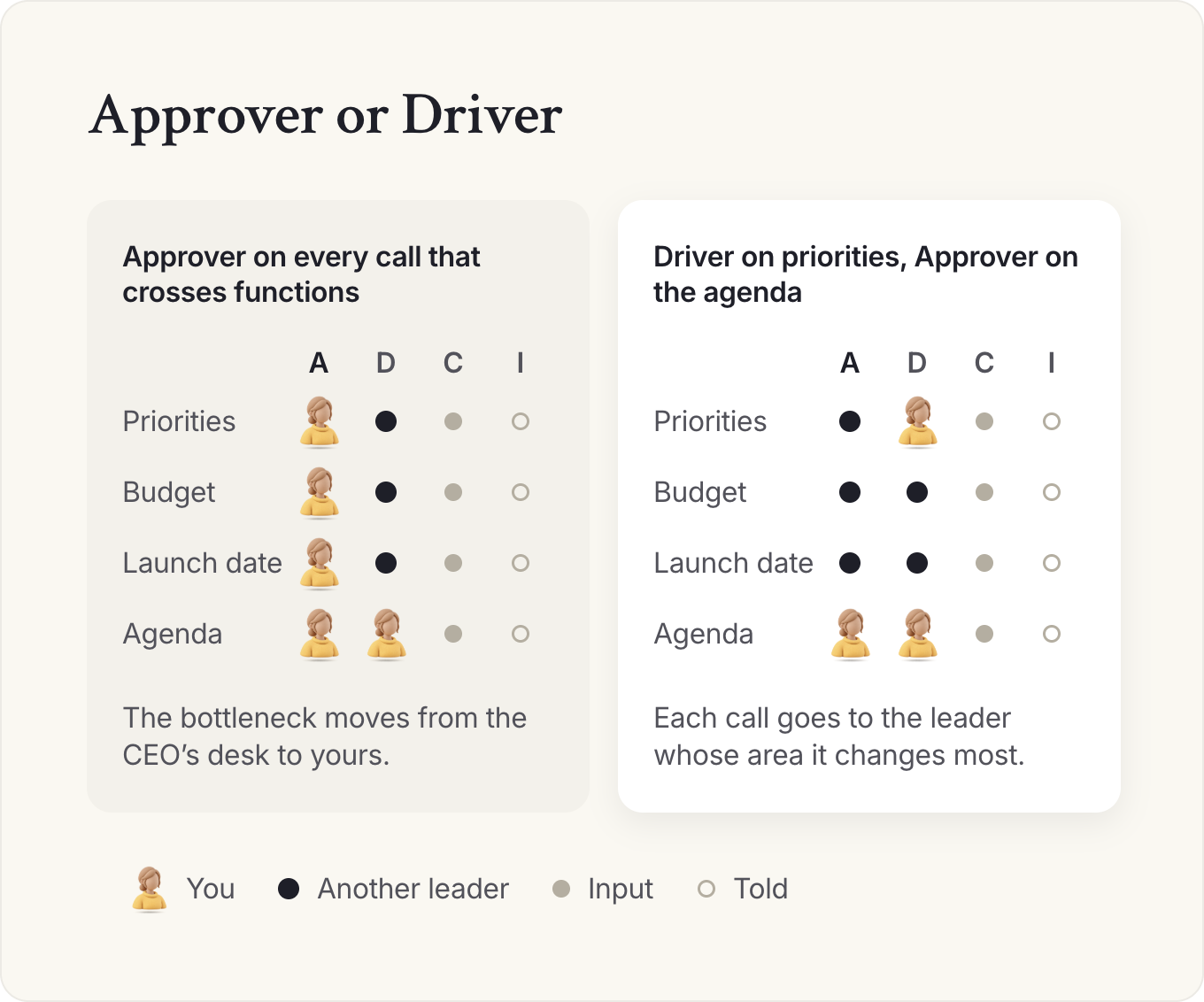
Watch for your name in every row. A relieved CEO sometimes answers the draft by making you the Approver on everything that crosses functions. The bottleneck has then moved from the CEO's desk to yours, and the leaders who outrank you will go around you to the CEO. The cross-team calls a CEO should hand you are about process, such as who joins a project and when it hands off. Most of the trade-offs themselves belong to the leaders. I'd give the row to the leader whose area the decision changes most, and keep the Driver role yourself.
How do you get the leadership team to use it?
Have the CEO announce it, plan the answer to the first request that skips it, and settle disputed rows in the open.
Send each leader their rows a week before the announcement, with one question: which of these would you call differently? A leader who loses a call they used to make informally will say so now, or say nothing and go to the CEO later. Talk to them one-to-one first, the way our operating rhythm guide pre-wires any contested decision.
Then the CEO announces the page at the Tuesday leadership meeting, in the CEO's own words. If you announce it yourself, leaders read it as a land grab. The same risk comes with any new right in your mandate.
The first real test comes when a leader takes a call on the page straight to the CEO. The CEO's answer has to be "Who's the Approver on that?" If the CEO decides it anyway, leaders learn the page is optional. Agree that answer with your CEO in your Monday one-on-one, before the announcement.
When two leaders both claim the A, settle it in a facilitated conversation. Priyanka Peeramsetty, engineering operations director at Crunchyroll and a two-time Chief of Staff, starts by asking both leaders for permission to steer. That step lets someone junior to both run the conversation. She then asks each for their top two non-negotiables, and types what each says live on a shared screen. Then she asks who the decision-maker is. Her version of the test above: "Whoever is the primary beneficiary of this particular project can be the decision-maker," she told our podcast. If the two still disagree, the row goes to the CEO with both views and your recommendation, and the answer goes in the page's change log.
Rolling out decision rights to leaders who outrank you? Compare notes with Chiefs of Staff who've done it. Membership includes member events, a private community and the Power Skills program.
See membershipHow do you know your decision rights are working?
Check the page against the decision log once a quarter. Every entry where the person who decided differs from the Approver on the page is a row to fix or a habit to change.
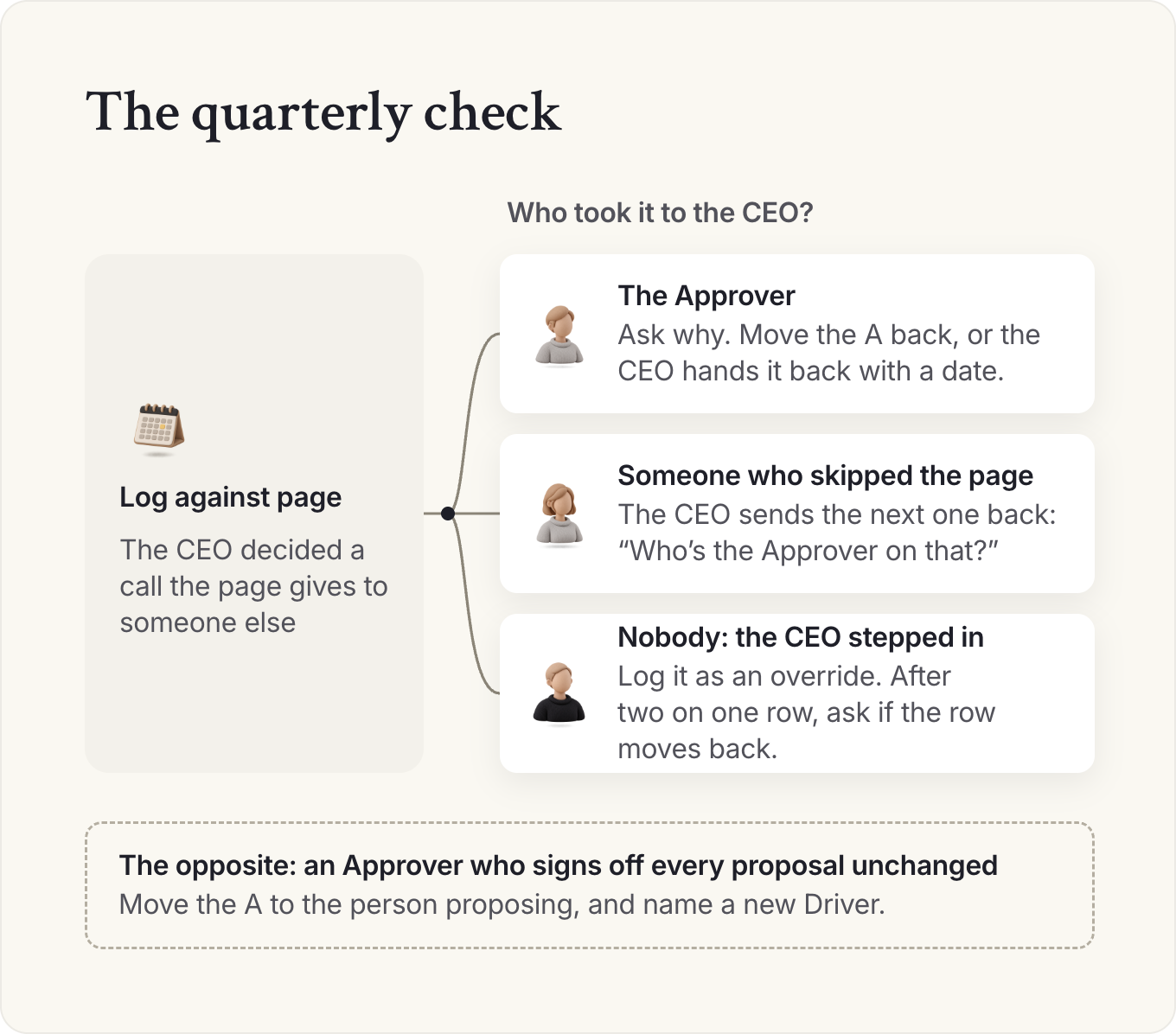
To find the cause, ask who took the call to the CEO:
- The Approver brought it to the CEO. Ask why. If the CEO should own the call, the row is wrong: move the A back and log the change. If the Approver wanted cover for a risky call, the CEO hands it back and asks for their decision by a date.
- Someone else went around the Approver, and the CEO decided. The page was skipped. The CEO sends the next one back with "Who's the Approver on that?"
- The CEO stepped in unasked. Log it as an override. After two on the same row, ask the CEO whether the row should move back.
The log can also show the opposite problem. If an Approver signs off every proposal unchanged, move the A to the person proposing and name a new Driver, as the launch-date row in the example did.
The leadership meeting gives you a second signal. If more than three items still need the whole team every week, the page is too thin. Add rows with a rule, such as the $50,000 one in the example. If a decision keeps coming back after it's made, check that its log entry names the trigger the team agreed would justify reopening it.
This week, pull last quarter's decision log and mark every entry the CEO decided. Draft the page from the ones that cross two leaders' areas, and take it to your Monday one-on-one. No log yet? Use last quarter's leadership meeting notes, and every call you saw go to the CEO.
Take this guide with you
The full guide as a PDF: every section, template and chart, ready to print or share with your team.
Your PDF is ready.
Download the PDFFree. We may email you new guides; unsubscribe anytime.
Frequently asked questions
Is RACI outdated?
No. RACI still works for a project plan: who does each task and who answers for it. It's a weak fit for a leadership team's recurring decisions, because it has no Driver role and its Accountable letter often ends up with two names.
Can the Driver also be the Approver?
Yes, for a decision inside one leader's area, such as a backfill inside the headcount plan. That leader frames the call and makes it. For a decision that crosses functions, name two people, so the Approver hears the other leaders' input from someone whose call it isn't.
What's the difference between Responsible and Accountable in RACI?
Responsible means the people who do the work. Accountable means the one person who answers for it and signs it off as done. A task can have several Responsible names and should have one Accountable. On a decision matrix, Accountable is closest to the DACI Approver.
Who has the authority to make decisions on a leadership team?
On most leadership teams the CEO holds final authority and hands most calls to the leader who owns the area. Decision rights write that down: for each recurring decision, one Approver, named on one page. The calls that cross functions need it most, because nobody owns them by default.
What happens when the Approver is away?
Name a stand-in on the page for the decisions that can't wait, often the Driver or the CEO. Everything else waits for the Approver, with a date in the record. If a row needs a stand-in most months, the Approver is probably the wrong person for that row.
- Chief of Staff Leveling Framework, Chief of Staff Network. Decision-making authority by level, from a survey of 200+ Chiefs of Staff.
- "DACI: A decision-making framework", Atlassian Team Playbook (checked November 2026).
- "RAPID decision making", Bain & Company, 2023.
- The Chief of Staff Podcast: Priyanka Peeramsetty.
- Chief of Staff Network member sessions (recordings not linked): "Decision Protocols Under Pressure", 2026.
- Where the Chief of Staff sits in the matrix by level is our read. The matrix and the rule for moving a rubber-stamped call are our recommendations, and the example is an illustration.
- Podcast quotes are lightly edited for clarity.
Learn the job with people who do it
Membership gets you the Power Skills program, member events and a private community of working Chiefs of Staff.
Land your first Chief of Staff role
Launchpad helps you prepare, position yourself and interview for the role.
Starting out in the role?
The Fundamentals email course walks you through scoping the mandate, setting the cadence and earning trust.
Lead AI adoption from the Chief of Staff seat
The Chief of AI Fellowship is for operators turning AI into how the company runs.
Hiring a Chief of Staff?
Post the role on the Chief of Staff job board, or browse open roles.
Hiring a Chief of Staff?
Post the role on our job board, or have our team source and screen candidates with you.
Get your resume ready for the role
Get feedback on your Chief of Staff resume before you apply.
Let the right roles find you
Join the talent network and hear about Chief of Staff roles first.
The Chief of Staff newsletter
What Chiefs of Staff are reading, hiring for and building.
Get the full report
Every chart and cut from our latest salary research, sent to your inbox.
Using AI with sensitive data?
Learn the legal side of using AI at work.
Keep going in this series