





The Chief of Staff career path: where the role leads
The Chief of Staff career path: where people go after the role, how long to stay in the seat and when to move. 53% leave more senior than they arrived.


Ask AI
 Share

The Chief of Staff career path leads up for just over half: 53% of Chiefs of Staff in our career data hold a more senior title after the role. The most common next steps are operations and strategy (30%) and functional leadership (29%). The odds of a step up peak at two to three years in the seat.
- Decide what you want the role to lead to by month six, and tell your principal. They won't plan your next role for you.
- Plan for two to three years. 57% of Chiefs of Staff who stay two to three years step up on their next move, against 38% of those who leave within a year.
- Look inside first. 61% of next moves at the same company are a step up, against 48% of moves to another company. Two thirds of new VPs or Heads of Operations are promoted where they were Chief of Staff.
- If you want to run a company, plan to move or to build. Only 12% of Chiefs of Staff who become CEO do it at the company where they were Chief of Staff.
- Own one result before you go, and pick one that looks like the job you want next. If you want revenue leadership, that might be a go-to-market reset.
Somewhere around month 18, the question starts. A friend, a recruiter or your own principal asks what's next. The role has no natural next rung, and the median stint ends at 20 months, so the question often comes before you've planned an answer.
Our career data follows 2,800+ members who have held the role, so the numbers below are what people actually did next. If you're looking for the path into the role instead, start with how to become a Chief of Staff.
What are the exit opportunities after Chief of Staff?
Most move into operations and strategy (30%) or into leading a function such as sales or marketing (29%). About one in six take another Chief of Staff role, and 7% found a company.
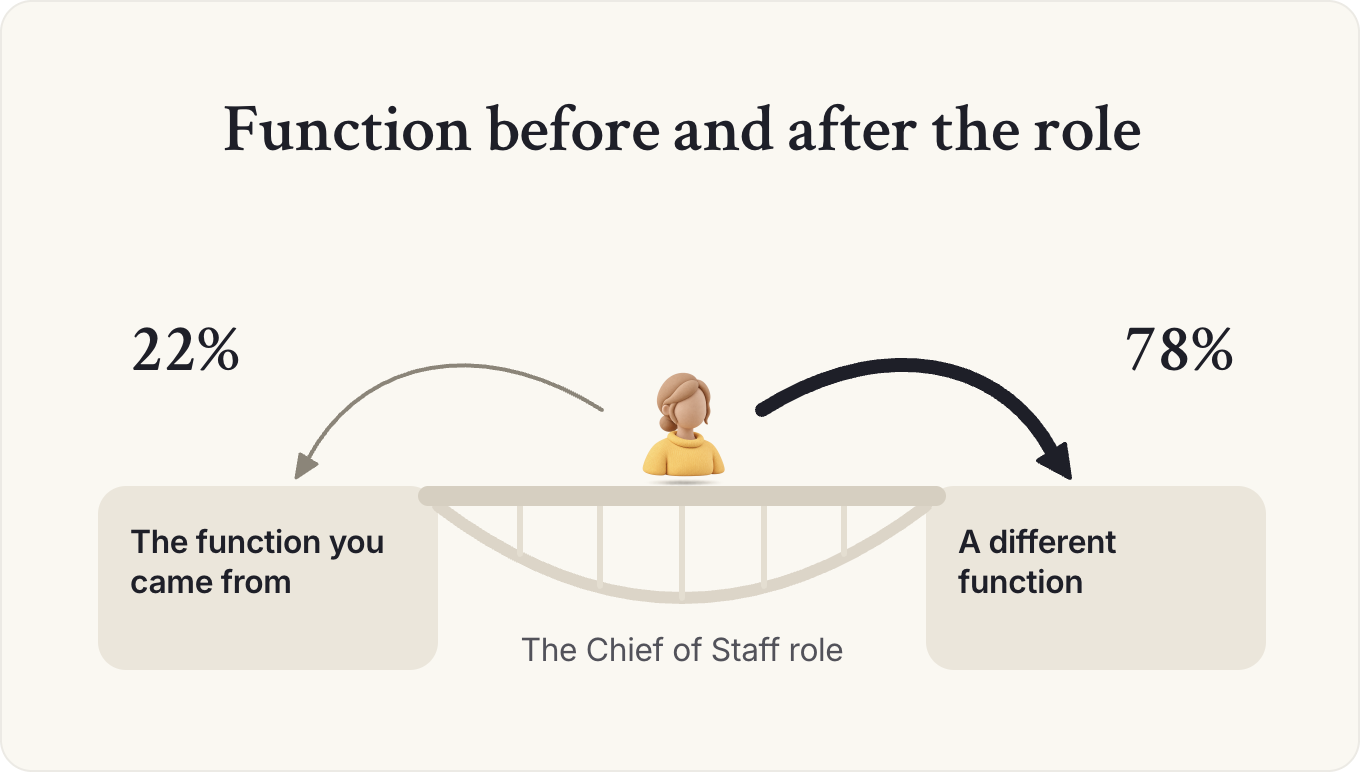
Most people change function on the way through. In our 2026 Pathways data, 78% end up in a different function from the one they came from, and only 22% go back to their old one. My read: treat the seat as a bridge to the work you want next, and pick that work while you're still in it.
Lissa Sorgenfrei, a former Chief of Staff at Capmo who now runs her own company, sees three routes out. The office around the CEO grows and you lead it. A role opens elsewhere in the company and you take it. Or you build something yourself.
Does a Chief of Staff role help your career progression?
For just over half, yes. 53% of Chiefs of Staff hold a more senior title after the role than before it, 25% are level and 22% step down. Some of those step downs are deliberate, such as a smaller title at a bigger or faster-growing company.
Within three years of leaving, about one in five (19%) have reached COO, VP of Operations, General Manager, Chief Strategy Officer or CEO. The share in any C-level role rises from 10.5% on the next move to 15.7% within three years.
People who take the seat early in their careers step up most often: 61% of those who start the role with five years' experience or less, against 40% of those who start with 16 years or more. The experienced group lands higher: 31% go to VP or above next, against 22% of the early starters.
How long should you stay in a Chief of Staff role?
Two to three years. 57% of Chiefs of Staff who stay two to three years step up on their next move, against 38% of those who leave within a year.
The median completed stint is 20 months, and the middle half run 12 to 30 months, so many people leave just before the odds peak. After three years, the step-up rate dips to 51%, but more moves land at VP or above: 35%, against 26% at two to three years. And 11% of those who stay more than three years found a company next.
Whatever the month, watch the seat itself. If your scope and your own decisions stay the same for two quarters, and nobody talks about what's next, start planning your move.
Tom Guthrie, our co-founder, and I went through these numbers on our episode about 3,000 Chief of Staff careers.
Should your next move be at the same company?
Look there first. 61% of next moves at the same company are a step up, against 48% of moves to another company.
Operations leadership is mostly won inside. Two thirds of Chiefs of Staff who become VP or Head of Operations do it at the company where they were Chief of Staff, and so do 46% of new COOs. These are handovers. The median gap between leaving the seat and starting the operations role is zero months.
A second Chief of Staff role and the CEO seat usually mean leaving. 83% of moves into another Chief of Staff role go to a new company, after a median gap of three months, so it takes a real search. Only 12% of those who become CEO do it at the company where they were Chief of Staff. If you work for the CEO, the guide to the CEO's Chief of Staff covers where that seat leads. If you work for a CTO, CFO or another functional leader, see what comes after a functional Chief of Staff role.
An inside move has a cost too. Sorgenfrei moved from Chief of Staff into a go-to-market role at Capmo, the company she had helped build for eight years. The hard part, she said, was going from a full view of the company to a narrower role.
Either way, the conversation starts with your principal. As Chief of Staff at a Series A startup, Michael Novak stepped in as interim head of product when the head of product left. He found he didn't like it, and later moved to strategy and business operations at Adobe. His advice is to do a needs assessment: find gaps in the company that need solving or that interest you, and pitch one to your principal as, in his words, "what your possible exit strategy could be." Your principal won't have the time to plan your career, he said. "You need to bring it to them."
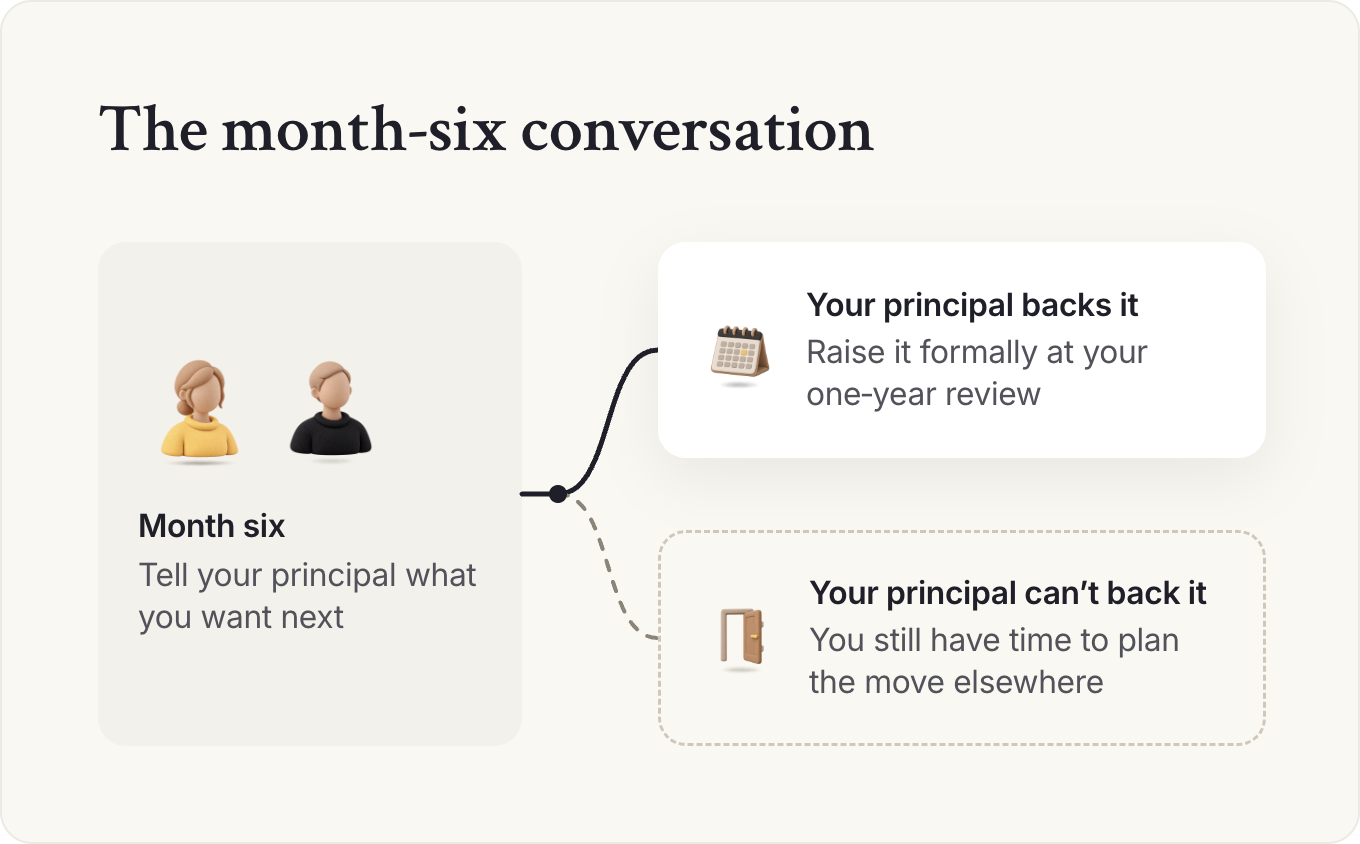
I'd tell your principal what you want next by month six, and raise it formally at your one-year review.
Want every chart behind these numbers? The full 2026 Pathways Report has each pathway's typical route, timing and seniority.
Download the full reportWhat does each path need from you while you're still in the seat?
A result you owned that looks like the next job. A go-to-market reset makes you credible for revenue leadership, and running the people agenda does the same for a Head of People role.
What each path needs, and how the move usually happens
| Path | What to own before you move | How the move usually happens |
|---|---|---|
| Operations and strategy | The planning process or the operating rhythm, with a result you can measure | Often a promotion at the same company |
| Functional leadership | One project in that function, such as a go-to-market reset | Sales and marketing moves happen inside 40 to 46% of the time |
| Another Chief of Staff role | A bigger scope than you started with, and a principal who will vouch for you | A search for a seat at a new company |
| Founder | A problem you've seen up close, tested on the side if your company allows it | Almost always by leaving |
| Consulting and advisory | A practice area people already ask you about | 87% at a new firm or on their own, as a consultant, advisor or fractional operator |
| General management | Time close to a profit and loss, through the budget or a business you helped run | CEO roles mostly at another company |
| Investing | A network of founders and a clear view on operations | Usually an entry role, such as scout, associate or an operating role |
Founding skews early. 12% of Chiefs of Staff who start the role with five years' experience or less go on to found a company, against 5% of those with 16 years or more. Sorgenfrei cut to a four-day week at Capmo, with her CEO's agreement, and used the spare day to try out ideas for her own company. She was clear that few companies allow it, so ask before you assume.
Can you grow without leaving the seat?
Sometimes. About 8% of completed Chief of Staff stints end with a bigger Chief of Staff title at the same company, such as Director to Senior Director, or a title that adds strategy or operations.
US job postings pay more when the title adds a VP, Director or Head level, and the salary guide has the figures. At Under Armour, Danielle Skowronek put strategy into her development plan, and now runs strategy and business planning alongside the Chief of Staff seat.
Some people choose the job again. Nearly a third (30%) of Chiefs of Staff have held the role two or more times, and one in ten three times. Serial Chiefs of Staff are the least likely to change rank after the role (37%), often because the bigger seat doesn't show in the title. A second seat is a step up when it brings a more senior principal, a bigger company or more decisions of your own, and the offer guide shows how to judge one.
How do you plan your next move?
Write it down and take it to your principal. Put it on one page: the role you want, why the company needs it, what you'll own and who takes over your work.
Template: Next-role proposal
Next-role proposal: [your name], [date]
The role I'd like next
- [Title or scope, e.g. Head of Business Operations]
- Target: [quarter]
Why the company needs it
- [A gap you've seen from the seat, with one fact]
- [A second gap, if there is one]
What I'll own between now and then
- [One result, with a measure and a date]
Who takes over my Chief of Staff work
- [Item]: [person or new hire], by [date]
- [Item]: [person or new hire], by [date]
What I need from you
- [Sponsorship, a stretch project, an introduction]
Review
- We check this at my one-year review: [date]
# Next-role proposal: [your name], [date]

## The role I'd like next
- [Title or scope, e.g. Head of Business Operations]
- Target: [quarter]

## Why the company needs it
- [A gap you've seen from the seat, with one fact]
- [A second gap, if there is one]

## What I'll own between now and then
- [One result, with a measure and a date]

## Who takes over my Chief of Staff work
- [Item]: [person or new hire], by [date]
- [Item]: [person or new hire], by [date]

## What I need from you
- [Sponsorship, a stretch project, an introduction]

## Review
- We check this at my one-year review: [date]
Example: Next-role proposal from a Chief of Staff to the CEO at a 400-person software company (illustration)
Next-role proposal: Priya Raman, October 2026
The role I'd like next
- Head of Business Operations, owning planning, the business reviews and pricing operations
- Target: Q2 2027
Why the company needs it
- Three teams run their own forecasts, and the quarterly business review spends its first hour reconciling them
- Pricing exceptions go to the CEO, 14 of them last quarter
What I'll own between now and then
- One forecast for the company by the January business review, signed off by the CFO
- A pricing exception policy that cuts CEO approvals to 3 or fewer a quarter, by March 31, 2027
Who takes over my Chief of Staff work
- Leadership meeting agenda and decision record: new Chief of Staff hire, by March 1, 2027
- Board pack coordination: the CFO's office, by February 1, 2027
What I need from you
- Your backing when I take the forecast to the leadership team
- An introduction to the CFO's planning lead this month
Review
- We check this at my one-year review: April 14, 2027
# Next-role proposal: Priya Raman, October 2026

## The role I'd like next
- Head of Business Operations, owning planning, the business reviews and pricing operations
- Target: Q2 2027

## Why the company needs it
- Three teams run their own forecasts, and the quarterly business review spends its first hour reconciling them
- Pricing exceptions go to the CEO, 14 of them last quarter

## What I'll own between now and then
- One forecast for the company by the January business review, signed off by the CFO
- A pricing exception policy that cuts CEO approvals to 3 or fewer a quarter, by March 31, 2027

## Who takes over my Chief of Staff work
- Leadership meeting agenda and decision record: new Chief of Staff hire, by March 1, 2027
- Board pack coordination: the CFO's office, by February 1, 2027

## What I need from you
- Your backing when I take the forecast to the leadership team
- An introduction to the CFO's planning lead this month

## Review
- We check this at my one-year review: April 14, 2027
Bring it to a 1:1, ask what your principal would change, and agree the review date before you leave the room. If your principal can't back the role you want, you've learned that in month six and still have time to plan the move elsewhere.
Take this guide with you
The full guide as a PDF: every section, template and chart, ready to print or share with your team.
Your PDF is ready.
Download the PDFFree. We may email you new guides; unsubscribe anytime.
Frequently asked questions
What's higher than a Chief of Staff?
Above the seat sit the executive roles people step up into: VP, Head of Operations, COO, General Manager and CEO. Where you start depends on the level of your seat, which runs from Analyst to Executive in our Leveling Framework. Within three years of leaving the seat, 12.5% are at VP level in some function.
Is COO the usual next step after Chief of Staff?
No. It's a small group: 4.5% move straight into a COO seat and 7% reach it within three years. Operations and strategy roles as a whole are the most common next step. Chief of Staff vs COO covers what the COO move asks of you.
Is Chief of Staff a dead-end role?
Not for most people. 53% of Chiefs of Staff leave more senior than they arrived, and about one in five reach COO, VP of Operations, General Manager, Chief Strategy Officer or CEO within three years. My read: a Chief of Staff role is a dead end only when the seat stops growing and you stay anyway. The Chief of Staff role guide covers whether it suits you.
What do you put on your resume after a Chief of Staff role?
The results you owned, with numbers and dates. Name the planning cycles you ran, the projects you shipped and handed off, and the decisions you made yourself. How to become a Chief of Staff has before-and-after resume lines.
- Chief of Staff Pathways Report 2026, Chief of Staff Network. 2,869 member career histories, 1,992 dated moves out of the role (next-move shares), 1,637 people with a full three-year window, a stint-level analysis of 2,158 moves (tenure and experience), and 1,222 moves with rank stated before and after (seniority change).
- Leveling Framework, Chief of Staff Network.
- The Chief of Staff Podcast: Lissa Sorgenfrei, Michael Novak, Danielle Skowronek, and Scott Amenta and Tom Guthrie (both of the Chief of Staff Network).
- The "what to own" column and the proposal template are our recommendations. The example is an illustration.
Learn the job with people who do it
Membership gets you the Power Skills program, member events and a private community of working Chiefs of Staff.
Land your first Chief of Staff role
Launchpad helps you prepare, position yourself and interview for the role.
Starting out in the role?
The Fundamentals email course walks you through scoping the mandate, setting the cadence and earning trust.
Lead AI adoption from the Chief of Staff seat
The Chief of AI Fellowship is for operators turning AI into how the company runs.
Hiring a Chief of Staff?
Post the role on the Chief of Staff job board, or browse open roles.
Hiring a Chief of Staff?
Post the role on our job board, or have our team source and screen candidates with you.
Get your resume ready for the role
Get feedback on your Chief of Staff resume before you apply.
Let the right roles find you
Join the talent network and hear about Chief of Staff roles first.
The Chief of Staff newsletter
What Chiefs of Staff are reading, hiring for and building.
Get the full report
Every chart and cut from our latest salary research, sent to your inbox.
Using AI with sensitive data?
Learn the legal side of using AI at work.
Keep going in this series

 Basics
 Excel in the role
 AI and the Chief of Staff
 Toolkit
 Hiring a Chief of Staff