




Chief of Staff for executives: how to work with one
What a Chief of Staff does for a CEO or senior executive, what to hand over first, how to run the weekly 1:1 and what to check on your side at six months.

Ask AI
 Share

A Chief of Staff is the primary strategic operator reporting directly to a senior executive, often the CEO, and acts as that leader's trusted advisor and right hand. For an executive, it means decisions arrive prepared, someone runs the leadership rhythm, and cross-team work has an owner. You get that return once you hand over decisions as well as tasks.
- Hand over decisions in the first month, starting with the ones that come back to your leadership meeting week after week. A Chief of Staff who only takes tasks gives you a few hours back and little else.
- Start with the operating rhythm: the leadership meeting agenda, the follow-ups and the planning calendar. It gives you hours back every week.
- When a leader brings you something on the Chief of Staff's Decide list, send it back the same day. If you answer it yourself, your leaders learn to skip the Chief of Staff.
- Read Friday's update before the Monday 1:1 and answer its decisions in writing. Keep the meeting for one risk and one hard topic.
- At six months, check what left your desk and stayed gone. If little did, look at what you held on to before you judge the hire.
Most executives who hire a Chief of Staff know what they want off their plate. Fewer have decided what to hand over first, what the person can decide without asking, or what the weekly 1:1 is for. Those three choices, made in the first month, decide whether you get hours back or one more meeting.
I became Chief of Staff to the CEO at Spring in 2016 and started this network a year later. Each hiring step has its own guide, linked below. The part only you can do is working with the person once they start.
What changes for you when you hire a Chief of Staff?
A Chief of Staff takes the work that sits between you and your leaders and that nobody else owns. It falls under four core responsibilities: priorities and decisions, running the operating rhythm, communication up and down, and cross-functional projects. The Chief of Staff role has the full definition and how it varies.
What a Chief of Staff takes off your desk
| Core responsibility | What changes for you |
|---|---|
| Priorities and decisions | Decisions reach you with options and a recommendation. Someone chooses on purpose what gets your time. |
| Running the operating rhythm | The leadership meeting, planning, business reviews and board prep run on a schedule without you chasing them. |
| Communication up and down | You hear what's going wrong early, and your decisions reach the company in words people act on. |
| Cross-functional projects | Work that belongs to no single leader gets an owner until it ships and is handed to a team. |
Your calendar, travel and inbox aren't on that list. If that's most of what you want handed over, you need an executive assistant, and Chief of Staff vs executive assistant shows where the line sits.
Many Chiefs of Staff work for someone other than the CEO. The executive they work for is called the principal, and of the postings that name one, 44% say CEO, founder or president. The rest support a CTO, CFO, revenue leader or another executive, and the job covers what that leader covers. A functional Chief of Staff usually runs your operating review in place of the company-wide leadership meeting, so read "leadership meeting" below as yours.
If you run a function, your Chief of Staff works two rhythms. Yours is your staff meeting, planning and reviews. The company's is what your function owes upward: plan inputs, prep for the CEO's leadership meeting and your section of the board deck. Below, read "leadership meeting" as your staff meeting and "your leaders" as your direct reports. If the CEO has a Chief of Staff too, I'd have the two agree early on who asks your teams for what, so nobody gets the same request twice.
Which guide do you need as an executive?
Find your situation below.
- Not sure you need one yet: do you need a Chief of Staff has the signs, the other fixes and the payback.
- Weighing an assistant or a COO instead: Chief of Staff vs executive assistant and Chief of Staff vs COO show which problem each hire solves.
- Need part of one, or a trial first: a fractional Chief of Staff works part time.
- Ready to hire: how to hire a Chief of Staff runs from scoping to day 90.
- Writing the posting: the job description guide has a template with decision rights built in, and an example for a CTO.
- Setting the pay: Chief of Staff salary has pay by level, company size and city.
- Finding candidates: Chief of Staff recruiters compares every route, from your own company to a search firm.
- Your Chief of Staff starts soon: the hiring guide has the day-one checklist. Agree a one-page mandate by week 4, then read on.
- Building a team around you: the office of the CEO covers who sits in it as you grow.
Hiring a Chief of Staff? Post the role on our job board, where Chiefs of Staff look for their next role.
Post a jobWhat should you hand a new Chief of Staff first?
Hand over one piece of the operating rhythm and one stuck problem in the first month. The rhythm gives you hours back every week, and the problem shows you their judgment. If you can only pick one, I'd hand over the rhythm.
It's also what employers ask for most. 61% of Chief of Staff postings mention the operating rhythm, OKRs or KPIs, against 37% for a thought partner on decisions.
In practice, handing over the rhythm means the agenda for Tuesday's leadership meeting, the decision record that goes out within two hours, and chasing the owners and dates on it. Our leadership meeting guide has the agenda.
Whatever you hand over, stop doing it yourself. If you keep rewriting the agenda the night before, your leaders learn to send their items to you, and the Chief of Staff becomes your note-taker.
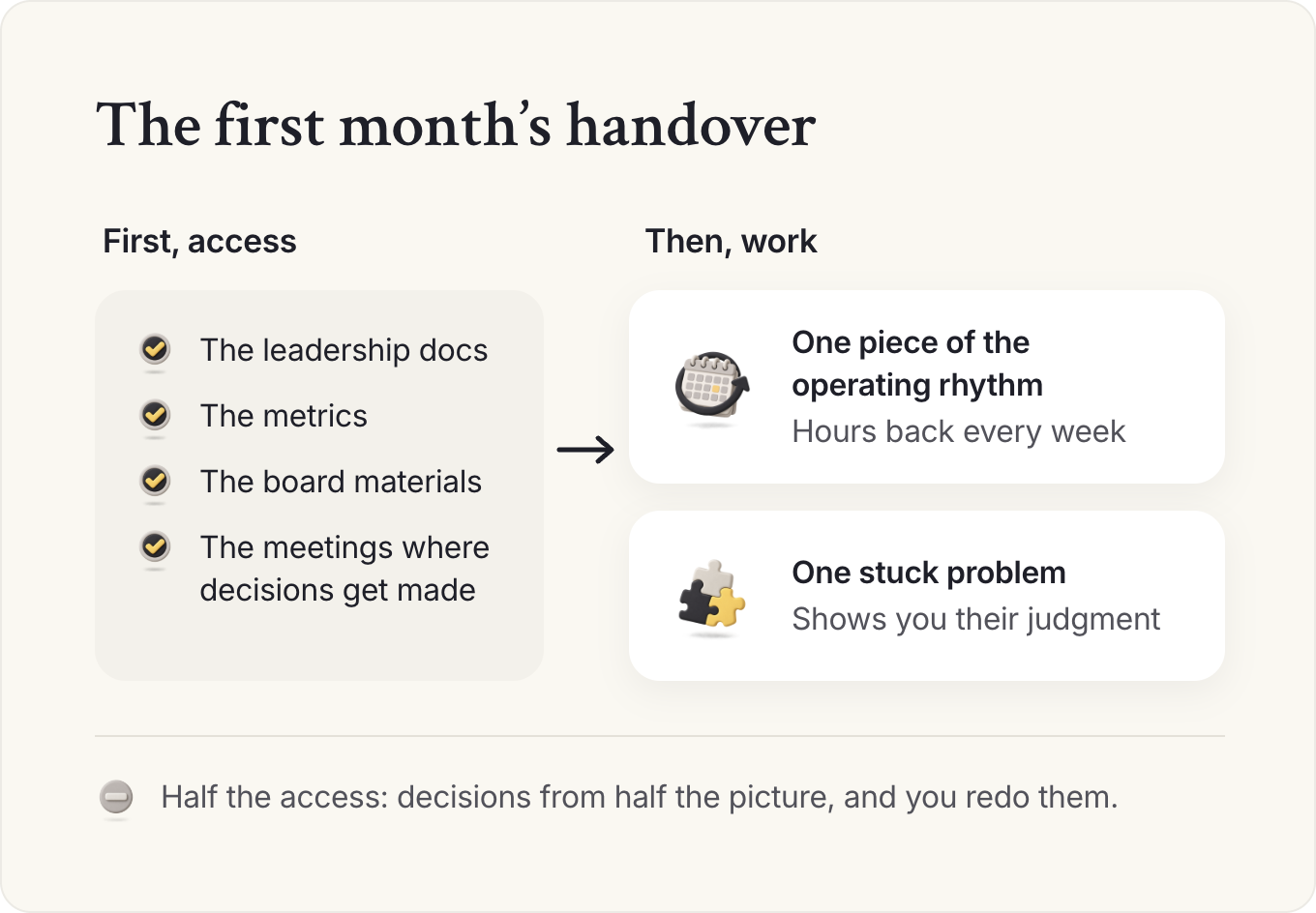
Give access before you give work. One founder told a member session that a Chief of Staff's influence comes from where they sit, because what the leadership team knows passes through them. So share the leadership docs, the metrics and the board materials, and bring your Chief of Staff into the meetings where decisions get made. If your Chief of Staff sees half of it, they'll prepare decisions from half the picture, and you'll redo them.
Which decisions should your Chief of Staff make without you?
Give them the decisions that recur, can be reversed and cross your leaders' areas. Keep the ones about people. Write them in three tiers: Decide (they decide alone), Recommend (they shape it, you decide) and Not own (someone else owns it, named).
A first Decide list for a CEO's Chief of Staff (illustration)
| Decision | Tier in month one | By month six |
|---|---|---|
| What goes on the leadership meeting agenda, and in what order | Decide | Decide |
| Which requests reach your calendar, and which go to a leader | Decide | Decide |
| Owners and dates for follow-ups from the leadership meeting | Decide | Decide |
| The planning calendar and what each leader submits | Recommend | Decide |
| Who joins a cross-functional project, and when it hands off | Recommend | Decide |
| Quarterly company priorities | Recommend | Recommend |
| Hiring, firing and pay for your direct reports | Not own (you, with HR) | Not own |
| Calendar logistics and travel | Not own (executive assistant) | Not own |
If you run a function, build the same list from your own week. Your staff meeting agenda and planning calendar go in Decide, headcount across your teams in Recommend, and the technical or financial calls your managers make in Not own. Our job description guide has the full example for a CTO's Chief of Staff.
The list also sets the level, more than the title does. On our Leveling Framework, a Manager gives meaningful input on strategic decisions and a Vice President is a key influencer on them. If you're paying for VP work, the Decide and Recommend columns have to show it.
The mandate guide has the one-page template the list goes into.
Announce the list to your leaders before the person starts, as the hiring checklist says. The test comes later, the first time a leader brings you something on the Decide list.
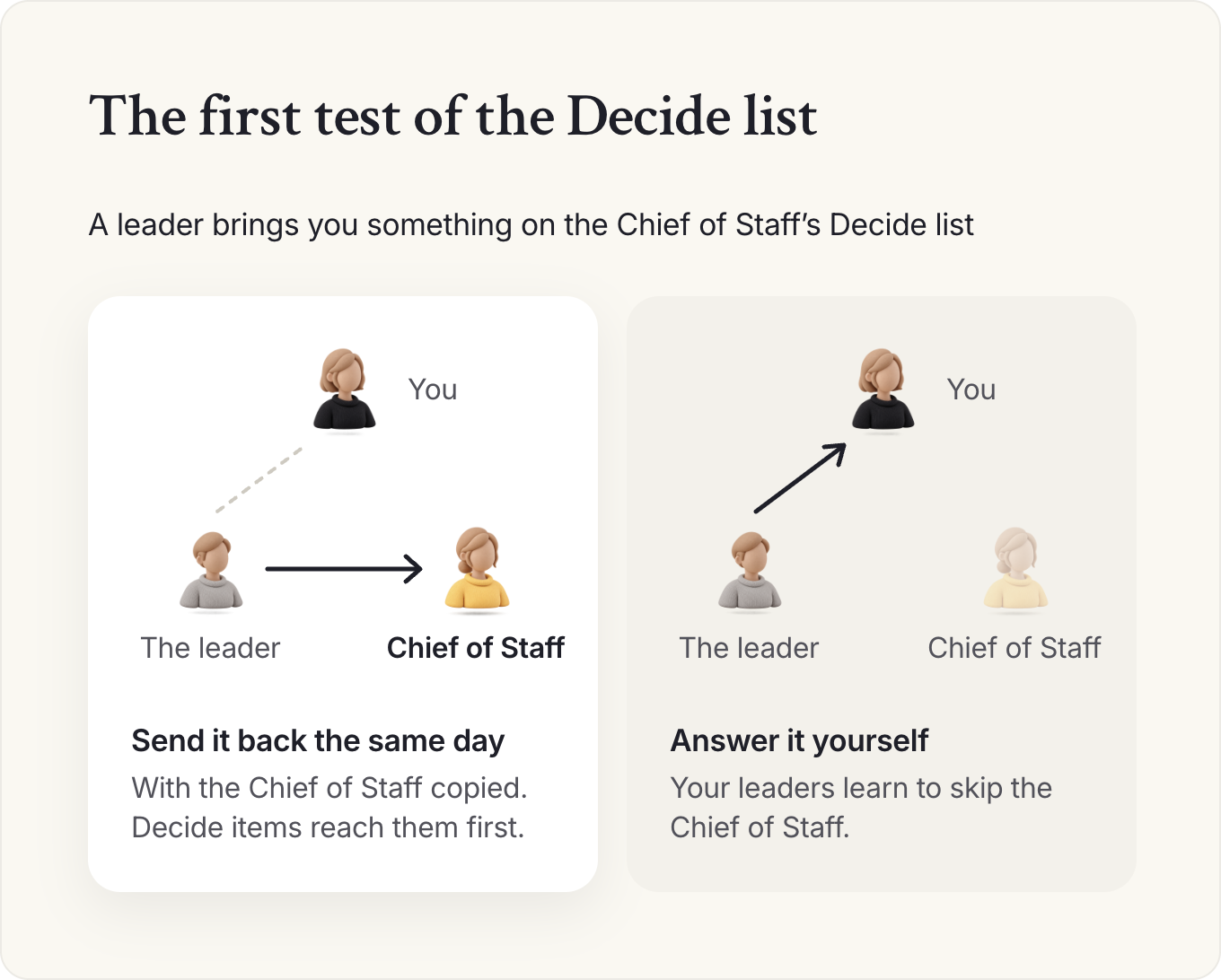
Send it back the same day, with the Chief of Staff copied. My read: the first leader to test the list is often the one who used to have your ear most. Tell that leader yourself, in private, why the list exists and what still comes straight to you.
Watch for a second problem: a Chief of Staff who uses the Decide list well and never disagrees with you. On the Recommend items, ask for their view before you give yours.
You don't want everyone to do what you want all the time. You want thought partners.
Zach Garippa, CEO, Order.co · Listen on the podcast
Zach's rule for news, good or bad, is "just tell me now." He also told our podcast that a Chief of Staff should ask their CEO how they want to hear things. Tell yours how and when you want to hear bad news, before they have to ask.
How should you run the weekly 1:1 with your Chief of Staff?
Book 30 to 45 minutes every Monday and read Friday's written update before you walk in, so the 1:1 is free for one risk and one hard topic.
Your Chief of Staff owns the agenda, and the weekly update guide has theirs. Your side is short:
- Read the update before Monday. If you didn't, say so and spend the first five minutes reading it.
- Close what you can in writing. A decision you answer on Friday doesn't need the meeting.
- Bring one thing yourself: the decision you're putting off, or something you heard that they haven't.
- Leave their task list out. Our Leveling Framework expects a Chief of Staff at every level to manage their own work, with regular check-ins.
Once the 1:1 is done, the agenda and pre-reads for Tuesday's leadership meeting go out. That's why Monday works: what you decide in the 1:1 reaches your leaders a day before they meet. If you run a function, Monday also preps you for the CEO's leadership meeting, so you walk in with your function's calls already made.
Even so, the 1:1 drifts back into status. One startup CEO described his warning sign at a member session: three tactical 1:1s in a row with his operations lead, whose job was close to a Chief of Staff's. His fix was to book separate time to step back, ask how the role was going and reread the document they'd written about the role together.
What should you check on your side after six months?
By six months, the items on the Decide list should reach the Chief of Staff first and stay decided. You should also have stopped doing at least one recurring thing yourself. Both depend on you as much as on them, so check your side first.
The six-month scorecard measures the role. Answer three questions for yourself before the review:
- What did I stop doing? Name the meeting, the report or the decision. If you can't, the role hasn't taken anything over yet.
- Which items on the Decide list did I take back, and why? Each one is a decision about the role you made alone.
- Would I move the next Recommend item to Decide today? If not, say what they'd have to show you, and by when.
If the honest answers point at you, fix that first and say so at the review.
Then talk about what comes next. In our 2025 survey, more than a third of Chiefs of Staff want to stay and take on a bigger role. Asked what would make them leave, they named three things most: bad management, pay and no way up. Each came up in about one answer in seven. Agree at the review what the role could grow into. The hiring guide covers re-leveling and naming the next role.
To judge whether the role itself is working, run the six-month check in our guide to whether you need a Chief of Staff.
I'd book the six-month review the day the offer is signed, for six months after the start date, with these three questions in the invite. If it isn't booked yet, book it today.
Take this guide with you
The full guide as a PDF: every section, template and chart, ready to print or share with your team.
Your PDF is ready.
Download the PDFFree. We may email you new guides; unsubscribe anytime.
Frequently asked questions
Can a Chief of Staff speak for you?
Yes, in the meetings and on the topics you name. Write both into the mandate and say them out loud at your leadership meeting. Everywhere else, your Chief of Staff shares context and says it's context. A Chief of Staff who speaks for you on everything gets tested by every leader, and one who never can turns into a messenger.
Should your Chief of Staff attend every meeting you attend?
In the first month, most of them, so they learn how decisions get made and your leaders get used to them in the room. After that, keep them in the meetings where decisions are made or followed up: the leadership meeting, planning and board prep. If they'd do nothing differently after a meeting, they don't need to be in it.
What should you never hand to a Chief of Staff?
Decisions about a person: hiring, firing, pay and performance for your direct reports. Your Chief of Staff can prepare them, gather what leaders say and draft the note, and you still decide. The same goes for the relationships only you can hold, such as your co-founder or your board chair. A Chief of Staff can prepare you for those conversations without taking them over.
Can two executives share one Chief of Staff?
It works when the two share most decisions, as co-founders often do, and agree whose call wins when priorities clash. With two leaders who run separate agendas, no single principal's priorities set the work, so it turns into a project role. Price it and scope it as one, or look at a fractional Chief of Staff for each.
Is a Chief of Staff an executive-level role?
It can be, and you choose. Our Leveling Framework has six levels, from Analyst or Associate up to CXO, and the same title covers all of them. Decision rights set the level more than the title does, so the Decide list above is where you choose it. If the job is aligning your VPs, hire at a level they'll recognize.
How much does a CEO's Chief of Staff make?
In our 2025 Salary Report, the average base salary is $167,954 and the median is $160,000. The survey covers Chiefs of Staff to every kind of principal. Pay depends on level more than on company size or industry, and our Chief of Staff salary guide breaks it down by level, company size and city.
- Chief of Staff Pathways Report 2026, Chief of Staff Network. 1,819 job postings (June to early October 2026), 741 of them naming the principal.
- Chief of Staff Salary Report 2025, Chief of Staff Network (n=479, mostly US).
- Leveling Framework, Chief of Staff Network.
- The Chief of Staff Podcast: Zach Garippa.
- Chief of Staff Network member sessions: How A CEO and CoS Work Together, 2023; The Startup Operating System: Founder Lessons for Chiefs of Staff, 2025.
- The first Decide list is an illustration. The 1:1 steps and the six-month questions are our recommendations.
- Podcast quotes are lightly edited for clarity.
Learn the job with people who do it
Membership gets you the Power Skills program, member events and a private community of working Chiefs of Staff.
Land your first Chief of Staff role
Launchpad helps you prepare, position yourself and interview for the role.
Starting out in the role?
The Fundamentals email course walks you through scoping the mandate, setting the cadence and earning trust.
Lead AI adoption from the Chief of Staff seat
The Chief of AI Fellowship is for operators turning AI into how the company runs.
Hiring a Chief of Staff?
Post the role on the Chief of Staff job board, or browse open roles.
Hiring a Chief of Staff?
Post the role on our job board, or have our team source and screen candidates with you.
Get your resume ready for the role
Get feedback on your Chief of Staff resume before you apply.
Let the right roles find you
Join the talent network and hear about Chief of Staff roles first.
The Chief of Staff newsletter
What Chiefs of Staff are reading, hiring for and building.
Get the full report
Every chart and cut from our latest salary research, sent to your inbox.
Using AI with sensitive data?
Learn the legal side of using AI at work.
Keep going in this series


 Basics
 Excel in the role
 AI and the Chief of Staff
 Toolkit
 Hiring a Chief of Staff