


How to influence without authority as a Chief of Staff
Influence a leader who doesn't report to you, with a one-page ask you can fill in tonight, a rule for your CEO's name and a plan for after a no.


Ask AI
 Share

You influence without authority as a Chief of Staff by making each ask worth a yes to the leader: it helps them hit their own number, costs their team little, and comes from someone whose last ask got done. Use your principal's name for decisions they've already made, and ask in your own name for everything else.
- Write one page before any ask that crosses teams: what the leader is measured on, what saying yes costs them, and the smallest version they could accept.
- In the first conversation, ask what was tried before and why it stopped. Bring your recommendation to the second one.
- When you cite your principal, name the decision, the date and the meeting where they made it.
- If a leader still says no by the date you set, show them your note, then take it to your principal as a choice between two options.
Most of what a Chief of Staff is asked to deliver sits in teams that report to someone else. The head of sales owns the forecast, the VP of Product owns the roadmap, and your principal expects both to change. You can't assign the work, and if every ask goes through the CEO, leaders learn to wait for the CEO.
What does influence without authority mean for a Chief of Staff?
It means getting leaders who don't report to you to change what their teams do. Most Chiefs of Staff depend on it. In the survey behind our Leveling Framework, only 14% say they manage people or otherwise dictate work directly.
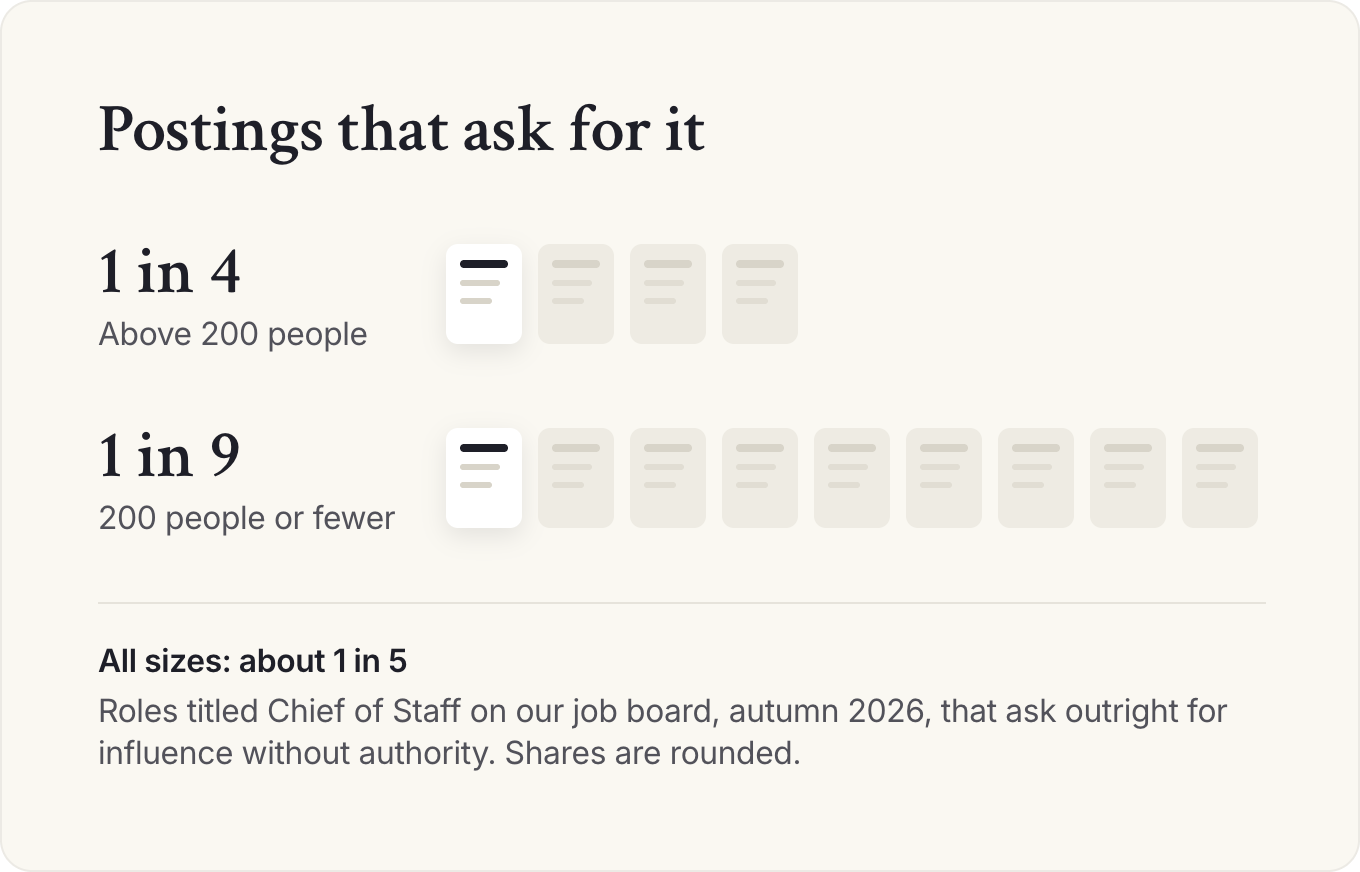
About one in five of the 300+ roles titled Chief of Staff on our job board this autumn asked outright for influence without authority, or for moving work across teams "without direct authority". At companies above 200 people it was about one in four, and at 200 or fewer, about one in nine.
Leaders know you speak for your principal, so every ask you make carries some of the principal's weight, whether you mean it to or not. That borrowed authority builds or drains each time your principal backs or reverses you, as the role guide explains.
How do you get a leader who doesn't report to you to act?
Make the ask easy to say yes to before you make it. Write one page about the leader and the ask, use the first conversation to listen, then come back with an ask sized to their quarter.
- Write the page, using the template below. What the leader is measured on comes from your stakeholder map, if you keep one.
- Listen before you recommend. "The number one skill for a chief of staff to develop is influencing without authority," Kyle Hagge, Chief of Staff at Morning Brew, told our podcast. "You're going to be in a ton of environments where you don't have titular authority to tell anyone to do anything." His first step is to learn what happened in the past, why the team works the way it does and what hurts, before he offers any recommendation.
- Shrink the ask to one person, one meeting or one quarter. A trial with an end date is easier to agree to than a permanent change, and it gives you a result to show.
- Carry part of the work yourself, starting with the piece that would make the leader's team say no: the prep, the summary or the notes.
- If the change needs more than one leader to agree, treat it as a decision and pre-wire it with the steps in the skills guide. The page below is for one leader and one change.
- Once the trial works, name the leader and what their team did in your weekly update.
Template: One ask, one page
One ask, one page: [what you need] from [leader], [date]
The ask
- What I need, and by when: [one sentence]
- The smallest version they could say yes to: [a trial, one person, one meeting]
- What has been tried before, and why it stopped: [ask them; don't guess]
The leader
- What they're measured on this quarter: [their number]
- What saying yes costs them: [time, people, risk, how it looks to their team]
- What they get, in their terms: [one line they would say themselves]
- Who they listen to: [names]
Whose name
- ☐ My principal has decided this: [date and meeting, link to the decision log]
- ☐ It's my suggestion: the ask goes in my name, with my reasons
What I'll do myself
- [the prep, the summary, the notes]
If they say no
- What I'll change once: [the narrower ask]
- The date I stop asking: [date]
- The choice I'd take to [principal]: [option A and its cost; option B and its cost]
- I tell [leader] first and show them the note: [yes / date]
After
- Credit, and where it goes: [weekly update, leadership meeting]
- What changed by the end of the trial: [one result]
# One ask, one page: [what you need] from [leader], [date]

## The ask
- What I need, and by when: [one sentence]
- The smallest version they could say yes to: [a trial, one person, one meeting]
- What has been tried before, and why it stopped: [ask them; don't guess]

## The leader
- What they're measured on this quarter: [their number]
- What saying yes costs them: [time, people, risk, how it looks to their team]
- What they get, in their terms: [one line they would say themselves]
- Who they listen to: [names]

## Whose name
- [ ] My principal has decided this: [date and meeting, link to the decision log]
- [ ] It's my suggestion: the ask goes in my name, with my reasons

## What I'll do myself
- [the prep, the summary, the notes]

## If they say no
- What I'll change once: [the narrower ask]
- The date I stop asking: [date]
- The choice I'd take to [principal]: [option A and its cost; option B and its cost]
- I tell [leader] first and show them the note: [yes / date]

## After
- Credit, and where it goes: [weekly update, leadership meeting]
- What changed by the end of the trial: [one result]
Example: Asking the VP of Product to join the churn review, Chief of Staff to the CEO at a 300-person software company (illustration)
One ask, one page: a product manager at the churn review, from Daniel Brooks (VP of Product), October 20, updated October 22
The ask
- What I need, and by when: one product manager at the monthly churn review, starting November 6
- The smallest version they could say yes to: one product manager, 45 minutes a month, for one quarter
- What has been tried before, and why it stopped: product joined in 2025; the meeting turned into feature requests and they stopped coming (Daniel, October 22)
The leader
- What they're measured on this quarter: shipping the Q4 roadmap on time
- What saying yes costs them: 45 minutes a month of a product manager; the risk that customer success uses the meeting to lobby
- What they get, in their terms: "The top churn reasons, ranked by revenue, before Q1 roadmap planning closes"
- Who they listen to: Alicia Gomez (VP of Customer Success), the head of engineering
Whose name
- ☐ My principal has decided this
- ☐ It's my suggestion: the ask goes in my name, with my reasons
What I'll do myself
- Write the churn summary before each review, ranked by revenue
- Hold the meeting to 45 minutes; feature requests go in a list, with no debate in the room
- Send the notes within a day
If they say no
- What I'll change once: a product manager joins only the last 15 minutes, for the ranked list
- The date I stop asking: November 20
- The choice I'd take to the CEO: product joins the churn review this quarter (cost: 45 minutes a month), or the Q1 roadmap is set without churn data (cost: we plan blind on retention)
- I tell Daniel first and show him the note: yes, before the CEO one-to-one
After
- Credit, and where it goes: name Daniel's team in the weekly update after the first review
- What changed by the end of the trial: at least one churn reason on the Q1 roadmap, or a written reason why not
# One ask, one page: a product manager at the churn review, from Daniel Brooks (VP of Product), October 20, updated October 22

## The ask
- What I need, and by when: one product manager at the monthly churn review, starting November 6
- The smallest version they could say yes to: one product manager, 45 minutes a month, for one quarter
- What has been tried before, and why it stopped: product joined in 2025; the meeting turned into feature requests and they stopped coming (Daniel, October 22)

## The leader
- What they're measured on this quarter: shipping the Q4 roadmap on time
- What saying yes costs them: 45 minutes a month of a product manager; the risk that customer success uses the meeting to lobby
- What they get, in their terms: "The top churn reasons, ranked by revenue, before Q1 roadmap planning closes"
- Who they listen to: Alicia Gomez (VP of Customer Success), the head of engineering

## Whose name
- [ ] My principal has decided this
- [x] It's my suggestion: the ask goes in my name, with my reasons

## What I'll do myself
- Write the churn summary before each review, ranked by revenue
- Hold the meeting to 45 minutes; feature requests go in a list, with no debate in the room
- Send the notes within a day

## If they say no
- What I'll change once: a product manager joins only the last 15 minutes, for the ranked list
- The date I stop asking: November 20
- The choice I'd take to the CEO: product joins the churn review this quarter (cost: 45 minutes a month), or the Q1 roadmap is set without churn data (cost: we plan blind on retention)
- I tell Daniel first and show him the note: yes, before the CEO one-to-one

## After
- Credit, and where it goes: name Daniel's team in the weekly update after the first review
- What changed by the end of the trial: at least one churn reason on the Q1 roadmap, or a written reason why not
In the example, product stopped coming to the churn review in 2025, because the meeting turned into feature requests. Daniel's answer to "what was tried before?" is why the page caps the meeting at 45 minutes and moves requests to a list.
When should you use your principal's name?
I'd use my principal's name for one thing: a decision they've already made, said with the date and the meeting where they made it. For anything else, ask in your own name and give your own reasons.
A founder who led one of our member sessions described what the other person hears. When someone opens a request by saying the CEO has made it a high priority, an engineer concludes the CEO didn't think it worth coming to the meeting. He saw new and junior people reach for the CEO's name most, because it feels like authority. His co-founder cited an observation from the military: rank was the weakest source of influence a junior officer had, and people were polite about it far more often than they respected it.
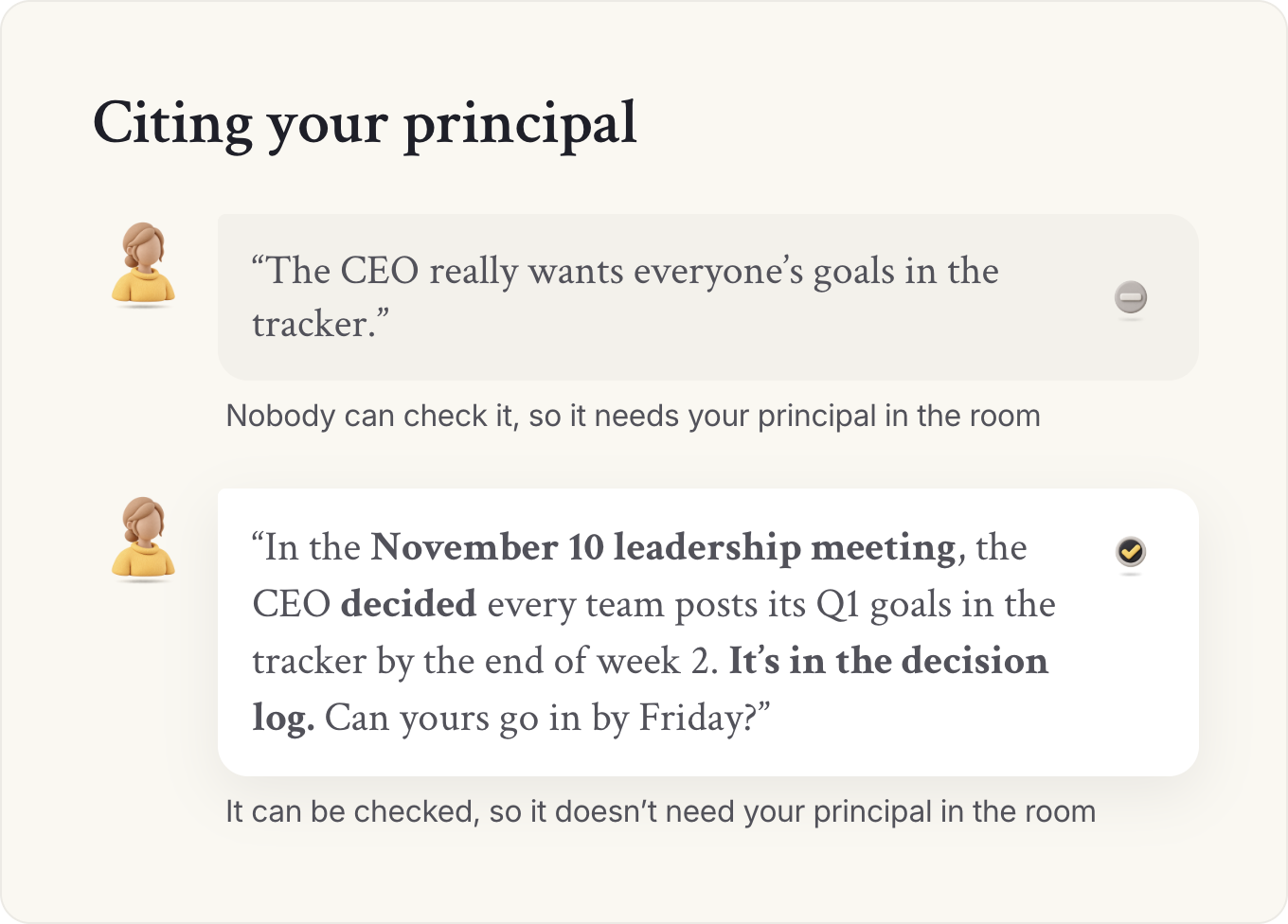
So when you cite a decision, cite the record. Compare these two lines to a VP who hasn't posted their team's goals:
- "The CEO really wants everyone's goals in the tracker."
- "In the November 10 leadership meeting, the CEO decided every team posts its Q1 goals in the tracker by the end of week 2. It's in the decision log. Can yours go in by Friday?"
The second one can be checked, so it doesn't need your principal in the room. That's a good reason to keep a decision log. If the decision was made in a hallway or a direct message, ask your principal to post it in one line to the leadership team before you cite it.
When the ask is your own idea, say so: "This is my suggestion, and here's why it helps your team." The leader can say no to that, so a yes means they agree. If they push back on something you asked for in your principal's name, the role guide gives three replies, depending on whether your principal decided it, you did, or you aren't sure.
If I needed the CEO's name twice in a month with the same leader, I'd stop and fix the relationship in a one-to-one. Messages that go out over your principal's signature are different: you draft them, and your principal approves every word before they go. The calls you may make alone belong in your mandate. Make those in your own name too.
What do you do when a leader says no or stalls?
Find out what the no is about, change the ask once, and set a date. If it still doesn't move, take it to your principal as a choice, and tell the leader before you do.
A no on the merits means your idea may be wrong, so ask what would have to be true for them to agree. A no on cost means the ask takes more from their team than you allowed for. A yes that doesn't move is the hardest to read. My read: most stalls come from a cost the leader hasn't said out loud, like a team that's already short or a boss who wants something else. Go back on the date you agreed, ask what got in the way and how stretched the team is, and only then ask again.
Before you escalate, ask whether the leader has a point. If they do, change the ask and tell them their objection changed it. If they don't, keep going. One posting on our job board asks for a Chief of Staff who can influence senior leaders "especially when the evidence says you are right and they are wrong."
If I had to escalate, I'd tell the leader first and show them the note. Write it as a choice between two options with a cost each, as the stakeholder guide recommends, and describe the leader's position the way they would. A leader who sees the note first can correct it, and learns that you don't go around them.
For one leader and one change, your one-to-one with your principal is the place for that choice. When it touches several leaders, it goes to the leadership meeting, so your principal decides with the trade-off in plain view, as the skills guide describes.
Then plan for what happens after your principal decides:
- If your principal decides your way, tell the leader yourself, the same day. Say nothing more about it in the leadership meeting, and give their team the credit when it works.
- If your principal decides their way, tell the leader and drop it until the revisit date you agreed with your principal (by default, next quarter). Next time you ask, they'll know you accept a decision that goes against you.
- If your principal won't decide, ask for a date when they will, and put the choice on that week's one-to-one agenda.
Want to practice this with people who do it every week? Membership includes the Power Skills program, with a track on influence, and a community of Chiefs of Staff working through the same asks.
See membershipHow do you build influence before you need it?
Build it between asks, from the two sources you control: a record of results and being useful to each leader. Your principal's backing and what you know across teams help too, and each source runs out in its own way.
The same founder from our member session counted only results toward that record: a shipped change, a signed customer, a leader whose problem went away. He also warned that spreading yourself across every project, and finishing few of them well, lowers your standing with the people you'll need.
Where a Chief of Staff's influence comes from
| Source | How you build it | How it runs out |
|---|---|---|
| A record of results | Changes that shipped and decisions that held | You run many things halfway |
| Usefulness to each leader | You fix something that slows their team | Every conversation comes with an ask |
| Your principal's backing | Your principal backs you in public when you speak for them | You use their name for things they never said |
| What you know across teams | You sit where every team's plans come together | You share it unevenly, or something told to you in confidence travels |
When Zen Foo, Chief of Staff at Aspire, started, the product roadmap lived in a spreadsheet of about two thousand rows. He listened to the product team's complaints and moved their tickets into Jira, where engineering already worked. "You can have this grand vision, this great BCG-type slide and vision and strategy, but no one is going to buy in unless it's easier for them," he told our podcast.
For each leader you'll need this quarter, ask which of the four sources you hold with them today.
How does it change with company size and seat?
On our job board, postings at companies above 200 people ask for influence without authority more than twice as often as smaller ones. Size and seat change who stands between you and the work, and how much your principal's name is worth there.
At a startup, the founder is in almost every meeting, so leaders can check anything you say in a minute. My read: the risk there is using the founder's name for everything because it's always within reach.
At a large company, the leaders you need may report to someone your principal has never met. Put your ask through the company's own processes: the planning cycle, the review forum, the owner of the system you want changed.
In a functional seat, such as Chief of Staff to the CTO, your principal's authority ends where engineering ends. Inside the function you speak for them. With sales, finance or legal you have no authority of your own, and everything in this guide applies.
If you're the executive and your Chief of Staff keeps bringing stalled items back to you, working with a Chief of Staff covers the access and backing that let them move work on their own.
This week, pick one cross-team item that has been stuck for a month. Write the page, and book 30 minutes with that leader to ask what was tried before.
Take this guide with you
The full guide as a PDF: every section, template and chart, ready to print or share with your team.
Your PDF is ready.
Download the PDFFree. We may email you new guides; unsubscribe anytime.
Frequently asked questions
What is the difference between influence and authority?
Authority is the right to decide or to direct someone's work, and it comes with a role: a manager over their team, a budget owner over their budget. Influence is getting people to act when you hold neither. A Chief of Staff borrows some authority from the principal and gets most other things done through influence.
What are some examples of influencing without authority?
Getting finance to close the month two days earlier so the board pack has real numbers. Getting regional leaders to report their forecast in one format. Getting engineering to send someone to a customer review. Each one changes another team's routine, and none of them can be ordered by a Chief of Staff.
Is influence without authority manipulation?
No, as long as everything you do would survive the leader seeing it. My test is whether you'd be comfortable if the leader read your one-page ask. If the page says what they're measured on, what it costs them and what they get, it would help them. If it holds anything you'd hide from them, rewrite it.
How do you influence leaders much more senior than you?
Ask for their view before you give yours, and bring what they can't see from their seat: the numbers from other teams, or what was tried last year. A senior leader may have watched an idea like yours fail before, so ask what happened. Keep the first ask small enough that saying yes costs them nothing in front of their own team.
- Chief of Staff Network job board: all roles titled Chief of Staff live on November 26, 2026 (posted from September 24), excluding founder's associate and founder's office titles; 344 after three duplicates (same company, same title) were removed. 68 descriptions asked for influence or work "without authority" (any of without direct, formal, line or positional authority, or no formal authority). By company size: 37 of 137 at over 1,000 people, 13 of 51 at 201 to 1,000, 17 of 147 at 200 or fewer, and 1 of 9 with no size given. Quoted posting language is from these descriptions.
- Leveling Framework, Chief of Staff Network. Survey question on level of influence.
- The Chief of Staff Podcast: Kyle Hagge, Zen Foo.
- Chief of Staff Network member session (recording not linked): "The Startup Operating System: Founder Lessons for Chiefs of Staff", 2025.
- The one-page ask is our recommendation, and the example is an illustration.
- Podcast quotes are lightly edited for clarity.
Learn the job with people who do it
Membership gets you the Power Skills program, member events and a private community of working Chiefs of Staff.
Land your first Chief of Staff role
Launchpad helps you prepare, position yourself and interview for the role.
Starting out in the role?
The Fundamentals email course walks you through scoping the mandate, setting the cadence and earning trust.
Lead AI adoption from the Chief of Staff seat
The Chief of AI Fellowship is for operators turning AI into how the company runs.
Hiring a Chief of Staff?
Post the role on the Chief of Staff job board, or browse open roles.
Hiring a Chief of Staff?
Post the role on our job board, or have our team source and screen candidates with you.
Get your resume ready for the role
Get feedback on your Chief of Staff resume before you apply.
Let the right roles find you
Join the talent network and hear about Chief of Staff roles first.
The Chief of Staff newsletter
What Chiefs of Staff are reading, hiring for and building.
Get the full report
Every chart and cut from our latest salary research, sent to your inbox.
Using AI with sensitive data?
Learn the legal side of using AI at work.
Keep going in this series