




What does a Chief of Staff to the CEO do?
What a Chief of Staff to the CEO owns, how senior the role is, how it changes as the company grows and where it leads, with data from 1,800+ job postings.

Ask AI
 Share

A Chief of Staff to the CEO works for the chief executive across the whole company. They prepare the CEO's decisions, run the leadership team's operating rhythm, handle board and investor work, and own projects that no single leader owns. Of job postings that name a principal, 44% say CEO, founder or president.
- Scope a CEO's Chief of Staff around the leadership team: its weekly meeting, the planning cycle and the board. The calendar, inbox and travel belong to an executive assistant.
- Set the level from the decisions the role will carry. Giving input on the CEO's decisions is Manager work, owning the planning cycle beside the CEO's direct reports is Director work, and representing the CEO with the board and investors is VP level or above.
- Agree a new scope each time the company changes shape: the first leadership team, a COO hire, a second person in the CEO's office, a new board.
- If you're the candidate, ask the CEO which decisions you'd own in month one and how they like to hear bad news. Ask each leader on the panel what they think the job is.
- Plan the next role early. The Chief of Staff seat is an inside track to operations leadership, and only 12% of former Chiefs of Staff who become CEO do it at the same company.
Most people who search for this role picture one job. A CEO at 30 people needs someone to run hiring and the finance admin. At 3,000 people, the CEO needs someone to keep twelve senior leaders on one plan and to prepare the board. Both are called Chief of Staff to the CEO.
The seat is the same in both: next to the CEO, with the whole company in view. The work, the level and what goes wrong change a lot between them. I was Chief of Staff to the CEO at Spring from 2016 until ShopRunner bought it in 2018, working on the board, investors and strategic projects.
What does a CEO's Chief of Staff own?
A Chief of Staff is the primary strategic operator reporting directly to a senior executive, often the CEO, and acts as that leader's trusted advisor and right hand. When that executive is the CEO, the scope is the whole company. You work across every function, beside the people who run them.
The four core responsibilities are the same as in any Chief of Staff role: priorities and decisions, running the operating rhythm, communication up and down, and cross-functional projects. The Chief of Staff role explains each one. What changes with the CEO as principal is who you work with and what you carry.
The CEO is still the most common principal. Where a posting says who the Chief of Staff supports, 44% name the CEO, founder or president. The rest support a technology, finance, revenue or other functional leader.
With the CEO as principal, you align the CEO's direct reports, and the board deck, the CEO's memos and the all-hands are often yours too. Our guide to a functional leader's Chief of Staff compares the two seats in full.
Aligning those leaders is the hard part. You have to move people who each run a function and report to the CEO, and you run nothing yourself.
Calendar work is a small part of the job. If a CEO mostly wants meetings booked and email cleared, that's an executive assistant's job, and Chief of Staff vs executive assistant shows where the line sits.
How senior is a Chief of Staff to the CEO?
As senior as the decisions the CEO hands over. The title alone tells you little, because our Leveling Framework uses the same title for six levels, from Analyst or Associate to CXO.
The CEO's seat pushes the level up in two ways. The people you have to align are the CEO's direct reports, and the work often includes investors. On the Leveling Framework, building relationships with customers, partners and investors starts at level 5, Vice President.
So read the level from your plan for the seat. If the role runs the leadership meeting and gives input on the CEO's decisions, that's Manager work in the hiring guide's level table. If it owns the planning cycle as a peer of the CEO's direct reports, that's Director. If it represents the CEO with the board and investors and makes calls when the CEO is away, that's VP or above.
The level also moves with company size. Executive-level Chiefs of Staff are common at small companies and rare at large ones, and Chief of Staff vs COO has the survey figures. My read: at a small company the CEO's Chief of Staff often carries a senior level because they sit on a small leadership team.
At a large company, check where the role sits against the CEO's direct reports before you read anything into the title. People arrive with real experience. The median Chief of Staff has about 11 years of work experience when they start the role, and about one in five arrive at director level or above. Chief of Staff salary prices each level.
How does the job change as the company grows?
The core stays the same: prepare the CEO's decisions, run the rhythm, own the work between leaders. What moves is how much of the work you do with your own hands, and how many layers your decisions have to reach.
The CEO's Chief of Staff at three stages (illustration)
| Stage | What the CEO needs most | What the Chief of Staff decides alone | What goes wrong |
|---|---|---|---|
| The founder still runs everything | Hands on the work nobody owns: hiring, finance admin, legal, vendors | Most operational calls in the areas they've taken on | The seat never grows past doing, and the title promised more |
| The CEO has a leadership team | Decisions prepared, and leaders who need each other kept on one plan | The leadership meeting agenda, the follow-ups, the planning calendar | Leaders read the role as a new layer between them and the CEO |
| Leaders run their own leaders | Priorities that hold across several layers, and a CEO voice the whole company hears | What reaches the CEO, and when a project hands over to a function | Projects a function could run stay with the CEO's office |
In the first row, the title often covers an operations generalist job, and the startup Chief of Staff guide follows that seat from seed to growth stage. Do you need a Chief of Staff helps a founder decide when the strategic version pays off. The third row is where an office forms around the CEO, and the office of the CEO guide shows how to structure it.
The stages don't change on a fixed date. The job changes at a few moments that every CEO's Chief of Staff meets:
- The CEO hires a COO. Operating metrics and the functions that move them go to the COO. You keep the CEO's priorities, the leadership agenda, the board and the CEO's communication. Chief of Staff vs COO has a template for the split.
- A second person joins the CEO's office. You may become a manager, with less of your own time for the CEO. Decide this together before the hire.
- A new board or a new round. Board work grows, and new investors want updates on their own schedule. Our board meetings guide covers the deck, the pre-read and preparing the CEO.
- The leadership team changes. A new senior leader may take over a project you've been running. Hand it over with a date, so it doesn't sit with both of you.
I'd agree the new scope out loud at each of these moments, with the CEO and then with the leadership team. If you don't, the role keeps every old task and adds the new ones.
What makes the relationship with the CEO work?
It works when you give the CEO the view across every function in private, and back the CEO's decision once it's made. Every other leader brings the CEO their own function's case. You're the one person who can say the plan won't work across all of them.
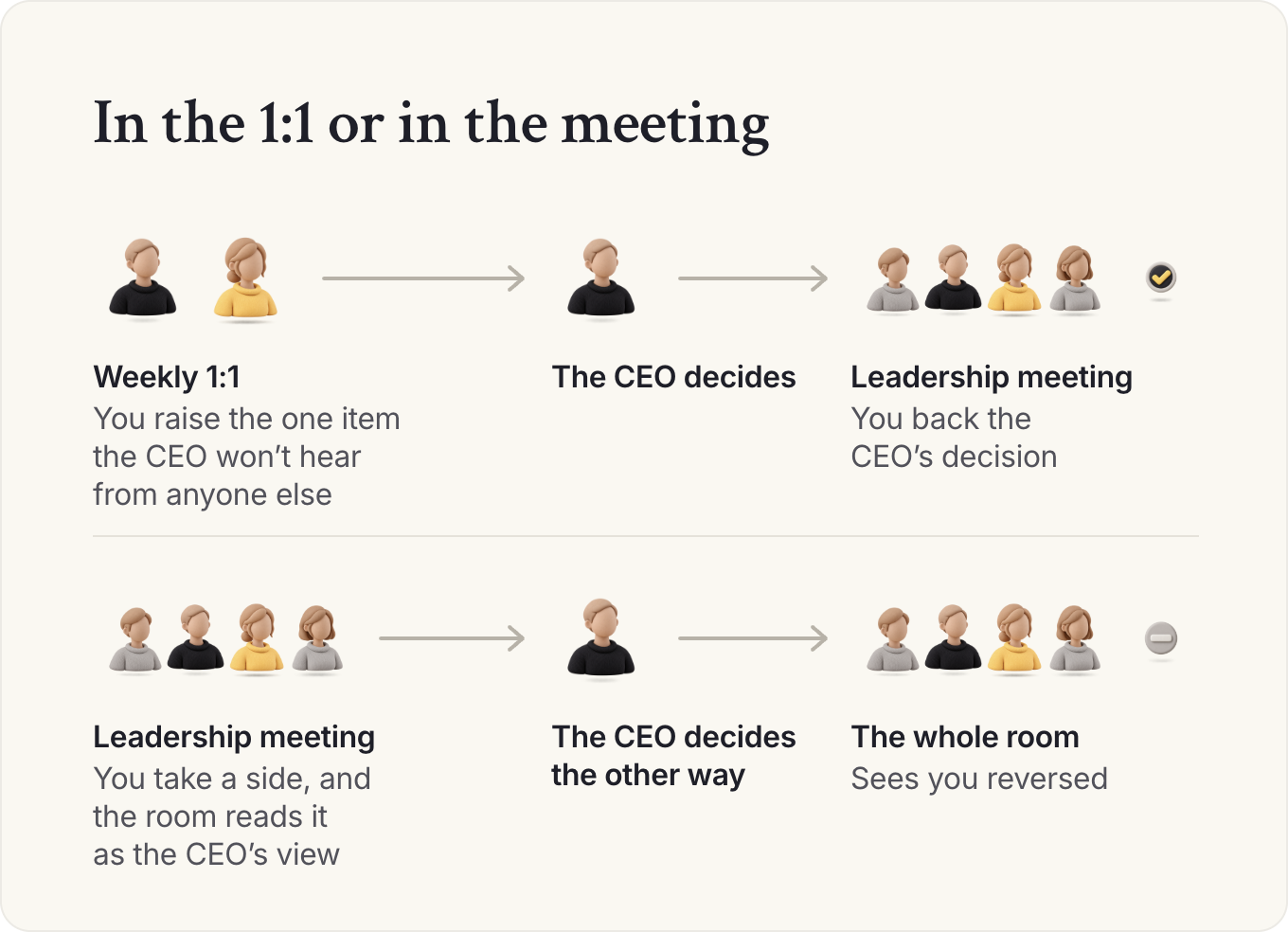
Patrick Aylward, then a vice president and Chief of Staff at Horizon Blue Cross Blue Shield of New Jersey, gave the reason in Harvard Business Review: "while a CEO's other direct reports typically emphasize their own areas, a good CoS can consider the needs of the whole enterprise." In practice, that means one item in each weekly 1:1 that the CEO won't hear from anyone else: the leader who has stopped pushing back, the customer story that contradicts the dashboard, the decision the company thinks is made and the CEO thinks is open.
Raise it in the 1:1, before the leadership meeting. When the CEO's Chief of Staff takes a side in the meeting, the room reads it as the CEO's view. If the CEO then decides the other way, the whole room sees you reversed. The Chief of Staff role guide explains why one public reversal costs more than a private correction.
Crystelle Desnoyer, a former Chief of Staff to the CEO at Techstars, told our podcast that "you have access to everything, especially the chief of staff to the CEO". In the same answer she called the Chief of Staff "the confidant" and said "you're alone".
You can't vent about the CEO to the leaders you work with. And what you say about a leader to the CEO carries weight, so you can't vent there either.
Later, at Kyndryl, Crystelle set up a Teams group for the company's Chiefs of Staff and called it the 007s. Start with the other Chiefs of Staff in your company, if there are any, then find people in the same seat at other companies.
Zach Garippa, CEO of Order.co, told our podcast that he talks to his Chief of Staff all day, every day. Both have children, so family time is off limits on both sides, and either one can work early or late around it. Agree which hours are off limits for each of you, and keep the rest flexible.
Expect the leadership team to test your role. A plan the CEO agreed in your interview still needs the co-founders and leaders who weren't in the room. Walk each of them through what you're there to do in your first two weeks, before your first request in the CEO's name.
If you're the CEO, ask your Chief of Staff in every 1:1 for the one thing you won't hear from anyone else, and thank them before you answer. Our guide for executives covers the rest of your side: what to hand over first, the Decide list and the six-month check.
How do CEOs hire and work with a Chief of Staff?
Decide what you'll hand over before you meet anyone, set the level from that, and put your direct reports on the interview panel. How to hire a Chief of Staff runs every step, from the mandate to day 90.
Zach wasn't familiar with the role before he hired his Chief of Staff. Advisors he trusted told him he needed one, so he spoke to about ten Chiefs of Staff at other companies, some outside his industry, to work out what he wanted. His reason: the role is broad, so if the hire goes wrong, the mistake is the CEO's.
I'd make three or four of those calls before you write the job description. Then three things matter more for a CEO than for other principals:
- Tell the finalists which changes you expect in their first year: a COO hire, a second person in your office, a new round. Each one changes the job. Ask each finalist how they'd handle the one most likely to come first.
- Name yourself as the principal in the job description, and list the first decisions you'll hand over. Only 41% of postings name who the Chief of Staff supports, so naming yourself tells candidates the seat is real. Our job description guide has a Chief of Staff to the CEO example for a Series A company.
- Give the finalists real time with you. A candidate who gets one short interview can't judge the seat, and the strong ones will notice.
Once they start, write the first one-page mandate together by week 4 and tell the leadership team what it says. The guide for executives has the Monday 1:1.
Hiring a Chief of Staff to the CEO? Post the role on our job board, where Chiefs of Staff and people who want the role look for jobs.
Post a jobShould you take a Chief of Staff to the CEO role, and where does it lead?
Take it if the CEO will give you decisions and their time, and if you can say what you want the role to lead to. Half of completed Chief of Staff stints last 20 months or less, and about three in four end within 30 months. Start planning the next move in your first few months.
Before you accept, count the hours the CEO gives you in the process. A CEO who meets you once for half an hour is unlikely to hand you decisions later.
Then ask the CEO which decisions you'd own in month one and how they like to hear bad news. Ask each leader you meet what they think the job is. Red flags in a Chief of Staff role has the full checklist, stage by stage.
Our career data does not split by principal. Across all Chiefs of Staff, the role is an inside track to operations leadership. Two thirds of Chiefs of Staff who become VP or Head of Operations do it at the company where they were Chief of Staff, and so do 46% of new COOs.
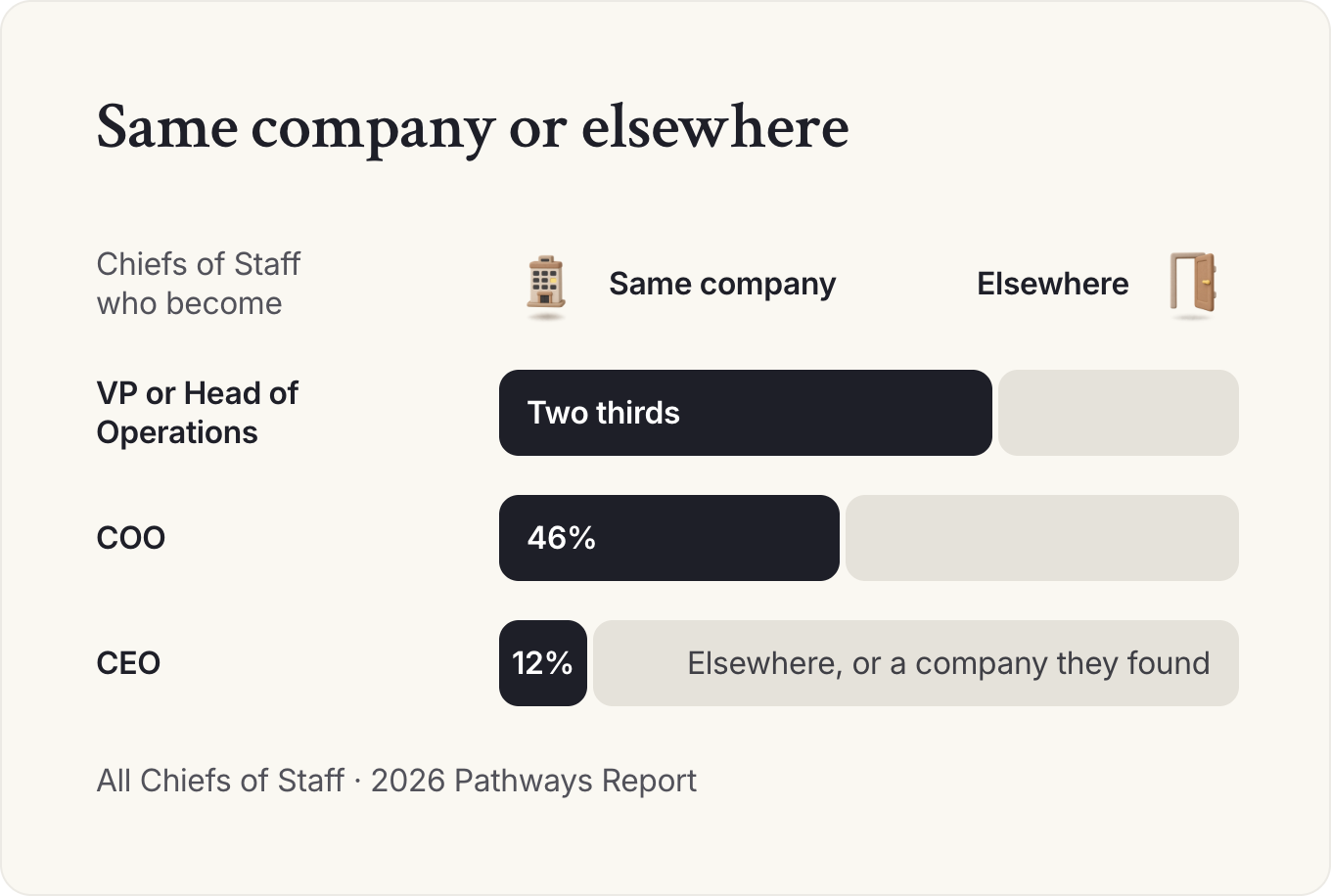
5% of former Chiefs of Staff become CEO within three years. Only 12% of Chiefs of Staff who become CEO do it at the company where they were Chief of Staff. The rest find the top job elsewhere or found a company.
So if you want operations leadership, tell the CEO early. Most VP and Head of Operations promotions from the seat happen inside the company. If you want to run a company one day, I'd plan to move or to build. Founding grew from 2% of moves out of the role in 2020 to 10% in 2025.
If you hold an offer, our offer guide shows how to judge and negotiate it. If you've just started, the first 90 days guide covers the first week to day 90.
Take this guide with you
The full guide as a PDF: every section, template and chart, ready to print or share with your team.
Your PDF is ready.
Download the PDFFree. We may email you new guides; unsubscribe anytime.
Frequently asked questions
Is a Chief of Staff to the CEO just a fancy executive assistant?
No. An executive assistant runs the CEO's time and logistics. The Chief of Staff works on what the CEO's time is spent on: priorities, decisions, the leadership team and the board. Many CEOs have both, and the two split the work by agreement. Chief of Staff vs executive assistant has the split.
Is a CEO's Chief of Staff more senior than a COO?
No, the COO is more senior in most companies. A COO is a C-suite executive who runs functions through a team. A Chief of Staff usually has no team and works through the CEO's authority. If your CEO hires a COO while you're in the seat, agree the new split with both of them before the COO starts.
Does a Chief of Staff to the CEO manage a team?
Often not at first. Many start alone, beside an executive assistant who reports to the CEO. As the company grows, the Chief of Staff often leads a small office of analysts and specialists. The office of the CEO guide covers who reports to whom.
- Chief of Staff Pathways Report 2026, Chief of Staff Network. 1,819 job postings (June to early October 2026), 741 of them naming the principal; 2,869 member career histories with 1,992 moves out of the role; within-three-years figures use 1,637 people.
- Chief of Staff Salary Report 2025, Chief of Staff Network (n=479).
- Leveling Framework, Chief of Staff Network.
- Dan Ciampa, "The Case for a Chief of Staff", Harvard Business Review, May to June 2020.
- The Chief of Staff Podcast: Zach Garippa, Crystelle Desnoyer.
- The three stages are an illustration built from postings and member roles. The checks and the re-scope moments are our recommendations.
Learn the job with people who do it
Membership gets you the Power Skills program, member events and a private community of working Chiefs of Staff.
Land your first Chief of Staff role
Launchpad helps you prepare, position yourself and interview for the role.
Starting out in the role?
The Fundamentals email course walks you through scoping the mandate, setting the cadence and earning trust.
Lead AI adoption from the Chief of Staff seat
The Chief of AI Fellowship is for operators turning AI into how the company runs.
Hiring a Chief of Staff?
Post the role on the Chief of Staff job board, or browse open roles.
Hiring a Chief of Staff?
Post the role on our job board, or have our team source and screen candidates with you.
Get your resume ready for the role
Get feedback on your Chief of Staff resume before you apply.
Let the right roles find you
Join the talent network and hear about Chief of Staff roles first.
The Chief of Staff newsletter
What Chiefs of Staff are reading, hiring for and building.
Get the full report
Every chart and cut from our latest salary research, sent to your inbox.
Using AI with sensitive data?
Learn the legal side of using AI at work.
Keep going in this series

 Basics
 Excel in the role
 AI and the Chief of Staff
 Toolkit
 Hiring a Chief of Staff