





Do you need a Chief of Staff?
Do you need a Chief of Staff? Count what waited on you over four weeks, see when an EA, COO or fractional hire fits better, and what they cost in US postings.

Ask AI
 Share

Yes, if decisions and cross-team work wait on you and no leader can own them. That starts with a leadership team to coordinate. If the gap is your calendar, hire an executive assistant. If one function misses its number, hire that leader or a COO. In US postings that list pay, the median for a Chief of Staff is $180,000.
- Decide from counts. Over four weeks, count the decisions that waited a week for you, the leadership meetings that ended without a decision, and the cross-team projects with no single owner.
- Fix your calendar first. If you have no assistant and spend more than five hours a week on your own scheduling, inbox and travel, an executive assistant gives those hours back. In US postings that list pay, an assistant's median pay is about half a Chief of Staff's.
- Wait if you won't hand over decisions in writing. A Chief of Staff who can't decide anything becomes a messenger, and your leaders will route around them.
- Time the hire by your leadership team. My rule of thumb is four or more direct reports who depend on each other. Funding stage tells you less.
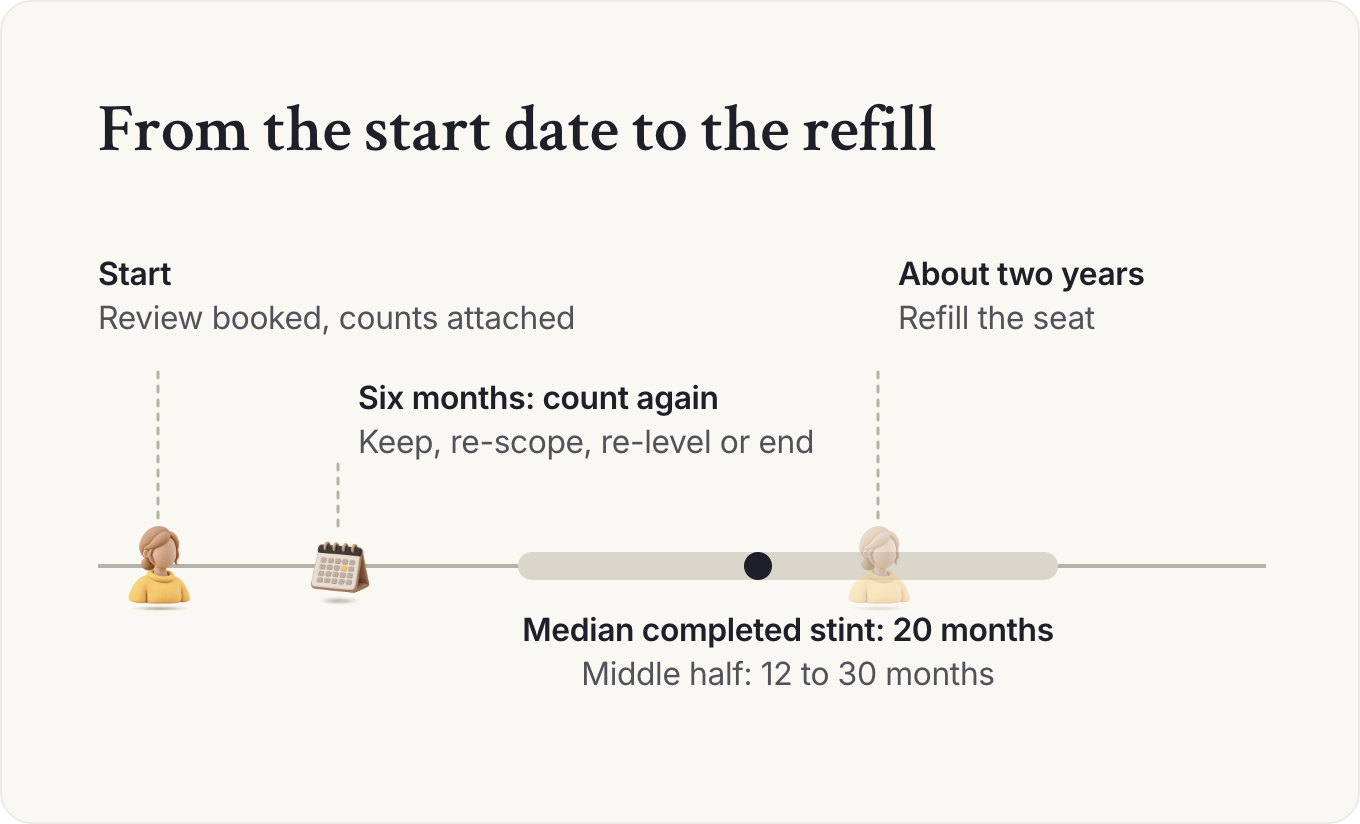
- Keep your counts. The day the offer is signed, book a review for six months after the start date, and run the same check again there.
Most founders who ask this question already feel stretched. The trouble is that being stretched can point to five different hires: an executive assistant, a functional leader, a COO, an operations hire or a Chief of Staff. Each one fixes a different problem.
Hire a Chief of Staff for the wrong problem and you pay a full salary for someone who spends their first months working out what the job is. You can tell the problems apart by counting what waited on you over the last four weeks. The check below turns those counts into one answer: a hire, or not yet. If the answer is a Chief of Staff, how to hire a Chief of Staff takes it from there.
How do you know if you need a Chief of Staff?
You need one when you have a leadership team of about four or more, and at least two of three things keep happening: decisions wait on you, the leadership meeting doesn't decide, and cross-team work has nobody owning it. Count them over four weeks before you write a job description.
Counting matters because the feeling is the same whatever the cause. Ena Patel, then Team President at Innovation Baseball Partners, had done Chief of Staff work in sports since 2018.
She told our podcast she expected the top seat to give her more control of her time. Instead she was changing hats by the hour and short of time to think. Her CFO told her, "You need a chief of staff."
Jenna Parker, then Chief of Staff at Healthie, got calls from founders who knew they wanted a Chief of Staff but weren't sure why. She started them with an audit: where their time goes, and which of that work only they can do.
She told us the answers end up writing the job description. The check below does the same audit with numbers.
Template: Do you need a Chief of Staff? A four-week check
Do you need a Chief of Staff? A four-week check
Look back at your last four weeks of calendar, email and leadership meeting notes. Write a number on each line. Estimates are fine.
Count
- Decisions that waited a week or more for you: [ ]
- Leadership meetings (of the last four) that ended without a decision, an owner and a date: [ ]
- Cross-team projects that are stalled and have no single owner: [ ]
- Hours a week you spend on your own calendar, inbox, travel and expenses: [ ]
- Hours a week you spend chasing follow-ups, preparing meetings and passing questions between your leaders: [ ]
- Direct reports who need each other to get their work done: [ ]
- Is one number missing every week, owned by one team? [yes / no]
- Can you name three decisions you would hand to someone else, in writing? [yes / no]
Read your result
Lines 1 to 3 count as "over" at 5 or more decisions, 2 or more meetings, and 1 or more projects. Go down the list and stop at the first result that fits.
- Line 4 is more than 5 hours and you have no assistant: hire an executive assistant first. Run this check again a month after they start.
- Line 6 is fewer than 4: not yet for a Chief of Staff. If line 7 is yes, hire the leader for that function. If any of lines 1 to 3 is over, hire someone to do that work themselves, in operations, finance or people. If neither, no new hire yet.
- Two or more of lines 1 to 3 are over, and line 8 is no: not yet. Write down three decisions you'd hand over, then count again.
- Two or more are over, line 7 is yes, and that number will cost you a customer or a quarter: hire the leader for that function first, then count again.
- Two or more are over, and line 5 is under 10 hours: no new hire yet. By our estimate, fractional Chiefs of Staff start at about 10 to 20 hours a week, so this is less work than the smallest engagement. Count again next quarter.
- Two or more are over, and line 5 is 10 hours or more but under 15: a fractional Chief of Staff, for about that many hours a week.
- Two or more are over, and line 5 is 15 hours or more: a full-time Chief of Staff.
- Line 7 is yes: hire the leader for that function.
- Only line 3 is over: an operations or program hire to own those projects.
- Only line 1 or only line 2 is over: run your leadership meeting differently for a quarter, then count again.
- None of the above: no new hire yet. Count again next quarter.
These thresholds are our own defaults. No survey sets them. Move them to fit your company, and keep the order.
# Do you need a Chief of Staff? A four-week check

Look back at your last four weeks of calendar, email and leadership meeting notes. Write a number on each line. Estimates are fine.

## Count
1. Decisions that waited a week or more for you: [ ]
2. Leadership meetings (of the last four) that ended without a decision, an owner and a date: [ ]
3. Cross-team projects that are stalled and have no single owner: [ ]
4. Hours a week you spend on your own calendar, inbox, travel and expenses: [ ]
5. Hours a week you spend chasing follow-ups, preparing meetings and passing questions between your leaders: [ ]
6. Direct reports who need each other to get their work done: [ ]
7. Is one number missing every week, owned by one team? [yes / no]
8. Can you name three decisions you would hand to someone else, in writing? [yes / no]

## Read your result
Lines 1 to 3 count as "over" at 5 or more decisions, 2 or more meetings, and 1 or more projects. Go down the list and stop at the first result that fits.

- **Line 4 is more than 5 hours and you have no assistant:** hire an executive assistant first. Run this check again a month after they start.
- **Line 6 is fewer than 4:** not yet for a Chief of Staff. If line 7 is yes, hire the leader for that function. If any of lines 1 to 3 is over, hire someone to do that work themselves, in operations, finance or people. If neither, no new hire yet.
- **Two or more of lines 1 to 3 are over, and line 8 is no:** not yet. Write down three decisions you'd hand over, then count again.
- **Two or more are over, line 7 is yes, and that number will cost you a customer or a quarter:** hire the leader for that function first, then count again.
- **Two or more are over, and line 5 is under 10 hours:** no new hire yet. By our estimate, fractional Chiefs of Staff start at about 10 to 20 hours a week, so this is less work than the smallest engagement. Count again next quarter.
- **Two or more are over, and line 5 is 10 hours or more but under 15:** a fractional Chief of Staff, for about that many hours a week.
- **Two or more are over, and line 5 is 15 hours or more:** a full-time Chief of Staff.
- **Line 7 is yes:** hire the leader for that function.
- **Only line 3 is over:** an operations or program hire to own those projects.
- **Only line 1 or only line 2 is over:** run your leadership meeting differently for a quarter, then count again.
- **None of the above:** no new hire yet. Count again next quarter.

These thresholds are our own defaults. No survey sets them. Move them to fit your company, and keep the order.
Example: four-week check for a 70-person Series A founder (illustration)
Do you need a Chief of Staff? A four-week check
Founder and CEO, Series A software company, 70 people. Counted over the four weeks before the Q3 board meeting.
Count
- Decisions that waited a week or more for you: 9 (pricing for two enterprise deals, three hiring approvals, the partner contract, the office lease, the Q3 hiring plan, the support tool)
- Leadership meetings that ended without a decision, an owner and a date: 3 of 4
- Cross-team projects that are stalled with no single owner: 2 (the self-serve launch, sitting between product and sales; the SOC 2 audit, between engineering and finance)
- Hours a week on my own calendar, inbox, travel and expenses: 2 (we have an EA)
- Hours a week chasing follow-ups, preparing meetings and passing questions between leaders: about 18
- Direct reports who need each other: 5
- One number missing every week, owned by one team? No. Churn is fine, pipeline is fine.
- Three decisions I'd hand over in writing? Yes: the leadership meeting agenda, the planning calendar, who owns each cross-team launch
Result
Lines 4 and 6 don't stop me. All three of lines 1 to 3 are over, line 8 is yes, and line 7 is no. Line 5 is 18 hours, so the answer is a full-time Chief of Staff.
At 10 hours on line 5, it would have been a fractional Chief of Staff for about 10 hours a week.
# Do you need a Chief of Staff? A four-week check

Founder and CEO, Series A software company, 70 people. Counted over the four weeks before the Q3 board meeting.

## Count
1. Decisions that waited a week or more for you: 9 (pricing for two enterprise deals, three hiring approvals, the partner contract, the office lease, the Q3 hiring plan, the support tool)
2. Leadership meetings that ended without a decision, an owner and a date: 3 of 4
3. Cross-team projects that are stalled with no single owner: 2 (the self-serve launch, sitting between product and sales; the SOC 2 audit, between engineering and finance)
4. Hours a week on my own calendar, inbox, travel and expenses: 2 (we have an EA)
5. Hours a week chasing follow-ups, preparing meetings and passing questions between leaders: about 18
6. Direct reports who need each other: 5
7. One number missing every week, owned by one team? No. Churn is fine, pipeline is fine.
8. Three decisions I'd hand over in writing? Yes: the leadership meeting agenda, the planning calendar, who owns each cross-team launch

## Result
Lines 4 and 6 don't stop me. All three of lines 1 to 3 are over, line 8 is yes, and line 7 is no. Line 5 is 18 hours, so the answer is a full-time Chief of Staff.
At 10 hours on line 5, it would have been a fractional Chief of Staff for about 10 hours a week.
The order of the check matters. The assistant comes first: without one, the calendar lands on the Chief of Staff and stays there. Team size comes next, because with fewer than four leaders there's little between them to coordinate. Delegation comes before the fractional and full-time answers, because a Chief of Staff with nothing to decide has no job.
Our guides to Chief of Staff vs executive assistant and Chief of Staff vs COO test each pair in more depth.
Would an EA, a COO or an operations hire fix it better?
Often, yes. Match the hire to what you counted, and price each option on the same basis: what US postings that list pay offer.
An assistant fixes your time, a functional leader or COO fixes a number, and an operations hire fixes data or one project. A Chief of Staff fixes decisions and coordination across your leaders.
Which hire fixes which problem
| What you counted | Better fix | Median US posted pay | Read next |
|---|---|---|---|
| Your calendar, inbox and travel take your evenings | Executive assistant | $95,000 (EA and executive business partner) | Chief of Staff vs executive assistant |
| One number misses every week, and one team owns it | The leader for that function | Depends on the function | Line 7 of the check |
| You want someone else to manage several functions day to day | COO, VP or Head of Operations | $155,000 (operations leadership: COO, VP or Head) | Chief of Staff vs COO |
| Reports, planning models and business reviews get built by hand | Business operations or strategy and operations | $156,000 | Chief of Staff vs COO, which also compares BizOps |
| One cross-team project that ends on a set date | Program or project manager | Not in our posting data | The section below |
| Decisions and cross-team work wait on you, and line 5 is 10 hours or more but under 15 | Fractional Chief of Staff | Priced by the hour or by retainer | Fractional Chief of Staff |
| Decisions and cross-team work wait on you, and line 5 is 15 hours or more | Chief of Staff | $180,000 | How to hire a Chief of Staff |
Source: Pathways Report 2026
Of the medians in that table, the Chief of Staff's is the highest, though the operations figure mixes COO, VP and Head of Operations roles. So be sure your counts point at coordination before you pay for it. A missed number with one owner gets fixed fastest by someone who manages that owner.
Chief of Staff, director of operations or project manager?
A director of operations owns how part of the business runs, usually with a team and a budget. That's the COO-shaped hire one level down, and it's right when the problem is delivery, service or process inside operations. A Chief of Staff usually has no team and works across all your leaders on what you would otherwise do yourself.
A project or program manager owns one piece of work with a known end, such as a migration, an audit or a launch. If line 3 is the only line over, that's the hire. If line 1 or line 2 is over too, the stalled projects are a symptom of how your leadership team works, and the check points you to a Chief of Staff.
When are you not ready for a Chief of Staff?
You're not ready if you won't hand over any decisions, if you want someone to deliver news you haven't delivered yourself, or if you're hiring because your peers have one. Any of these turns a strong hire into an expensive assistant or an early exit. So does hiring before you have a leadership team to coordinate, which the next section covers.
You won't hand anything over
A Chief of Staff earns authority when your leaders see them make calls you don't reopen. If every decision still goes back to you, all they can do is pass messages. Your leaders notice fast and start coming to you directly, and the person you hired starts looking for a job with a real remit.
Line 8 of the check is the test. If you can't name three decisions you'd hand over in writing today, write them before you post the role. Our Chief of Staff mandate guide shows how the three tiers work: what they decide, what they recommend, and what someone else owns.
You want someone to deliver the hard news
Some founders hire a Chief of Staff to settle a co-founder dispute or to ease out a VP they haven't spoken to yet. A Chief of Staff can prepare that conversation and run what follows. They can't have it for you, and if they try, your team reads them as your enforcer for as long as they stay.
I'd rather you wait a quarter than hire into that. Have the conversation first, then hire for the work it leaves behind.
You're hiring because your peers have one
The title is popular, and a founder who hires for it usually ends up with a smart person and no remit. If your four-week counts are low, the new hire will invent work to look useful. Count again next quarter, and spend the salary on the hire your counts do point to.
What size company needs a Chief of Staff?
Any size can, and our data shows the role at every headcount. What changes with size is the level and the work.
For a startup, funding stage is a weak signal on its own. The shape of your leadership team tells you more: how many leaders report to you, and how much of their work depends on each other.
Just over half the Chiefs of Staff in our salary survey work at companies of 200 people or fewer, and two thirds at 500 or fewer. That tells you where the people who answered our survey work. It doesn't measure where the role pays off, so the stages below are my read of how the job changes as you grow.
Before you have a leadership team
At this size the job is mostly doing the work. Andrew Rea, co-founder and CEO of Taxwire, told our podcast that early on everyone is building or selling, and "even series A might be too early" for the strategic version of the role. David Moon, then his Chief of Staff, had to remind him to invoice customers.
That can still be the right hire. Teddy Owen, then Chief of Staff at Moonhub, joined as employee four, because a solo founder wanted someone to run the operational side (HR, legal, IT) that a second co-founder often covers.
He told us he built a team of outside partners, such as accountants and lawyers, for the areas where he's weakest. If you hire at this stage, hire an operator who wants to do the work, and use the title only if you mean the seat to grow.
Some founders hire this early hoping the person grows into their COO. Jenna Parker told us she has seen founders do this. In our career data, 7% of Chiefs of Staff reach COO within three years, and 46% of those who become COO do it at the company where they were Chief of Staff. If that's your plan, say so when you make the hire, so your future leaders hear it from you first.
Once you have a leadership team
My rule of thumb is four or more direct reports who need each other to get work done. That's when the waiting, the meetings and the stalled projects from the check start to show, because no single leader owns the work between them. The Chief of Staff runs the operating rhythm, prepares your decisions and owns that in-between work until a team can take it.
At this point the Chief of Staff usually sits beside your direct reports, so level the role to them. A Chief of Staff two levels below the VPs they need to align will spend the year asking permission.
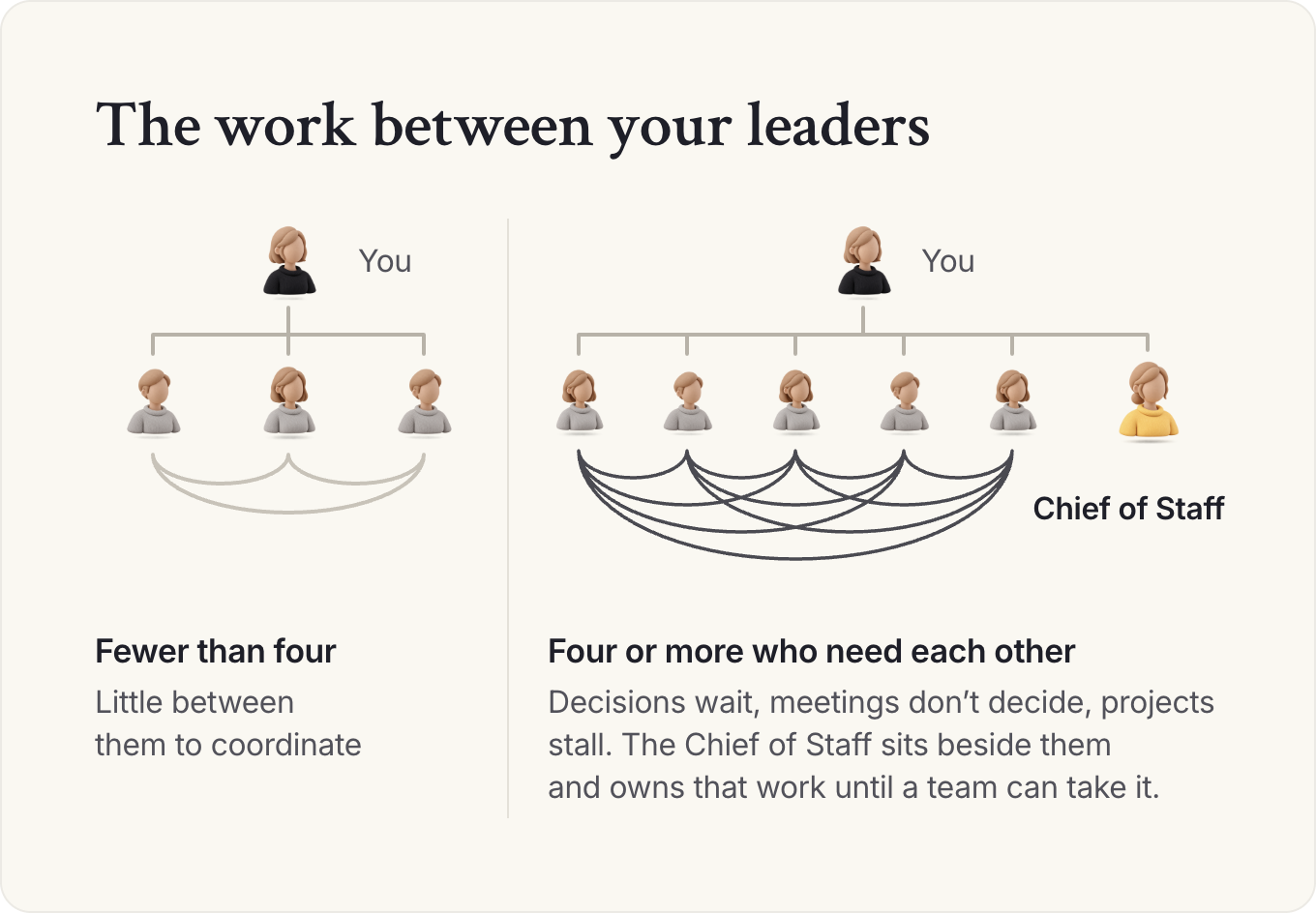
Expect at least one of those VPs to read the hire as a new layer between them and you. Tell them what the role will decide before you post it, so they hear it from you before they see the job ad.
At a larger company
At a large company, your Chief of Staff may well work for a leader below the CEO. Postings show how common that is at any size: where a posting says who the Chief of Staff supports, only 44% name the CEO, founder or president. In our survey, Manager-level roles spike at very large companies (see the chart), which fits a Chief of Staff who supports a VP.
If you run a function at a large company, the same check works on your part of the business, so count your own leadership team. At that size your Chief of Staff often works alongside a wider office of the CEO.
How much does a Chief of Staff cost, and what should it return?
Write down what the role should return, then budget by level. In US postings that list pay, the median for a Chief of Staff is $180,000.
I'd write the return before you look at a single salary figure. Put it in two sentences: what's happening now that shouldn't be, and what will be different in six months.
The return is what moves because the role exists: decisions that take days, not weeks, a leadership meeting that runs without you chasing it, and a stalled launch that ships. You also get hours of your week back for selling, fundraising or product. Your four-week counts are the baseline, so the same counts six months later show the return.
Most posted bands run about $150,000 to $200,000. Add any bonus, equity at a startup, benefits and a search fee if you use a firm. The Chief of Staff salary guide has pay by level, company size and city. Pick the level from the decisions the role will make: our Leveling Framework ties each level to how much the person shapes decisions.
Plan for the time the person stays. The median completed Chief of Staff stint is 20 months, and the middle half run 12 to 30 months.
So plan to refill the seat in about two years, whether they move up inside the company or leave it. If they move up, you keep a trained operator, and possibly the person who takes over operations next. Operations and strategy is the most common next move for Chiefs of Staff.
Pricing the role before you post it? The 2025 Salary Report has Chief of Staff pay by level, company size, city and industry, with bonus and equity.
Download the full reportHow do you know after six months whether it worked?
Run the four-week check again and put the counts next to the ones you took before the hire. If decisions wait less, the leadership meeting decides things and the stalled projects have owners, keep the role and set the next two quarters.
If the counts haven't moved, look at what's still broken. Each pattern points to a different fix, and only one of them is about the person.
The six-month verdict
| What you see at six months | What it usually means | What to do |
|---|---|---|
| Your leaders bring the Chief of Staff the decisions you handed over, and the counts are down | It's working | Keep it. Set the next two quarters, and check the level if the scope grew |
| Decisions still wait on you, though the Chief of Staff is busy | You never announced what they decide, or you keep reopening it | Yours to fix: put the decision rights in writing to your leaders, and stop reopening them |
| The Chief of Staff mostly runs your calendar and builds your decks | You hired into an assistant's job | Hire the assistant, then move the Chief of Staff onto lines 1 to 3 of the check |
| Your leaders go around the Chief of Staff | The level is too low for the people they must align, or the role was never introduced | Re-level against the leaders they work beside, and introduce the role again in your leadership meeting |
| Lots of activity, nothing shipped | Too many priorities in the mandate | Cut the mandate to its top two responsibilities |
| The mandate is clear, the level is right, and your leaders still don't trust them | The wrong person | End it well and rehire, using what you learned to rewrite the job description |
Work down the table in order. Rows two to five are about the setup, which is yours. Only the last row is about the person, and you can't judge the person fairly until the setup is right.
The Chief of Staff will track their own outcomes on the six-month scorecard in our role guide. Your job at the review is the verdict: keep, re-scope, re-level or end. I'd make the call at the six-month review, and not let a bad fit drift to month eighteen.
If the check said yes, keep this week's counts. The day the offer is signed, book a 45-minute review for six months after the start date and attach them.
Take this guide with you
The full guide as a PDF: every section, template and chart, ready to print or share with your team.
Your PDF is ready.
Download the PDFFree. We may email you new guides; unsubscribe anytime.
Frequently asked questions
Can a fractional Chief of Staff be a trial for a full-time hire?
Yes, and it's a good way to learn what the work is before you commit. Agree up front what would make it full-time, such as the work passing 15 hours a week (the check's full-time line) or the person needing to be in every leadership meeting. Our fractional Chief of Staff guide covers when to convert and how to price it.
I already have an executive assistant. Do I still need a Chief of Staff?
Possibly. A good assistant gives you your time back, and then you find out whether decisions were the bottleneck all along. If your calendar runs well and lines 1 to 3 of the check are still over, the gap is decisions and coordination. An assistant isn't hired to own those, so the answer is probably a Chief of Staff.
Does a CTO or other functional leader need a Chief of Staff?
Often. After the CEO, founder or president, the most common leader in postings that name one is a technology, product or engineering leader, at 21%. Run the check on your own leadership team, because the same signs apply inside a function. A functional Chief of Staff usually runs your operating review in place of the company-wide leadership meeting. Our guide for executives covers working with a Chief of Staff as a functional leader.
How long does a Chief of Staff usually stay?
About 20 months at the median, so plan to refill the seat in about two years. Chiefs of Staff who stay two to three years are the most likely to step up next. Agree the expected tour and a likely next role when you hire, because a named next step gives a strong person a reason to stay through that window.
Should I promote someone or hire from outside?
Look inside first. About a third of Chief of Staff hires come from inside the company. Someone you already trust starts faster. How to hire a Chief of Staff covers how to promote without a stall, and how to ask in a way they can turn down.
- Chief of Staff Salary Report 2025, Chief of Staff Network (n=479). Base pay by self-selected level, respondents by company headcount, and level mix by headcount from the report text.
- Chief of Staff Pathways Report 2026, Chief of Staff Network. 1,819 job postings (June to early October 2026) and 2,869 career histories. Pay figures are from US postings that state pay, about 1 in 5.
- The State of Chief of Staff Jobs, Chief of Staff Network, 2024.
- Leveling Framework, Chief of Staff Network.
- Chief of Staff Network podcast: Ena Patel, Jenna Parker, Andrew Rea and Teddy Owen, linked in the text.
- The four-week check, its thresholds, the route order and the six-month verdict table are our recommendations. The Series A example is an illustration.
Learn the job with people who do it
Membership gets you the Power Skills program, member events and a private community of working Chiefs of Staff.
Land your first Chief of Staff role
Launchpad helps you prepare, position yourself and interview for the role.
Starting out in the role?
The Fundamentals email course walks you through scoping the mandate, setting the cadence and earning trust.
Lead AI adoption from the Chief of Staff seat
The Chief of AI Fellowship is for operators turning AI into how the company runs.
Hiring a Chief of Staff?
Post the role on the Chief of Staff job board, or browse open roles.
Hiring a Chief of Staff?
Post the role on our job board, or have our team source and screen candidates with you.
Get your resume ready for the role
Get feedback on your Chief of Staff resume before you apply.
Let the right roles find you
Join the talent network and hear about Chief of Staff roles first.
The Chief of Staff newsletter
What Chiefs of Staff are reading, hiring for and building.
Get the full report
Every chart and cut from our latest salary research, sent to your inbox.
Using AI with sensitive data?
Learn the legal side of using AI at work.
Keep going in this series



 Basics
 Excel in the role
 AI and the Chief of Staff
 Toolkit
 Hiring a Chief of Staff