


How to evaluate and negotiate a Chief of Staff offer
Is your Chief of Staff offer good? Score the level, scope and pay against the band for your level, then negotiate in 7 steps, with scripts to copy.

Ask AI
 Share

A good Chief of Staff offer settles the job before the money: your level, the decisions you'll own, your time with your principal and the date you'll be reviewed. Get those in writing first. Then negotiate in order: level, title, base, bonus, equity, review date. Our 2025 survey's median base was $160,000, but compare yours with your level's average.
- Settle the job before the money. Your level, the decisions you'll own and your principal's time decide whether the role works, and they're easiest to get in writing before you sign.
- Agree the level first, because it sets the pay band. In our 2025 salary survey, Director-level Chiefs of Staff average about $29,000 more in base than Manager-level ones.
- Ask for the terms that cost the company nothing: written decision rights, a 12-month review of level and pay, and the expected next role.
- Value a startup grant only with four numbers: option count, fully diluted shares, strike price and last preferred price. Until you have them, compare offers on base.
- Never accept on the call. Reply in writing, and send a recap the same day so the letter matches what you agreed.
Most Chief of Staff offers spell out a base, a grant and a start date. Few spell out the decisions you'll make, whether you'll sit in the leadership meeting, or what the job turns into after two years. Those gaps decide whether the role works, and you can close them before you sign far more easily than after.
Whether you're landing a Chief of Staff role or making the offer, the scorecard below lists what should be in writing before anyone signs. If you're the executive, write those lines into the offer before the candidate has to ask, starting with the level and the decision rights. Our guide to hiring a Chief of Staff covers the rest of the offer process.
Is this a good Chief of Staff offer?
A Chief of Staff offer is good when it names your level and decision rights, gives you real access to your principal (the executive you'll work for), and pays inside the band for that level at a company of that size. If the pay is fair and the scope is vague, the offer is still unfinished.
The scorecard below puts the parts that decide the job first and the money last. Score each line from 1 to 3, then mark every gap as "fix before signing" or "walk away". Expect most gaps to be fixable, because they cost the company little to write down.
Template: Chief of Staff offer scorecard
Chief of Staff offer scorecard
Company: [name, headcount, stage] · Principal: [name, title] · Offer date: [date] · Reply due: [date]
Score: 3 = clear and in writing, 2 = said out loud, 1 = missing or vague
| Part of the offer | What the offer says | Score | Fix before signing / walk away |
|---|---|---|---|
| Principal: who, and how much 1:1 time each week | |||
| Level: which leaders the role sits beside | |||
| Decision rights: what I decide, recommend, don't own | |||
| Access: leadership meeting, board materials | |||
| Reporting line: solid to the principal, dotted or split | |||
| Admin share: who owns calendar, travel, inbox | |||
| Title | |||
| Expected tour and next role | |||
| Base: inside the band for the level and company size | |||
| Bonus: terms in writing (see the salary guide checklist) | |||
| Equity: four facts and terms in writing (see the salary guide checklist) | |||
| Review date for level and pay |
My read
- Lines scored 1: [list]
- Fix before signing: [list, with the ask for each]
- Walk away if: [the one or two gaps I won't accept]
# Chief of Staff offer scorecard

Company: [name, headcount, stage] · Principal: [name, title] · Offer date: [date] · Reply due: [date]

Score: 3 = clear and in writing, 2 = said out loud, 1 = missing or vague

| Part of the offer | What the offer says | Score | Fix before signing / walk away |
| --- | --- | --- | --- |
| Principal: who, and how much 1:1 time each week | | | |
| Level: which leaders the role sits beside | | | |
| Decision rights: what I decide, recommend, don't own | | | |
| Access: leadership meeting, board materials | | | |
| Reporting line: solid to the principal, dotted or split | | | |
| Admin share: who owns calendar, travel, inbox | | | |
| Title | | | |
| Expected tour and next role | | | |
| Base: inside the band for the level and company size | | | |
| Bonus: terms in writing (see the salary guide checklist) | | | |
| Equity: four facts and terms in writing (see the salary guide checklist) | | | |
| Review date for level and pay | | | |

## My read
- Lines scored 1: [list]
- Fix before signing: [list, with the ask for each]
- Walk away if: [the one or two gaps I won't accept]
Example: offer scorecard for a Series B CEO's Chief of Staff (illustration)
Chief of Staff offer scorecard
Company: 180 people, Series B · Principal: CEO and co-founder · Offer date: Nov 3 · Reply due: Nov 10
Score: 3 = clear and in writing, 2 = said out loud, 1 = missing or vague
| Part of the offer | What the offer says | Score | Fix before signing / walk away |
|---|---|---|---|
| Principal: who, and how much 1:1 time each week | CEO, weekly 1:1 promised in interviews | 2 | Fix: put the weekly 1:1 in the offer note |
| Level: which leaders the role sits beside | "Works with the exec team" | 1 | Fix: confirm Director, beside the VPs |
| Decision rights: what I decide, recommend, don't own | Not written | 1 | Walk away if still unwritten after the final call |
| Access: leadership meeting, board materials | Leadership meeting yes, board not mentioned | 2 | Fix: own the board pre-read |
| Reporting line: solid to the principal, dotted or split | Solid line to the CEO | 3 | None |
| Admin share: who owns calendar, travel, inbox | Existing EA keeps them | 3 | None |
| Title | Chief of Staff | 3 | None |
| Expected tour and next role | Not discussed | 1 | Fix: ask for the expected tour in writing |
| Base: inside the band for the level and company size | $165,000 | 2 | Fix: ask for the Director band |
| Bonus: terms in writing (see the salary guide checklist) | 10%, "at CEO discretion" | 1 | Fix: tie it to company targets |
| Equity: four facts and terms in writing (see the salary guide checklist) | 25,000 options, no share count or strike | 1 | Fix: get the four facts before replying |
| Review date for level and pay | None | 1 | Fix: 12-month review, in writing |
My read
- Lines scored 1: level, decision rights, next role, bonus terms, equity facts, review date
- Fix before signing: confirm Director level; written decision rights; the expected tour and next role; bonus tied to company targets; the four equity facts; 12-month review
- Walk away if: decision rights stay unwritten after the final call
# Chief of Staff offer scorecard

Company: 180 people, Series B · Principal: CEO and co-founder · Offer date: Nov 3 · Reply due: Nov 10

Score: 3 = clear and in writing, 2 = said out loud, 1 = missing or vague

| Part of the offer | What the offer says | Score | Fix before signing / walk away |
| --- | --- | --- | --- |
| Principal: who, and how much 1:1 time each week | CEO, weekly 1:1 promised in interviews | 2 | Fix: put the weekly 1:1 in the offer note |
| Level: which leaders the role sits beside | "Works with the exec team" | 1 | Fix: confirm Director, beside the VPs |
| Decision rights: what I decide, recommend, don't own | Not written | 1 | Walk away if still unwritten after the final call |
| Access: leadership meeting, board materials | Leadership meeting yes, board not mentioned | 2 | Fix: own the board pre-read |
| Reporting line: solid to the principal, dotted or split | Solid line to the CEO | 3 | None |
| Admin share: who owns calendar, travel, inbox | Existing EA keeps them | 3 | None |
| Title | Chief of Staff | 3 | None |
| Expected tour and next role | Not discussed | 1 | Fix: ask for the expected tour in writing |
| Base: inside the band for the level and company size | $165,000 | 2 | Fix: ask for the Director band |
| Bonus: terms in writing (see the salary guide checklist) | 10%, "at CEO discretion" | 1 | Fix: tie it to company targets |
| Equity: four facts and terms in writing (see the salary guide checklist) | 25,000 options, no share count or strike | 1 | Fix: get the four facts before replying |
| Review date for level and pay | None | 1 | Fix: 12-month review, in writing |

## My read
- Lines scored 1: level, decision rights, next role, bonus terms, equity facts, review date
- Fix before signing: confirm Director level; written decision rights; the expected tour and next role; bonus tied to company targets; the four equity facts; 12-month review
- Walk away if: decision rights stay unwritten after the final call
In the example, six lines score 1. Four of them (decision rights, next role, equity facts, review date) cost the company nothing to write down. The level costs real money, because it moves the band, so it goes first on the call and gets the most time.
For the base, bonus and equity lines, use the benchmarks by level, company size and city in our salary guide. Before the offer stage, our guide to role red flags covers how to tell whether the role is real at all.
A few gaps rarely improve after you join, and those are the ones to treat as reasons to walk away.
Gaps in a Chief of Staff offer: fix before signing or walk away
| Gap | Fix before signing | Walk away when |
|---|---|---|
| Level unnamed | Ask which leaders you sit beside; confirm in the recap | The answer changes from one interviewer to the next |
| Decision rights unwritten | Ask for three short lists in the offer note | Still unwritten after the final call |
| Equity facts missing | Ask for the four numbers in writing | The company won't share them and says the grant makes up for a low base |
| Split reporting line | Name who settles conflicts between the two | Both leaders expect you to run their priorities first |
| No review date | Ask for a review at 12 months, tied to six-month outcomes | Nobody will commit to any date |
| Exploding deadline | Ask for more time on the call, and name the day you'll reply | The deadline is shorter than the time you need to check the terms |
How do you judge the parts of the offer that aren't cash?
Judge them by asking what each one lets you do in your first six months. A Chief of Staff often has no team and no budget of their own, so the job runs on authority borrowed from the principal, and the offer's non-cash terms decide how much of it you get.
The principal and their time
Your principal's time decides more about this job than anything else in the offer. Ask how often you'll meet one to one, whether they've had a Chief of Staff before and what happened to that person, and what they'll stop doing once you arrive.
A useful test is the first 90 days. Ask your principal what they'd want done by the end of month three. If they can describe the strategy but can't name three things you'd do to move it, expect the role to be defined later, one request at a time.
In a first Chief of Staff role, I'd take a strong principal and written decision rights at the bottom of the band over the top of the band without them. A pay gap can close at your first review. A year without decision rights leaves you little to describe in your next interview loop.
Decision rights and the level
Decision rights come in three tiers: what you decide alone, what you shape for your principal to decide, and what another named owner holds. They're the clearest evidence of your level, which is why our guide to Chief of Staff job descriptions tells employers to write them before any duties. If the offer can't list them, ask for them as three short lists in the offer note.
These are normal asks. If you're the executive, put them in the offer before the candidate has to ask: the level, the band, the equity facts, the expected tour (how long the role is meant to last) and a 12-month review. Once you've agreed them, the decision-rights lists become the core of your Chief of Staff mandate in your first month.
Reporting line, access and the admin share
A solid line to your principal gets you into their calendar and their meetings, and it gets you their backing in a dispute. A dotted line to the CEO with a solid line to someone else often means two sets of priorities and a weaker hand in both. Ask which meetings you'll attend by right: the leadership meeting, the operating review and the board pre-read are the three that matter most.
Then ask who owns the calendar, travel and inbox. If there's no executive assistant and nobody else named, that work becomes yours by default. Our guide to Chief of Staff vs executive assistant has a table of the signs an offer is a hybrid role.
The same tests separate two offers that look close on paper.
Two Chief of Staff offers, side by side (illustration)
| Offer A: 900-person software company | Offer B: 120-person Series B | |
|---|---|---|
| Principal | COO, solid line; dotted line to the CEO | CEO, solid line |
| Decision rights | Runs a project list set by the COO | Decides the leadership meeting agenda and the planning process |
| Access | Operating review; not the leadership meeting | Leadership meeting and board pre-read |
| Admin share | No EA on the team | EA keeps calendar and travel |
| Base | $185,000 | $170,000 |
| Expected tour and next role | Not discussed | Two years, with a path to head of operations named |
Offer A pays $15,000 more and describes a Manager-level role with a Director-level salary. Offer B is a Director-level role at a lower base, with a next step written down. For a first Chief of Staff role, B is the stronger offer, and you can ask for a 12-month review to close the pay gap.
A would win if the COO is the principal you most want to learn from, or if the role comes with a written path to the CEO's office. So before you decide, ask what the COO would teach you, and whether that path to the CEO's office can go in writing.
Location, development and the exit terms
If the role is remote or hybrid, ask which pay zone sets the base and how many days a month you'll spend in the room with your principal. Access is most of what this job runs on, and it's thinner on video.
Ask for a development budget for a course or coaching. It costs the company little, so it's an easy yes when the base won't move.
Then read the exit terms: severance, any non-compete, and what happens to your unvested equity if the company is sold and your role goes. Your job depends on one executive more than most jobs do, so also ask what happens to the role if your principal leaves.
How should you weigh equity, title and base pay?
Weigh them by how far you can trust each one: base most, the title by the decisions behind it, and private-company equity least. Each trades against the others, so decide which one you'll give ground on before the call.
Three fictional offers show how to read a base against the level, size and city benchmarks.
Three example Chief of Staff offers against 2025 benchmarks (illustration)
| Series C, Boston | Seed startup, New York | Public company, Chicago | |
|---|---|---|---|
| Company | About 300 people | 25 people | 8,000 people |
| Principal | CEO | CEO and founder | Business unit president |
| Level offered | Director scope | Executive title | Director |
| Base | $160,000 | $150,000 | $195,000 |
| Bonus | 10% target | None | 15% target |
| Equity | Options, value unknown | 0.4% in options | RSUs, $60,000 over 4 years |
| Level average | Director $173,667 | Executive $193,999 | Director $173,667 |
| Company-size average | 201 to 500 employees $181,273 | 11 to 50 employees $141,936 | 5,001 to 10,000 employees $217,385 |
| City average | Boston $180,316 | New York $186,498 | Chicago $163,412 |
| Read | About $20,000 under the local market | Fair for size, low for title | Fair, check the bonus history |
Source: 2025 Salary Report, global survey averages in US dollars. The offers are fictional.
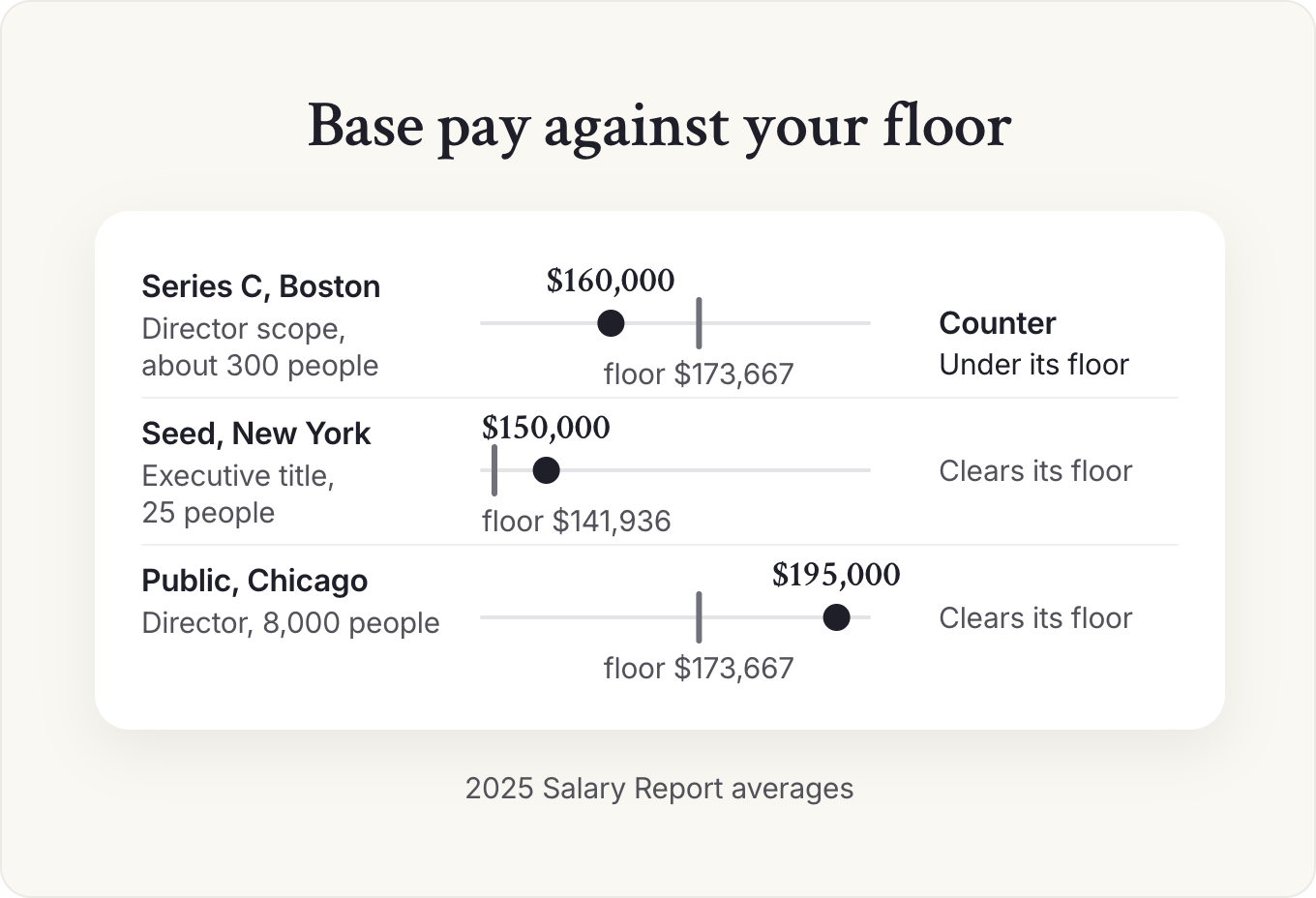
The Series C offer is a reasonable first offer with room to move. Its base sits right at the overall median. Boston averages about $180,000, and companies of 201 to 500 people about $181,000.
For Director scope at that size, a fair base is about $174,000 to $181,000: the Director average and the average for 201 to 500 employees. Ask in that range, and get the equity facts before you value the options at anything.
The seed offer looks low against the Executive average and is normal for a 25-person company. An Executive title at a seed company is common. It helps your next offer only if you made Executive-level decisions.
Price the 0.4% at zero until you have the four equity facts. Then decide whether the scope alone is worth $150,000, and if it is, ask for a written 12-month review of level and pay, tied to the Series A.
The public-company offer is the safest and the most likely to be under-scoped. $195,000 plus a 15% bonus is fair for a Director. It's above the Director average and above Chicago's. It's under the average for companies of 5,001 to 10,000 people, but few survey responses come from companies that size.
Big companies often hire a Chief of Staff into a band and then hand them a project list, so ask how often the bonus has paid out in full, and get the decision rights in writing.
Use the lower of the level and size averages as your floor. The Series C base is under its floor, so that's the one to counter. The other two clear their floors, so the title, equity and bonus terms decide those two.
Startup equity: what to ask beyond the four numbers
To value an option grant, you need four numbers: the option count, the fully diluted share count, the strike price and the last preferred price. Our salary guide shows the startup equity math step by step, so this section covers the terms that change how much of the grant you keep.
- Ask how long you have to buy vested options after you leave. With a 90-day window, you may have to pay the strike on short notice. Your grant letter says whether you hold incentive stock options (ISOs), which keep their tax treatment only if you exercise within three months of leaving. In the UK, EMI options keep their full tax relief only if you exercise within 90 days of leaving. Check with a tax adviser before you count on a longer window.
- Ask whether early exercise is allowed: some companies let you buy unvested options at the start. Check with a tax adviser before you use it.
- Ask what happens to your unvested shares if the company is bought.
- Ask whether grants are topped up when your scope grows. A Chief of Staff whose job doubles in year two otherwise keeps vesting at the rate set for the smaller job.
At a public company, the same questions get simpler: the value of the restricted stock units, the vesting schedule and the refresh policy.
How much equity should a Chief of Staff get?
Among Chiefs of Staff with equity in our 2025 salary survey, the median reported value was about $100,000, and a few very large holdings pull the average far higher. As a share of the company, work it out yourself: divide your option count by the fully diluted share count.
The company's stage matters most. A grant at seed is a bigger slice of a riskier company; the same dollar value at Series C is a smaller slice of a likelier exit.
A small share of a company that sells can be worth more than a large share of one that never does. So ask the founder what has to go right for the company to sell, and what your role changes about that.
If the company won't share the fully diluted share count, you can't value the grant, so compare the offers on base and count the equity as upside.
A bigger title or more pay?
I'd take a bigger title only when the decision rights come with it. Nearly half of Chiefs of Staff with two years' experience or less place themselves at Director level or above. The report itself suggests part of that may be title inflation, and hiring managers at your next company will test the title against what you decided.
The opposite trade, less pay for a role you love, has a cost too. Rahul Desai, then our general manager, made the point on our 2024 salary report episode. The first number you accept follows you: "the money you're willing to accept does something in your own head of anchoring you." If you take a lower base for a principal or a company you believe in, get the review date in writing so the number has an end date.
What should you negotiate, and in what order?
Negotiate the level and decision rights first, then the title and reporting line, then base, bonus, equity, the review date and finally the start date. Each answer sets the anchor for the next ask, so a change early in the list moves everything below it.
You don't need to win every line, but settle the first two before money comes up, because every number after them is priced off the level.
What to negotiate in a Chief of Staff offer, in order
| Order | What | Why at this point | The ask | Who can say yes |
|---|---|---|---|---|
| 1 | Level and decision rights | The level sets the pay band for everything below | "Which leaders will this role sit beside, and which three decisions will I make without you?" | Your principal |
| 2 | Title and reporting line | The title follows the level; the reporting line sets your access | "With Director scope, can the title and level read Director, reporting to you?" | Principal, then HR |
| 3 | Base | Priced off the level and company size | "For Director scope at a company your size, I'm looking for $[number]." | Recruiter or HR inside the band; principal to change the band |
| 4 | Bonus terms | The target % comes with the band; the terms decide if it pays | "What is it tied to, and how often has it paid in full?" | HR or finance |
| 5 | Equity facts and terms | A grant you can't value can't be compared | "Can you send the share count, fully diluted shares, strike and last preferred price?" | Founder or CFO; the board for a bigger grant |
| 6 | Review date and next role | Costs the company nothing at signing | "Can we write in a 12-month review of level and pay, and the expected next role?" | Your principal |
| 7 | Start date and sign-on | Closes gaps the base couldn't | "Could a sign-on cover the bonus I'd give up by leaving in [month]?" | Recruiter or HR |
Each line in the table also has a different owner. Your principal can change scope, title and decision rights in a sentence. A recruiter can move the base only inside a band, and a bigger option grant at a startup often needs the CFO or the board.
In the UK and much of Europe, your current notice period sets the earliest start date. Check it before you agree a date, and ask whether the new company will wait.
Why the level goes first
Average base climbs from about $91,000 at Analyst level to about $194,000 at Executive level. These are global averages in US dollars, so check your city in the salary guide before you name a number.
Decision-making authority is one of the eight competencies in our Leveling Framework, and the decisions you'll own are the easiest evidence to point to for the level you're asking for.
Ask for the level in your principal's words. "Which leaders will this role sit beside?" gets you a level without forcing anyone to name a band, and "which three decisions will I make without you?" gives you the proof. I'd ask both questions in the final interview, while the offer is still a draft and easy to change.
A higher level also raises the bar you'll be judged against. At your 12-month review, a Director is measured on Director outcomes, so get the six-month outcomes for that level in writing while you agree the level.
Another illustration: a Series B company offers you "Chief of Staff to the CEO" at $150,000. In the final interview you ask which decisions you'll make alone, which you'll recommend and which belong to someone else. The answers: you'll run the leadership meeting agenda and the planning calendar, you'll draft the board deck for the CEO to rewrite, and nothing is yours to decide yet.
That's Manager work, which averages about $144,000, so the offer is fair. If the CEO wants the agenda and the quarterly planning process to be yours to decide, that's Director work, and you should say so before you sign.
Pick your number from the middle 50% range for your level in the salary guide, above your floor. When the decision rights match the level, ask in the top half of that range. When they don't yet, ask at the average and put the rest into the 12-month review.
When the base won't move
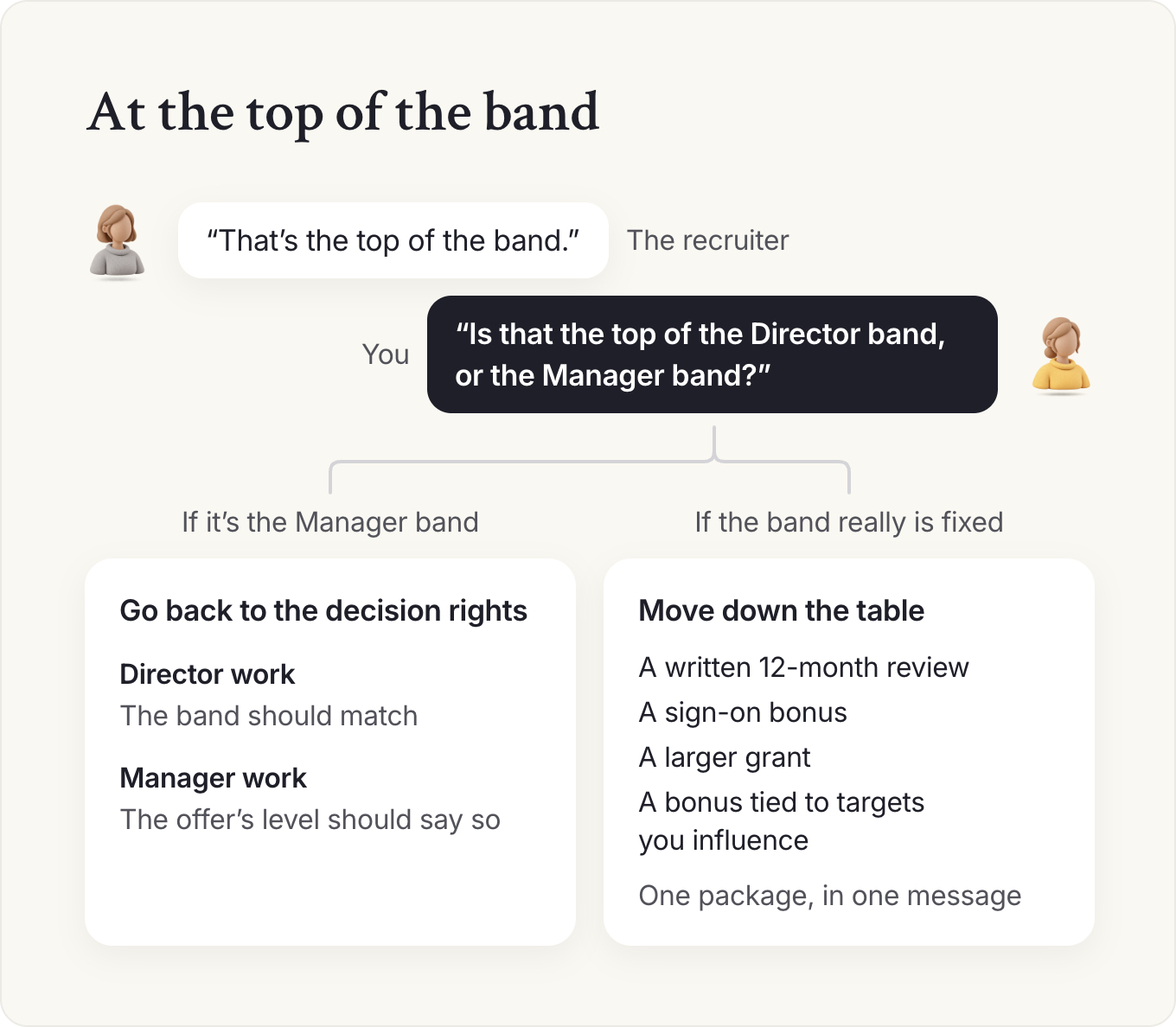
When a recruiter says the base is at the top of the band, the useful reply is a question about the band. "Is that the top of the Director band, or the Manager band?" Sometimes the honest answer is that the role was banded before anyone wrote down the scope.
If it's the Manager band, go back to the decision rights. Either the scope is Director work and the band should match, or the scope is Manager work and the level in the offer should say so.
If the band really is fixed, move down the table. A written 12-month review, a sign-on bonus, a larger grant or a bonus tied to targets you influence can all close part of the gap. Put your counter as one package in one message, so the company answers the whole thing at once.
Our post on learning to negotiate covers general technique for the conversation itself.
The call and what comes after it
Most of the negotiation happens on one or two calls with the recruiter or your principal. If you're worried that pushing will sour things with the person you're about to work for, open with scope. Your principal has to answer the scope questions anyway, and the answers give you the case for the number.
If you hold a second offer, mention it once, with the facts, and only if you'd take it. A competing offer you wouldn't accept tends to come out in the questions that follow, and it costs you the trust you'll need in the job.
Template: Chief of Staff offer call script
Offer call script
1. Open (20 seconds)
- Thank you for the offer. I'm excited about [the outcome I'll own].
2. Confirm the scope (ask, then listen)
- Before we talk numbers, can I check the scope? I understand I'd [decision right 1] and [decision right 2], and sit beside [which leaders]. Is that right?
3. Name the number (one sentence of data, one ask)
- For [level] scope, the Chief of Staff Network's 2025 Salary Report puts average base at about $[level figure]. I'm looking for $[number].
4. The rest of the package (one breath)
- I'd also like [bonus terms], the four equity facts so I can value the grant, and a 12-month review of level and pay in writing.
5. If they push back
- "That's the top of the band": Which level's band is that?
- "We can't move base": Then can we look at [sign-on / grant size / review date]?
- Silence: wait. Don't fill it.
6. Close
- Could you send the revised offer in writing by [day]? I'll reply within [number] working days.
# Offer call script

## 1. Open (20 seconds)
- Thank you for the offer. I'm excited about [the outcome I'll own].

## 2. Confirm the scope (ask, then listen)
- Before we talk numbers, can I check the scope? I understand I'd [decision right 1] and [decision right 2], and sit beside [which leaders]. Is that right?

## 3. Name the number (one sentence of data, one ask)
- For [level] scope, the Chief of Staff Network's 2025 Salary Report puts average base at about $[level figure]. I'm looking for $[number].

## 4. The rest of the package (one breath)
- I'd also like [bonus terms], the four equity facts so I can value the grant, and a 12-month review of level and pay in writing.

## 5. If they push back
- "That's the top of the band": Which level's band is that?
- "We can't move base": Then can we look at [sign-on / grant size / review date]?
- Silence: wait. Don't fill it.

## 6. Close
- Could you send the revised offer in writing by [day]? I'll reply within [number] working days.
Example: offer call for the Series B scorecard above (illustration)
Offer call script: Series B, Chief of Staff to the CEO
1. Open
- Thank you for the offer. I'm excited about running the planning cycle and the Series C board process.
2. Confirm the scope
- Before we talk numbers, can I check the scope? I understand I'd own the leadership meeting agenda and the quarterly planning process, and sit beside the VPs. Is that right?
3. Name the number
- The Chief of Staff Network's 2025 Salary Report puts average Director base at about $174,000. I'm looking for $180,000.
4. The rest of the package
- I'd also like the bonus tied to the company targets I'll run, the share count, fully diluted shares, strike and last preferred price for the 25,000 options, and a 12-month review of level and pay in writing.
5. If they push back
- "That's the top of the band": Is that the Director band?
- "We can't move base": Then could we write the review at 12 months, tied to the Series C, and look at the grant size?
6. Close
- Could you send the revised offer in writing by Friday? I'll reply within two working days.
# Offer call script: Series B, Chief of Staff to the CEO

## 1. Open
- Thank you for the offer. I'm excited about running the planning cycle and the Series C board process.

## 2. Confirm the scope
- Before we talk numbers, can I check the scope? I understand I'd own the leadership meeting agenda and the quarterly planning process, and sit beside the VPs. Is that right?

## 3. Name the number
- The Chief of Staff Network's 2025 Salary Report puts average Director base at about $174,000. I'm looking for $180,000.

## 4. The rest of the package
- I'd also like the bonus tied to the company targets I'll run, the share count, fully diluted shares, strike and last preferred price for the 25,000 options, and a 12-month review of level and pay in writing.

## 5. If they push back
- "That's the top of the band": Is that the Director band?
- "We can't move base": Then could we write the review at 12 months, tied to the Series C, and look at the grant size?

## 6. Close
- Could you send the revised offer in writing by Friday? I'll reply within two working days.
I'd never accept on the call, however good the number sounds. Thank them, say you'll reply in writing, and give a day. If you need the written counter first, our salary guide has a counteroffer email with the data built in.
One member, Chief of Staff at a Series A fintech, told a member session that she accepted her offer for that job without negotiating and came to regret it. From then on she negotiated at every performance review. She opened with data for similar roles, stage and location, and offered to discuss her level on its own if her boss saw it differently. Over nearly three years, her pay rose by about half.
Within a few hours of the call, send a recap. It records what was agreed and what's still open, so you can check the written offer against it.
Template: Recap email after a Chief of Staff offer call
Subject: Recap of today's call: Chief of Staff offer
Hi [Name],
Thanks for the time today. Here's my understanding, so the written offer matches it.
Agreed
- Level and title: [e.g. Director, Chief of Staff], reporting to [principal]
- Decision rights: I decide [x]; I recommend [y]; [z] stays with [owner]
- Base: $[number]
- Review: level and pay reviewed at 12 months, against [the six-month outcomes we discussed]
Still open
- [e.g. Bonus: what it's tied to]
- [e.g. Equity: share count, fully diluted shares, strike and last preferred price]
Next step
- You'll send the revised offer by [day]. I'll reply within [number] working days of receiving it.
If I've got anything wrong, tell me and I'll correct it.
Best,
[Your name]
Subject: Recap of today's call: Chief of Staff offer

Hi [Name],

Thanks for the time today. Here's my understanding, so the written offer matches it.

**Agreed**
- Level and title: [e.g. Director, Chief of Staff], reporting to [principal]
- Decision rights: I decide [x]; I recommend [y]; [z] stays with [owner]
- Base: $[number]
- Review: level and pay reviewed at 12 months, against [the six-month outcomes we discussed]

**Still open**
- [e.g. Bonus: what it's tied to]
- [e.g. Equity: share count, fully diluted shares, strike and last preferred price]

**Next step**
- You'll send the revised offer by [day]. I'll reply within [number] working days of receiving it.

If I've got anything wrong, tell me and I'll correct it.

Best,
[Your name]
If you agreed scope with your principal and pay with the recruiter, each of them holds half the deal. Send the recap to whoever writes the letter, and copy your principal on the scope lines, so the decision rights reach the written offer.
To prepare for the call with Claude, paste in the offer and your scorecard, and ask for the opening, the objections and the answers. The "Ask AI" menu on the prompt below opens it for you.
Prompt: Prepare my Chief of Staff offer conversation
Act as a negotiation coach for Chief of Staff offers. Help me prepare for one call.

The offer: [paste the offer: company, headcount, stage, principal, title, base, bonus, equity, start date]
My scorecard notes: [paste the lines I scored 1 or 2]
What they said in interviews about scope and decisions: [paste]
My floor and my ask: [base floor, base ask, anything I won't accept]

1. Tell me which Chief of Staff Network Leveling Framework level the offer describes (Analyst/Associate, Sr. Associate/Jr. Manager, Manager/Sr. Manager, Director, Vice President, CXO/Executive), based on the decisions I'll make, and why. If the title and the decisions point to different levels, say so.
2. List the three gaps that matter most, in this order of priority: level and decision rights, title and reporting line, base, bonus terms, equity facts, review date, start date and sign-on.
3. For each gap, write the exact question or ask, in one sentence.
4. List the four objections I'm most likely to hear and a one-sentence answer to each.
5. Write a 60-second opening for the call.
6. List everything I should ask to have in writing before I accept.

Be direct. Don't invent salary figures: if you need a benchmark, tell me what to look up.
What changes when the offer is internal or you're moving up from EA?
An internal offer is still an offer, and it needs the same scorecard, even when negotiating feels ungrateful. The risk is that the title changes and the job doesn't.
Dominique Lear became Chief of Staff at Incandescent when the previous one left. Her CEO told her in one sentence, and she asked what would change.
And I was like, "Okay, so what do I do tomorrow?" And he's like, "The same thing you're currently doing."
Dominique Lear, Chief of Staff, Incandescent · Listen on the podcast
Her role grew a great deal over five years at the firm. Don't count on that happening by itself: ask for the change when the title changes. Benchmark the pay against Chief of Staff roles at your level, using the salary guide. Your old band is the wrong reference, because it priced a different job.
Then ask for three things in writing: the decision rights you now hold, who takes your old work and by when, and the review date. For an executive assistant moving into the role, the second item matters most, because the calendar and travel follow you unless someone else is hired. Our guide to Chief of Staff vs executive assistant covers hybrid roles in detail.
Before you sign, put the written offer next to your recap email and check them line by line: level, title, decision rights, base, bonus terms, the four equity facts and the review date. Send anything missing back to whoever writes the letter that day. Once you've signed, our guide to your first 90 days picks up from day one.
Negotiating your first Chief of Staff offer? Launchpad includes a Job Search Masterclass on positioning, the hidden job market and negotiation, and ends with your own Chief of Staff operating plan.
Explore LaunchpadTake this guide with you
The full guide as a PDF: every section, template and chart, ready to print or share with your team.
Your PDF is ready.
Download the PDFFree. We may email you new guides; unsubscribe anytime.
Frequently asked questions
Do I have to tell a company my current salary?
You don't have to volunteer it. Answer with the range you expect for the level instead: "For Director scope at a company your size, I'm looking for around $X." If the posting listed a range, answer against it. In New York, employers with four or more employees must list the pay or a pay range when they advertise a job, promotion or transfer.
How long can I take to decide on a Chief of Staff offer?
Ask for two to five working days once the written offer arrives, and up to a week if you're finishing other interviews. Ask for the time on the call and name a day. If the company won't give you enough time to check the terms in writing, treat that as information about how decisions get made there.
Can I negotiate a sign-on bonus as a Chief of Staff?
Yes, especially when you'd lose a bonus or unvested equity by leaving your current job. Put a number on what you'd give up and ask for a sign-on to cover it. Check whether it has a repayment clause, and for how long, before you count it.
Should a lawyer read my Chief of Staff offer letter?
It depends on what the letter holds. If it includes an executive agreement, a large equity grant, a non-compete or severance terms, check with an employment lawyer before you sign. Ask them to read the equity plan as well as the letter, because the plan sets the exercise window.
Can I renegotiate after I've accepted verbally?
Only on terms the written offer gets wrong. If the letter doesn't match what you agreed on the call, point to your recap email and ask for it to be corrected. Reopening agreed terms after a verbal yes costs trust with the principal you're about to work for.
- 2025 Chief of Staff Salary Report, Chief of Staff Network, 2025 (n=479; figures follow the report text where it differs from a chart).
- Chief of Staff Leveling Framework, Chief of Staff Network (survey of 200+ Chiefs of Staff).
- Chief of Staff podcast: Rahul Desai (2024 salary report episode), Dominique Lear.
- "Leveling-up As A CoS", Chief of Staff Network member session, 2023.
- 26 U.S.C. §422(a)(2) (incentive stock options); New York Labor Law §194-B (pay ranges in job ads); GOV.UK, How employment related securities work (EMI options).
- The scorecard, the negotiation order, the scripts, the recap email, the example offers and the gap table are our recommendations and illustrations.
Learn the job with people who do it
Membership gets you the Power Skills program, member events and a private community of working Chiefs of Staff.
Land your first Chief of Staff role
Launchpad helps you prepare, position yourself and interview for the role.
Starting out in the role?
The Fundamentals email course walks you through scoping the mandate, setting the cadence and earning trust.
Lead AI adoption from the Chief of Staff seat
The Chief of AI Fellowship is for operators turning AI into how the company runs.
Hiring a Chief of Staff?
Post the role on the Chief of Staff job board, or browse open roles.
Get your resume ready for the role
Get feedback on your Chief of Staff resume before you apply.
Let the right roles find you
Join the talent network and hear about Chief of Staff roles first.
The Chief of Staff newsletter
What Chiefs of Staff are reading, hiring for and building.
Get the full report
Every chart and cut from our latest salary research, sent to your inbox.
Using AI with sensitive data?
Learn the legal side of using AI at work.
Keep going in this series