





How to Choose a Chief of Staff Recruiter or Search firm
Hiring a Chief of Staff? Compare retained search firms, contingent recruiters, specialist networks and your own team: fees of about a third, time and fit.

Ask AI
 Share

Look inside your company first. Outside it, you can hire a Chief of Staff four ways. A retained search firm is paid about a third of first-year cash pay, hire or not. A contingent recruiter is paid only if you hire their candidate. With a job board or your own team, you screen. Choose by seniority, confidentiality and screening time.
- Pick the route from the search. A confidential search or a seat beside your most senior leaders justifies a retained firm. A clear role you can screen yourself usually doesn't.
- Budget the fee on cash pay. Retained fees run about a third of estimated first-year cash compensation, plus expenses, plus a top-up if the final offer is higher.
- Brief any recruiter on the principal and the decision rights. Name the backgrounds they must not screen out.
- Read the shortlist for range. Only 7% of Chiefs of Staff came straight from consulting. A slate of former consultants suggests the recruiter screened on the job post.
- Before you sign, ask which companies the firm can't recruit from.
Few companies hire a Chief of Staff often. From June to early October 2026, about 1,430 different employers posted 1,819 Chief of Staff roles, and no single company posted more than 14. So your hiring team has probably filled this seat rarely, if ever. Ask any recruiter who calls how many they've filled. A retained search costs about four months of the hire's cash pay.
The route you pick, the brief you write and how you read the shortlist decide whether the money buys a hire. Two options are ours, a job board and a hiring service, and I say so where they come up. The full hiring process, from the mandate to the offer, is in our guide on how to hire a Chief of Staff.
What are your options for hiring a Chief of Staff?
Look inside your company first. Outside it, you have four routes: a retained search firm, a contingent recruiter, a job board or community, and your own team. They differ in who carries the risk. A retained firm is paid to run the search whether or not you hire. A contingent recruiter is paid only if you hire their candidate. With a posting or your own team, you carry the screening yourself.
Inside, look for whoever already runs cross-team work your leaders rely on: someone in operations, strategy, revenue operations or program management, or a senior executive assistant. Our hiring guide covers how to promote someone without a stall.
Firms that call themselves Chief of Staff specialists sit inside these routes too. Ask each one how it's paid, and on what. Alex Cherucheril, who moved from Chief of Staff to head of business operations at Welcome Tech, found his Chief of Staff role through one. He says a few recruiters look for startup generalists, or for former consultants and bankers.
Four routes to a Chief of Staff hire
| Route | How it's paid | Best when | Watch for |
|---|---|---|---|
| Retained search firm | A retainer of about a third of estimated first-year cash pay, owed whether or not you hire | The search must stay confidential, the seat is senior, or you need people who aren't looking | Off-limits rules, expenses on top, a long process |
| Contingent recruiter or agency | A fee on first-year pay, owed only when you hire their candidate | The role is clear and you want resumes quickly | Resumes sent with little screening, and several agencies sending the same people |
| Job board or community: specialist job boards, communities, your investors' talent team | Posting fees or the network's own terms; no percentage on a posting | You can describe the role well and run the screens | A posting is public, and you do most of the screening |
| Your own team | Your recruiters' time and yours | You have a talent team with time for one hard search | The role is new to them, and the job post becomes the brief |
How much do Chief of Staff recruiters charge?
A retained search firm charges about a third of the hire's estimated first-year cash compensation. A contingent recruiter or agency is paid only if you hire their candidate, usually 20% to 25% of first-year cash pay. Both are percentages of pay, so the fee rises with the level you hire at.
One large search firm says in its annual report that its fee is "generally one-third of the estimated first-year cash compensation" of the person placed, plus a share of the fee for expenses and an "uptick" fee if the final pay beats the estimate. The retainer is owed whether or not you hire through the firm, so if you end up hiring someone from your own network, it's still spent.
Contingent fees are less documented. SHRM, writing about executive search in 2016, put contingency fees at about 20% to 25% of first-year cash compensation, owed only if the recruiter fills the job.
Here's what that means on one salary (illustration). Take a $180,000 base with no bonus, the median among US Chief of Staff postings that list pay. A third is $60,000. A 20% fee is $36,000 and a 25% fee is $45,000. If the offer has a bonus or a signing bonus, add them before you do the sum.
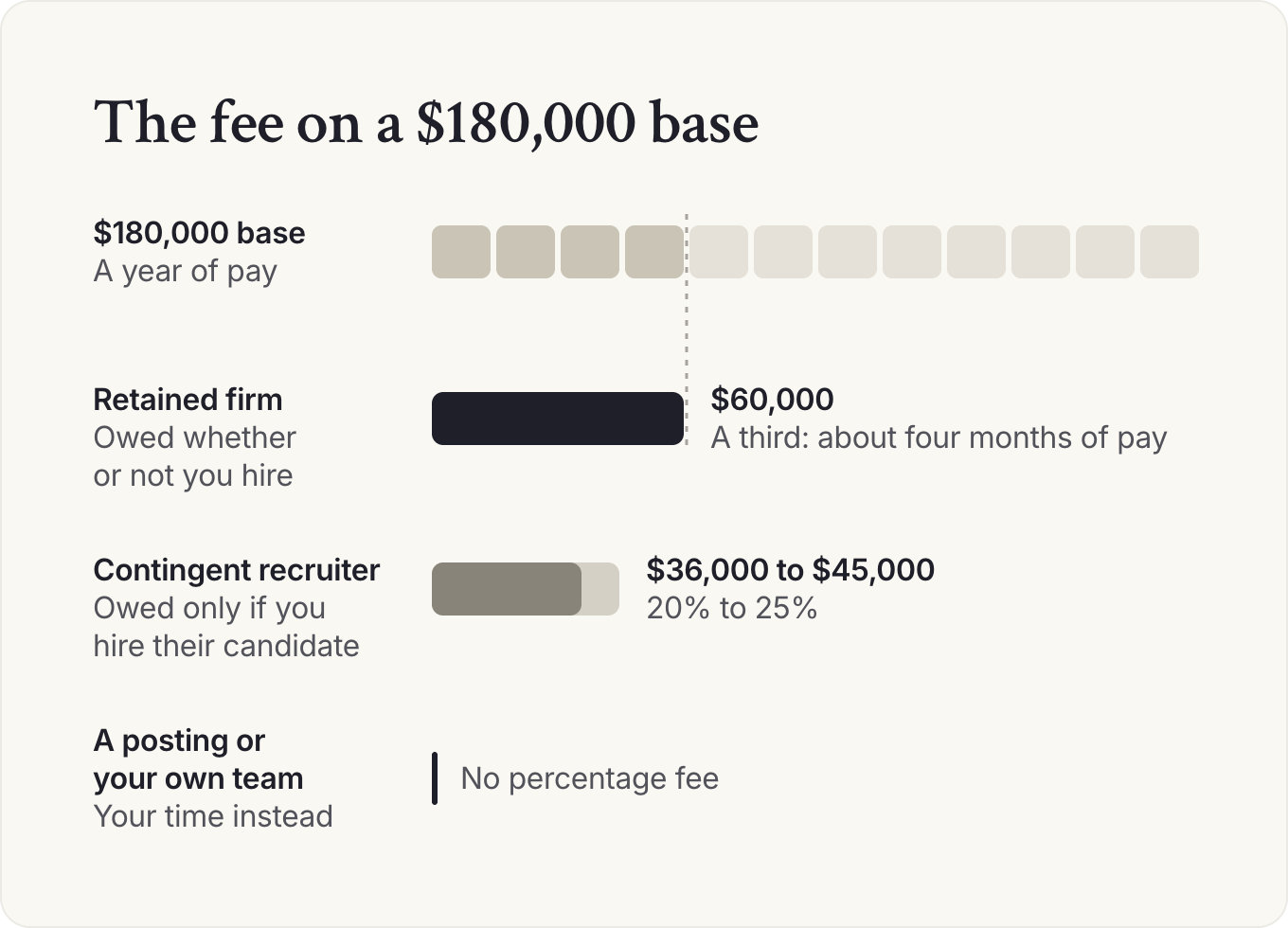
Three terms move the real number. Ask for each in writing:
- What counts as compensation. Base only, or base plus target bonus and sign-on?
- The expense line. Is it a fixed percentage of the fee, capped, or billed as incurred?
- The guarantee. What happens if the hire leaves or is let go in the first year?
A posting or your own team has no percentage fee. It costs your time instead: writing the brief, reading every application, and running every first call.
How long does each route take?
My read: a retained search runs for months. A contingent recruiter can send resumes quickly. A posting runs for weeks before you know what it brought in. Your own team takes as long as your hours allow.
Ask the firm how long its last three Chief of Staff searches took, from signing to start date.
A contingent recruiter is paid only when you hire, so their incentive is speed. Expect the first resumes early, often from people already on the market. On our job board, a promoted posting runs for 30 days. Once you're interviewing, we'd plan on four to eight weeks from first interview to signed offer on any route.
My read: a slow search can lose the people who are on the market. When Chiefs of Staff move from one Chief of Staff role to another, half start the new role within three months of leaving the last. If the seat sits empty during a long search, a fractional Chief of Staff can hold the operating rhythm in the meantime.
Which route fits your search?
Match the route to three things: how senior the seat is, how quiet the search must be, and how much screening you can do. Senior, confidential or hard-to-reach searches justify a retained firm. Most other searches can start with a posting or your own team.
Here's how I'd sort the common cases:
- Your first Chief of Staff, at a company under a few hundred people. I'd start with your own network and a posting, and pay a percentage only if those turn up nobody in four to six weeks. The role is new, so you'll learn what you want from the first conversations.
- A confidential search. Your current Chief of Staff doesn't know yet, or the company is mid-deal. Use a retained firm. A posting is public, and a contingent recruiter may describe your role to many people to find one.
- A seat beside your most senior leaders. For a VP-level Chief of Staff who runs board work or the planning cycle, assume the people you want are employed and not looking. Someone has to call them, and that's what a retainer pays for.
- A principal who rarely posts roles. Family offices often keep their roles off the big job boards, in our experience. Use a recruiter who works with family offices and can meet the principal. Donald J Cunningham, then head of a family office, told our podcast that a great recruiter is a partner you use again and again, if they have access to the principal and really understand how the organization works.
- A clear role, a talent team with time, and a deadline. Run it in-house and add a contingent recruiter for reach. Agree up front which candidates each one can claim.
Here's where our two options fit. You can post the role on our Chief of Staff job board, where Chiefs of Staff look for their next role. It reaches people who are looking, and that's also its limit: it won't find the employed operator who isn't, and a public posting doesn't suit a confidential search. Our hiring service is the other option. We find candidates for you and introduce them.
Want help finding candidates? Our hiring service sources and screens them for you.
Get recruiting supportHow do you brief a Chief of Staff recruiter?
Brief the recruiter on the work you need done: the principal, the decisions the role makes, the leaders it sits beside, the cash band, and the backgrounds you want them to keep in. A recruiter can only search for the role you describe, and a vague job post comes back as a generic shortlist.
I'd give the recruiter an hour with you before they make a single call. That's the access Donald described. Your working style is the thing a recruiter can't read from a job description, and it decides much of the fit.
Start from your job description and your mandate. The brief below adds what those two documents leave out: what not to filter on, the companies off-limits, how quiet the search is, and the pitch to candidates. Keep it to a page, and send it to the leaders on your interview panel too. Candidates will compare the recruiter's pitch with what your leaders tell them, so the two need to match.
Template: Chief of Staff recruiter brief
Chief of Staff recruiter brief
Company: [name, stage, headcount] · Principal: [name, title] · Date: [date]
The gap, in two sentences
- What is happening that shouldn't be: [sentence]
- What will be different in six months if someone owns it: [sentence]
The principal
- How I work: [writing or talking, fast or considered, hours, travel]
- What I need from this person that I don't get today: [one line]
What the role decides
- Decides alone: [2 to 3 items]
- Recommends, I decide: [2 to 3 items]
- Never touches: [1 to 2 items]
Level and pay
- Level: [Leveling Framework level] · Sits beside: [the leaders at the same level]
- Cash: base [range] + bonus [target] · Equity: [yes or no, range]
- Fee basis we agree: [base only / base + target bonus]
Who we want on the slate
- Backgrounds to include: [operations, revenue, product, finance, consulting, a senior EA]
- Don't screen out for: [no prior Chief of Staff title, no consulting (27% of postings ask for it, but only 7% of Chiefs of Staff came straight from consulting), no single metric they "owned"]
- Deal-breakers: [2 to 3, specific]
Where to look, and where not to
- Target companies: [list]
- Off-limits (ours): [customers, partners]
- Off-limits (yours): [send me the companies you can't recruit from]
How we'll run it
- Who knows about this search: [names]. Use our company name in first calls: [yes / no]
- Interview panel: [names, roles] · Work sample: [yes / no]
- First three profiles by: [date] · Full slate by: [date] · Offer target: [date]
The pitch
- Why someone good would take this seat: [one line]
- The likely next role in two to three years: [one line]
# Chief of Staff recruiter brief

**Company:** [name, stage, headcount] · **Principal:** [name, title] · **Date:** [date]

## The gap, in two sentences
- What is happening that shouldn't be: [sentence]
- What will be different in six months if someone owns it: [sentence]

## The principal
- How I work: [writing or talking, fast or considered, hours, travel]
- What I need from this person that I don't get today: [one line]

## What the role decides
- Decides alone: [2 to 3 items]
- Recommends, I decide: [2 to 3 items]
- Never touches: [1 to 2 items]

## Level and pay
- Level: [Leveling Framework level] · Sits beside: [the leaders at the same level]
- Cash: base [range] + bonus [target] · Equity: [yes or no, range]
- Fee basis we agree: [base only / base + target bonus]

## Who we want on the slate
- Backgrounds to include: [operations, revenue, product, finance, consulting, a senior EA]
- Don't screen out for: [no prior Chief of Staff title, no consulting (27% of postings ask for it, but only 7% of Chiefs of Staff came straight from consulting), no single metric they "owned"]
- Deal-breakers: [2 to 3, specific]

## Where to look, and where not to
- Target companies: [list]
- Off-limits (ours): [customers, partners]
- Off-limits (yours): [send me the companies you can't recruit from]

## How we'll run it
- Who knows about this search: [names]. Use our company name in first calls: [yes / no]
- Interview panel: [names, roles] · Work sample: [yes / no]
- First three profiles by: [date] · Full slate by: [date] · Offer target: [date]

## The pitch
- Why someone good would take this seat: [one line]
- The likely next role in two to three years: [one line]
Example: recruiter brief for a Series B CEO (illustration)
Chief of Staff recruiter brief
Company: fintech, Series B, 180 people · Principal: CEO · Date: March 3
The gap, in two sentences
- What is happening that shouldn't be: product and sales plan separately, and I settle their conflicts in my inbox.
- What will be different in six months if someone owns it: one quarterly plan, one leadership agenda, and conflicts settled before they reach me.
The principal
- How I work: I read long memos and decide fast; I don't use slides. In the office three days a week, one trip a month.
- What I need from this person that I don't get today: someone who tells me what I'm missing before the leadership meeting.
What the role decides
- Decides alone: the leadership meeting agenda; the planning calendar; which cross-team projects get a weekly review
- Recommends, I decide: priority calls between product and sales; the quarterly plan; changes to the board deck
- Never touches: hiring and firing decisions; individual pay
Level and pay
- Level: Director · Sits beside: VP Product, VP Sales, CFO
- Cash: base $165,000 to $190,000 + 15% target bonus · Equity: yes, options
- Fee basis we agree: base + target bonus
Who we want on the slate
- Backgrounds to include: revenue operations, product operations, strategy and operations, consulting, a senior EA who runs planning today
- Don't screen out for: no prior Chief of Staff title, no consulting, no single metric they "owned"
- Deal-breakers: has never worked across peers without authority; needs a team in year one
Where to look, and where not to
- Target companies: payments and lending companies of 100 to 1,000 people
- Off-limits (ours): our two largest bank partners
- Off-limits (yours): list due before we sign
How we'll run it
- Who knows about this search: CEO, CFO, head of people. Use our company name in first calls: no
- Interview panel: CEO, CFO, VP Sales · Work sample: yes, a planning memo from real data
- First three profiles by: March 24 · Full slate by: April 14 · Offer target: May 30
The pitch
- Why someone good would take this seat: they run the planning cycle and sit in every leadership and board prep meeting from week one.
- The likely next role in two to three years: head of strategy and operations, or a GM role.
# Chief of Staff recruiter brief

**Company:** fintech, Series B, 180 people · **Principal:** CEO · **Date:** March 3

## The gap, in two sentences
- What is happening that shouldn't be: product and sales plan separately, and I settle their conflicts in my inbox.
- What will be different in six months if someone owns it: one quarterly plan, one leadership agenda, and conflicts settled before they reach me.

## The principal
- How I work: I read long memos and decide fast; I don't use slides. In the office three days a week, one trip a month.
- What I need from this person that I don't get today: someone who tells me what I'm missing before the leadership meeting.

## What the role decides
- Decides alone: the leadership meeting agenda; the planning calendar; which cross-team projects get a weekly review
- Recommends, I decide: priority calls between product and sales; the quarterly plan; changes to the board deck
- Never touches: hiring and firing decisions; individual pay

## Level and pay
- Level: Director · Sits beside: VP Product, VP Sales, CFO
- Cash: base $165,000 to $190,000 + 15% target bonus · Equity: yes, options
- Fee basis we agree: base + target bonus

## Who we want on the slate
- Backgrounds to include: revenue operations, product operations, strategy and operations, consulting, a senior EA who runs planning today
- Don't screen out for: no prior Chief of Staff title, no consulting, no single metric they "owned"
- Deal-breakers: has never worked across peers without authority; needs a team in year one

## Where to look, and where not to
- Target companies: payments and lending companies of 100 to 1,000 people
- Off-limits (ours): our two largest bank partners
- Off-limits (yours): list due before we sign

## How we'll run it
- Who knows about this search: CEO, CFO, head of people. Use our company name in first calls: no
- Interview panel: CEO, CFO, VP Sales · Work sample: yes, a planning memo from real data
- First three profiles by: March 24 · Full slate by: April 14 · Offer target: May 30

## The pitch
- Why someone good would take this seat: they run the planning cycle and sit in every leadership and board prep meeting from week one.
- The likely next role in two to three years: head of strategy and operations, or a GM role.
Two lines in this brief do the most work. The fee basis stops an argument at invoice time. "Don't screen out for" protects the backgrounds most Chiefs of Staff actually come from. It also stops the recruiter from screening on title, so people who do the work under another title stay on the slate.
The level line needs care too. Set it from the decisions in the brief, using our Leveling Framework, and tell the recruiter which of your leaders the hire will sit beside.
How do you judge a recruiter's shortlist?
Read the shortlist for range, for fit to the decisions in your brief, and for evidence of how each person works. A good slate surprises you with at least one background you wouldn't have searched for. A weak one repeats the job post back to you.
I'd ask for the first three profiles before the full slate, and rewrite the brief if two of them miss. That costs two weeks at most, and it shows how well the recruiter listened.
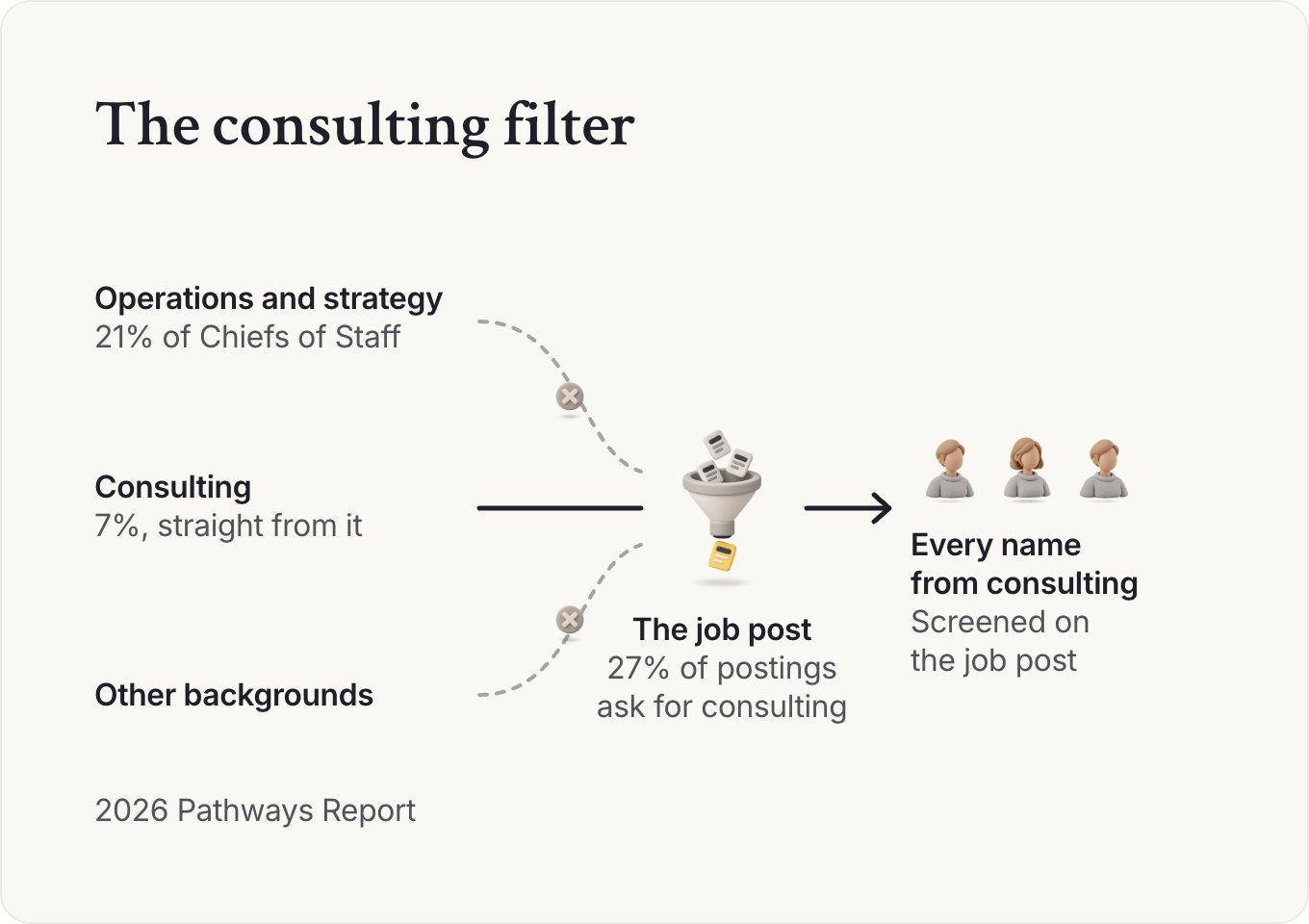
One miss to look for is the consulting filter. 27% of Chief of Staff postings ask for consulting experience, yet only 7% of Chiefs of Staff came straight from consulting. Operations and strategy supplies the most, at 21%. If every name on the slate came from consulting, the recruiter probably screened on the job post. Our hiring guide covers what to look for in the person instead.
Another miss is screening on owned metrics. Priyanka Peeramsetty, engineering operations director at Crunchyroll and a two-time Chief of Staff, told our podcast that most recruiters are used to people who own one number, and not all Chief of Staff work turns into a metric. She'd ask how a candidate solved a problem and what risks they took. Check that the recruiter's notes do the same.
Chief of Staff shortlist check
| Check | A strong slate | Send it back when |
|---|---|---|
| Range | Three or more backgrounds, at least one you wouldn't have searched for | Every name came from the same function |
| Fit to the brief | One line per candidate, tied to a decision the role makes | The notes repeat the resume |
| Level | Each person has worked beside leaders at the level of yours | Titles match and the scope doesn't |
| Interest | Each person has heard the pitch and can say why they want this seat | Some haven't been told what the role is |
| How they work | Notes describe a problem they solved and how | Notes list metrics only |
Judge the firm before you sign, too. Ask three questions. How many Chief of Staff searches have you finished in the last two years, and can I call one of those principals? Which companies can't you recruit from? Who will make the calls on my search?
Off-limits can shrink your search. Search firms often agree to stay away from their clients' people for a set period. If your target companies are their clients, those people are out of reach. Compare their off-limits list with your target list before you sign.
Looking for a Chief of Staff recruiter as a candidate?
Recruiters fill some Chief of Staff roles, so treat them as one channel among several. Our guide to landing a Chief of Staff role covers how to run the whole search. You can also join our talent network to hear about roles, or browse the job board.
Take this guide with you
The full guide as a PDF: every section, template and chart, ready to print or share with your team.
Your PDF is ready.
Download the PDFFree. We may email you new guides; unsubscribe anytime.
Frequently asked questions
Can I use more than one recruiter for a Chief of Staff search?
With contingent recruiters, yes. Agree in writing which recruiter owns a candidate they submitted, and for how long, and whether a fee applies to someone who also applied through your posting. Otherwise two agencies may claim the same person. A retained firm usually works as the only firm on the search, and its retainer is owed either way. Tell it about any posting you run.
What happens if the Chief of Staff leaves soon after starting?
That depends on the guarantee in your contract, so get it in writing before you sign. Ask whether the firm will run a new search if the hire is let go or resigns in the first year, whether that search is free apart from expenses, and how long the period runs. Ask a contingent recruiter the same, since their fee is owed once you hire.
Can I negotiate a recruiter's fee?
Yes. It's a contract term like any other. Ask for a fee on base pay only, a fixed fee instead of a percentage, a cap on expenses, or a lower rate if you hire someone you introduced yourself. The trade-off is that a firm paid less may give your search less of its time. Settle the fee before the first invoice. It's hard to change after the slate arrives.
Who are the best Chief of Staff recruiters?
We don't rank firms. The right one for you has filled Chief of Staff seats in the last two years at companies of your size and stage. Its off-limits list should leave your target companies open, and a principal it worked for should vouch for it. Ask for that reference call. If a firm can't name a recent Chief of Staff search, ask who on its team has run one.
Do I need a recruiter if I have an in-house talent team?
Not always. A good talent team can run this search if it has the time and you write the brief yourself. The risk is that the role is new to them, so the job post becomes the brief. Give them the same one-page brief you'd give an outside firm. Add a recruiter only for reach or confidentiality.
- Chief of Staff Pathways Report, Chief of Staff Network, 2026. 1,819 unique Chief of Staff job postings from about 1,430 employers, June to early October 2026 (data from Inform Growth). Pay is the annualized midpoint of stated US ranges, on about one in five postings. Backgrounds from 2,653 member career histories with a known prior function; repeat Chief of Staff moves from the stint-level analysis. Read the Pathways report.
- Chief of Staff Leveling Framework, Chief of Staff Network, built from a survey of 200+ Chiefs of Staff.
- Korn Ferry, Form 10-K for the fiscal year ended April 30, 2026, filed June 26, 2026. Search fees, indirect expenses, upticks, off-limit agreements.
- SHRM, How to Work Effectively with an Executive Search Firm, July 18, 2016. Contingency and retained fee levels, exclusivity.
- Chief of Staff Network podcast. Donald J Cunningham, Priyanka Peeramsetty and Alex Cherucheril, linked in the text. Paraphrased from episode transcripts.
- Our hiring services. The job board and the hiring service ("Get recruiting support") as described on our job posting page, read November 20, 2026.
- The four routes table, the route choices, the recruiter brief, the example and the shortlist check are our recommendations and illustrations. No survey measured them.
Learn the job with people who do it
Membership gets you the Power Skills program, member events and a private community of working Chiefs of Staff.
Land your first Chief of Staff role
Launchpad helps you prepare, position yourself and interview for the role.
Starting out in the role?
The Fundamentals email course walks you through scoping the mandate, setting the cadence and earning trust.
Lead AI adoption from the Chief of Staff seat
The Chief of AI Fellowship is for operators turning AI into how the company runs.
Hiring a Chief of Staff?
Post the role on the Chief of Staff job board, or browse open roles.
Hiring a Chief of Staff?
Post the role on our job board, or have our team source and screen candidates with you.
Get your resume ready for the role
Get feedback on your Chief of Staff resume before you apply.
Let the right roles find you
Join the talent network and hear about Chief of Staff roles first.
The Chief of Staff newsletter
What Chiefs of Staff are reading, hiring for and building.
Get the full report
Every chart and cut from our latest salary research, sent to your inbox.
Using AI with sensitive data?
Learn the legal side of using AI at work.
Keep going in this series



 Basics
 Excel in the role
 AI and the Chief of Staff
 Toolkit
 Hiring a Chief of Staff