


Is this a real Chief of Staff role? Red flags to check
Chief of Staff role red flags and the interview question that tests each. Only 20% of postings ask for calendar gatekeeping. Score the posting first.

Ask AI
 Share

A real Chief of Staff role names the executive you'd work for, gives you decisions to make or shape, and is judged on outcomes, such as planning that runs on time. The biggest red flags are an executive nobody names after the first call, mostly calendar and inbox work, no decision rights and no answer to what comes next.
- Score the role three times: on the posting, after the interviews and on the offer. Weigh the principal and the decisions you'd own above the title, because a role missing both is hard to change once you've joined.
- On the posting, look for the operating rhythm: the leadership meeting, OKRs and KPIs. Three in five postings ask for it. If the posting doesn't say whose Chief of Staff you'd be, ask the recruiter.
- In the interviews, ask the principal for one decision they'd hand you in your first month, and ask every other executive what the role would own. Specific answers that match are the strongest green flag you can get before you sign.
- On the offer, get three things in writing before you accept: the reporting line, one six-month outcome and a date to review scope and level.
- Take a yellow role when the access is real and every gap can be closed before you sign. Walk away when the answers get vaguer from one interview round to the next.
Five other jobs often borrow the Chief of Staff title, and the posting alone rarely tells you which one you're reading. You usually find out in the interviews, or after you've signed.
If you're the executive hiring, expect a strong candidate to run the checklist below on you. The green-flag column in the first table shows the answers they'll want from you. Write the posting from our job description template. Our hiring guide covers whether you need a Chief of Staff, what access to give one and how to interview candidates. Before the first interview, pick one decision you'd hand over in month one, and tell your leadership team why the role exists.
How do you identify a good Chief of Staff role?
Look at three things: who your principal would be (the executive you'd work for), which decisions you'd make or shape, and what you'd be judged on after six months. A good role gives a clear answer to each. A mislabeled one describes a different job, and the five below are the mislabels we see most.
Five jobs that borrow the Chief of Staff title
| What the job really is | What the posting says | Question that exposes it | Green-flag answer |
|---|---|---|---|
| Executive assistant with a bigger title | Calendar, travel, inbox and note-taking fill a third of the bullets | "What would you hand me on my first Monday?" | "Prep for Tuesday's leadership meeting and the open hiring decisions. My EA keeps the calendar." |
| Project or program manager | A list of initiatives to "drive" or "track", with no leadership meeting, planning cycle or board work | "Which recurring meetings would I run, and which decisions come out of them?" | "The weekly leadership meeting and quarterly planning. You set the agenda and chase the decisions." |
| Operations generalist | Tools, dashboards, process and "operational excellence"; reports into an operations or strategy team | "Who do I report to, and how often do we meet one to one?" | "Me. Weekly, plus whatever the week needs." |
| Functional lead in disguise | Runs one department's projects or team; sees one part of the business | "What will I see across the company: board materials, financials, every leader's priorities?" | "All of it. You sit in the leadership meeting and the board prep." |
| Chief of Stuff | "Wear many hats", "special projects as assigned", "whatever comes up" | "If three new requests land on me next week, who decides which ones I drop?" | "We agree your priorities each week, and anything outside them goes back to its owner." |
Most real roles carry a little of every row. Real Chiefs of Staff book rooms and pick up work with no owner. A row becomes a flag when it describes the whole job.
Each of the five is also a real job, and for some readers it's the right one. An operations role at a well-run company can teach you more than a Chief of Staff seat with no access. The risk is accepting one of them while you believe it's a Chief of Staff seat, then planning your pay and your next move around a job you don't have.
Why companies use the title for other jobs
The title helps a company recruit and signals seniority without committing to a level. It also lets a principal who has never worked with a Chief of Staff make the hire before deciding what the job is. A speaker at one of our member sessions said the title depends on how the principal defines it: an assistant job at one company, a CEO apprenticeship at another, a label for strategic projects at a third.
How each impostor shows up after you start
The assistant job shows itself in the first weeks, when the requests are all scheduling. Executive support can still be a door in: 6% of Chiefs of Staff came straight from it.
To spot a glorified EA job before you sign, ask the principal whether you'd run their leadership meeting and make the calls while they're away.
The project manager job shows itself in the leadership meeting, because you aren't in it. You get a list of initiatives and a status template, and you report on work other people decide.
The operations generalist reports to someone other than the executive they "support". Within a quarter they own the dashboards and the tooling, and nobody asks their view on a decision.
The functional lead runs one team well and never sees the rest of the company. Stephania Greco, Chief of Staff at Bicycle Capital, described the drift: "you're now in a position that feels less like a chief of staff role and more like a functional leader role". She added that it can be fine for a limited time.
The Chief of Stuff is the slowest to show. Every task without an owner lands on you, each one reasonable, and six months in you can't name a result that is yours.
Is a functional principal a red flag?
No. Only about two in five postings name who the Chief of Staff supports, and fewer than half of those say the CEO, founder or president. The rest support a technology, finance, revenue or other functional leader, and those are real roles.
I'd worry more about an unnamed principal than a functional one. A role where nobody will say whose Chief of Staff you'd be, even after the first call, often means the company hasn't decided, and you'll find out in the role.
What are the Chief of Staff role red flags at each stage, from posting to offer?
Three must-haves carry the most weight: knowing whose Chief of Staff you'd be after the first call, a decision you'd make or shape in your first month, and the reporting line in writing. The checklist below scores 16 items from 0 to 2. Once all three stages are scored, a 0 on one must-have caps the role at yellow, and a 0 on two makes it red.
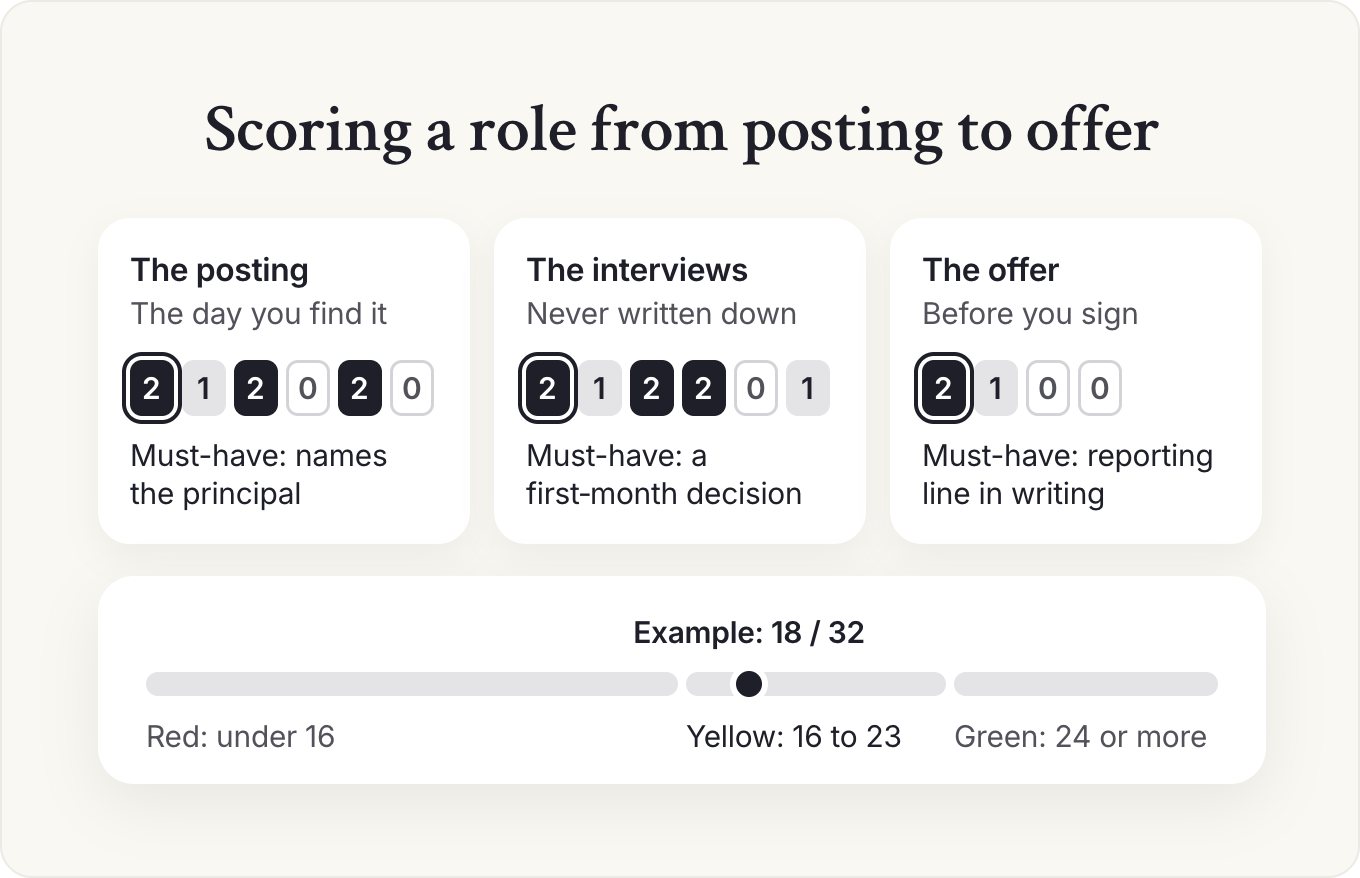
Score the posting the day you find it. The stage 1 reading, out of 12, tells you whether to interview. Then score again after interviews, because most of what matters is never written down. The last four items are for the offer letter, and you score them before you sign.
At the posting stage, an unnamed principal is normal. About three in five postings don't say whose Chief of Staff you'd be. Score item 1 a 0 for now, and change it after the first call. Do the same for pay. Only about 1 in 5 postings state it, most of them in the US, so ask for the band on that call and rescore item 6.
Template: Chief of Staff role checklist
Chief of Staff role checklist
Role: [title], [company], reporting to [name, title]
Score each item: 0 = no or unknown, 1 = partly, 2 = clearly yes.
Must-haves are marked (M). A 0 on any must-have caps the role at yellow.
Stage 1: the posting
| # | Check | Score |
|---|---|---|
| 1 | (M) It names the principal: who I'd report to and support | |
| 2 | Most bullets are outcomes I'd own ("own", "run", "lead", "decide") | |
| 3 | It names part of the operating rhythm: leadership meeting, planning, OKRs, board prep | |
| 4 | Calendar, travel, inbox and notes are under a fifth of the bullets | |
| 5 | It says why the role exists now | |
| 6 | It states a pay band or a level |
Stage 1 reading (out of 12): 7 or more, interview. 4 to 6, ask the recruiter about items 1 and 6 first. Under 4, skip.
Stage 2: the interviews
| # | Check | Score |
|---|---|---|
| 7 | (M) The principal names a decision I'd make or shape in my first month | |
| 8 | Each executive I meet describes the same role | |
| 9 | The principal engages with my view: pushes back, asks how I'd handle a hard call | |
| 10 | I'd see board materials, financials and every leader's priorities | |
| 11 | Someone else owns the admin work, or there's a plan for it | |
| 12 | There's an answer to what comes after this role |
Stage 3: the offer
| # | Check | Score |
|---|---|---|
| 13 | (M) The reporting line is in writing | |
| 14 | The title matches the level of the decisions I'd make | |
| 15 | One six-month outcome is in writing | |
| 16 | A date to review scope and level is in writing |
Result
Apply the totals and must-have rules once all three stages are scored.
- Total: [ ] / 32
- Green: 24 or more, and every must-have scores 1 or 2
- Yellow: 16 to 23, or one must-have at 0
- Red: under 16, or two must-haves at 0
- Three things to get in writing before I accept: 1. 2. 3.
# Chief of Staff role checklist

Role: [title], [company], reporting to [name, title]
Score each item: 0 = no or unknown, 1 = partly, 2 = clearly yes.
Must-haves are marked (M). A 0 on any must-have caps the role at yellow.

## Stage 1: the posting
| # | Check | Score |
| --- | --- | --- |
| 1 | (M) It names the principal: who I'd report to and support | |
| 2 | Most bullets are outcomes I'd own ("own", "run", "lead", "decide") | |
| 3 | It names part of the operating rhythm: leadership meeting, planning, OKRs, board prep | |
| 4 | Calendar, travel, inbox and notes are under a fifth of the bullets | |
| 5 | It says why the role exists now | |
| 6 | It states a pay band or a level | |

Stage 1 reading (out of 12): 7 or more, interview. 4 to 6, ask the recruiter about items 1 and 6 first. Under 4, skip.

## Stage 2: the interviews
| # | Check | Score |
| --- | --- | --- |
| 7 | (M) The principal names a decision I'd make or shape in my first month | |
| 8 | Each executive I meet describes the same role | |
| 9 | The principal engages with my view: pushes back, asks how I'd handle a hard call | |
| 10 | I'd see board materials, financials and every leader's priorities | |
| 11 | Someone else owns the admin work, or there's a plan for it | |
| 12 | There's an answer to what comes after this role | |

## Stage 3: the offer
| # | Check | Score |
| --- | --- | --- |
| 13 | (M) The reporting line is in writing | |
| 14 | The title matches the level of the decisions I'd make | |
| 15 | One six-month outcome is in writing | |
| 16 | A date to review scope and level is in writing | |

## Result
Apply the totals and must-have rules once all three stages are scored.
- Total: [ ] / 32
- Green: 24 or more, and every must-have scores 1 or 2
- Yellow: 16 to 23, or one must-have at 0
- Red: under 16, or two must-haves at 0
- Three things to get in writing before I accept:
  1.
  2.
  3.
Example: Chief of Staff to the CEO, Series B, 120 people (illustration)
Chief of Staff role checklist
Role: Chief of Staff, a Series B software company, reporting to the CEO and co-founder
Score each item: 0 = no or unknown, 1 = partly, 2 = clearly yes.
Stage 1: the posting
| # | Check | Score |
|---|---|---|
| 1 | (M) Names the principal: "reporting to our CEO" | 2 |
| 2 | Outcomes over tasks: 4 of 10 bullets start with "own" or "run" | 1 |
| 3 | Operating rhythm: quarterly planning and board prep named | 2 |
| 4 | Admin under a fifth: 3 of 10 bullets are calendar and notes | 0 |
| 5 | Why now: "we doubled headcount this year" | 2 |
| 6 | Pay band or level: neither | 0 |
Stage 1 reading: 7 / 12. Interview.
Stage 2: the interviews
| # | Check | Score |
|---|---|---|
| 7 | (M) Month-one decision: "you'll set the agenda for the exec meeting and decide what comes off it" | 2 |
| 8 | Same role from every executive: the CFO described "help with the board deck" | 1 |
| 9 | The CEO pushed back on my pricing view and asked for the reasoning | 2 |
| 10 | Board materials and financials: yes, from week one | 2 |
| 11 | Admin owner: no EA, "we'll see" | 0 |
| 12 | After the role: "maybe operations", no detail | 1 |
Stage 3: the offer
| # | Check | Score |
|---|---|---|
| 13 | (M) Reporting line in writing: yes | 2 |
| 14 | Title vs decisions: VP title, decisions at Manager to Director level | 1 |
| 15 | Six-month outcome in writing: no | 0 |
| 16 | Review date in writing: no | 0 |
Result
- Total: 18 / 32. Yellow. Every must-have scores 2.
- Three things to get in writing before I accept:
- An EA hire, or a named owner for calendar and travel, by the end of Q1
- One six-month outcome: "quarterly planning runs on time and the exec meeting ends with written decisions"
- A scope and level review at month six
# Chief of Staff role checklist

Role: Chief of Staff, a Series B software company, reporting to the CEO and co-founder
Score each item: 0 = no or unknown, 1 = partly, 2 = clearly yes.

## Stage 1: the posting
| # | Check | Score |
| --- | --- | --- |
| 1 | (M) Names the principal: "reporting to our CEO" | 2 |
| 2 | Outcomes over tasks: 4 of 10 bullets start with "own" or "run" | 1 |
| 3 | Operating rhythm: quarterly planning and board prep named | 2 |
| 4 | Admin under a fifth: 3 of 10 bullets are calendar and notes | 0 |
| 5 | Why now: "we doubled headcount this year" | 2 |
| 6 | Pay band or level: neither | 0 |

Stage 1 reading: 7 / 12. Interview.

## Stage 2: the interviews
| # | Check | Score |
| --- | --- | --- |
| 7 | (M) Month-one decision: "you'll set the agenda for the exec meeting and decide what comes off it" | 2 |
| 8 | Same role from every executive: the CFO described "help with the board deck" | 1 |
| 9 | The CEO pushed back on my pricing view and asked for the reasoning | 2 |
| 10 | Board materials and financials: yes, from week one | 2 |
| 11 | Admin owner: no EA, "we'll see" | 0 |
| 12 | After the role: "maybe operations", no detail | 1 |

## Stage 3: the offer
| # | Check | Score |
| --- | --- | --- |
| 13 | (M) Reporting line in writing: yes | 2 |
| 14 | Title vs decisions: VP title, decisions at Manager to Director level | 1 |
| 15 | Six-month outcome in writing: no | 0 |
| 16 | Review date in writing: no | 0 |

## Result
- Total: 18 / 32. Yellow. Every must-have scores 2.
- Three things to get in writing before I accept:
  1. An EA hire, or a named owner for calendar and travel, by the end of Q1
  2. One six-month outcome: "quarterly planning runs on time and the exec meeting ends with written decisions"
  3. A scope and level review at month six
The example scores yellow, and every gap can be closed before you sign. The CEO named a real decision and the board work is real. Two gaps are paperwork, a written outcome and a review date, and the third is a hire.
A red result usually comes from the must-haves. If nobody will name the principal or a first-month decision, the score on everything else doesn't matter much. The thresholds are our rule of thumb, so adjust them to your situation.
For a line-by-line read of a single posting, use the pen exercise in the job description guide.
To run a posting through the checklist before you've spoken to anyone, paste it into an AI assistant with the prompt below. It scores stage 1 from the text and writes the questions for stage 2.
Prompt: Score a Chief of Staff posting against the red-flag checklist
I'm considering a role titled Chief of Staff. Score it against the checklist below and tell me whether it's a real Chief of Staff role.

Checklist (score each 0, 1 or 2; 0 means no or not stated):
Stage 1, the posting:
1. (Must-have) Names the principal, the person I'd report to and support
2. Most bullets are outcomes I'd own ("own", "run", "lead", "decide") more than "support" or "coordinate"
3. Names part of the operating rhythm: leadership meeting, planning cycle, OKRs, board prep
4. Calendar, travel, inbox and note-taking are under a fifth of the bullets
5. Says why the role exists now
6. States a pay band or a level

Then:
- Quote the line behind each score.
- Say which of these the role most resembles, and why: a real Chief of Staff role, an executive assistant role with a bigger title, a project or program manager role, an operations generalist role, a functional lead role, or a catch-all "Chief of Stuff" role.
- List the decisions the posting suggests I would Decide (alone), Recommend (shape, and the principal decides) or Not own (another owner, named).
- Write the six interview questions I should ask to score stage 2: a first-month decision, whether every executive describes the same role, whether the principal wants my view, what I'd see across the company, who owns the admin work, and what comes after the role. For each, describe a green-flag answer and a red-flag answer.
- Give the stage 1 score out of 12 and a one-paragraph verdict: 7 or more, interview; 4 to 6, ask the recruiter about items 1 and 6 first; under 4, skip. Many postings don't name the principal, so treat a missing one as a question for the first call. Say what I'd need to see to move the score up.

Be direct. Don't rewrite the posting, and don't guess at facts it doesn't state.

Posting:
[paste the posting here]

Anything I already know from conversations (optional):
[paste notes here]
Once a posting scores 7 or more on stage 1, take its six interview questions into your first call.
To calibrate, score three postings in one sitting. Putting a posting that scores 4 next to one that scores 10 shows you what a strong one says.
Looking for roles worth scoring? Browse open Chief of Staff roles on our job board and run each one through the checklist.
Browse open rolesWhat interview questions expose a mislabeled Chief of Staff role?
Ask the principal for a decision, and ask everyone else what the role is. Those two answers fill most of stage 2, and the principal's reaction to them tells you the rest. For the questions they'll ask you, see our 33 Chief of Staff interview questions. For what they're testing, see what makes a good Chief of Staff in our guide to Chief of Staff skills.
You're allowed to ask hard questions here. A strong principal expects them, because asking hard questions on their behalf is the job. Frame them as preparation: "I want to be useful in week one, so help me understand what I'd own."
Ask for a decision, then read the level from it
Ask the principal which decision they'd hand you in your first month, to make or to shape. "Help me with my calendar" is a task, and "Run the planning cycle and decide what goes to the leadership meeting" is a decision with a scope.
I'd judge the role by the decisions you're offered first and the title second. Sort each decision you hear into three tiers: Decide (you decide alone), Recommend (you shape it, the principal decides) and Not own (another owner, named).
Then check the result against the Decision-Making Authority row of our Leveling Framework. The table is our reading of how the tiers line up with it.
Reading the level from the decisions you're offered (our reading of the Leveling Framework)
| What the principal describes | Leveling Framework decision-making authority | Likely level |
|---|---|---|
| Not own: strategic decisions sit with named owners, and you carry them out | "Not involved in strategic decision-making" or "implement strategic decisions" | Analyst / Associate, or Sr. Associate / Jr. Manager |
| Recommend on strategy, and Decide how the operating rhythm runs: agendas, follow-ups, the planning timeline | "Provide meaningful input on strategic decisions" | Manager / Sr. Manager, or Director |
| Recommend on most strategic decisions, Decide inside an agreed remit, and handle the board, investors or partners | "Key influencer on strategic decisions" | Vice President, or CXO / Executive |
Some companies now name the level up front. Rahul Desai, then our general manager, said that "even hiring managers say, 'This role is a level four on the Chief of Staff Network scale.'"
If the principal can't name one decision they'd hand you in the first month, I'd treat the role as an assistant role and price it that way. That can still be a good job, if the pay and your expectations match it.
Ask about the day-to-day and the tour
Most principals describe the strategy in an interview and leave out the day-to-day. Ask what a normal Tuesday in month two looks like: which meetings you'd run and which documents you'd write.
On the front end, you should clarify with your prospective principal what the doing is
Lindsey O'Sullivan, then Chief of Staff at Applecart, and a founding advisor to the Chief of Staff Network · Listen on the podcast
O'Sullivan tells candidates to ask two more things. First, what level they'd come in at. She means how much the company expects them to take on, from small projects to big ones. Second, the tour of duty: is it two years, and what comes after?
If the company hasn't thought about it yet, she says that's fine, because the interview is a good time to set that expectation. Watch for a principal who brushes the question off.
The tour matters because the role is usually a stint. The median completed Chief of Staff stint is 20 months, and the middle half run 12 to 30 months. About 1 in 20 postings now openly sell the job as a launchpad, some naming COO or general manager as the next step.
Ask what happened to the last person in the seat. If you're the first, ask where the principal expects you to be in two years. Have your own answer ready too: why this role, and not an operations or product role that would teach you similar things?
Ask everyone else what the role is
First check that there's a leadership team to ask. Keeping the senior team aligned is core Chief of Staff work, so a company that hasn't hired its leaders yet limits how much of the job you can do.
Ask each executive you meet the same question: "What would the Chief of Staff own here?" Write the answers down after each call. If the CFO says "the board deck", the head of product says "unblocking my team" and the CEO says "running the leadership team", you're being hired for three jobs.
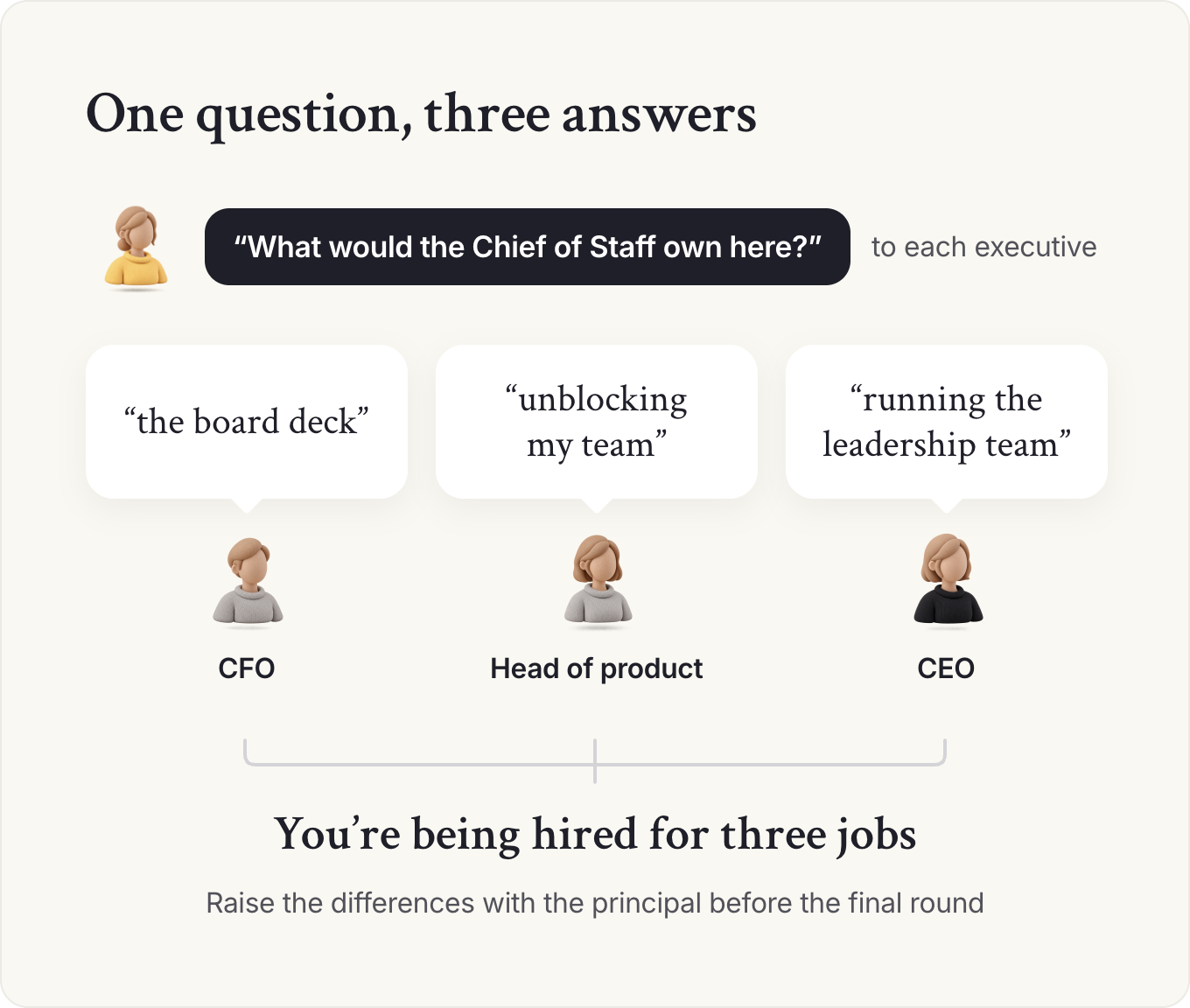
Raise the differences with the principal before the final round. Their answer shows whether they'll settle scope disputes for you once you're in the seat, or leave you to settle them with their direct reports. Also ask each executive for one piece of advice on working with the principal, because advice that repeats across people describes the real working style.
Then ask how things work today: who runs cross-functional projects now, and who the principal calls when a big decision is stuck. The answers tell you whose work you'd absorb, and who might resist.
Two more questions are worth the slight awkwardness. "What other titles did you consider for this role?" tells you how the company sees it. "What's a recent week that would have gone better with a Chief of Staff?" tells you whether the principal has a real problem in mind.
Read the principal in the room
Some executives say they want a thought partner and hire a very capable assistant. You find out by disagreeing. Bring your own short read of the business's main problems and what you'd do first, or offer a view on something they raised. Then watch whether they argue with it, ask for your reasoning or move on.
Then ask: "What's the hardest thing about working with you?" Believe the answer, because your job will be to work around it. Ask too what feedback their own team has given them. The answer tells you how much they'll take from you. And ask how they like to hear from you: a written note, a quick check-in or a standing meeting.
A principal with a real need can say why the role exists now and what breaks if the seat stays empty for six months, usually by naming a meeting or a project that's stuck.
Ask about their worst week, and what their team sees when they're under pressure. Ask too what's off-limits to you, such as pay data or performance reviews. A limit named before you sign is easy to plan around.
Last, ask yourself two things. Would you defend this person in a bad week, even on a decision you argued against? And would you want to work the way they do five years from now? You'll spend more time with them than with anyone else at the company, so look for a style that complements yours. You add the most by taking on the work they enjoy least.
Eric Nehrlich, who spent more than six years as Chief of Staff for Google Search Ads, described the green-flag version: "I'm in the room where it happens." He did the budget and headcount planning, organized the strategy planning sessions and took part in decisions about where the business was going.
If the principal's description of your job sounds like that, score item 10 a 2.
Should you take a Chief of Staff role with yellow flags?
Often, yes, if the gaps are fixable and you get them in writing before you sign. A missing band or a vague outcome can be fixed in one conversation. A principal who can't name a single decision for you is much harder to change once you've joined.
Many roles will score yellow, especially first Chief of Staff hires. Those companies often can't describe the job well, because the job is new to them. That's normal, and part of your value is defining it with them.
What must the offer letter say to prove the role is real?
The offer should put the four offer-stage items from the checklist on paper: the reporting line, a title that matches the decisions you heard, one six-month outcome and a date to review scope and level. For the outcome and the review date, a short email from the principal counts, and a one-page mandate is better.
Check the title against the decisions you heard in interviews. A Director title on Sr. Associate / Jr. Manager decisions will usually be reviewed and promoted at that lower level, as our guide to what a Chief of Staff does explains.
Then check the pay against the seat. In the US, postings that list pay put the Chief of Staff median at about $180,000, against about $95,000 for executive assistant roles. An offer near the lower figure prices the job as an assistant role, whatever the title says. Pay, equity and how to negotiate them are in our guide to your Chief of Staff offer.
When a yellow role is worth taking
If you'll sit in the leadership meeting and the principal argues with you, the missing pieces are worth negotiating.
A yellow role can also be the right first step. If you're coming from executive support or an early-career job, a role with some assistant work and real exposure can be a fair trade, as long as the exposure is written into the role. The hybrid section of our EA vs Chief of Staff guide covers how to set that up.
A yellow role takes time to fix. One you don't reshape becomes the job on the posting, and the title then follows you into your next search. If you take one, put the six-month review in the calendar the day you accept.
If the gap is the admin work, ask who owns it and by when. "An EA by the end of Q1" is a plan, while "we'll figure it out" usually leaves the work with you.
When to walk away
Walk away when two must-haves score 0. With no named principal and no first-month decision, nobody has decided what the job is yet, and it will take shape from whatever lands on your desk.
Also walk away when the answers get vaguer as the interviews go on. A principal who described decisions in round one and only tasks by the final round has shown you how the job will drift.
What if you already took a mislabeled Chief of Staff role?
Write the job you want and propose it. A one-page Chief of Staff mandate sets out why the role exists, its priorities, three six-month outcomes and your decision rights, and it gives your principal something to say yes to. Book the conversation for your next one-to-one, and bring the draft.
Start with the operating rhythm, because it's the work most postings ask for and it has a visible result every week. Offer to run one recurring meeting, and do it well for a month. Then use the review to ask for the next piece.
Give the reshape one scope review before you decide whether to stay. Leaving early has a cost: 38% of Chiefs of Staff who leave within a year step up to a more senior role, against 57% of those who stay two to three years. If your principal still won't put a scope change in writing after that review, start your search then.
Take this guide with you
The full guide as a PDF: every section, template and chart, ready to print or share with your team.
Your PDF is ready.
Download the PDFFree. We may email you new guides; unsubscribe anytime.
Frequently asked questions
Is it a red flag if a recruiter won't name the principal?
Not at first. Recruiters often hold back the company name until the first call. On that call, ask for the principal's title, the company's stage and why the role exists. If you still can't learn whose Chief of Staff you'd be after it, score the first checklist item a 0 and treat the role as yellow at best.
Is it a red flag if the company already has several Chiefs of Staff?
Usually, no. Larger companies often have one for the CEO and others for functional leaders. Ask who each one supports, where your remit ends and theirs begins, and who runs the leadership team's operating rhythm. If nobody can answer the last question, expect to spend your first months negotiating scope with a peer.
Is it a red flag if the company has never had a Chief of Staff?
Usually, no. A first Chief of Staff often helps define the role. Ask whether the leadership team took part in the interviews, and how and when the principal will announce the hire. A team that first hears about the role on your start date is likely to question your remit in month one, so ask for the announcement to go out before you join.
Should I ask to speak to the previous Chief of Staff?
Yes, if there was one. Ask what they owned, which decisions they made, what they'd change about the role and where they went next. A predecessor who moved into a leadership role is a strong green flag. If the company won't connect you, or the last two left within a year, ask why before you accept.
Is it a red flag if the posting asks for AI skills?
No. About one in four Chief of Staff postings ask for AI skills, from general fluency to named tools. Look at what the AI work sits next to. If it's most of the role, such as building internal tools with no operating rhythm or decisions attached, you're looking at a different job with a Chief of Staff title.
How do you tell a good Chief of Staff role from a bad one?
Check three things, in this order. Can someone name your principal by the first call? Will the principal name a decision you'd make or shape in your first month? Will the offer put the reporting line, one six-month outcome and a review date in writing? A good role passes all three. Whether the career itself is worth it is in our guide to whether Chief of Staff is a good career move.
- Chief of Staff Pathways Report 2026, Chief of Staff Network, 2026 (1,819 job postings, June to October 2026, data from Inform Growth; pay from US postings that state it, about 1 in 5; 2,869 career histories).
- Chief of Staff Leveling Framework, Chief of Staff Network (survey of 200+ Chiefs of Staff).
- Chief of Staff Network podcast: Lindsey O'Sullivan (then Chief of Staff at Applecart; a founding advisor to the Chief of Staff Network), Rahul Desai (then general manager of the Chief of Staff Network), Eric Nehrlich (former Chief of Staff for Google Search Ads), Stephania Greco (Chief of Staff at Bicycle Capital).
- A Chief of Staff Network member session (paraphrase; the speaker is not named).
Learn the job with people who do it
Membership gets you the Power Skills program, member events and a private community of working Chiefs of Staff.
Land your first Chief of Staff role
Launchpad helps you prepare, position yourself and interview for the role.
Starting out in the role?
The Fundamentals email course walks you through scoping the mandate, setting the cadence and earning trust.
Lead AI adoption from the Chief of Staff seat
The Chief of AI Fellowship is for operators turning AI into how the company runs.
Hiring a Chief of Staff?
Post the role on the Chief of Staff job board, or browse open roles.
Get your resume ready for the role
Get feedback on your Chief of Staff resume before you apply.
Let the right roles find you
Join the talent network and hear about Chief of Staff roles first.
The Chief of Staff newsletter
What Chiefs of Staff are reading, hiring for and building.
Get the full report
Every chart and cut from our latest salary research, sent to your inbox.
Using AI with sensitive data?
Learn the legal side of using AI at work.
Keep going in this series