

How a Chief of Staff researches a decision
How a Chief of Staff researches decisions: scope the question, ask people first, use AI deep research safely, write a one-page memo. 2 templates, 2 prompts.

Ask AI
 Share

A Chief of Staff does research to answer one question the principal needs answered for a decision, by an agreed deadline. The result is a one-page memo with the answer, a recommendation and a stated confidence level. The best facts usually sit inside the company. AI deep research speeds up the reading, and every claim you keep still needs checking.
- Before you read anything, ask what would change your principal's mind. The answer turns a vague ask into a test you can run, often from your own CRM in an afternoon.
- Call the person closest to the answer before you search: the sales lead who covers the market, or someone outside who made the same decision last year.
- Treat a deep research report as a pile of leads. Open the source behind every number you keep, and check hardest where the report tells you what you hoped to hear.
- Put the answer, your recommendation and your confidence level in the first three lines of the memo. When the evidence is mixed, recommend anyway and say the confidence is low.
- Offer the one-hour version first, treat the agreed depth as a budget, and log every answer so a repeat question takes minutes.
Most research requests leave out what you need to start: what's being decided, by when, and how sure your principal (the executive you work for) needs to be. "Can you look into whether we should expand into Germany?" names only the topic. Without the rest, you can spend a weekend reading market reports and arrive with forty pages of notes and no answer.
Research that disappoints usually goes wrong in the first hour: a vague question, no agreed depth, and public sources first when the most useful facts sat in the company's own sales calls. AI deep research now does the reading in minutes, which makes a confident wrong answer faster to produce too. When it's done well, one clear page on a hard question saves the leadership team a meeting, and it's often the work that makes the CEO start asking for your view.
What research does a Chief of Staff do?
A Chief of Staff researches whatever stands between the principal and a decision: quick factual answers, deeper decision research, competitor and market scans, vendor choices and build-or-buy calls, internal diagnostics on why something isn't working, and sometimes due diligence on an acquisition or investment.
Principals think out loud, and a lot of what they think comes out as a question. Teddy Owen, then Chief of Staff at Moonhub, told our podcast that his principal asks him a lot of discrete research questions, and he takes them straight to an AI tool. Postings point to the bigger jobs. 43% of more than 1,800 postings ask for strategy and annual planning, 37% for a thought partner on decisions, 27% for special projects and 12% for M&A or corporate development. Each of those needs research behind it.
The six kinds of research a Chief of Staff does
| Type | Typical question | Usual depth | Best first sources | What you deliver |
|---|---|---|---|---|
| Quick answer | "What do competitors charge for X?" | 1 hour | AI tool, pricing pages, sales team | A paragraph with sources |
| Decision research | "Should we expand into Germany?" | 1 to 5 days | Your own data, customers, people who've done it | One-page memo with recommendation |
| Competitor or market scan | "What changed in our market this quarter?" | 1 day | Competitor sites, job postings, release notes, sales calls | Scan with implications |
| Vendor or build-or-buy | "Which notetaker should we approve?" | 1 to 2 weeks | Requirements from users, IT, references | Comparison and recommendation |
| Internal diagnostic | "Why are enterprise deals slipping?" | 1 to 3 weeks | Interviews, CRM and finance data | Findings, root causes, options |
| Due diligence | "Should we buy this company?" | Weeks | Data room, interviews, outside advisors and specialists | Diligence memo |
You don't need a consulting background for any of this. 27% of postings ask for management consulting experience, but only 7% of Chiefs of Staff came straight from consulting. In our Leveling Framework, Chiefs of Staff from Analyst to Jr. Manager support planning with data and analysis. From Manager you develop strategic plans, and from Director you also advise senior leadership on strategy.
If you're the principal asking, three things get you a better answer sooner. Say what you're deciding and by when. Say what would change your mind. Then pick the depth: an hour, a day or a week. Expect a recommendation with a confidence level, even when the evidence is mixed.
How do you scope a research request before you start?
Before you open a single source, agree five things with your principal: the decision the research serves, the question in one sentence, the deadline, how deep to go, and what's out of scope. Ten minutes of scoping saves more time than anything else you'll do on the job, because it decides what you'll read and what you'll skip.
Principals ask in shorthand. "Look into Germany" might mean "should we hire a sales team there next year" or "the board asked about Europe and I need a view by Thursday", and each needs different sources and a different deliverable. Reply within minutes, in whatever channel they asked, with the two questions you can't fill in yourself: what's being decided, and what would change their mind. Once they answer, send the note back so you both agree on it.
Template: Research scoping note
Research scope: [short title]
Requested by: [principal] · Owner: [Chief of Staff] · Date: [date]
1. Decision this serves: [what will be decided, by whom, in which meeting]
2. The question, in one sentence: [question]
3. What would change your mind: [the evidence that would tip the decision]
4. Depth: [1 hour / 1 day / 1 week] · Due: [date and time]
5. In scope: [markets, segments, time period, competitors]
6. Out of scope: [what we won't look at this time]
7. Sources to start with: [internal data, people to ask, then external]
8. Deliverable: [paragraph / one-page memo / scan] · Recommendation expected: yes
9. Confidentiality: [what can and can't go into AI tools or outside conversations]
Confirmed with [principal] on [date].
The most useful scoping question is "what would change your mind?" If your principal says "I'd go ahead if at least five of our top twenty accounts have German entities," you can answer it from your CRM in an afternoon.
Then agree depth out loud. Most requests fit one of three levels: an hour (a quick answer with sources, enough to talk it through), a day (a scan, or one narrow test, with a view: enough to pick a direction) and a week (a memo with evidence on a wider question, enough to decide on). Usually you need less depth than you'd assume. I'd always put "recommendation expected: yes" on the note. You read faster when you're reading toward a view.
Worked example (illustration): scoping "look into Germany"
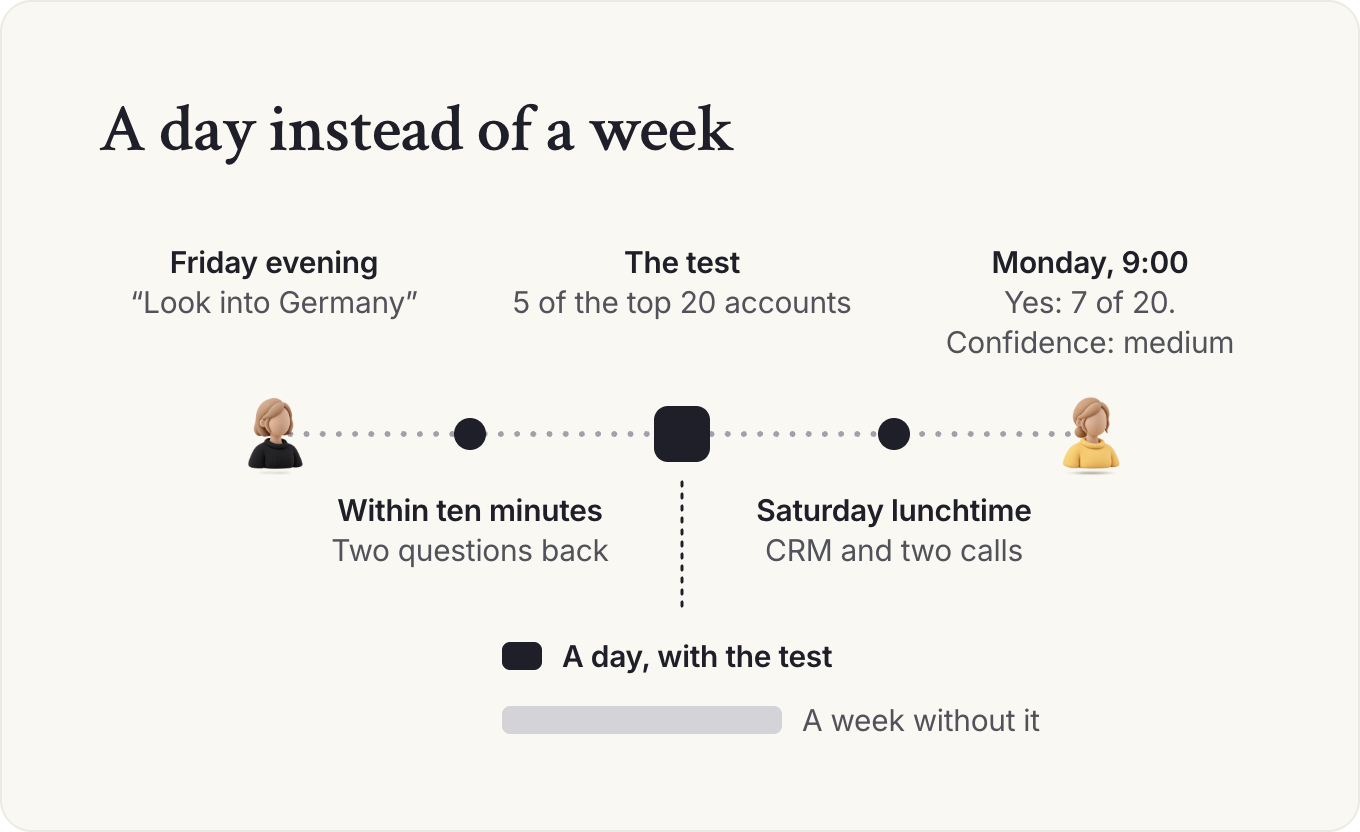
The Germany request arrives on Friday evening, with one more line: "Need something for Tuesday's leadership meeting." You reply within ten minutes: "Happy to. Is this for a yes or no on hiring a seller there next year, or for the board's Europe question? And what would make it a yes?"
Your principal answers that the board asked, and that she'd back a German sales hire if enough current customers already operate there. You agree a number: at least five of the top twenty accounts with German entities. The test is narrow, so depth is a day, due Monday at 9. Without the test, this would have been a week. Out of scope: other EU countries, local entity setup, tax. The note now asks something your CRM and two calls can answer by Saturday lunchtime.
Judgment calls when scoping
If your principal can't say what would change their mind, the decision isn't framed yet. Offer two or three framings and let them pick. If the question arrives with its answer attached ("find data showing we should..."), do the work honestly and say early if the evidence points the other way. A principal is better served hearing it from you on Tuesday than from the board in a month. If the request comes from a board member through your principal, ask what the asker needs to see, since a director's question often wants two paragraphs and one chart.
The next time your principal asks you to "look into" something, reply with the scoping note before you start, and notice how often the question changes.
Where do the best answers come from?
For anything bigger than a quick answer, start inside the company: your own data, then the people closest to customers, then customers themselves, then people outside who've made the same decision, and only then public sources and AI summaries of the web. The inside sources are faster, more specific to your situation, and something no competitor can read.
Public research tells you about a market; your own data tells you about your position in it. For the Germany question, the useful facts are how many current customers already operate there, what your sales team hears from German prospects, and what share of support tickets come from European time zones. A fifteen-minute call with the sales lead who covers Europe often answers more than a day of reading. Short recurring reviews with each department head, as in our post on data-driven decision making, tell you which numbers exist and who owns them. If those numbers don't exist yet, our piece on becoming data-driven shows where to start.
Then talk to people who've been there. Someone at another company who expanded into Germany last year will tell you in thirty minutes what it really cost and which assumption was wrong. Public sources and AI come last, and they're good for context and numbers you can cite. They can't tell you which of the many true things matter for your decision.
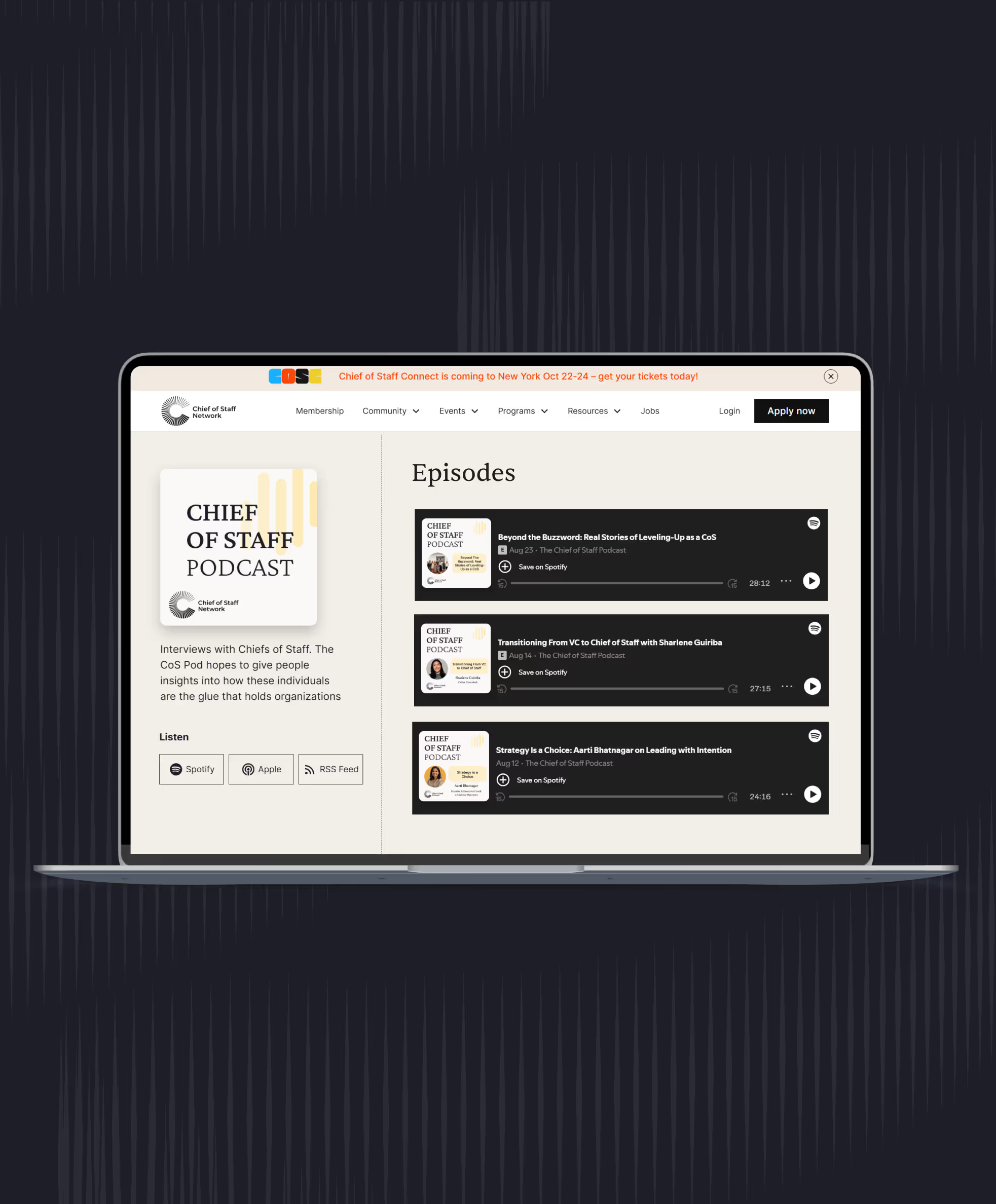
Anna Aden, then Chief of Staff to the Managing Director for Asia Pacific at the Tony Blair Institute for Global Change, told our podcast that as information gets easier to come by, the scarce skill is finding the kernels of truth that matter to one stakeholder versus another.
The fastest research is often a well-phrased question to someone who has already made the decision. Join the Chief of Staff Network and ask members who have made the same call. They're in our community, peer groups and member events.
See membershipHow do you use AI deep research without getting burned?
Use AI deep research for the first pass of reading: give it a scoped brief, let it gather and summarize sources, then open every source behind any claim or number you plan to keep. Treat the report as a pile of leads, and keep confidential company data out of any tool your company hasn't approved.
A question that used to take a day of reading now takes ten minutes of waiting and an hour of checking. Abhishek Vora, then Chief of Staff to the CEO at LaunchDarkly, told our podcast about a run of acquisitions and funding rounds among their competitors. His team ran deep research on those competitors' public material. The ten-minute run produced a seventeen-page report that helped them plan a competitive response.
You have to go through with a fine-tooth comb because some of the stuff is actually inaccurate.
Abhishek Vora, then Chief of Staff to the CEO, LaunchDarkly · Listen on the podcast
Most of the quality comes from the brief. It should name the decision, ask for primary sources with dates, and ask the tool to label what's well supported, what rests on a single source and what's its own inference. That last instruction tells you where to start checking.
Ask for a short report as well. Every extra page is more to check, so the brief below caps the report at 2,000 words and ends with the five facts that matter most for the decision. Check those five first.
Prompt: Deep research brief
I'm a Chief of Staff researching a question for a decision my CEO will make. Run deep research and write a report I can verify.

Decision: [what will be decided, by whom, by when]
Question: [one sentence]
What would change the decision: [the evidence that matters most]
Scope: [markets, segments, time period, competitors]. Out of scope: [list]

Instructions:
- Prefer primary sources: company filings, official statistics, product documentation, pricing pages, regulators. Avoid content marketing, listicles and undated pages.
- For every number, give the source, the date of the figure and a direct link. If sources disagree, show both.
- Separate what is well supported from what is a single-source claim or your inference. Label each.
- End with: the 5 facts that matter most for the decision, the biggest open questions, and what you could not find.
- Under 2,000 words. Use tables where comparing more than two things.
The steps are similar in Claude and ChatGPT. I'd use Claude.
Claude
- In a new chat, click the "+" button at the bottom left and turn on Research. Web search must be on too, and Research needs a paid plan.
- If your company has approved it, turn on connectors such as Gmail or Google Docs so the research can include your own email and documents. Start Research on the web or in the desktop app, because on mobile it searches only the web and skips connectors. Leave them off for anything confidential the company hasn't cleared for AI use.
- Paste the deep research brief above, filled in from your scoping note.
- When the report arrives, ask for a table of every factual claim with its source link, then open the sources for anything you'll use.
ChatGPT
- In a new chat, choose Deep research from the tools (+) menu or from the sidebar.
- If you want to stay within trusted sources, open Sites, then Manage sites, to limit or prioritize specific domains, and connect only apps your company has approved.
- Paste the deep research brief above. Review the research plan it proposes and narrow it before it starts.
- When the report arrives, ask for a table of every factual claim with its source link, then open the sources for anything you'll use.
Other assistants work in a similar way. Use the one you prefer or your company allows.
Why deep research reports go wrong
A deep research tool reads many pages of mixed quality and writes one confident summary, so a figure from an undated blog post gets the same tone as one from a company filing. Citations can point to a page that mentions the topic without supporting the claim, and figures go stale without a year attached. Let the tool gather and organize, and anchor every number you keep to a source you can open.
In a Chief of Staff Network workshop on AI adoption, a member who was then an independent consultant described a deep research run from an earlier job, for a study on how HR organizations use AI. Some of the studies it cited proved exactly the hypothesis the team had. When they went back to the sources, nearly every finding that had seemed too good to be true failed in one of three ways: the organization was invented, the organization was real but the study was invented, or the study was real but the statistics weren't in it. So check hardest where the report agrees with you, and ask for the source whenever a claim matters.
Worked example (illustration): checking a report in an hour
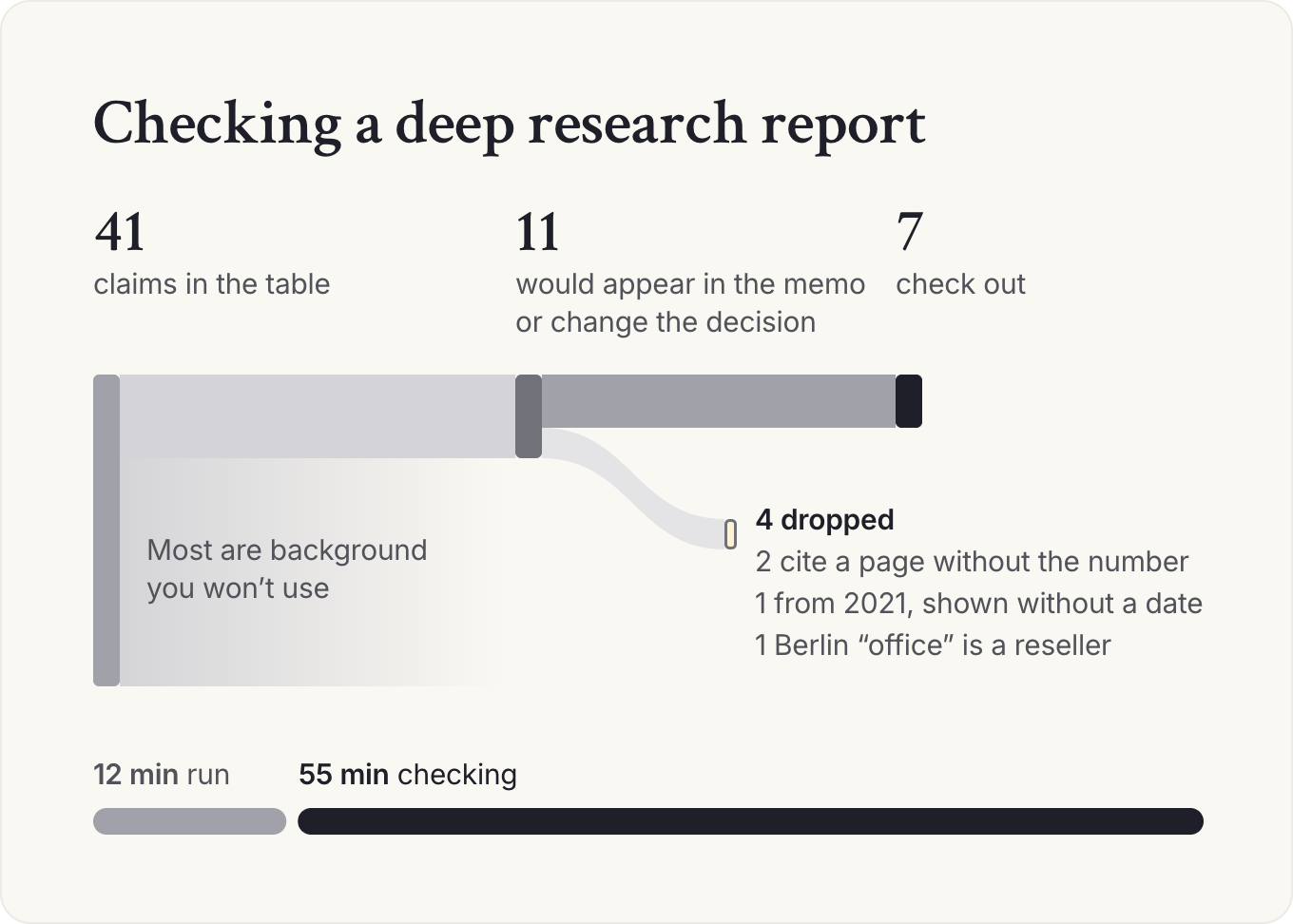
The deep research run on German expansion returns four pages, close to the 2,000 words you asked for. You ask for a table of every factual claim with its source, and get 41 rows. Most are background you won't use. You mark 11 that would appear in your memo or change the decision, and open each source. Seven check out. Two cite a page that doesn't contain the number. One market-size figure is from 2021, presented without a date. One competitor "office in Berlin" turns out to be a reseller. Your memo uses the seven and drops the other four. The run took 12 minutes, and the checking took 55.
Judgment calls on AI research
Verify every number in the memo, every claim that would change the decision, and anything that surprised you. Background you won't cite can stay unchecked. Keep three kinds of question away from deep research: anything answerable from your own data, anything confidential your company hasn't cleared for AI tools, and events from the last few days. Confidential material goes only into tools your company has approved, signed into the company account. Before you paste in a customer's or an employee's details, check your company's data rules. Our guide to AI for Chiefs of Staff covers those rules, GDPR included.
Once your principal sees what these tools produce, they'll start forwarding their own reports with "thoughts?". Treat a forwarded report like any first draft: find the claims that matter, verify them, and send back what's true and what you'd do. If a claim that matters is wrong, say so early, as you would with a question that arrives with its answer attached.
This week, take one question you'd normally spend a day on. Write the brief, run it, and time both the run and the checking. Plan your next research deadline on the checking time.
How do you turn findings into a recommendation your principal can use?
Write one page that leads with the answer and your recommendation, states how confident you are and why, separates what you know from what you're assuming, lays out the options, and puts the evidence in an appendix. Your principal asked a question to make a decision, so the first lines should help them make it.
The common failure is the report that walks through everything you found in the order you found it, leaving your principal to do the synthesis on their phone between meetings. Alexa Gellman, then Chief of Staff at Inspired Capital, told our podcast that most of her job was deal work, including writing investment memos and presenting them to the investment team. An investment memo is a research memo with a decision attached, written to a standard everyone knows how to read.
Put your answer, your recommendation and your confidence level in the first three lines of every research memo.
Confidence is the line most memos leave out. Say it plainly (high, medium or low) and give the reason: "Medium: three of five customer calls support this, but our usage data covers only six months." Your principal can then decide how much more evidence they need before acting.
If you're the principal, read the reason after the confidence level first, because it names the evidence that's thin. Ask for another day only if that evidence is on the memo's "What would change my recommendation" list, and expect a line on what the day would add.
When the decision itself needs a formal write-up for a group, the decision memo in our guide to briefing your principal takes over, and this memo becomes its appendix.
Template: Research memo
[Question, in one sentence]
To: [principal] · From: [Chief of Staff] · Date: [date] · Decision: [what, by when] · Test: [what would change your mind, from the scoping note]
Answer
[Two sentences: the answer to the question.]
Recommendation
[What I recommend we do, and the first step.]
Confidence: [high / medium / low], because [one line].
What we know
- [Fact that matters most for the decision] ([source])
- [Fact] ([source])
What we're assuming
- [Assumption] (how we'd test it: [test])
Options
| Option | For | Against | What it costs |
|---|---|---|---|
| [A] | |||
| [B] | |||
| Do nothing |
What would change my recommendation
- [Evidence that would flip it]
Open questions
- [What we couldn't find, and whether it matters]
Appendix
- Sources (with dates), data pulls, interview notes (facts only)
# [Question, in one sentence]
To: [principal] · From: [Chief of Staff] · Date: [date] · Decision: [what, by when] · Test: [what would change your mind, from the scoping note]

## Answer
[Two sentences: the answer to the question.]

## Recommendation
[What I recommend we do, and the first step.]

Confidence: [high / medium / low], because [one line].

## What we know
- [Fact that matters most for the decision] ([source])
- [Fact] ([source])

## What we're assuming
- [Assumption] (how we'd test it: [test])

## Options
| Option | For | Against | What it costs |
| --- | --- | --- | --- |
| [A] | | | |
| [B] | | | |
| Do nothing | | | |

## What would change my recommendation
- [Evidence that would flip it]

## Open questions
- [What we couldn't find, and whether it matters]

## Appendix
- Sources (with dates), data pulls, interview notes (facts only)
Example: Research memo for a Series B CEO (illustration)
Should we hire a seller in Germany next year?
To: CEO · From: Chief of Staff · Date: Monday, 9:00 · Decision: Germany hire in or out of the Q1 headcount plan, by Jan 15 · Test: at least five of the top 20 accounts with German entities
Answer
Yes, on the test you set. Seven of our top 20 accounts already run German entities, and your bar was five.
Recommendation
Hire one senior account executive based in Germany in Q1, reporting to the VP Sales, and review after two quarters. First step: the VP Sales drafts the role this week.
Confidence: medium, because the account data is solid but only two of the seven have told us they'd buy more there.
What we know
- 7 of the top 20 accounts have German entities (CRM and company filings, pulled Saturday)
- 3 of those 7 already pay for seats used by German staff (billing export, last 12 months)
- German prospects ask for local-language contracts and EU data hosting (VP Sales, two recent calls)
What we're assuming
- These accounts buy faster from a local seller (test: ask all seven in this quarter's account reviews)
- We can hire a senior seller in 90 days (test: recruiter estimate this week)
Options
| Option | For | Against | What it costs |
|---|---|---|---|
| One senior AE in Germany | Covers the seven accounts in their time zone; small bet | One person carries the whole test | One salary, travel, recruiter fee |
| Cover Germany from the US team | No hire; can start now | Six-hour time gap; no local contracts | Sales time taken from US pipeline |
| Do nothing | Keeps focus on the US plan | The seven keep growing in Germany without us | Expansion revenue we never see |
What would change my recommendation
- Fewer than three of the seven say they'd buy more with local support
- EU data hosting turns out to be a hard requirement we can't meet next year
Open questions
- Entity and tax setup: out of scope here; counsel scopes it if we go ahead
Appendix
- CRM pull, billing export, call notes (VP Sales, two prospects), deep research run (7 checked claims kept)
# Should we hire a seller in Germany next year?
To: CEO · From: Chief of Staff · Date: Monday, 9:00 · Decision: Germany hire in or out of the Q1 headcount plan, by Jan 15 · Test: at least five of the top 20 accounts with German entities

## Answer
Yes, on the test you set. Seven of our top 20 accounts already run German entities, and your bar was five.

## Recommendation
Hire one senior account executive based in Germany in Q1, reporting to the VP Sales, and review after two quarters. First step: the VP Sales drafts the role this week.

Confidence: medium, because the account data is solid but only two of the seven have told us they'd buy more there.

## What we know
- 7 of the top 20 accounts have German entities (CRM and company filings, pulled Saturday)
- 3 of those 7 already pay for seats used by German staff (billing export, last 12 months)
- German prospects ask for local-language contracts and EU data hosting (VP Sales, two recent calls)

## What we're assuming
- These accounts buy faster from a local seller (test: ask all seven in this quarter's account reviews)
- We can hire a senior seller in 90 days (test: recruiter estimate this week)

## Options
| Option | For | Against | What it costs |
| --- | --- | --- | --- |
| One senior AE in Germany | Covers the seven accounts in their time zone; small bet | One person carries the whole test | One salary, travel, recruiter fee |
| Cover Germany from the US team | No hire; can start now | Six-hour time gap; no local contracts | Sales time taken from US pipeline |
| Do nothing | Keeps focus on the US plan | The seven keep growing in Germany without us | Expansion revenue we never see |

## What would change my recommendation
- Fewer than three of the seven say they'd buy more with local support
- EU data hosting turns out to be a hard requirement we can't meet next year

## Open questions
- Entity and tax setup: out of scope here; counsel scopes it if we go ahead

## Appendix
- CRM pull, billing export, call notes (VP Sales, two prospects), deep research run (7 checked claims kept)
Keep it to one page above the appendix. If you can't, the question was probably two questions, and your principal should see them separately.
Judgment calls on the recommendation
When the evidence is mixed, recommend anyway and say the confidence is low. "Low confidence: I'd run a three-month pilot before hiring" is something your principal can act on. When your answer cuts against what your principal expected, lead with it anyway, and put the strongest evidence for their view in the options table. When the memo will travel to the board or the leadership team, agree with your principal whether the recommendation goes with it or stays with them. Walk your principal through the answer before the memo reaches a meeting, so they never hear it there first.
How do you research a competitor or a market in a day?
Work from a fixed source list: the competitor's own website, pricing and documentation, their release notes, their job postings, customer reviews, your own sales and win-loss notes, and their filings or funding news. Run AI deep research across the public sources, add what your sales team knows, and finish with a one-page scan that says what changed and what it means for your company.
A fixed list makes the scan repeatable: the first takes a day, the next quarter a few hours. Job postings are the source people forget. A competitor posting for five enterprise account executives in Germany has answered part of your expansion question for you.
Narrow the question before you run deep research. Start with a quick prompt to firm up the competitor list for one product area, so you don't miss an important player. Then run deep research on the top two competitors in that area. Two competitors in one product area is a scope one person can check.
Prompt: Competitor scan from public sources
Run a competitor scan on [competitor] for [our company, one line on what we do]. Focus on changes in the last [90 days / 12 months].

Use only public sources: their website, pricing page, product documentation, release notes or changelog, job postings, press releases, funding or acquisition news, filings if public, and customer review sites. Give a link and date for every finding.

Report in this structure:
1. What changed: product, pricing, positioning, team (from job postings), funding or M&A
2. What their job postings suggest they're building or entering next
3. Where they now claim to beat us, in their own words
4. What customers praise and complain about most
5. Three implications for us, each labeled as fact-based or inference
6. What you couldn't find

Keep it under 1,000 words. Don't speculate beyond the sources; label anything that is inference.
Then add what only you have. Paste the scan next to your win-loss notes and sales call summaries, and ask what the public picture is missing. Ten recent deal notes often say more about a competitor's real position than their whole website. Keep it honest: use public information and what customers tell you freely, never ask a new hire to share a former employer's confidential material, and never misrepresent who you are.
How do you keep research from eating your week?
Time-box every request to the depth you agreed, keep a research log so repeat questions take minutes, hand recurring research to the teams who own the data, and offer the one-hour version when a request doesn't justify more.
Research is interesting and visible to your principal, and it has a clear end product. That's why it crowds out the operating rhythm and follow-ups. If research has taken more than a fifth of your week for a month, something is off. Treat the depth on the scoping note as a budget: when you hit it, send what you have with your confidence level and a line on what another day would add.
Keep a research log, one line per request: the question, the date, the answer, the confidence and a link to the memo. When the CEO asks about Germany again in nine months, you start from your own answer. Keep the log next to your decision log, as our context management guide sets it up. If you pull the same churn analysis every month, it belongs in a dashboard the data or finance team owns.
I'd offer the one-hour version first for most requests. "I can give you a quick read by end of day, or a proper answer by Thursday. Which do you need?" Most of the time, the quick read is enough. This week, start the research log with the last five questions you answered.
Keep reading
 Context management for Chiefs of StaffToolkit
 How to brief your principal: briefing memos, decision memos and pre-readsToolkit
- The Chief of Staff toolkit: tools and templates for the daily workToolkit
Toolkit
- The Chief of Staff toolkit: tools and templates for the daily work
- How to brief your principal: briefing memos, decision memos and pre-reads
- Executive communications for Chiefs of Staff: writing for the CEO and running internal comms
- Leadership team meeting agenda: how to run the meeting, take notes and follow up
- Executive calendar management: how a Chief of Staff runs the calendar and inbox
- Context management for Chiefs of Staff
- Stakeholder management for Chiefs of Staff: how to map and track the people your principal depends on
- How Chiefs of Staff research decisions, with and without AI
- How a Chief of Staff runs board meetings and investor relations
Take this guide with you
The full guide as a PDF: every section, template and chart, ready to print or share with your team.
Your PDF is ready.
Download the PDFFree. We may email you new guides; unsubscribe anytime.
Frequently asked questions
Can I trust AI deep research?
Use it as a first pass that you check. Deep research tools gather and summarize many sources quickly, but reports contain errors. Open the source behind every number or claim you'll use, check its date, and mark single-source claims as such. Keep confidential company data in tools your company has approved.
Should a Chief of Staff give a recommendation or just the facts?
Give a recommendation every time, with a stated confidence level. Your principal asked because they want help deciding. A clear view with honest uncertainty is more useful than a neutral summary, and it's how research builds your reputation as a thought partner.
How do I research competitors ethically?
Use public sources: websites, pricing, documentation, release notes, job postings, filings, news and review sites, plus what customers tell you. Never ask employees to share a former employer's confidential information, and never misrepresent who you are to get information.
Do I need consulting experience to do research as a Chief of Staff?
No. 27% of Chief of Staff job postings ask for management consulting experience, but only 7% of Chiefs of Staff came straight from consulting, according to the Chief of Staff Network's Pathways Report. Scoping, sourcing and writing a clear memo are skills you can learn on the job.
Where can I find research about the Chief of Staff role itself?
The Chief of Staff Network publishes three reports on the role. The 2025 Salary Report covers pay by level, stage and location; the median base salary is $160,000. The Pathways Report covers more than 1,800 Chief of Staff job postings and where Chiefs of Staff go after the role. The Leveling Framework describes six levels, from Analyst to Executive, and comes from a survey of 200+ Chiefs of Staff.
- 2026 Chief of Staff Pathways Report, Chief of Staff Network, 2026 (1,819 job postings; 2,653 career histories with a known background).
- Chief of Staff Leveling Framework, Chief of Staff Network (survey of 200+ Chiefs of Staff).
- 2025 Chief of Staff Salary Report, Chief of Staff Network, 2025 (479 respondents).
- Teddy Owen, Chief of Staff Network podcast.
- Anna Aden, Chief of Staff Network podcast.
- Abhishek Vora, Chief of Staff Network podcast.
- Alexa Gellman, Chief of Staff Network podcast.
- A Chief of Staff Network member workshop on AI adoption, December 2025 (recording).
- Vendor help pages: Claude and ChatGPT, checked November 2026.
- Depth levels, the scoping note and the memo format: Chief of Staff Network recommendations.
Learn the job with people who do it
Membership gets you the Power Skills program, member events and a private community of working Chiefs of Staff.
Land your first Chief of Staff role
Launchpad helps you prepare, position yourself and interview for the role.
Starting out in the role?
The Fundamentals email course walks you through scoping the mandate, setting the cadence and earning trust.
Lead AI adoption from the Chief of Staff seat
The Chief of AI Fellowship is for operators turning AI into how the company runs.
Hiring a Chief of Staff?
Post the role on the Chief of Staff job board, or browse open roles.
Get your resume ready for the role
Get feedback on your Chief of Staff resume before you apply.
Let the right roles find you
Join the talent network and hear about Chief of Staff roles first.
The Chief of Staff newsletter
What Chiefs of Staff are reading, hiring for and building.
Get the full report
Every chart and cut from our latest salary research, sent to your inbox.
Using AI with sensitive data?
Learn the legal side of using AI at work.
Keep going in this series