


How to land your first Chief of Staff role
Land your first Chief of Staff role in 7 stages: choose a level, find the roles nobody posts, test the seat, weigh the offer and get ready for day one.

Ask AI
 Share

To land a first Chief of Staff role, write down the level, principal, scope and pay you want before your first call. Spend most of your search hours on people who can introduce you to a principal, and apply only where your results match the posting. Before the final round, ask whether the role is funded this year.
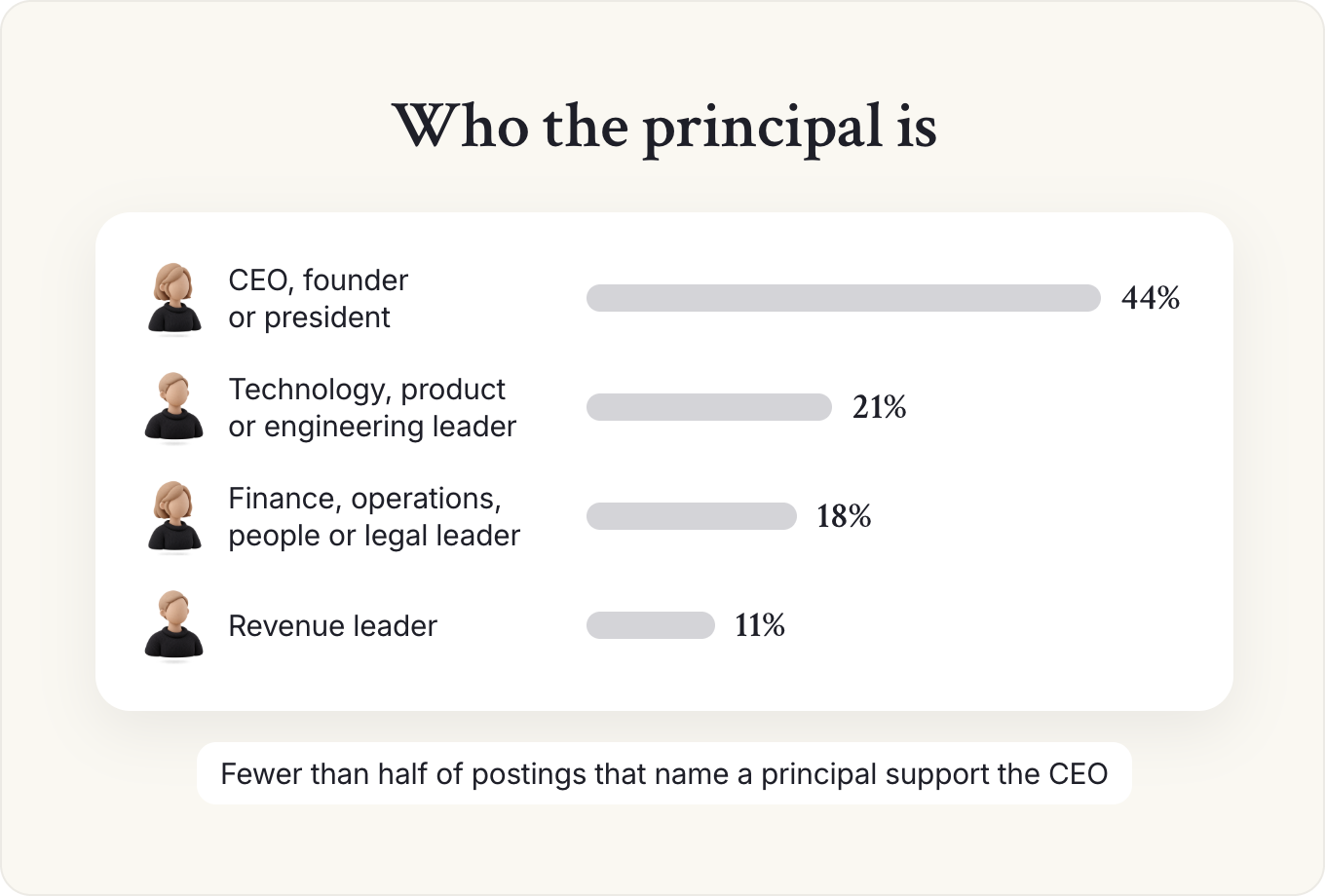
- Search beyond the CEO's office and the Chief of Staff title. Fewer than half of postings that name a principal support the CEO, founder or president, and many first roles carry another title.
- Keep each outreach note under 150 words, with the first line about the reader. Before an interview, send the principal work they can see, such as notes on their product.
- Tell your interview stories at the level in your spec. The level you present is usually the level you're offered.
- Decide how you'll answer a counteroffer before you resign. The reasons you're leaving are written in your spec, and a raise doesn't change them.
A first Chief of Staff search can go right at almost every stage and still not end in the role. One member, searching in 2023, applied to more than 50 jobs, interviewed with about 10 companies and reached four final rounds. Then three of those four roles lost their budget and stopped existing.
Most of what decides a first search is settled before the first application: the level you aim for, the kind of principal and the titles you search. If you're still deciding whether the role suits your background, start with how to become a Chief of Staff. If the leader you'd support already works with you, write the reverse job description below first, because it is the role you'd pitch.
What are the stages to land a Chief of Staff role?
There are seven, from picking your target to day one. Finish stage 1 before you send anything, because it decides which applications are worth sending.
The seven stages, from your first decision to day one
| Stage | What you do | What you walk away with | Go deeper |
|---|---|---|---|
| 1. Pick your target | Decide why you want the role, then the level, the kind of principal and the titles to search | A reverse job description: your own spec for the role | This guide |
| 2. Close your gaps | Fill the one or two skills your target roles ask for that you can't yet prove | A project or course you can point to | Chief of Staff training and courses |
| 3. Run the search | Work two pipelines, warm and posted, on a weekly rhythm | A tracker with live conversations in it | This guide |
| 4. Test the seat | Check each role against your spec, confirm it's funded, and look for the signs of a mislabeled job | A shortlist of roles worth finishing | Red flags in a Chief of Staff role |
| 5. Prove it | Rewrite your resume around results and tell stories that show judgment | A resume, a cover letter and stories ready for any interview | Resume and cover letter examples, and interview questions |
| 6. Weigh the offer | Compare the level, scope, decision rights and pay with your spec, then negotiate | An offer that matches your spec | Evaluate and negotiate the offer |
| 7. Leave well and start | Resign cleanly, hand over, and prepare with your principal | A clean exit and a plan for week one | This guide, then your first 90 days |
The spec you write in stage 1 is the yardstick for stages 4 and 6, and the tracker you start in stage 3 shows, week to week, whether the search is working.
Which Chief of Staff roles should you aim for?
Aim for roles at the level you can hold today, with a kind of principal you can work for, under any of the titles the work hides behind. I'd pick the level and the kind of principal before you pick a single company. That costs you some roles to chase, and it saves you from interviewing for jobs you'd turn down.
Pick your level
Our Leveling Framework, built with more than 200 Chiefs of Staff, describes six levels: Analyst / Associate; Sr. Associate / Jr. Manager; Manager / Sr. Manager; Director; Vice President; and CXO / Executive. What separates them is mostly decision rights: what you decide alone, what you recommend, and what you don't own.
Pay goes up with the level. Among about 480 Chiefs of Staff, most of them in the US, average base pay runs from about $91,000 at Analyst / Associate to about $194,000 at Executive. Our salary guide has the full table by level, company size and city.
To place yourself, read the level descriptions and mark the one where you could already do most of the work without help. That's your target. One level above is a stretch you can argue for in an interview. My read: a role two levels above usually ends in a talk about moving you down a level.
Pick your principal
Your principal is the executive you'd work for. What they delegate, how fast they decide and how they take bad news will shape most of your week. 44% of postings that name the principal say the CEO, founder or president. Most of the rest support a technology, product or engineering leader (21%), a finance, operations, people or legal leader (18%), or a revenue leader (11%).
For a first role, a functional principal can be the easier door. They usually want depth in their own area, so an operations manager is a natural fit for a COO, and a product manager for a chief product officer.
Search the titles around it
Many first roles carry another title, and the work is the same. Search for the duties: running the leadership meeting, planning cycles, board prep, cross-team projects for one senior leader.
Titles to search besides Chief of Staff
| Title | Where you often see it | What to check |
|---|---|---|
| Founder's associate | Seed and Series A startups | Whether you'd work across the company or mostly for the founder's inbox |
| Business operations or strategy and operations | Growth-stage tech companies | Whether you'd report to the CEO or COO, or sit inside a function |
| Office of the CEO or strategy associate | Larger companies | Whether you'd own a process or mostly prepare decks |
| Business manager | Banks, asset managers, family offices | Whether it's the executive's right hand or an admin role |
| Head of special projects | Companies after a funding round or a merger | Whether each project has a sponsor and an end date |
| Deputy or associate Chief of Staff | Large companies with an existing Chief of Staff | Who you'd learn from, and whether the path to the full role is real |
One more filter belongs in your spec. Check the reporting line on any role that "supports the leadership team": a role that reports to several leaders has no single principal to agree scope with.
Write all of this down as a reverse job description: the job description you'd write for yourself. I'd write it before your first call, and hold every conversation up against it. Founders and executives are good at selling a smaller job with a bigger story, and a written spec is what stops you agreeing to it in the room. Keep the spec to yourself in early calls. A list of terms can end a conversation before anyone has seen your work. Use it to choose your questions, and put its scope and decision-rights lines on the table at the offer stage.
Template: Your reverse job description
My reverse job description
Why this role, why now
[One sentence: what you want to be doing 2 to 3 years after this role]
Level
- Level I can hold today: [Leveling Framework level]
- Why: [two pieces of evidence]
Principal
- Kind of leader: [CEO or founder / COO / another executive]
- How I work best with a principal: [one line]
Company
- Stage and size: [e.g. Series B to D, 150 to 800 people]
- Where my experience fits: [business model, sector, customers]
- Location and remote: [city, hybrid, remote]
Scope I want, ranked
- [e.g. running the operating rhythm]
- [e.g. cross-functional projects]
- [e.g. communication up and down]
Decision rights I need
- Decide: [what I'd decide alone]
- Recommend: [what I'd shape and my principal would decide]
- Not own: [what belongs to someone else]
Pay
- Floor: [$]
- Target: [$]
Deal-breakers
- [e.g. no named principal]
- [e.g. more than a fifth of the job is calendar and travel]
# My reverse job description

## Why this role, why now
[One sentence: what you want to be doing 2 to 3 years after this role]

## Level
- Level I can hold today: [Leveling Framework level]
- Why: [two pieces of evidence]

## Principal
- Kind of leader: [CEO or founder / COO / another executive]
- How I work best with a principal: [one line]

## Company
- Stage and size: [e.g. Series B to D, 150 to 800 people]
- Where my experience fits: [business model, sector, customers]
- Location and remote: [city, hybrid, remote]

## Scope I want, ranked
1. [e.g. running the operating rhythm]
2. [e.g. cross-functional projects]
3. [e.g. communication up and down]

## Decision rights I need
- Decide: [what I'd decide alone]
- Recommend: [what I'd shape and my principal would decide]
- Not own: [what belongs to someone else]

## Pay
- Floor: [$]
- Target: [$]

## Deal-breakers
- [e.g. no named principal]
- [e.g. more than a fifth of the job is calendar and travel]
Example: reverse job description for a senior program manager (illustration)
My reverse job description
Why this role, why now
In three years I want to lead a strategy and operations team at a growth-stage company.
Level
- Level I can hold today: Manager / Sr. Manager
- Why: I run launch planning across 5 product teams, and I run the monthly review of our top 10 company projects
Principal
- Kind of leader: COO, or a CEO at a company without one
- How I work best with a principal: weekly 1:1, written updates, they decide fast once options are framed
Company
- Stage and size: Series B to D, 200 to 800 people
- Where my experience fits: B2B software sold to hospitals and clinics, regulated buyers
- Location and remote: Boston or hybrid; fully remote only for a COO I already know
Scope I want, ranked
- Running the operating rhythm: planning, the leadership meeting, business reviews
- Cross-functional projects with a named owner and an end date
- Board and investor prep
Decision rights I need
- Decide: leadership meeting agenda, planning calendar, which projects get a status review
- Recommend: priorities for the quarter, headcount trade-offs
- Not own: hiring decisions, budget approval
Pay
- Floor: $150,000 base
- Target: $170,000 base plus bonus
Deal-breakers
- No named principal, or "supports the leadership team"
- A role that's mostly the COO's calendar and travel
# My reverse job description

## Why this role, why now
In three years I want to lead a strategy and operations team at a growth-stage company.

## Level
- Level I can hold today: Manager / Sr. Manager
- Why: I run launch planning across 5 product teams, and I run the monthly review of our top 10 company projects

## Principal
- Kind of leader: COO, or a CEO at a company without one
- How I work best with a principal: weekly 1:1, written updates, they decide fast once options are framed

## Company
- Stage and size: Series B to D, 200 to 800 people
- Where my experience fits: B2B software sold to hospitals and clinics, regulated buyers
- Location and remote: Boston or hybrid; fully remote only for a COO I already know

## Scope I want, ranked
1. Running the operating rhythm: planning, the leadership meeting, business reviews
2. Cross-functional projects with a named owner and an end date
3. Board and investor prep

## Decision rights I need
- Decide: leadership meeting agenda, planning calendar, which projects get a status review
- Recommend: priorities for the quarter, headcount trade-offs
- Not own: hiring decisions, budget approval

## Pay
- Floor: $150,000 base
- Target: $170,000 base plus bonus

## Deal-breakers
- No named principal, or "supports the leadership team"
- A role that's mostly the COO's calendar and travel
Once the spec is written, turn it into a list of places to look. The prompt below does a first pass: give it your spec and your resume, then correct what it gets wrong, because you know your network and it doesn't.
Prompt: Build my Chief of Staff target list
I'm looking for my first Chief of Staff role. Below are my reverse job description (the role I want) and my resume.

Using them, give me:
1. The 3 to 4 kinds of company where I match on the most points (stage, size, business model, sector), and why each fits
2. The kinds of principal I should target (CEO, COO or another executive) and which of my results each would care about most
3. Job titles to search besides "Chief of Staff" that match the work I want, and what to check in each
4. 10 questions to ask people in my network to find warm paths to principals at those companies
5. The first three short notes I should send this week, each under 150 words, starting with something specific about the reader

Be blunt. If my level or pay target doesn't match my experience, say so and explain why.

My reverse job description:
[paste here]

My resume:
[paste here]
How do you pitch the role to your own leader?
Wait until your leader has brought up the problem with you in the room, such as decisions that wait on them or projects nobody owns. If that leader isn't your manager, tell your manager first. Talk about the problem you want to own. The title can wait.
Then turn your reverse job description into one page for that leader. Its scope lines say what the role would own in its first six months, and its Not own line says what it wouldn't. Add why now, why a Chief of Staff beats the other options, and three outcomes that would show it worked. How to become a Chief of Staff walks through the full proposal and the answers to expect.
How do you run a Chief of Staff job search?
Run two pipelines at once, warm and posted, and give each a fixed amount of time every week. I'd spend most of my search hours on people, and apply only where the fit is obvious from the posting. The cost is a slower start, with fewer applications to point to in the first month. For the posted pipeline, start with our Chief of Staff job board.
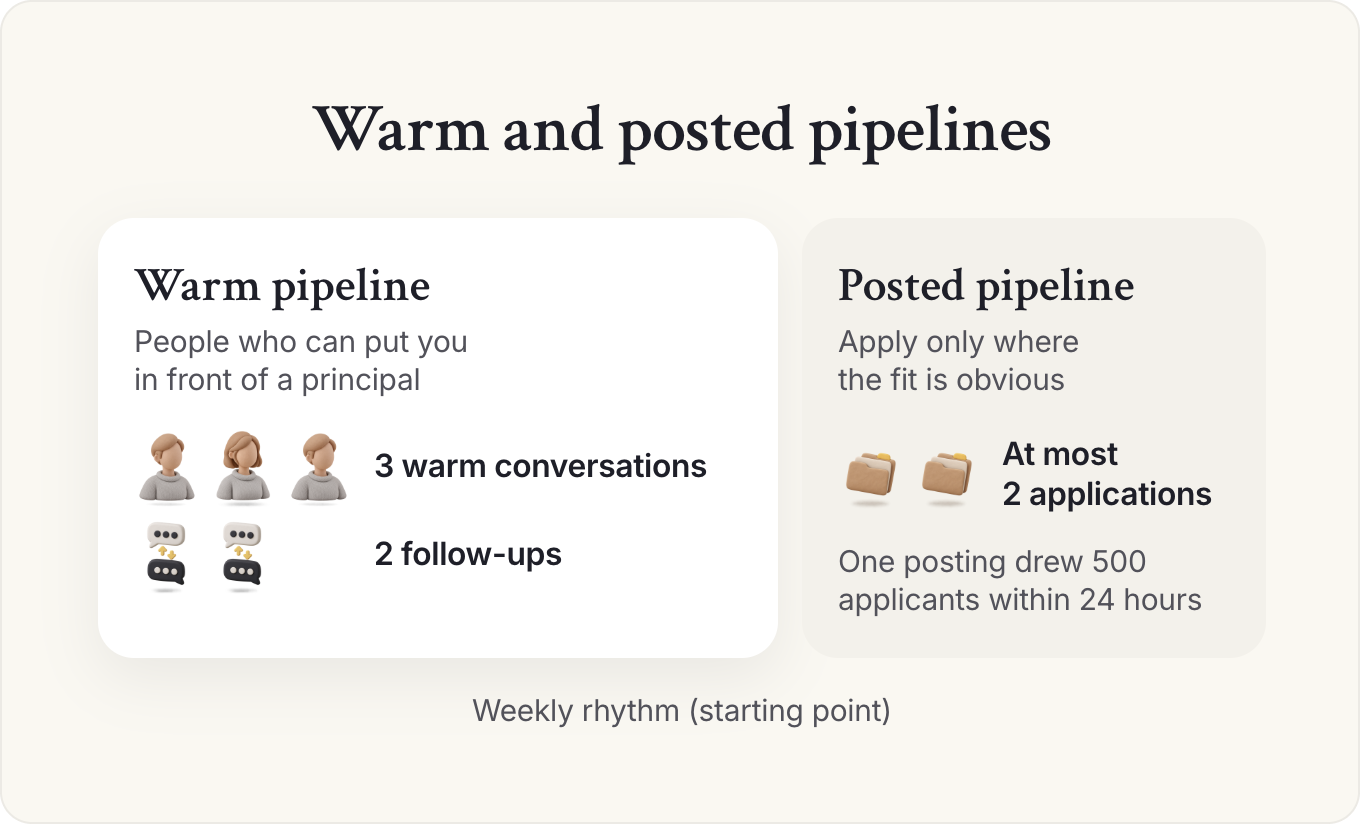
At one of our member sessions in 2023, a recruiter who works with startups and financial firms described a posting that drew 500 applicants within 24 hours, more than the company had time to read. That recruiter's view: silence after an application usually means nobody had time to sort the pile. It says little about you. A short, specific note to a principal skips the pile.
Build the warm pipeline
The warm pipeline is the people who can put you in front of a principal: leaders whose work you know, sitting Chiefs of Staff, former managers, investors, alumni and communities where roles get shared early. The same recruiter starts every search with their own network, checking who they've spoken to and whose resume they already hold, before any headhunting.
Have coffee with sitting Chiefs of Staff, too. The median stint is 20 months, so the Chief of Staff at a company you'd like to join may be the person who helps pick their successor.
It's really, really, really hard to stand out in a pile of resumes.
Sophie Kaye, Chief of Staff at Frame.io through its acquisition by Adobe · Listen on the podcast
Sophie Kaye keeps building those relationships while she's happy in a job, so they exist when she needs them. She contacts people who share one thing with her, such as a school or a hobby, and asks for a coffee to hear how they built their careers. Before you send a first note, make your LinkedIn headline name the work you want, in the words a principal would search.
Anything you tell someone in your industry can reach your current manager, so decide now what you'd say if it does.
Keep each note under 150 words, with the first line about the reader. Send a few every week, and log each one in your tracker.
Template: Outreach note to a potential principal
Subject: [Specific thing they did] and a thought on [their company]
Hi [Name],
I [heard you on X / read your post on Y / saw Z launch]. The part about [specific point] stuck with me, because [one sentence on why it connects to your experience].
I lead [what you own today] at [company]. Last quarter I [one result with a number, ideally cross-team].
I'm looking for a Chief of Staff role with a leader who is [stage or challenge, e.g. scaling a leadership team past 10 people]. From the outside, it looks like [their company] might be at that point, especially around [one specific gap you can see].
Would you be open to a 20-minute conversation in the next few weeks? Even if there's no role today, I'd value your view on [specific question].
[Your name]
[LinkedIn or one-page summary link]
Example: outreach note from a revenue operations lead to a Series B CEO (illustration)
Subject: Your planning post and a thought on the Series B

Hi Dana,

I read your post on why quarterly planning took six weeks. The part about every decision waiting on you stuck with me, because I cut our planning cycle from five weeks to two last year.

I lead revenue operations at a 200-person logistics software company. I ran the move to annual contracts across sales, finance and legal; 40% of renewals converted in two quarters.

I'm looking for a Chief of Staff role with a CEO scaling a leadership team past 10 people. From the outside, your company looks close to that point after the Series B.

Would you be open to a 20-minute conversation in the next few weeks? Even if there's no role today, I'd value your view on how you'd split planning between a COO and a Chief of Staff.

Sam
Subject: Your planning post and a thought on the Series B
Hi Dana,
I read your post on why quarterly planning took six weeks. The part about every decision waiting on you stuck with me, because I cut our planning cycle from five weeks to two last year.
I lead revenue operations at a 200-person logistics software company. I ran the move to annual contracts across sales, finance and legal; 40% of renewals converted in two quarters.
I'm looking for a Chief of Staff role with a CEO scaling a leadership team past 10 people. From the outside, your company looks close to that point after the Series B.
Would you be open to a 20-minute conversation in the next few weeks? Even if there's no role today, I'd value your view on how you'd split planning between a COO and a Chief of Staff.
Sam
Apply only where the fit is obvious
Copy the posting's main lines into a short cover note, and under each one put a result of yours with a number. If you can't fill most of them honestly, the role is a stretch, and your hours are better spent on the warm pipeline. To read a posting's level before you apply, see how to read a Chief of Staff job description.
Then show your work before the interview. The member from the opening reached first and final rounds with shown work. Before each conversation they signed up for the startup's product, then sent notes on what they saw in its marketing, sales and product, and what they'd do first if they joined. Some of those companies weren't hiring a Chief of Staff at the time.
Look where roles aren't posted
Some corners of the market rarely post on the big job boards. A lot of family offices don't post their roles on Indeed or LinkedIn, as I said to Donald J Cunningham, head of a family office, on our podcast. His own first family office job came from an obscure Indeed ad he answered in the middle of the night, and the ad wasn't exactly asking for a Chief of Staff. When a role does reach a board, read past the title on any ad that describes running an executive's office.
Some roles start as something smaller. Two years into a PhD program, Michael Novak messaged founders on LinkedIn and joined a Series A startup as a strategy and operations contractor. He explained to the founders what a Chief of Staff does and then filled the role, as he told our podcast. I'd take a contract or a neighboring title with the right principal over the Chief of Staff title with the wrong one. The cost is time without the title, so agree early what would turn the contract into the full role, and by when.
To keep both pipelines moving, track every conversation in one place and review it at the same time each week. The rhythm under the tracker is a starting point; adjust it to the hours you have.
Template: Chief of Staff search tracker
Chief of Staff search tracker
| Target | Principal | Level guess | Source | Fit with my spec (1 to 5) | Last touch | Next step and date | Status |
|---|---|---|---|---|---|---|---|
| [Company] | [Name, title] | [Level] | [Warm / posted / recruiter] | [1 to 5] | [Date, what happened] | [What, by when] | [Talking / applied / interviewing / closed] |
My weekly rhythm (starting point)
- 3 warm conversations (new people)
- 2 follow-ups on earlier conversations
- At most 2 applications, only where I can map the posting to my results
- 1 piece of shown work (product notes, a short memo, a point of view)
- 30 minutes on Friday to update this tracker and pick next week's targets
# Chief of Staff search tracker

| Target | Principal | Level guess | Source | Fit with my spec (1 to 5) | Last touch | Next step and date | Status |
| --- | --- | --- | --- | --- | --- | --- | --- |
| [Company] | [Name, title] | [Level] | [Warm / posted / recruiter] | [1 to 5] | [Date, what happened] | [What, by when] | [Talking / applied / interviewing / closed] |

## My weekly rhythm (starting point)
- 3 warm conversations (new people)
- 2 follow-ups on earlier conversations
- At most 2 applications, only where I can map the posting to my results
- 1 piece of shown work (product notes, a short memo, a point of view)
- 30 minutes on Friday to update this tracker and pick next week's targets
Example: week five of a search, filled in (illustration)
Chief of Staff search tracker
| Target | Principal | Level guess | Source | Fit with my spec (1 to 5) | Last touch | Next step and date | Status |
|---|---|---|---|---|---|---|---|
| Series C health software, 400 people | COO | Manager / Sr. Manager | Warm: former manager | 5 | Oct 2: coffee, COO wants planning fixed before Q1 | Send one-page view on their planning cycle by Oct 9 | Talking |
| Series B logistics software, 180 people | CEO and founder | Sr. Associate / Jr. Manager | Posted | 3 | Sep 28: applied with mapped cover note | Ask a former colleague there for an intro by Oct 6 | Applied |
| Public medical device company | Chief Operating Officer | Director | Recruiter | 2 | Oct 1: first screen | Ask about decision rights before round 2 | Interviewing |
| Series A clinic software, 40 people | CEO and founder | Analyst / Associate (titled founder's associate) | Warm: alumni | 2 | Sep 30: used the product, sent notes | Follow up Oct 7 | Talking |
This week
- 3 warm conversations: 2 done
- 2 follow-ups: done
- Applications: 1 (mapped)
- Shown work: planning-cycle memo for the Series C COO
# Chief of Staff search tracker

| Target | Principal | Level guess | Source | Fit with my spec (1 to 5) | Last touch | Next step and date | Status |
| --- | --- | --- | --- | --- | --- | --- | --- |
| Series C health software, 400 people | COO | Manager / Sr. Manager | Warm: former manager | 5 | Oct 2: coffee, COO wants planning fixed before Q1 | Send one-page view on their planning cycle by Oct 9 | Talking |
| Series B logistics software, 180 people | CEO and founder | Sr. Associate / Jr. Manager | Posted | 3 | Sep 28: applied with mapped cover note | Ask a former colleague there for an intro by Oct 6 | Applied |
| Public medical device company | Chief Operating Officer | Director | Recruiter | 2 | Oct 1: first screen | Ask about decision rights before round 2 | Interviewing |
| Series A clinic software, 40 people | CEO and founder | Analyst / Associate (titled founder's associate) | Warm: alumni | 2 | Sep 30: used the product, sent notes | Follow up Oct 7 | Talking |

## This week
- 3 warm conversations: 2 done
- 2 follow-ups: done
- Applications: 1 (mapped)
- Shown work: planning-cycle memo for the Series C COO
A month in, look at where your live conversations came from. If nearly all of them came from people and none from applications, move more hours to people.
If you have first conversations but no second meetings, the problem is usually your story. Rework your interview stories before you book more calls. If applications get no first conversations at all, fix the resume.
Sending applications this month? Get feedback on your resume before you send the next one.
Get a reviewHow do you get from a shortlist to an offer?
Keep only the roles that pass your reverse job description on the level, the principal, the scope and the decision rights. Then take each one through the rounds in this order.
- Score each role from 1 to 5 against your spec in your tracker, and drop any role that hits a deal-breaker, such as no named principal.
- Ask the principal which decision they keep having to revisit. If they name one quickly, you've found work you could own in your first months. If they can't name one, ask what they'd hand you in your first month before you go further. Red flags in a Chief of Staff role has the questions that expose a mislabeled seat.
- Tell your stories at the level in your spec, because the level you present is usually the level you're offered. When the principal describes the role, say back the problem you hear, such as "decisions get made in hallways and don't stick". If you're right, you've shown them the job you'd do.
- Before the final round, ask whether the role is in this year's approved budget, and who signed off on the headcount. The member from the opening lost three final-round roles when the money went.
- Do the case study, but don't do real work for free. In the final rounds, the member from the opening took on test projects only when the company paid for them.
- When the offer comes, compare it line by line with your spec: the level, the principal, the scope and the decision rights first, and only then the money. Put your scope and decision-rights lines on the table here.
Only about 1 in 5 Chief of Staff postings state pay. When the number comes late, it's easy to anchor on it. Evaluating and negotiating the offer covers the order to negotiate in and what to say. For the resume, the interview stories and the case study, use our guide to becoming a Chief of Staff.
What should you do between signing and day one?
Resign cleanly, then prepare with your principal. Tell your manager in person before anyone else hears, agree a notice period, and write a one-page handover note for whoever picks up your work. In the US, two weeks is the usual notice. In the UK and much of Europe, senior contracts often set one to three months, so check yours before you agree a start date.
Decide before you resign how you'll answer a counteroffer. Reread the deal-breakers and scope lines in your spec, and ask whether more money changes any of them. Your current manager is often your first reference call later, and sometimes a useful ally in the new role.
For the weeks before you start, our guide to your first 90 days covers the conversation to have with your principal, the access to ask for and the user manual to write.
Take this guide with you
The full guide as a PDF: every section, template and chart, ready to print or share with your team.
Your PDF is ready.
Download the PDFFree. We may email you new guides; unsubscribe anytime.
Frequently asked questions
How long does a Chief of Staff job search take?
People who move from one Chief of Staff role to another have a median gap of about three months between the two roles. That figure measures the gap between jobs. It does not measure the search. My read: a first search has no title to point to, so it usually takes longer. Plan for several months of the warm pipeline, and check your tracker monthly to see which channel produces conversations.
Do recruiters fill Chief of Staff roles?
Yes, some do. Alex Cherucheril came into his Chief of Staff role through a recruiter who works with startup generalists, former consultants and bankers, as he told our podcast. Log recruiters as their own source in your tracker, and tell them the level and the kind of principal you want.
What should you do if your search stalls?
Keep working, and stay in touch with the people you met. The member from the opening, whose three final-round roles lost their budget, took a sales engineering job at a Series A fintech company. Later, someone they had connected with earlier reached out about a Chief of Staff role. Tell your contacts where you landed, and review your tracker every month.
How many Chief of Staff roles are remote?
About one in five. 21% of Chief of Staff postings are flagged remote, and the other four in five are on-site, hybrid or silent on it. Ask early if location matters to you. Browse open roles by location on our job board.
Should you tell people you're looking for a Chief of Staff role?
Yes, the people you trust. Many roles move through people, and nobody can suggest you for a role they don't know you want. Tell them the level and the kind of principal from your spec. To hear about roles from companies hiring through us, join our talent network.
- 2026 Chief of Staff Pathways Report, Chief of Staff Network. 2,869 career histories and 1,819 job postings.
- 2025 Chief of Staff Salary Report, Chief of Staff Network. 479 respondents.
- Chief of Staff Leveling Framework, Chief of Staff Network. 200+ Chiefs of Staff.
- The Chief of Staff Podcast: Sophie Kaye, Donald J Cunningham, Michael Novak and Alex Cherucheril.
- "CoS Hiring Trends 2023 Summit", Chief of Staff Network member session, October 2023.
Learn the job with people who do it
Membership gets you the Power Skills program, member events and a private community of working Chiefs of Staff.
Land your first Chief of Staff role
Launchpad helps you prepare, position yourself and interview for the role.
Starting out in the role?
The Fundamentals email course walks you through scoping the mandate, setting the cadence and earning trust.
Lead AI adoption from the Chief of Staff seat
The Chief of AI Fellowship is for operators turning AI into how the company runs.
Hiring a Chief of Staff?
Post the role on the Chief of Staff job board, or browse open roles.
Get your resume ready for the role
Get feedback on your Chief of Staff resume before you apply.
Let the right roles find you
Join the talent network and hear about Chief of Staff roles first.
The Chief of Staff newsletter
What Chiefs of Staff are reading, hiring for and building.
Get the full report
Every chart and cut from our latest salary research, sent to your inbox.
Using AI with sensitive data?
Learn the legal side of using AI at work.
Keep going in this series