

What does a Chief of Staff do?
A Chief of Staff is the primary strategic operator reporting to a senior executive. The 4 core responsibilities, reporting lines, 6 levels and pay.

Ask AI
 Share
A Chief of Staff is the primary strategic operator reporting directly to a senior executive, often the CEO, and acts as that leader's trusted advisor and right hand. The job covers four core responsibilities: priorities and decisions, the operating rhythm, communication up and down, and cross-functional projects. Of postings that name a principal, 44% say CEO, founder or president.
- The job is four core responsibilities: priorities and decisions, the operating rhythm, communication up and down, and cross-functional projects. The mix changes with the company.
- The operating rhythm is the most common ask: 61% of the more than 1,800 Chief of Staff job postings in the Chief of Staff Network's 2026 Pathways Report mention operating cadence, OKRs or KPIs.
- Only 44% of postings that name the principal say CEO or founder. The functional Chief of Staff is now the majority.
- Pay tracks level, from $91,462 at Analyst to $193,999 at Executive. The average base salary is $167,954, according to the Chief of Staff Network's 2025 Salary Report (nearly 500 respondents).
- The role is a launchpad: 53% leave more senior than they arrived, and the odds peak after two to three years in the seat.
Ask ten executives what a Chief of Staff does and you get ten job descriptions: the person who runs the board deck, the CEO's right hand, a strategy lead, a fixer, a glorified assistant. Executives hire against that fuzzy picture and get a calendar manager when they needed someone to speed up decisions. Good people take jobs that turn out to be inbox triage with a bigger title, and find out six months in. [SCOTT: the moment at Spring when you realized what the job actually was, e.g. a board prep or acquisition week?]
This is the clearest way I know to explain the corporate Chief of Staff, backed by salary surveys going back to 2019, the career histories of nearly 2,900 Chiefs of Staff and more than 1,800 job postings from this year. Government and military Chiefs of Staff share the title but run a different job, with formal authority over a staff. For the whole arc in one read, see our Chief of Staff handbook.
What does a Chief of Staff do?
A Chief of Staff is the primary strategic operator for one senior leader, and acts as that leader's trusted advisor and right hand. In practice the work falls into four core responsibilities: priorities and decisions, the operating rhythm, communication up and down, and cross-functional projects.
Think about a CEO who announces a pricing change on Monday. By Friday, sales is quoting the old price, finance has modeled a different version and nobody has told customer success. Everyone heard the decision, and nobody owned turning it into next week's work. A Chief of Staff would have left Monday's meeting with an owner for each team, a date for the new price sheet and a note to customer success before lunch.
The weight of each responsibility moves with the company. At a 30-person startup, cross-functional projects can take most of the week, because many functions don't exist yet. At a 30,000-person company, the rhythm and communication take over, because the hard part is getting twelve business units to plan on the same calendar. Our archetypes framework names six common shapes the role takes.
The four core responsibilities
- Priorities and decisions. The Chief of Staff decides with the principal what reaches them, what gets delegated and what gets a polite no, and prepares the decisions that matter so the leader can make them in one sitting. Itamar Melamed, Senior Director and Chief of Staff at Empathy, described the calibration on our podcast as "sufficient enough so he has everything covered, but not too much information so he has cognitive load." 37% of postings ask for a thought partner on decisions. Every request you decline on the principal's behalf comes back to you, so say why and point the person to who can help.
- Running the operating rhythm. Weekly leadership meetings, monthly business reviews, quarterly planning, OKRs, board prep. The Chief of Staff builds the cadence so decisions get made once and followed up without the leader chasing. Jamie Dalton, Chief of Staff at Adobe, builds it top down: "I start at the annual level, and I bring it all the way down to the weekly level." The full playbook is our guide to the Chief of Staff operating rhythm.
- Communication up and down. Bad news softens on its way up, and by the time a problem reaches the CEO it has been smoothed into something manageable. The Chief of Staff tells the principal what nobody else will, then turns decisions into language the organization acts on, mostly in writing through briefs and decision memos. 46% of postings ask for executive communication. When you bring bad news about a peer's team, tell the peer first and give them the chance to bring the fix with it.
- Cross-functional projects. A new market test, a reorg, an AI rollout, a messy integration. If it matters and has no home, it lands on the Chief of Staff until it's ready to hand off. Bryan Silverman, now COO at Suzy, framed these projects as "I'm gonna take this on for three months, but our goal is at the end of three months that, like, we're scaling this thing out." Set the handoff date when you take the project on, or you become the bottleneck the role was hired to remove.
What employers ask for
When we read more than 1,800 Chief of Staff postings for our 2026 Pathways Report, operating cadence came first by a distance and calendar gatekeeping came near the bottom.
What Chief of Staff job postings ask for
| Responsibility | Share of postings | Core responsibility |
|---|---|---|
| Operating cadence, OKRs, KPIs | 61% | Rhythm |
| Executive comms and content | 46% | Communication |
| Strategy and annual planning | 43% | Rhythm |
| Cross-functional initiatives | 41% | Projects |
| Thought partner on decisions | 37% | Priorities |
| Board and investor work | 33% | Rhythm |
| Budget and finance | 31% | Rhythm |
| Special projects | 27% | Projects |
| Gatekeeping executive time | 20% | Priorities |
| Leadership team management | 17% | Rhythm |
| M&A and corporate development | 12% | Projects |
| People, hiring and org design | 8% | Projects |
Source: Chief of Staff Network, 2026 Pathways Report, more than 1,800 job postings, June to October 2026.
Gatekeeping the calendar shows up in one posting in five. If most of your week goes to the calendar and the inbox, you are in an executive assistant role with a bigger title, and it's worth saying so to your principal before the review cycle says it for you.
61% of Chief of Staff job postings ask for the operating rhythm: operating cadence, OKRs or KPIs.
What does a Chief of Staff's week look like?
Most weeks share one shape. The week is built around the leadership rhythm, with time held back for the one or two projects nobody else owns and a steady stream of small decisions about what reaches the principal.
Here is an illustrative week for a Chief of Staff to the CEO of a 200-person company, a composite of many members' calendars.
An illustrative week, Chief of Staff to a CEO
| Day | Rhythm | Communication | Priorities and projects |
|---|---|---|---|
| Monday | Prep and run the leadership meeting; send decisions and owners within the hour | 30 minutes with the CEO on what changed over the weekend | Triage the CEO's inbox of asks into decide, delegate, decline |
| Tuesday | Check OKR progress with two lagging teams | Skip-level coffee with a team lead who rarely speaks up in meetings | Half a day on the pricing rollout nobody owns |
| Wednesday | Draft the monthly board update | Rewrite the CEO's all-hands talking points into plain language | Pricing rollout working session with sales, finance and customer success |
| Thursday | Quarterly planning prep with finance | Tell the CEO the hiring plan is two months behind, and why | Clear the decision log: which open items the CEO must decide this week |
| Friday | Weekly note to the CEO: decisions made, risks, what needs them next week | Read the week's customer escalations | Protect two hours for thinking about next quarter |
When the week breaks, what gives first
Most weeks, something urgent displaces part of the plan. Protect the rhythm first, because the rest of the company plans around it: if the decision log goes out two days late, a dozen people lose a week of clarity, and if your project work slips a day, one project does.
- Keep: the leadership meeting, the decision log within the hour, and the weekly note. Shorten them if you must.
- Keep: anything with a date someone outside the company sees, like a board update or a customer commitment.
- Move: your project working sessions, with a message to the people involved and a new date.
- Drop: the thinking block and the admin, this week only.
If the thinking block disappears three weeks running, the problem is the plan, so take something off it in your next one-to-one. The order bends with context. In a remote company the weekly note moves above everything except the meeting. During a fundraise or a board week, external dates outrank internal ones. A functional Chief of Staff adds the CEO's own operating rhythm to the keep list, because a missed input costs your principal credibility with their peers.
The other daily skill is choosing your altitude. Jamie Lynn White, who was Chief of Staff for marketing at Notion when we spoke, describes three: her principal, the leadership team and the work itself. A week spent in the weeds feels productive and leaves the leadership team without anyone watching the whole board.
Try the prompt below on last week's calendar. For real weeks from Chiefs of Staff at startups, scale-ups and large companies, read a day in the life.
Prompt: Map my week to the four core responsibilities
I'm a Chief of Staff. Below is my calendar and task list from last week.

Classify every block into one of five buckets:
1. Priorities and decisions (deciding what reaches my principal, what gets delegated, what gets declined, and preparing decisions)
2. Operating rhythm (leadership meetings, planning, OKRs, board and business reviews)
3. Communication (carrying honest information up to my principal and turning decisions into messages the company acts on)
4. Cross-functional projects (cross-team projects that have no other owner)
5. Admin (scheduling, logistics, inbox, travel)

Then give me:
- The share of my hours in each bucket, as a table
- The three blocks that should have gone to someone else, and who
- One change to next week's calendar that would move at least two hours from Admin into the four core responsibilities

My calendar and tasks:
[paste here]
Who does a Chief of Staff report to?
A Chief of Staff reports to one senior leader, called the principal, and works on that leader's behalf across the organization. Traditionally that principal was the CEO, and today fewer than half of the postings that name a principal say so.
Only 41% of the postings we analyzed say who the Chief of Staff supports. Where they do, 44% name the CEO, founder or president and the rest support a functional leader, according to the Chief of Staff Network's 2026 Pathways Report.
Sarah Kislak was Chief of Staff to the head of engineering at Box, and describes the job as "really to help connect the dots across every part of the system... and nothing really lived in isolation." A functional Chief of Staff has the same four core responsibilities inside one part of the company, plus translation: carrying the CEO's priorities into the function and the function's reality back up. When the CEO also has a Chief of Staff, put a standing 30-minute check-in with them on the calendar in your first week, so the relationship exists before your function and the CEO's office first disagree.
Authority is borrowed
A Chief of Staff usually manages few or no people. Their authority is borrowed from the principal and earned with everyone else, and it gets tested early: a senior leader will push back on something you asked for "on behalf of" the principal, to see whether the principal backs you.
The mechanism is a credibility account. Every time you speak for the principal and they back you, the account grows, and people start coming to you first. Every time they reverse you in public, it drains, and the leadership team learns that the real decision happens one step further up. A single public reversal costs more than any private correction, because everyone in the room updates at once.
Here's how the test usually runs, as an illustration. You ask the VP of Sales for the pipeline numbers two days early, so the CEO can use them in the board deck. The VP replies that the CEO never asked for that and the date stands. The right response depends on what the principal has already decided.
- The CEO has decided it: say so plainly, with the reason ("The CEO wants the pipeline in Thursday's draft so the board sees it before the call"). Don't apologize for the ask.
- It's your judgment: own it as yours ("This is my call, because the deck needs a day of review. If it's a real problem, I'll take it to the CEO"). Borrowing authority you weren't given empties the account fastest.
- You're unsure: check with the CEO before you reply, and tell the VP you're checking.
Agree with your principal in advance how they'll respond when someone goes around you. The answer I'd ask for is "What did my Chief of Staff say?", followed by backing you in public and correcting you in private if you got it wrong.
When you lose an argument with your principal, Itamar Melamed sees two options: bring more evidence on a better day, or disagree and commit, after which the organization should never be able to tell which side you argued. And before you read pushback as defiance, ask what happened. Dora Nagy, who was Chief of Staff to the COO at SoftBank's Vision Fund, told me most conflict she sees comes from the stories people build in their heads, like reading a slow reply as a snub when the other person was on a flight.
Around month three, if the account is healthy, people bring you problems before they reach the principal. That's the signal to agree which decisions you can now make yourself. A functional Chief of Staff borrows twice, so if your principal loses an argument at the leadership table, your asks in their name carry less weight that week.
Speak for your principal only on decisions they've already made, until they tell you otherwise.
How senior is a Chief of Staff?
A Chief of Staff can sit anywhere from Analyst to Executive. Our Leveling Framework defines six levels, with 2025 average base pay from $91,462 to $193,999, according to the Chief of Staff Network's 2025 Salary Report (nearly 500 respondents). The same title covers someone two years out of university and a seasoned executive who runs the leadership team.
What changes across the Leveling Framework is decision rights. At level 1 you are not involved in strategic decisions. At level 2 you implement them. At levels 3 and 4 you provide meaningful input. At levels 5 and 6 you are a key influencer, and you manage relationships with customers, partners and investors as well as the leadership team.
Chief of Staff levels and base salary, 2025
| Level | Decision role | Average base | Middle 50% range |
|---|---|---|---|
| 1. Analyst / Associate | Not involved in strategic decisions | $91,462 | $83K to $101K |
| 2. Sr. Associate / Jr. Manager | Implements strategic decisions | $111,474 | $78K to $135K |
| 3. Manager / Sr. Manager | Provides meaningful input | $144,464 | $110K to $182K |
| 4. Director | Provides meaningful input | $173,667 | $132K to $202K |
| 5. Vice President | Key influencer | $186,739 | $145K to $219K |
| 6. CXO / Executive | Key influencer | $193,999 | $141K to $220K |
The bands widen as you go up, and level 3's middle half alone spans $72K, from $110K to $182K. That's what an unclear role looks like in data: the same title paying very different amounts, depending on whether the person shapes decisions or carries them out.
The market pays most for an expanded seat. Postings for Chief of Staff roles that add strategy have a median advertised salary of $250K, and VP, Director or Head-titled Chief of Staff roles $230K, against $174K for a plain Chief of Staff title, according to our 2026 Pathways Report. Women hold 80% of Director-level Chief of Staff roles and 69% at the Executive/CXO tier, according to our 2025 Salary Report. For pay by company size, industry and city, see our Chief of Staff salary guide, and for what separates the levels, our guide to Chief of Staff skills.
Before you take a Chief of Staff job, read the level in the decision rights you're offered. A level 4 title with level 2 decision rights will be paid, reviewed and promoted like level 2.
Prompt: Find the real level of a Chief of Staff role
Here is a Chief of Staff job description, plus notes from my conversations with the hiring executive.

Place this role on the Chief of Staff Network's six-level framework:
1. Analyst / Associate: not involved in strategic decisions
2. Sr. Associate / Jr. Manager: implements strategic decisions
3. Manager / Sr. Manager: provides meaningful input on strategic decisions
4. Director: provides meaningful input on strategic decisions, with a wider remit than level 3
5. Vice President: key influencer on strategic decisions, manages relationships with customers, partners and investors
6. CXO / Executive: key influencer on strategic decisions, controls budget and resource allocation

For your answer:
- The level you'd place it at, and the three phrases in the text that decided it
- The decision rights the role clearly has, and the ones it doesn't mention
- Five questions I should ask the hiring executive to confirm the level before I accept

Job description and notes:
[paste here]
How is a Chief of Staff different from an executive assistant or a COO?
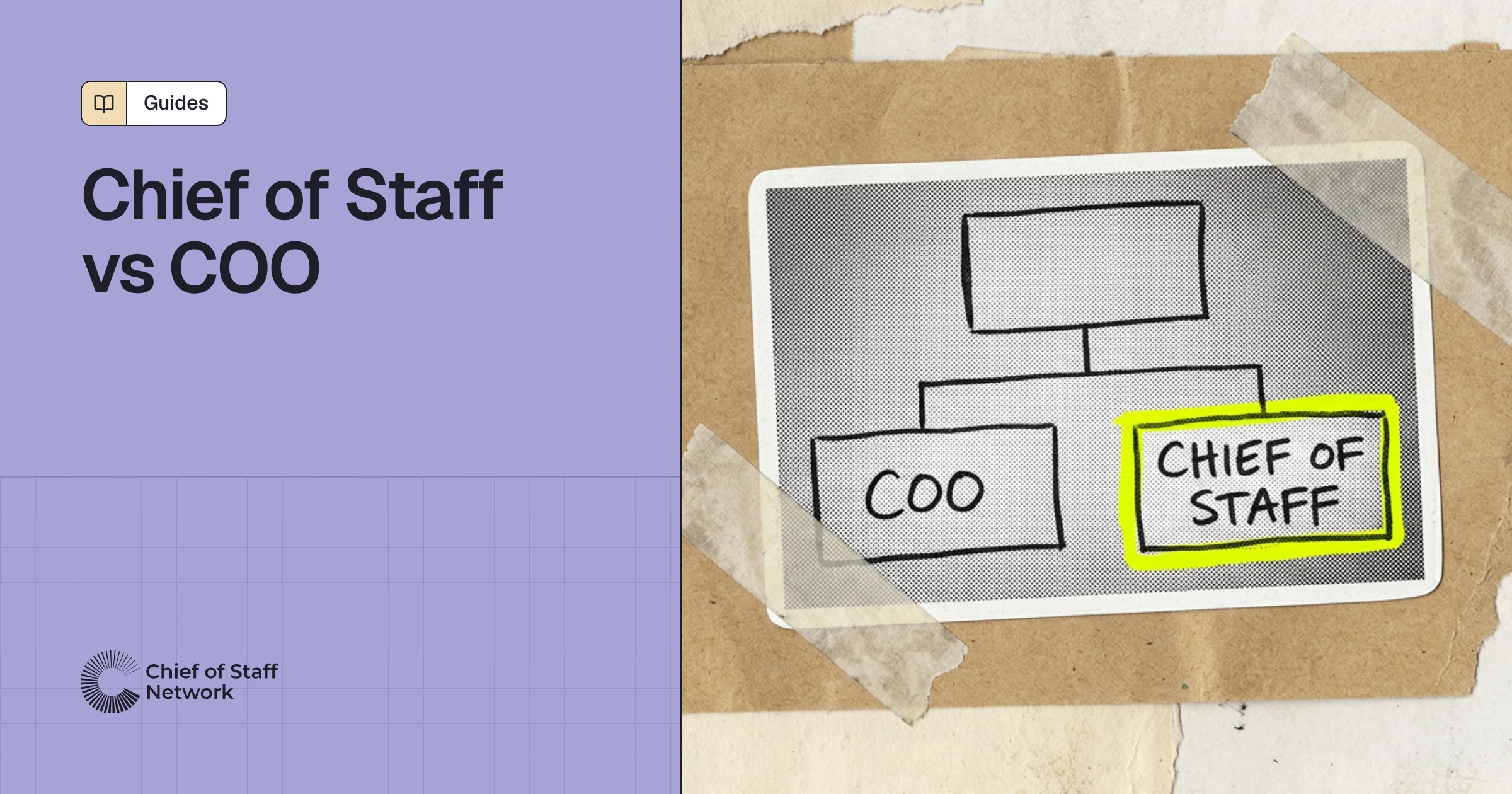
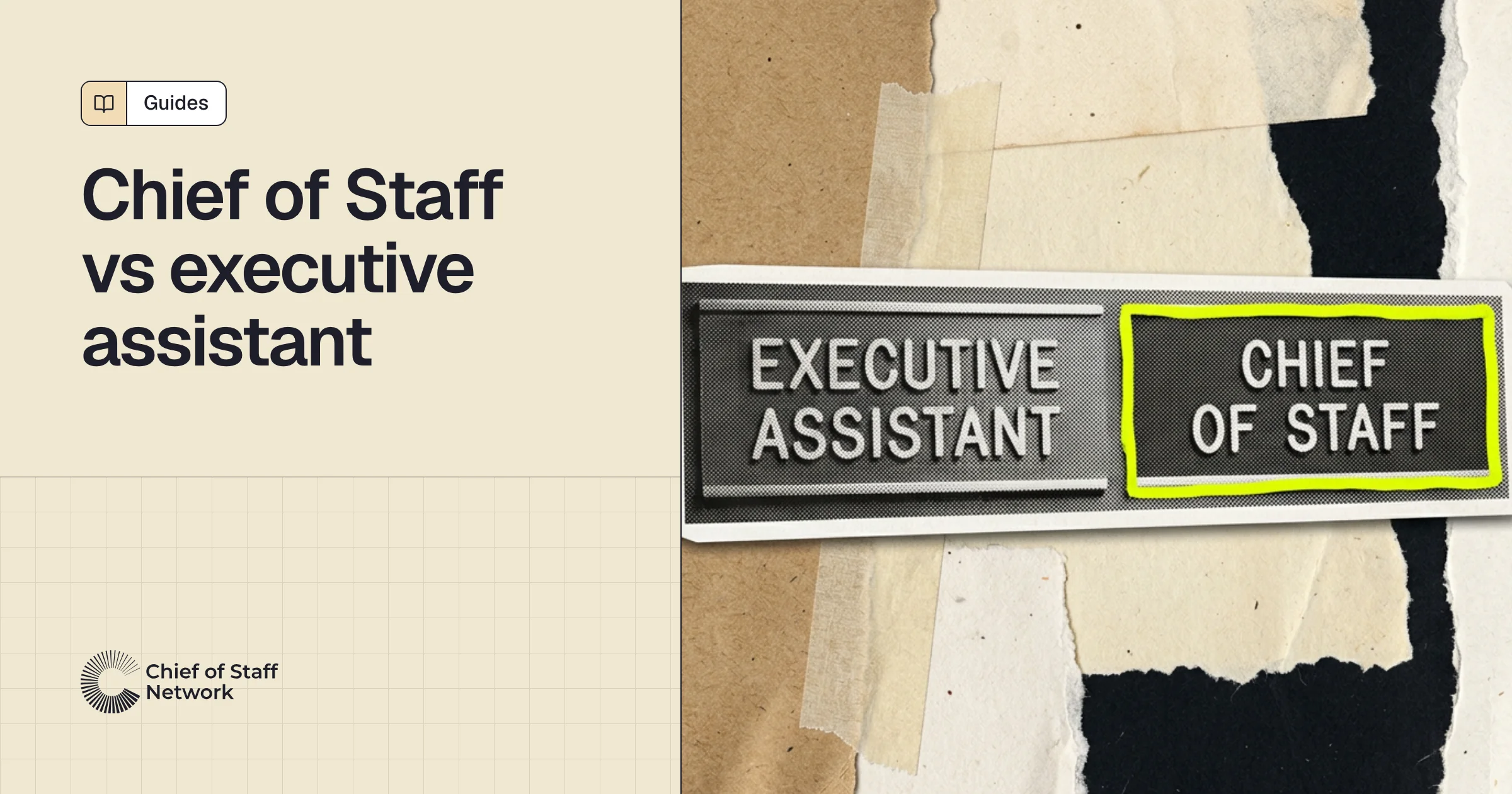
The executive assistant manages the leader's time and logistics. The COO runs operations and owns results through a team. The Chief of Staff works on the leader's priorities and decisions, usually without a team or a P&L.
The clearest description I've heard came from a CEO. Tyler Denk, co-founder and CEO of beehiiv, sat down with us alongside his Chief of Staff, Brian Schneider.
...Any big decision, like, if I'm not around to make it, like, you should have the autonomy to make that decision 'cause you have full context of everything that I'm doing.
Tyler Denk, co-founder and CEO, beehiiv · Listen on the podcast
Denk's test is whether you could make a big decision while the leader is away, because you know everything they know.
Chief of Staff vs executive assistant vs COO
| Executive assistant | Chief of Staff | COO | |
|---|---|---|---|
| Focus | The leader's time and logistics | The leader's priorities and decisions | Running the business |
| Direct reports | Rarely | Few or none | Functional leaders and their teams |
| Owns a P&L | No | Rarely | Usually |
| Typical tenure | Years | About two years (median 20 months) | Years |
| Median advertised salary (US) | $95K | $180K | $155K (COO, VP or Head of Operations) |
| Success looks like | Nothing slips | The right things happen without the leader chasing | Targets hit |
Salary source: Chief of Staff Network, 2026 Pathways Report, median advertised salary among US postings that list pay, June to October 2026. The COO row mixes very different operations jobs, so don't read it as "Chief of Staff outranks COO".
If you have to choose one hire, ask what is breaking. If it is the calendar, hire the assistant. If decisions get made and then don't turn into action, hire the Chief of Staff. Our comparisons of the Chief of Staff vs executive assistant and vs COO go further, including the 7% of Chiefs of Staff who reach COO within three years.
Why do companies hire a Chief of Staff, and when?
Companies hire a Chief of Staff when the leader becomes the bottleneck. Decisions wait on one person, the leadership team pulls in different directions and important projects stall because nobody owns them.
You hear it first: "Can you just loop me in on everything?" "Who's driving this?" "We decided that last quarter, didn't we?" These are coordination problems between the VPs, and hiring another VP won't fix them. Ryan Kelly, the first Chief of Staff at Veremark, argued on our podcast that the role exists "to enable the velocity of the business." If you're hiring, write down which decisions, projects and meetings should move faster once the role exists. That list is the first draft of the mandate, and it's how you'll judge whether the hire paid off. Our guide on how to hire a Chief of Staff covers the rest, and the job description template turns the mandate into a posting.
The role appears at every size, usually after a funding round, a reorg, an acquisition or a new CEO. Remi Guarini was the founding Chief of Staff at Neon and its only employee for the first eight months. Jessica Li was the first employee and Chief of Staff at Beacons. At the other end, software led all sectors in our 2026 job data with 190 postings, followed by financial services (98). Postings at companies with 11 to 50 employees have a median advertised salary of $140k, against $215k at companies with 5,001 to 10,000, according to our 2026 Pathways Report.
How do you measure a Chief of Staff's success?
Agree three outcomes with a measure for the first six months, because a Chief of Staff has no quota and activity is easy to mistake for progress. Good outcomes look like this: the leadership meeting runs without the principal chairing it, the planning cycle closes on time, the stuck project ships.
Measurement is hard because the role's output is mostly things that didn't happen: the decision that didn't wait a week, the conflict that never reached the CEO. Without a measure agreed up front, both sides fall back on hours, meetings and documents. Itamar Melamed's test is how many decisions he took off his CEO's plate and made for him. "You're not a firewall. You're a filter," as he put it.
You can count it without a new system. Add one column to the decision log from the leadership meeting: who made the call, tagged "principal", "Chief of Staff" or "owner". Each month, the Chief of Staff and owner lines should both rise.
Here's the six-month scorecard, with a filled-in version for a Chief of Staff to the CEO of a 200-person company:
Template: Six-month Chief of Staff scorecard
Chief of Staff scorecard: [name], months 1 to 6
Outcome 1: The leadership meeting decides things once
- Measure: share of decisions in the log reopened within 30 days
- Baseline (month 1): [e.g. 4 of 10]
- Target (month 6): [e.g. 1 of 10 or fewer]
Outcome 2: Decisions leave the principal's desk
- Measure: decisions per month made by the Chief of Staff or the named owner, not the principal
- Baseline (month 1): [count]
- Target (month 6): [count, agreed with the principal]
Outcome 3: One stuck project ships and is handed off
- Project: [name]
- Measure: shipped by [date]; handed to [owner] by [date]
Principal's hours
- Hours per week in meetings the principal doesn't need to attend: [baseline] to [target]
Review
- 90-day check: [date]
- Six-month review: [date]
- What I'll stop doing next quarter: [list]
# Chief of Staff scorecard: [name], months 1 to 6

## Outcome 1: The leadership meeting decides things once
- Measure: share of decisions in the log reopened within 30 days
- Baseline (month 1): [e.g. 4 of 10]
- Target (month 6): [e.g. 1 of 10 or fewer]

## Outcome 2: Decisions leave the principal's desk
- Measure: decisions per month made by the Chief of Staff or the named owner, not the principal
- Baseline (month 1): [count]
- Target (month 6): [count, agreed with the principal]

## Outcome 3: One stuck project ships and is handed off
- Project: [name]
- Measure: shipped by [date]; handed to [owner] by [date]

## Principal's hours
- Hours per week in meetings the principal doesn't need to attend: [baseline] to [target]

## Review
- 90-day check: [date]
- Six-month review: [date]
- What I'll stop doing next quarter: [list]
Example: six-month scorecard for a CEO's Chief of Staff, 200 people (illustration)
Chief of Staff scorecard: Maya, months 1 to 6
Outcome 1: The leadership meeting decides things once
- Measure: decisions in the log reopened within 30 days
- Baseline (month 1): 4 of 11
- Target (month 6): 1 of 10 or fewer
Outcome 2: Decisions leave the CEO's desk
- Measure: decisions per month made by me or the named owner
- Baseline (month 1): 3
- Target (month 6): 12, agreed with the CEO
Outcome 3: The pricing migration ships and is handed off
- Shipped by April 30; handed to the VP of Revenue Operations by May 15
CEO's hours
- Meetings the CEO doesn't need to attend: 9 hours a week, down to 3
Review
- 90-day check: March 27
- Six-month review: June 26
- What I'll stop doing next quarter: the weekly office-move check-in, the hiring tracker
# Chief of Staff scorecard: Maya, months 1 to 6

## Outcome 1: The leadership meeting decides things once
- Measure: decisions in the log reopened within 30 days
- Baseline (month 1): 4 of 11
- Target (month 6): 1 of 10 or fewer

## Outcome 2: Decisions leave the CEO's desk
- Measure: decisions per month made by me or the named owner
- Baseline (month 1): 3
- Target (month 6): 12, agreed with the CEO

## Outcome 3: The pricing migration ships and is handed off
- Shipped by April 30; handed to the VP of Revenue Operations by May 15

## CEO's hours
- Meetings the CEO doesn't need to attend: 9 hours a week, down to 3

## Review
- 90-day check: March 27
- Six-month review: June 26
- What I'll stop doing next quarter: the weekly office-move check-in, the hiring tracker
Set the baseline in month one, before you change anything, or a good six months looks like an opinion. A functional Chief of Staff swaps the company-wide meeting for their function's operating review. At a 20-person startup, the third outcome often matters most, because the project is the job.
Two failure modes show up around month three. One is a scorecard full of activity, like "ran 12 meetings", which tells your principal nothing about what changed. The other is a decision count that rises while the principal is still in every meeting, which means you're making small calls and the big ones still wait. Bring that to your one-to-one before the review does.
What should a new Chief of Staff do in the first 30 days?
Listen, map and earn one small, visible win before you change anything big. Leave the leadership meeting alone in month one. The first month decides whether the leadership team treats you as the principal's extension or the principal's assistant.
Drift happens even with a principal who wants the role to work. A few weeks into his role, Brian Schneider messaged his CEO, Tyler Denk, to say he didn't feel he was really being his Chief of Staff yet, and Tyler agreed. That's the case for agreeing a one-page mandate in your first month even if nobody asks for one.
Template: First 30 days as a Chief of Staff
First 30 days as a Chief of Staff
Week 1: Listen
- 1:1 with every direct report of your principal, plus five people one level down
- Ask each: What's blocked? What does [principal] not hear? What would you stop doing?
- Read the last two board decks, the current OKRs or goals, and last quarter's plan
- Sit in every leadership meeting. Say little. Take notes on how decisions actually get made
Week 2: Map
- Write down the operating rhythm as it really runs: each meeting, its owner, inputs, decisions and follow-ups
- List every cross-team project that has no clear owner
- Note where information gets stuck before it reaches your principal
Week 3: Propose
- Draft your one-page mandate
- Write down one fix to the rhythm to propose for month two (e.g. a new leadership meeting agenda with a decision log). Don't change the meeting yet
- Pick one cross-functional project to take on, with a handoff date
Week 4: Ship
- Agree the mandate with your principal in one 60-minute session
- Ship the first milestone of your cross-functional project
- Start a weekly note to your principal: decisions made, risks, what needs them next week
- Book a 90-day review with your principal now
# First 30 days as a Chief of Staff

## Week 1: Listen
- 1:1 with every direct report of your principal, plus five people one level down
- Ask each: What's blocked? What does [principal] not hear? What would you stop doing?
- Read the last two board decks, the current OKRs or goals, and last quarter's plan
- Sit in every leadership meeting. Say little. Take notes on how decisions actually get made

## Week 2: Map
- Write down the operating rhythm as it really runs: each meeting, its owner, inputs, decisions and follow-ups
- List every cross-team project that has no clear owner
- Note where information gets stuck before it reaches your principal

## Week 3: Propose
- Draft your one-page mandate
- Write down one fix to the rhythm to propose for month two (e.g. a new leadership meeting agenda with a decision log). Don't change the meeting yet
- Pick one cross-functional project to take on, with a handoff date

## Week 4: Ship
- Agree the mandate with your principal in one 60-minute session
- Ship the first milestone of your cross-functional project
- Start a weekly note to your principal: decisions made, risks, what needs them next week
- Book a 90-day review with your principal now
The weekly note in week 4 turns your one-to-one from triage into a conversation about what's coming; our guide to the Chief of Staff weekly update has the template. For the full first quarter, with the listening tour kit and the day-30 memo, read your first 90 days.
Starting out in the role? The Fundamentals email course walks you through scoping the mandate, setting the cadence and earning trust.
Start the courseHow is AI changing the Chief of Staff role?
AI is making context more valuable, and the Chief of Staff holds more company context than anyone else in the company. Drafting, summarizing and first-pass analysis are getting cheap. What stays scarce is knowing what the leader wants, what the company is doing and where the two disagree.
AI adoption often lands on the Chief of Staff without anyone deciding it should, because it's cross-functional work and the role already owns that. The limit is the same thing that makes the role valuable. Sawyer Middeleer, the first employee and Chief of Staff at Aomni and now founder of Revi Systems, warns that "the human has a lot of context in their head. They have a lot of judgment in their head about what a good response looks like." Automate a process before you've mapped that judgment and the work gets faster and worse.
What the data says about AI and pay
One in four Chief of Staff job postings now asks for AI skills, according to the Chief of Staff Network's 2026 Pathways Report, though asking for the skill doesn't raise the advertised pay on its own. The survey tells a different story: Chiefs of Staff who already work in an AI-first way earn more, according to our 2025 Salary Report.
AI First Chiefs of Staff working at companies that are only AI Curious average $243K. My read is that companies pay most for the person who can move them ahead of where they are, with results you can point to, like leading the rollout that changes how the leadership team works. Our guide to the AI chief of staff covers how to lead adoption and the Chief of AI path.
Is Chief of Staff a good career move?
For most people, yes, if you treat it as a tour with a plan. Of the Chiefs of Staff we tracked, 53% hold a more senior title after the role than before it, and about one in five reach COO, VP of Operations, General Manager, Chief Strategy Officer or CEO within three years, according to the Chief of Staff Network's 2026 Pathways Report, based on more than 1,200 moves with rank stated before and after.
Bryan Silverman, who went from an entry-level sales role to COO at Suzy, calls the role "the ultimate career accelerant for me, uh, exposing me to all parts of the business." You see how every function works and who makes decisions, years earlier than you would from inside one team. If you're not in the role yet, our guide on how to become a Chief of Staff maps the routes in.
Staying put works: 61% step up when they stay at the same company, against 48% when they leave. And 78% change function across the role, so most people use the seat to get somewhere new.
The tour is often too short. The median completed stint is 20 months, yet the odds of a step up peak at two to three years (57%) and are lowest for those who leave within a year (38%). If you'd rather stay and expand the role, as 37% of Chiefs of Staff in our 2025 Salary Report do, negotiate the bigger mandate and the title that matches it at your 12-month review. The 2026 Pathways Report maps a typical route for each direction.
Keep reading
 The Chief of Staff handbookStart here
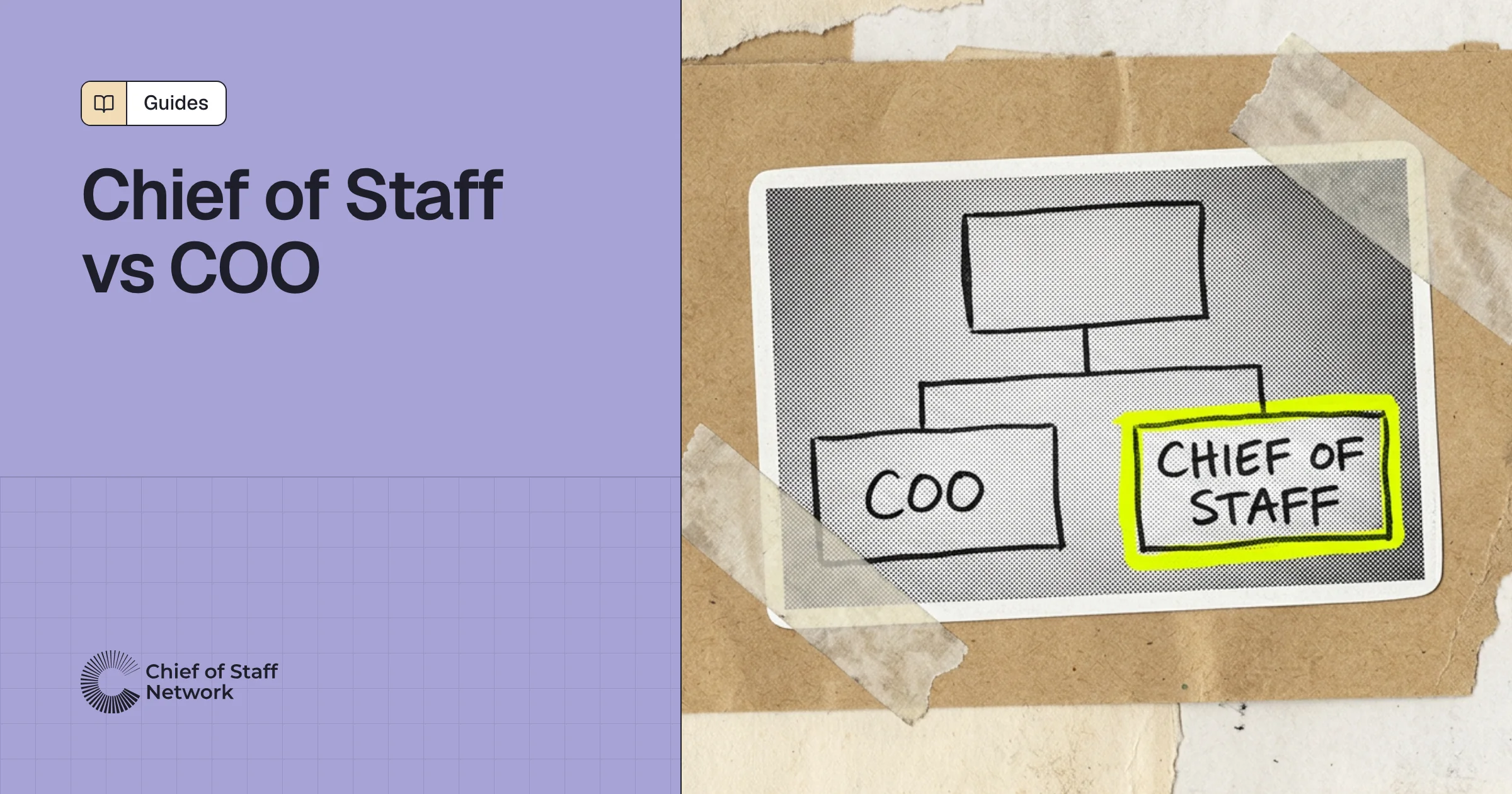 Chief of Staff vs COO: what's the difference?Start here
 Chief of Staff vs executive assistant: what's the difference?Start here
Start here
- The Chief of Staff handbook
- What does a Chief of Staff do?
- Chief of Staff vs COO: what's the difference?
- Chief of Staff vs executive assistant: what's the difference?
- A day in the life of a Chief of Staff
- Chief of Staff skills: what the job demands at every level
- Chief of Staff salary (2026): pay by level, company size and city
- Chief of Staff job description (template and examples)
- How to hire a Chief of Staff
- How to become a Chief of Staff
Take this guide with you
The full guide as a PDF: every section, template and chart, ready to print or share with your team.
Your PDF is ready.
Download the PDFFree. We may email you new guides; unsubscribe anytime.
Frequently asked questions
- 2025 Chief of Staff Salary Report, Chief of Staff Network. Survey of Chiefs of Staff in 100 cities across 26 countries, n=479. Base salary, level (self-selected against our Leveling Framework), gender, AI maturity, career plans. Download the full report.
- 2026 Chief of Staff Pathways Report, Chief of Staff Network. Dated career histories of 2,869 Chiefs of Staff, 1,992 moves out of the role, a stint-level analysis of 2,158 moves, and 1,819 unique job postings (June to early October 2026; posting data from Inform Growth). Download the full report.
- Chief of Staff Leveling Framework, Chief of Staff Network. See the framework.
- Chief of Staff Archetypes Framework, Chief of Staff Network. See the archetypes.
- Chief of Staff podcast. Quotes from Dora Nagy (SoftBank Vision Fund), Itamar Melamed, Jamie Lynn White (summary), Jamie Dalton, Bryan Silverman, Sarah Kislak, Tyler Denk, Ryan Kelly and Sawyer Middeleer, from their episodes.
- The illustrative week, the pipeline example and the six-month scorecard are illustrations written for this guide from many members' descriptions.
Learn the job with people who do it
Membership gets you the Power Skills program, member events and a private community of working Chiefs of Staff.
Land your first Chief of Staff role
Launchpad helps you prepare, position yourself and interview for the role.
Starting out in the role?
The Fundamentals email course walks you through scoping the mandate, setting the cadence and earning trust.
Lead AI adoption from the Chief of Staff seat
The Chief of AI Fellowship is for operators turning AI into how the company runs.
Hiring a Chief of Staff?
Post the role on the Chief of Staff job board, or browse open roles.
Get your resume ready for the role
Get feedback on your Chief of Staff resume before you apply.
Let the right roles find you
Join the talent network and hear about Chief of Staff roles first.
The Chief of Staff newsletter
What Chiefs of Staff are reading, hiring for and building.
Get the full report
Every chart and cut from our latest salary research, sent to your inbox.
Using AI with sensitive data?
Learn the legal side of using AI at work.