

Chief of Staff skills by level
The skills a Chief of Staff needs at each level, from judgment to AI fluency, based on 1,800+ job postings, our Leveling Framework and salary data.

Ask AI
 Share
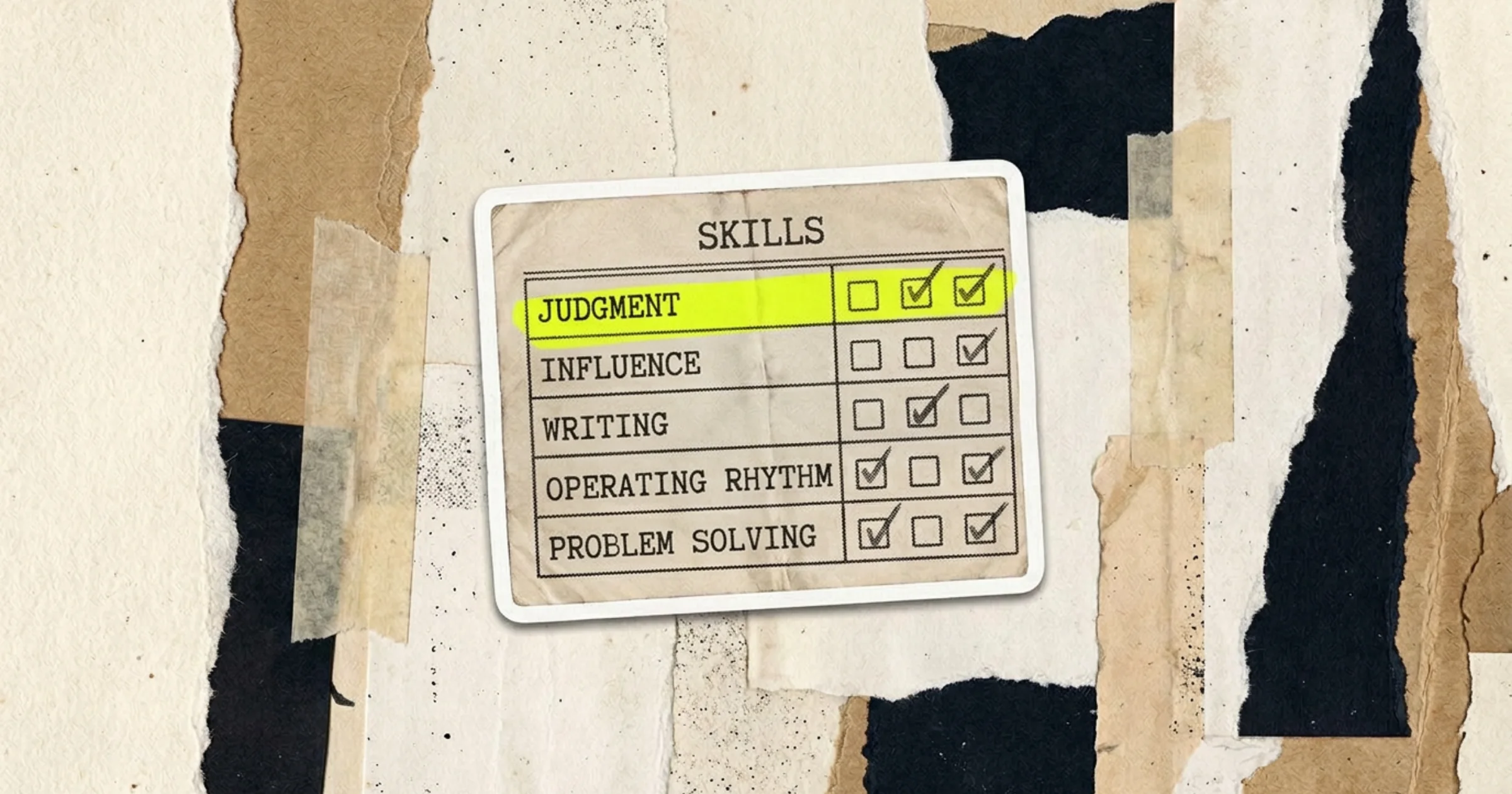
The most important Chief of Staff skill is judgment: knowing what deserves the leader's time. Around it sit influence without authority, executive communication, running an operating rhythm and structured problem-solving, on a base of discretion. Decision rights separate the levels, and one in four postings now ask for AI fluency, according to the Chief of Staff Network's 2026 Pathways Report.
- Postings ask most for operating cadence (61%), executive communication (46%) and strategy and planning (43%), across the more than 1,800 Chief of Staff job postings in the Chief of Staff Network's 2026 Pathways Report.
- Influence is the main lever: 47% of Chiefs of Staff in our Leveling Framework survey say their power comes from relationships across the firm. Only 14% manage people directly.
- Seniority tracks decision rights. Average base pay runs from $91,462 at Analyst level to $193,999 at Executive level, according to the Chief of Staff Network's 2025 Salary Report (nearly 500 respondents).
- AI fluency pays. AI-first Chiefs of Staff average $189,128 in base pay, 16% more than the AI-curious ($162,721), in the same report.
- No degree or certificate is required. Hiring managers look for evidence that you've run work across teams for a senior leader.
You can be the person who keeps everything running and still be told you're not strategic enough. It's one of the most common stories we hear from members: the meetings happen, the decks ship, the reorg lands, and the review says "meets expectations" with a note to "show up more strategically."
Usually nobody names the skill that's missing, and most skills lists stop at "communication, organization, strategic thinking," which describes almost every job in a company. Below are the skills by level from our Leveling Framework, what more than 1,800 job postings ask for, and a self-assessment you can run this week.
What skills does a Chief of Staff need?
A Chief of Staff needs five working skills: judgment about what deserves the leader's time, influence without authority, executive communication, the ability to build and run an operating rhythm, and structured problem-solving. All five rest on a base of discretion.
Job descriptions are the most honest list of skills there is. When we analyzed more than 1,800 Chief of Staff postings for our 2026 Pathways Report, each common responsibility quietly tested a skill. (Our guide on what a Chief of Staff does maps the same postings to the four core responsibilities.)
The skill each posting responsibility tests
| Responsibility in the posting | Share of postings | The skill it tests |
|---|---|---|
| Operating cadence, OKRs, KPIs | 61% | Building systems other people run on |
| Executive communications and content | 46% | Writing in the leader's voice, compressing complexity |
| Strategy and annual planning | 43% | Structured thinking, trade-offs |
| Cross-functional initiatives | 41% | Influence without authority |
| Thought partner on decisions | 37% | Judgment, candor |
| Board and investor work | 33% | Precision, discretion, narrative |
| Budget and finance | 31% | Reading the numbers that drive the business |
| Special projects | 27% | Moving cross-team work with no owner |
| Gatekeeping executive time | 20% | Judgment about priorities |
| Leadership team management | 17% | Facilitation, holding peers to commitments |
Source: 2026 Pathways Report, Chief of Staff Network, more than 1,800 postings.
Most of the skills in the right-hand column are about other people: getting them aligned, getting them to commit, telling them something they don't want to hear. That's why the role is hard to prepare for. Most people arrive from a job that rewarded excellent work of their own, and this one rewards making excellent work happen through other people, often people who outrank you.
Here's how the five working skills show up in a normal week:
- Judgment: you decide which of the 40 requests that hit your leader this week deserve their time, which you can answer, and which go back to the sender.
- Influence without authority: you get a VP of Sales to change a forecast process they don't own and you don't manage.
- Executive communication: you turn a 30-slide product review into the five lines your CEO needs before a board call.
- Operating rhythm: you design the weekly leadership meeting so decisions get made there instead of in hallways afterwards, usually against OKRs and KPIs.
- Structured problem-solving: a project nobody owns is three weeks late, and you find out why, name an owner and set a date.
Discretion sits under all of it. You'll know about reorganizations before they happen and compensation before it's announced. One leak and people stop telling you things.
Which hard skills matter?
Three hard skills show up again and again: reading the numbers, building the documents leaders decide from, and tracking work across teams. 33% of postings mention board and investor work, 31% budget and finance, and 12% M&A and corporate development, according to the Chief of Staff Network's 2026 Pathways Report.
You need to read a spreadsheet model well enough to find the assumption in a forecast that won't hold, write a memo a board member can follow cold, and run a project tracker the leadership team keeps current. SQL, BI dashboards and deeper financial modeling matter most in data-heavy or finance-led roles.
What are the eight competencies in the Leveling Framework?
Our Leveling Framework names eight competencies that apply at every level of the role: decision-making authority, strategic thinking, cross-functional management, stakeholder management, leadership, communication, problem-solving and adaptability. Every Chief of Staff uses all eight. What changes by level is how far each one reaches.
A Chief of Staff at a 30-person startup and a Chief of Staff to a division president at a public company share a title and very little else, and the competencies let you compare roles the title hides.
The eight competencies, Levels 1 to 4 vs Levels 5 and 6
| Competency | Levels 1 to 4 (Analyst to Director) | Levels 5 and 6 (VP and Executive) |
|---|---|---|
| Decision-making authority | Not involved in strategic decisions at Level 1; carries them out at Level 2; gives meaningful input at Levels 3 and 4 | A key influencer on strategic decisions |
| Strategic thinking | Supports planning with risk, trade-off and data work at Level 1; sees revenue and profit impact at Level 2; writes the plans others follow at Level 3; authors strategy from Level 4 | Authors strategy, combining financial judgment and executive influence |
| Cross-functional management | Implements tools and processes at Level 1; designs policies and processes and breaks down silos from Level 2 | Same at Level 5; only Level 6 controls meaningful budget and resources |
| Stakeholder management | Keeps the organization aligned through recurring meetings: all-hands, board, leadership team | Adds relationships with investors, partners and customers |
| Leadership | Designs own work at Level 1; starts motivating others at Level 2; shapes the work environment at Levels 3 and 4 | An organizational leader who counsels and coaches people up to the executive team |
| Communication | Active listening, clear writing, choosing the right channel | Key advisor and confidant to the principal and executive team |
| Problem-solving | Novel solutions at Level 1; metrics and trends to spot problems and build the case from Level 2 | Persuasion, alignment and strong business cases |
| Adaptability | Rapid context switching at Level 1; resourcefulness with unfamiliar problems from Level 2 | Delegates or postpones work, often by running an office for the principal |
Source: Leveling Framework, Chief of Staff Network.
The survey behind the framework shows how the job feels from the inside. 72% of respondents manage their own work with regular or occasional check-ins with their principal. 47% say their main lever is strong relationships and influence across the firm, another 24% influence the whole leadership team, and only 14% manage people or dictate work directly, according to our Leveling Framework survey of 200+ Chiefs of Staff. If you're coming from a people-manager job, most of your old tools are gone.
Two of the eight competencies do most of the work of setting your level. Communication, leadership and problem-solving grow because your decision rights grow: a Level 2 Chief of Staff who writes beautifully is still implementing decisions other people made, and a Level 5 Chief of Staff who writes adequately is shaping them.
Two of the eight competencies set your level: decision-making authority and strategic thinking.
How do you assess and build your Chief of Staff skills?
Score yourself against the eight competencies, pick the one or two that block your next level, and build them through real work over 90 days. Then ask your principal to score you too. The gap between the two scores is often more useful than either score.
Template: Chief of Staff skills self-assessment
Chief of Staff skills self-assessment
Score each line 1 to 5. 1 = describes Levels 1 to 2, 3 = Levels 3 to 4, 5 = Levels 5 to 6. Add one piece of evidence from the last 90 days for every score of 3 or more.
| Competency | 1 (executor) | 3 (contributor) | 5 (advisor/proxy) | Me | My principal | Evidence |
|---|---|---|---|---|---|---|
| Decision-making authority | I implement decisions once made | I give input before decisions are made | I shape decisions and make some in my principal's name | |||
| Strategic thinking | I support planning with data and analysis | I author parts of the plan | I author strategy and its financial case | |||
| Cross-functional management | I run tools and trackers | I design processes that break down silos | I control budget or resources across teams | |||
| Stakeholder management | I run recurring meetings | I run the leadership team and board cadence | I manage external relationships (board, investors, partners) | |||
| Leadership | I run my own workstreams well | I shape how the team works | Leaders across the org look to me for direction | |||
| Communication | I write clear notes and updates | I write decision memos leaders act on | I'm a confidant and advisor to the executive team | |||
| Problem-solving | I solve the problem I'm given | I find problems early using metrics | I build the case that changes the plan | |||
| Adaptability | I switch context fast | I handle problems I've never seen | I decide what to postpone or delegate for the office | |||
| AI fluency | I use AI tools for my own drafts | I've rolled out a tool for a team | I've redesigned a workflow and measured the result |
- Lowest two scores: ______ and ______
- The one my next level depends on most: ______
# Chief of Staff skills self-assessment

Score each line 1 to 5. 1 = describes Levels 1 to 2, 3 = Levels 3 to 4, 5 = Levels 5 to 6. Add one piece of evidence from the last 90 days for every score of 3 or more.

| Competency | 1 (executor) | 3 (contributor) | 5 (advisor/proxy) | Me | My principal | Evidence |
|---|---|---|---|---|---|---|
| Decision-making authority | I implement decisions once made | I give input before decisions are made | I shape decisions and make some in my principal's name | | | |
| Strategic thinking | I support planning with data and analysis | I author parts of the plan | I author strategy and its financial case | | | |
| Cross-functional management | I run tools and trackers | I design processes that break down silos | I control budget or resources across teams | | | |
| Stakeholder management | I run recurring meetings | I run the leadership team and board cadence | I manage external relationships (board, investors, partners) | | | |
| Leadership | I run my own workstreams well | I shape how the team works | Leaders across the org look to me for direction | | | |
| Communication | I write clear notes and updates | I write decision memos leaders act on | I'm a confidant and advisor to the executive team | | | |
| Problem-solving | I solve the problem I'm given | I find problems early using metrics | I build the case that changes the plan | | | |
| Adaptability | I switch context fast | I handle problems I've never seen | I decide what to postpone or delegate for the office | | | |
| AI fluency | I use AI tools for my own drafts | I've rolled out a tool for a team | I've redesigned a workflow and measured the result | | | |

- Lowest two scores: ______ and ______
- The one my next level depends on most: ______
Example: self-assessment for a CEO's Chief of Staff, Series B, 120 people (illustration)
Skills self-assessment: Sam, Chief of Staff to the CEO
| Competency | Me | My principal | Evidence |
|---|---|---|---|
| Decision-making authority | 3 | 2 | Gave input on the Q3 hiring freeze before the CEO decided |
| Strategic thinking | 2 | 2 | |
| Cross-functional management | 4 | 4 | Redesigned the launch checklist across product, sales and support |
| Stakeholder management | 4 | 3 | Run the Monday leadership meeting and the board pre-read |
| Leadership | 3 | 3 | Two VPs bring planning questions to me before the CEO |
| Communication | 4 | 4 | Wrote the reorg memo; the all-hands had no clarifying questions |
| Problem-solving | 3 | 3 | Spotted mid-market churn in the weekly dashboard a month early |
| Adaptability | 3 | 3 | Ran the office closure plan in five days |
| AI fluency | 2 | 3 | The CEO points to the board-prep workflow I set up for finance |
- Lowest two scores: strategic thinking and AI fluency
- The one my next level depends on most: strategic thinking. Next 90 days: write the pricing section of the FY27 plan, with its financial case
# Skills self-assessment: Sam, Chief of Staff to the CEO

| Competency | Me | My principal | Evidence |
| --- | --- | --- | --- |
| Decision-making authority | 3 | 2 | Gave input on the Q3 hiring freeze before the CEO decided |
| Strategic thinking | 2 | 2 | |
| Cross-functional management | 4 | 4 | Redesigned the launch checklist across product, sales and support |
| Stakeholder management | 4 | 3 | Run the Monday leadership meeting and the board pre-read |
| Leadership | 3 | 3 | Two VPs bring planning questions to me before the CEO |
| Communication | 4 | 4 | Wrote the reorg memo; the all-hands had no clarifying questions |
| Problem-solving | 3 | 3 | Spotted mid-market churn in the weekly dashboard a month early |
| Adaptability | 3 | 3 | Ran the office closure plan in five days |
| AI fluency | 2 | 3 | The CEO points to the board-prep workflow I set up for finance |

- Lowest two scores: strategic thinking and AI fluency
- The one my next level depends on most: strategic thinking. Next 90 days: write the pricing section of the FY27 plan, with its financial case
The plan only works if you make room for it. If you're in back-to-back meetings and working 55-hour weeks, strategic work won't fit on top. Hand recurring work to the teams that should own it, stop the work nobody would miss, and make the case for an analyst if the role has outgrown one person.
Build the skill through a project
Skills in this role grow through owned work, because the evidence a principal trusts is a result they watched you produce. Lauren Stein, who was Chief of Staff at GrowthLoop when we spoke, got the company SOC 2 and HIPAA certified, a project she said was "so technically above my head" when she started. It changed her role: she now supports the CTO on infrastructure and answers architecture questions from prospects' engineering leaders.
The other direction is to build on what you already do best. Dara Chen, Chief of Staff at Rad AI when we spoke, describes the best Chiefs of Staff as people who "spike" in certain areas. Hers is people and culture, and as the company grew her CEO asked her to take over hiring and the onboarding playbook.
I'd fix the gap when it blocks your next level's decision rights, since a Chief of Staff who can't read a budget won't be trusted to author strategy. Otherwise, build the spike, because it's what your principal will hand you more of. Either way, agree the project with your principal, write down what "done" looks like, and turn it into a 90-day plan with the prompt below.
Prompt: Build my 90-day Chief of Staff skills plan
You are an experienced Chief of Staff coach. I'm a Chief of Staff and I want a 90-day plan to close my biggest skill gap.

My context:
- Company: [size, stage, industry]
- My principal: [title], I've worked with them for [time]
- My current level (Analyst, Sr. Associate, Manager, Director, VP or Executive): [level]
- The level I want next: [level]
- My self-assessment scores and evidence: [paste table]
- Hours a week I can protect for development: [number]

Build a plan with:
1. The one competency to focus on first and why, given my next level.
2. Three real work projects in the next 90 days where I can practice it (not courses), each with what "good" looks like.
3. Work I should hand off or stop to make room, and who could own it.
4. A weekly 15-minute check-in routine with my principal to get feedback.
5. Evidence I should collect by day 90 to show the gap is closing.

Ask me up to three clarifying questions before you write the plan.
When your scores and evidence show you operating a level up, bring them to your next compensation conversation; our salary guide shows how to anchor it in your level.
Before Friday, do the self-assessment, send it to your principal with a request to score you too, and book 30 minutes to compare the scores.
How do Chief of Staff skills change from Analyst to Executive?
Skills shift in three stages. At Levels 1 and 2 you're an executor who makes the leader's plan happen. At Levels 3 and 4 you contribute to the plan, and from Director level you start authoring parts of it. At Levels 5 and 6 you're an advisor and, at times, the leader's proxy.
[SCOTT: one or two lines on a skill you had to learn fast at Spring, e.g. the first board cycle or the acquisition, and what it taught you about the jump between levels?]
Pay follows the same curve. According to our 2025 Salary Report, with nearly 500 respondents, average base salary climbs at every level, and the steepest single step is from Senior Associate to Manager.
The jump from Senior Associate to Manager (about $33,000) is bigger than the jump from Manager to Director (about $29,000). That's the point where the job stops being "do what was decided" and starts being "help decide." Above Director, the steps get smaller in dollars but larger in exposure, as the work moves to the board and outside stakeholders.
Levels 1 and 2: from doing to orchestrating
Early on, your value is reliability: the meeting notes, the action tracker, the dashboards, the follow-ups. The skill to build is turning tasks into systems, like an action log the leadership team updates itself. David Kirby describes the trap on our podcast: high performers get stuck because they keep doing the work themselves. In his words, the job is "doing with the lens of orchestration."
Levels 3 and 4: from reporting to judging
In the middle levels you're in the room for real decisions, and the gap people hit is the one in our opening: you're trusted to carry out decisions but not yet to shape them. The fix is to bring a view along with the status.
Here's what that looks like on paper, as an illustration. The status version of a Friday line reads: "Hiring plan: 6 of 10 Q3 roles open. Engineering is the main gap." The judgment version reads: "Hiring plan: 6 of 10 Q3 roles open, all in engineering. At current pace we fill 3 by quarter end. I'd move two of the roles to contractors for one quarter, which costs about the same and protects the October launch. The VP of Engineering prefers to wait. Can you decide by Wednesday?" Same facts, plus a forecast, a recommendation with its cost, the disagreement and a deadline. That's Level 3 work on one line.
Not every update should carry a recommendation:
- You have the context and the call is within your principal's remit: recommend one option and say what it costs.
- You're missing context a peer has, such as a customer commitment or a technical constraint: bring two options, say which you lean toward, and name what would change your mind.
- The decision belongs to another leader: give your view to that leader directly and let them carry it.
Give the recommendation to your principal privately, and tell the affected leader beforehand what you're going to say, so they don't hear it first in the meeting. A wrong recommendation costs you less than a year of status reports, as long as you show your reasoning. Around month three, if it's working, your principal starts asking "what do you think?" before you offer, which is the moment to agree which of those calls you can now make yourself. By Level 4 the framework expects you to author parts of the strategy, which means owning its financial case too.
Levels 5 and 6: from advising to representing
At the top of the framework you're a confidant to the whole executive team and you sometimes act for the principal. Stakeholder management goes external: investors, partners, customers. Adaptability changes meaning too, from switching context fast to deciding what not to do, and running an office so your principal can do the same. Level 5 and 6 roles exist in a smaller set of companies, so the top levels depend as much on where you sit as on how good you are.
What separates a good Chief of Staff from a great one?
A good Chief of Staff makes the leader's plan happen reliably. A great one changes the plan when it should change, and has earned enough trust from the principal and the leadership team to do that. The difference is how early you're brought into decisions, and whether people tell you the truth.
A simple test: when your principal is out, do leaders wait for them, or do they come to you? One founder told us on our podcast that he wants a Chief of Staff who could step into any meeting he runs and make the call when he's away. Getting there takes four things that rarely show up on skills lists.
The first is integrity. Priyanka Peeramsetty, engineering operations director at Crunchyroll and a two-time Chief of Staff, describes it as the base of a pyramid.
The base is, you cannot gossip. You need to keep sensitive information for yourself... No one's gonna follow up with you, so you own your tasks, you own your principal's tasks.
Priyanka Peeramsetty, engineering operations director, Crunchyroll · Listen on the podcast
Nobody checks whether you kept a confidence or closed a loop without being chased, which is why the people around you remember when you did. The second is making disagreement explicit. Marlen Heske, Chief of Staff at Enpal, uses "clarity before harmony" as a north star: name the disagreement, get a decision, then rebuild the relationship. The third is the trust of peers, which decides whether leaders act on what you ask when your principal isn't there. The fourth is seeing around corners: because you talk to everyone, you hear about the high performer who's about to quit or the deal that's slipping, and you turn it into something the principal can act on without becoming the office gossip.
Good vs great, in practice
| Situation | A good Chief of Staff | A great Chief of Staff |
|---|---|---|
| Leadership meeting ends with nods | Sends clean notes and action items | Calls each leader that afternoon to find the objection they didn't say out loud |
| Principal asks for a board deck | Builds it on time, well designed | Pushes back on the story before building it |
| A project is late | Reports the delay | Brings a recommendation: cut scope, add an owner or move the date |
| Principal is out | Holds the fort, forwards decisions | Makes the call within agreed limits and explains it after |
| New request arrives | Says yes and adds it to the list | Asks what it replaces |
If you're stuck in the first column, working more won't move you. Trust to judge grows when you argue for a position before the decision is made, and are right often enough that your principal starts asking you first. In your next one-to-one, bring one recommendation, with the trade-off it costs, on a decision that hasn't been made yet.
Build these skills with peers who do the job. Membership includes our community, events and the Power Skills program on influence, communication and judgment.
See membershipHow do you build influence without authority?
You build influence without authority by becoming the most useful person to the people you need: the one with context they don't have, who follows through every time and who gives credit away. Influence is a balance you earn in small deposits, long before you need to make a withdrawal.
Share useful context before people ask, like the decision coming next quarter that will affect their team. Make dissent the expected output: before you close a decision, ask each leader for the biggest risk they see from their seat, so you hear the budget concern while it's cheap to fix. And never let a leadership meeting be the first time a leader hears a proposal that affects them.
Pre-wiring a decision, step by step
People defend positions they've taken in public, so an objection raised in a meeting is expensive to change and one raised in a one-to-one costs nothing. Here's an illustration. You want to move quarterly planning two weeks earlier, so budgets close before the board meeting instead of after it.
- List who it touches and how. Finance gains time. Sales loses two weeks of pipeline data. Product has a launch in the old planning window.
- Talk to the person who loses most first. The VP of Sales hears it from you a week before the meeting, with the reason and an offer: a mid-quarter pipeline refresh so the plan isn't stuck with stale numbers.
- Change the proposal with what you hear. Product's launch conflict is real, so the first cycle moves one week instead of two.
- Tell each person what changed because of them. "I moved it one week because of your launch" turns an objector into a co-author.
- Send a short pre-read 48 hours ahead that names the trade-offs and who raised them.
If one leader still won't move because of their own team's cost, take it to the meeting and let the principal decide with the trade-off in plain view. If they question whether the change is needed at all, go back to your principal before the meeting. Say openly that you're talking to everyone affected, because a series of private conversations can look like back-channeling, and in a remote team do part of it in a short doc each leader can comment on.
Influence usually fails when the Chief of Staff spends it on the principal's behalf without the principal's backing. We go deeper on this in what senior Chiefs of Staff actually own.
Agree with your principal which calls you can make in their name, then make them the same way every time.
Which communication skills matter most?
The communication skills that matter most are writing short, decision-ready documents, compressing complex inputs into the few lines a leader needs, and speaking directly when others won't. 46% of postings ask for executive communications and content, according to our 2026 Pathways Report.
A Chief of Staff writes the leadership meeting agenda, the decision memo, the all-hands talking points and the board narrative, and each has the same job: help someone decide or act faster. Compression means turning a 40-page planning doc into a paragraph that says what's decided, what's at risk and what you need. Directness means saying the uncomfortable thing plainly, which is harder when the person you're contradicting is your principal's peer. We cover the fundamentals in strategic communication for Chiefs of Staff.
The fastest way to practice both is a weekly note to your principal, sent before the one-to-one so the quick decisions get answered in writing.
Template: Weekly note to your principal
Subject: Week of [date]: 3 decisions, 2 risks
Decisions I need from you (reply inline)
- [Decision]: my recommendation: [option], because [one line]. Need by [day].
- [Decision]: my recommendation: [option]. Need by [day].
- [Decision]: FYI only unless you disagree.
What moved this week (no action needed)
- [Initiative]: [status in one line, with a number]
- [Initiative]: [status in one line]
What's coming (next 2 to 4 weeks)
- [Risk or event], why it matters, what I'm doing about it
- [Risk or event]
For our 1:1
- [One strategic topic to discuss]
- [Optional: my development / career topic]
Subject: Week of [date]: 3 decisions, 2 risks

## Decisions I need from you (reply inline)
1. [Decision]: my recommendation: [option], because [one line]. Need by [day].
2. [Decision]: my recommendation: [option]. Need by [day].
3. [Decision]: FYI only unless you disagree.

## What moved this week (no action needed)
- [Initiative]: [status in one line, with a number]
- [Initiative]: [status in one line]

## What's coming (next 2 to 4 weeks)
- [Risk or event], why it matters, what I'm doing about it
- [Risk or event]

## For our 1:1
- [One strategic topic to discuss]
- [Optional: my development / career topic]
Keep the decisions section to three items, each with your recommendation attached, so your principal sees your judgment every week.
Which AI skills does a Chief of Staff need now?
A Chief of Staff now needs to map work before buying AI tools, write the context documents that make AI useful, evaluate and roll out tools across teams, and measure what changed. One in four Chief of Staff postings already ask for AI skills, according to our 2026 Pathways Report.
Average base salary rises with personal AI maturity, from $148,999 for self-rated AI novices to $189,128 for AI-first Chiefs of Staff, according to the Chief of Staff Network's 2025 Salary Report (nearly 500 respondents). The premium looks largest where the company is behind: in a small group of respondents, AI-first Chiefs of Staff at AI-curious companies averaged $243K. Postings that ask for AI skills haven't yet attached a premium to that line, so pay follows the AI work you've shipped.
Adoption often lands on the Chief of Staff because AI is only as good as its context and the role holds more of it than almost anyone. The Chief of Staff Network's Chief of AI Report Part 2 found the CEO is the primary decision maker for AI adoption 31% of the time, with the Chief of Staff and the CTO tied next at 10% each. We call that group the AI Triad: the CEO sponsors, the Chief of Staff scopes and runs the rollout, and the CTO handles the technical fit.
The AI skills worth building, in order:
- Map how a process actually runs today and where time goes, before you buy anything.
- Write the context an AI tool needs: priorities, decision history, team ownership, glossary.
- Run a pilot on one workflow, with one team and one number that should move.
- Agree what data can go where with legal and security before people improvise.
- Use it yourself daily, for meeting synthesis, first drafts and stakeholder summaries.
For where adoption stands, download the full Chief of AI Report. For structured practice, the Chief of AI Fellowship is built for this.
What qualifications does a Chief of Staff need?
Usually none on paper. A Chief of Staff needs no specific degree, certificate or prior title. The qualification that counts is evidence that you've run work across teams for a senior leader, communicated under pressure and been trusted with sensitive information.
Most Chiefs of Staff hold a bachelor's (44%) or master's (41%) degree, and those with only a high school diploma still average about $147K in base pay, according to the Chief of Staff Network's 2025 Salary Report (nearly 500 respondents). An MBA helps most when you're switching industries, and few hiring managers treat a non-accredited certificate as proof you can do the job. We cover which backgrounds convert in how to become a Chief of Staff, and our Chief of Staff vs executive assistant guide shows which skills carry over from an assistant seat.
What hiring managers check for (our guide on how to hire a Chief of Staff shows the same list from their side):
- You've owned a cross-functional project from start to finish, with a result you can put a number on.
- You've worked closely with a senior leader and can describe how you made them more effective.
- You can write: they'll often ask for a memo or a case exercise.
- You've handled confidential information and can show how.
- You've used AI tools in real work, which a quarter of postings now ask for.
Write one sentence of evidence from your own work for each bullet. Any bullet you can't fill is the experience to go get next. If you're early in the role, our post on Level 1 shows what the first stage asks of you, and our episodes on the emotional side of the role and on boundaries with Tristan Lim cover what skills lists leave out.
Keep reading
 Chief of Staff salary (2026): pay by level, company size and cityStart here
 Chief of Staff vs executive assistant: what's the difference?Start here
 How to hire a Chief of StaffStart here
Start here
- The Chief of Staff handbook
- What does a Chief of Staff do?
- Chief of Staff vs COO: what's the difference?
- Chief of Staff vs executive assistant: what's the difference?
- A day in the life of a Chief of Staff
- Chief of Staff skills: what the job demands at every level
- Chief of Staff salary (2026): pay by level, company size and city
- Chief of Staff job description (template and examples)
- How to hire a Chief of Staff
- How to become a Chief of Staff
Take this guide with you
The full guide as a PDF: every section, template and chart, ready to print or share with your team.
Your PDF is ready.
Download the PDFFree. We may email you new guides; unsubscribe anytime.
Frequently asked questions
- 2026 Chief of Staff Pathways Report, Chief of Staff Network. 1,819 Chief of Staff job postings from 2026, global (responsibilities, AI asks). Download the full report.
- 2025 Chief of Staff Salary Report, Chief of Staff Network. Base salary by level, by self-rated personal and company AI maturity, and by education (n=479; no report prints n). Download the full report.
- Leveling Framework, Chief of Staff Network. Eight competencies across six levels, and survey results on relationship with the principal, primary directive and level of influence (200+ Chiefs of Staff). See the framework.
- Chief of AI Report Part 2, Chief of Staff Network. Who decides on AI adoption. Download the full report.
- Chief of Staff podcast episodes with Lauren Stein, Dara Chen, David Kirby, Priyanka Peeramsetty, Marlen Heske, linked in the text.
Learn the job with people who do it
Membership gets you the Power Skills program, member events and a private community of working Chiefs of Staff.
Land your first Chief of Staff role
Launchpad helps you prepare, position yourself and interview for the role.
Starting out in the role?
The Fundamentals email course walks you through scoping the mandate, setting the cadence and earning trust.
Lead AI adoption from the Chief of Staff seat
The Chief of AI Fellowship is for operators turning AI into how the company runs.
Hiring a Chief of Staff?
Post the role on the Chief of Staff job board, or browse open roles.
Get your resume ready for the role
Get feedback on your Chief of Staff resume before you apply.
Let the right roles find you
Join the talent network and hear about Chief of Staff roles first.
The Chief of Staff newsletter
What Chiefs of Staff are reading, hiring for and building.
Get the full report
Every chart and cut from our latest salary research, sent to your inbox.
Using AI with sensitive data?
Learn the legal side of using AI at work.