

Chief of Staff vs executive assistant
An executive assistant protects a leader's time; a Chief of Staff moves their priorities. Compare duties, pay ($180k vs $95k median) and the EA path.

Ask AI
 Share
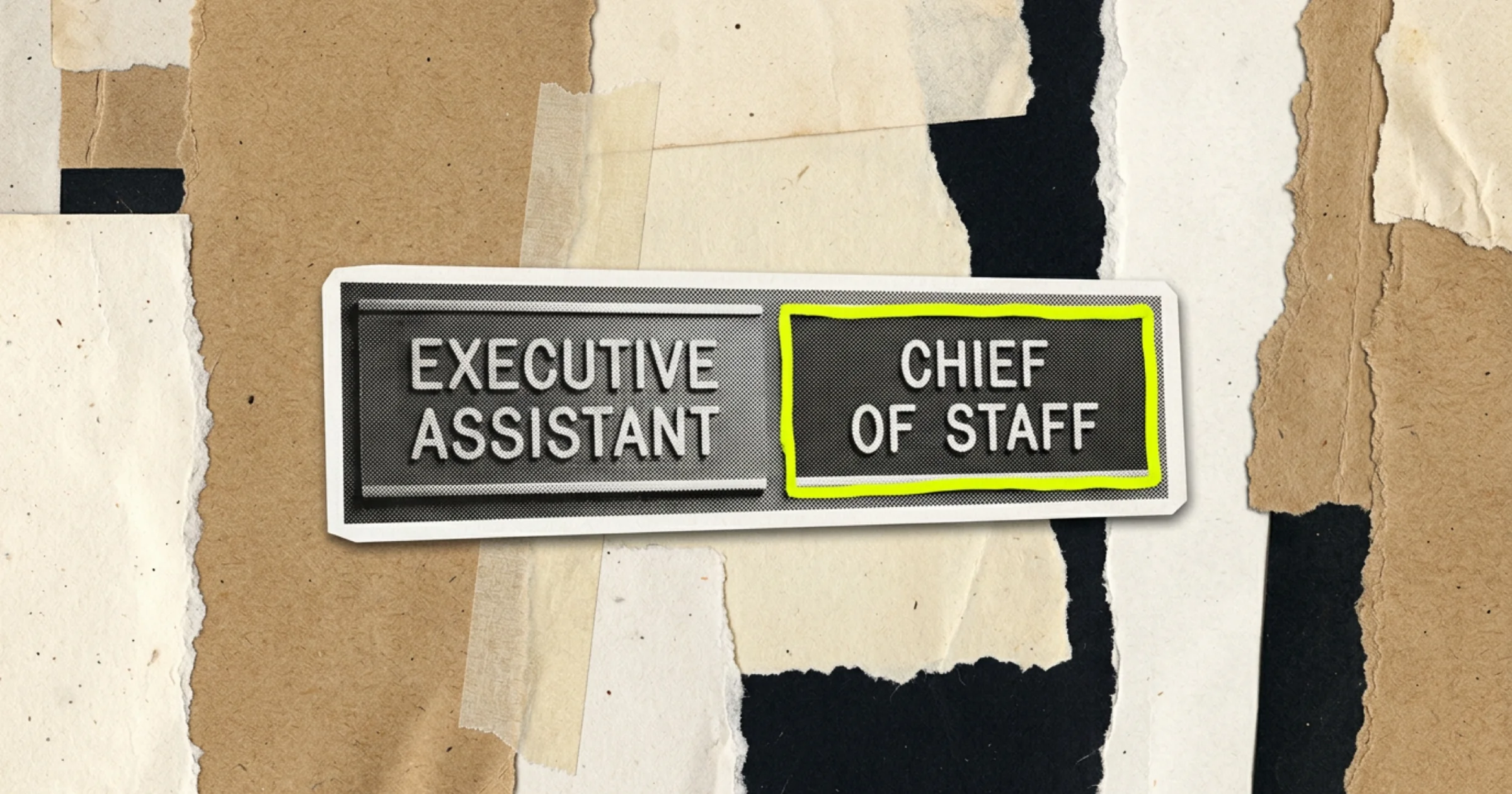
An executive assistant manages a leader's time, information and logistics so nothing slips. A Chief of Staff manages the leader's priorities and decisions so the right work moves without the leader chasing it. Among postings that list pay, Chief of Staff roles advertise a median $180k against $95k for EA roles, according to the Chief of Staff Network's 2026 Pathways Report. The two work best as a pair.
- An executive assistant protects the leader's time. A Chief of Staff extends the leader's judgment: they can stand in at a meeting and make the call.
- Among postings that list pay, Chief of Staff roles advertise a median of $180k, against $95k for EA and executive business partner roles, according to the Chief of Staff Network's 2026 Pathways Report (more than 1,800 postings; about 1 in 5 state a salary).
- Only 20% of those Chief of Staff postings mention gatekeeping executive time. 61% mention operating cadence, OKRs or KPIs.
- 6% of Chiefs of Staff moved in straight from executive support, across about 2,650 career histories. The stories we hear most often are internal promotions.
- Hybrid EA/Chief of Staff roles are real. Take one only with a written path to owning outcomes.
Most executives can't say why they need a Chief of Staff instead of a better assistant. And most assistants who already do strategic work can't get anyone to see them as anything else. Both problems come from the same blur between two jobs that sit side by side and look alike from the outside.
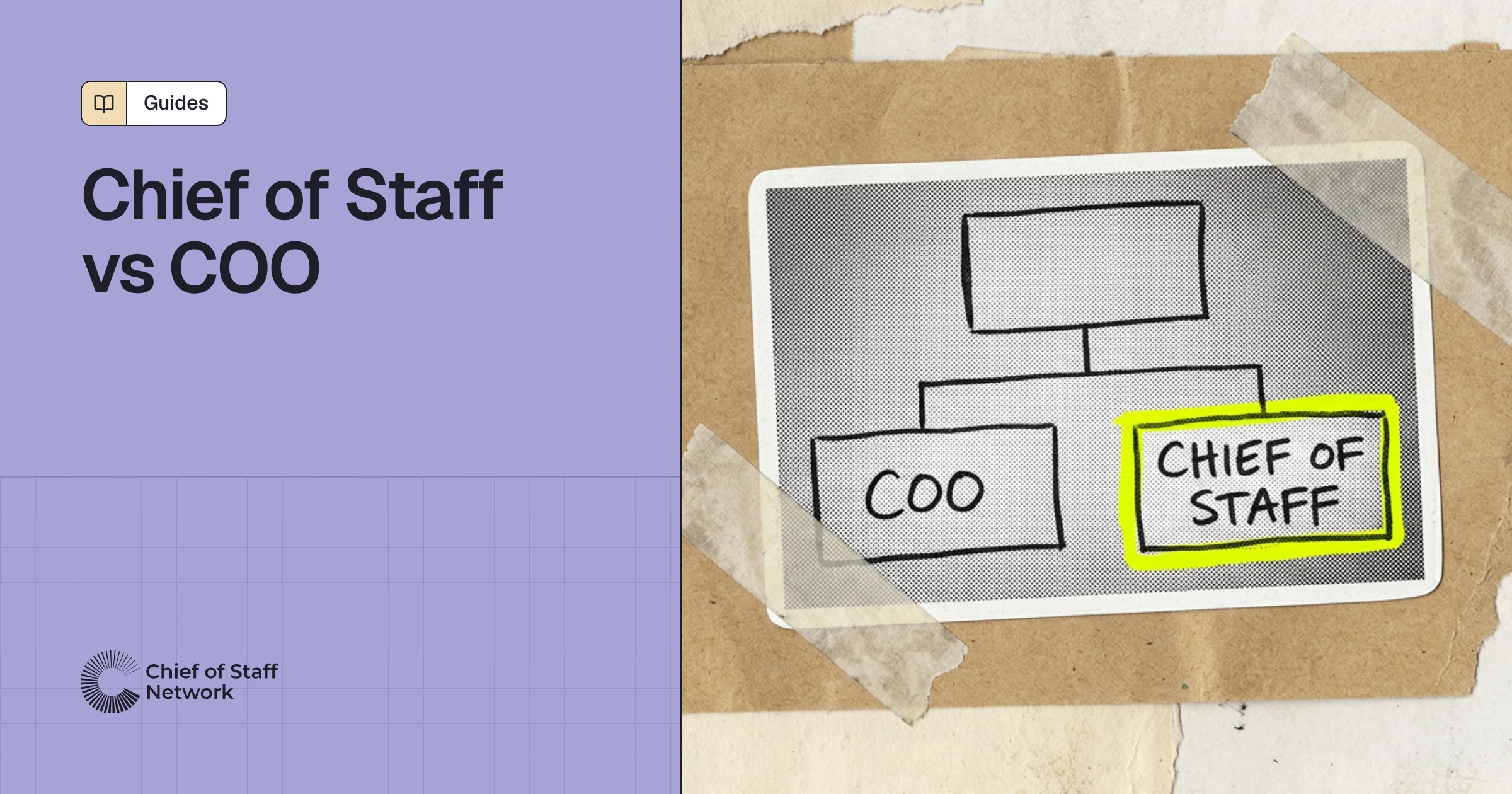
If you're comparing the role with the COO instead, read Chief of Staff vs COO, and for the whole role, our Start here handbook.
What is the difference between a Chief of Staff and an executive assistant?
An executive assistant manages the leader's time, information flow and logistics. A Chief of Staff manages the leader's priorities and the decisions and work that follow from them. The EA is measured by what doesn't go wrong. The Chief of Staff is measured by what happens without the leader having to push it.
Take one board meeting week. The executive assistant books the room and the travel, finds the hour the CEO needs to review the deck, and makes sure the pre-read reaches every director on time. The Chief of Staff decides with the CEO what the board needs to hear, chases the numbers from finance, writes the narrative, runs the dry run and follows up on every promise the CEO made in the room. Only the Chief of Staff's part changes what the board decides.
The cleanest test I know is substitution. Could this person sit in for the leader at a meeting they run and make the decision, because they hold the full context? That's the bar for a Chief of Staff, as we explain in what a Chief of Staff does, and nobody expects it of an assistant, however senior. The overlap sits in the first of the role's four core responsibilities, priorities and decisions; the operating rhythm, communication up and down and cross-functional projects sit outside the assistant job.
Chief of Staff vs executive assistant
| Executive assistant | Chief of Staff | |
|---|---|---|
| Manages | The leader's time, inbox, travel and access | The leader's priorities, decisions and follow-through |
| Success looks like | Nothing slips, the leader is prepared | The right work happens without the leader chasing it |
| Typical outputs | Calendar, briefings, logistics, meeting prep | Operating cadence, decision memos, leadership meetings, special projects |
| Decision rights | Over the calendar and logistics, within the leader's rules | Over priorities and trade-offs, delegated by the leader |
| Works with | The leader and other assistants | The leader, the leadership team and the board |
| Typical tenure | Usually not time-boxed | About two years (median completed stint 20 months) |
| Median advertised salary (US) | $95k (EA / EBP) | $180k |
| Where it leads | Senior EA or EBP, operations, sometimes Chief of Staff | 53% leave more senior than they arrived |
Salary and tenure: the Chief of Staff Network's 2026 Pathways Report, from job postings June to October 2026 (salaries are US postings) and member career histories.
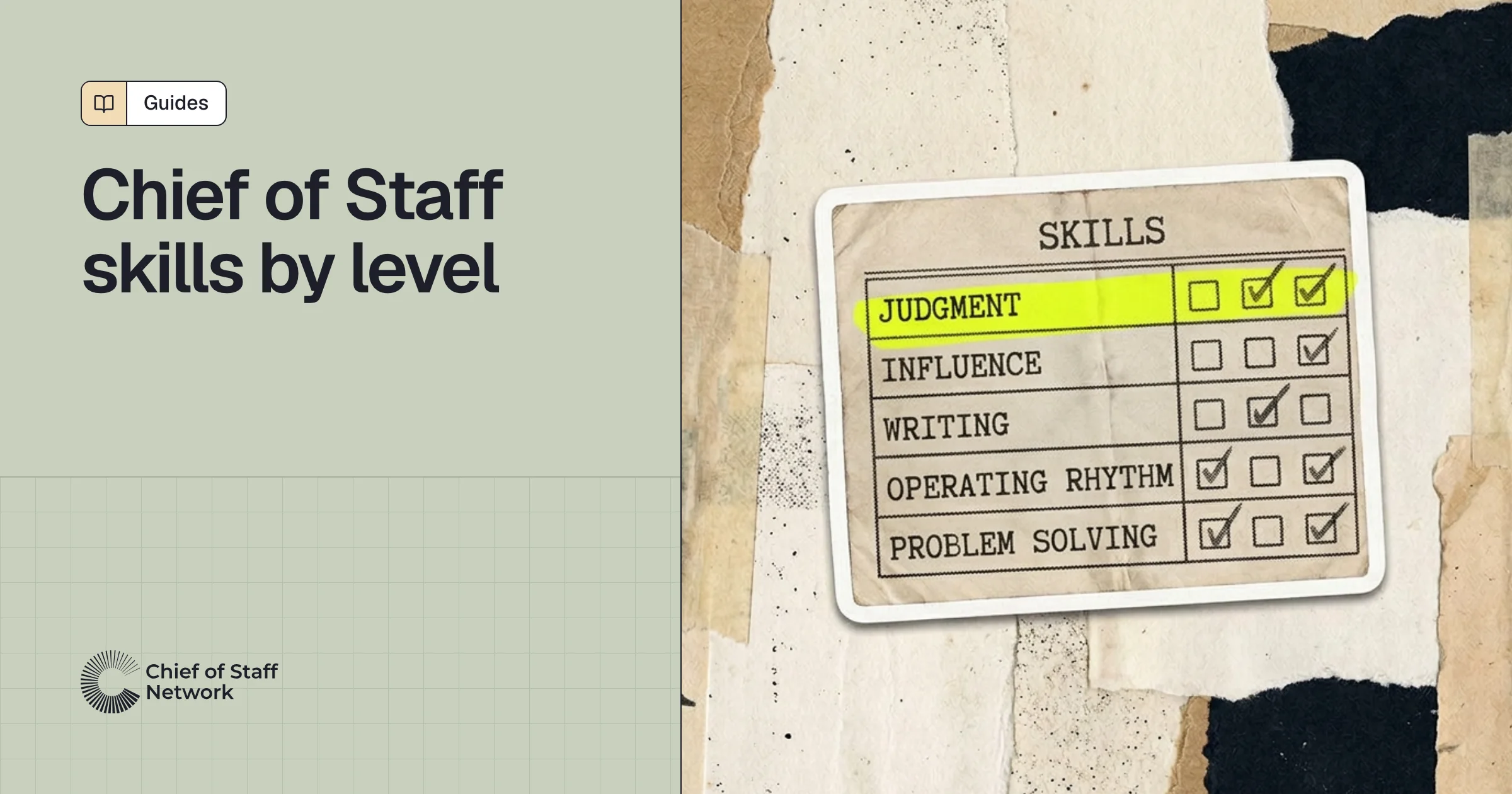
The skills overlap more than the jobs do. A strong EA already has discretion and a feel for what the leader needs before they ask. What's usually missing is the business itself: the numbers, the plan, and running a meeting that ends in a decision. Our guide to Chief of Staff skills lists what employers test at each level.
Tag a week of the leader's requests: time and logistics go to the EA, priorities and decisions go to the Chief of Staff.
Is a Chief of Staff just an executive assistant with a better title?
No, not when the role is real. In the more than 1,800 Chief of Staff postings in the Chief of Staff Network's 2026 Pathways Report, only 20% mention gatekeeping the executive's time. Operating cadence, OKRs or KPIs show up in 61%, executive communications in 46% and strategy and annual planning in 43%.
Some roles are mislabeled, and the difference shows up in what each does with the same request. Say a VP asks for 30 minutes with the CEO this week. The executive assistant finds the slot, protects the prep time and sends the invite. The Chief of Staff asks what decision the meeting is for, whether the CEO needs to be in it at all, and what the VP should bring so it ends with an answer. That last part is a meeting brief.
My take: the overlap is fine as long as someone owns it. When neither person knows who decides what reaches the leader, the leader gets two filters that disagree. If you're hiring, the job description guide shows how to write the decision rights into the role so it doesn't drift back into scheduling.
Should you hire a Chief of Staff or an executive assistant first?
Usually the assistant. Hire for what's breaking: if meetings collide, travel goes wrong and your inbox runs your day, hire an executive assistant. If decisions get made and nothing happens, priorities get relitigated and projects have no owner, hire a Chief of Staff.
The assistant comes first by default because it gives back the most of the leader's hours soonest, at about half the cost at the median ($95k against $180k among postings that list pay). A Chief of Staff hired into a team with no assistant tends to become one, because the calendar is the most urgent fire every morning.
Which hire fixes what
| What's breaking | Likely hire | Why |
|---|---|---|
| Double bookings, missed travel, slow replies | Executive assistant | Time and logistics problem |
| You spend evenings on scheduling and expenses | Executive assistant | Your hours are going to support work |
| Decisions don't turn into action | Chief of Staff | No one owns follow-through |
| The leadership meeting is a status update | Chief of Staff | No one owns the operating rhythm |
| Cross-team projects stall without an owner | Chief of Staff | The work has no home |
| You have an EA and still can't get to strategy | Chief of Staff | Your bottleneck is decisions |
Founders often ask whether they need a Chief of Staff or a virtual assistant. If the work can be written as instructions, it's assistant work, and a virtual or part-time assistant may cover it. If it needs judgment about what matters and who should do it, it's Chief of Staff work, and if that judgment work only needs a day or two a week, a fractional Chief of Staff is the honest middle ground. Our guide on how to hire a Chief of Staff covers scoping and hiring end to end.
How does a Chief of Staff's salary compare to an executive assistant's?
A Chief of Staff earns roughly twice what an executive assistant does at the median. Among postings that list pay, Chief of Staff roles advertise a median of $180k, with a typical band of $150k to $200k, and EA and executive business partner roles advertise $95k, according to the Chief of Staff Network's 2026 Pathways Report.
Employers pay a Chief of Staff for decisions and outcomes that cut across the business, and they pay an assistant for the leader's time and the quality of their day. The bottom of the Chief of Staff ladder does overlap the top of the EA market. Analyst and Associate level Chiefs of Staff average $91,462, with a middle half of $83k to $101k, according to the Chief of Staff Network's 2025 Salary Report (nearly 500 respondents). Pay climbs with decision rights on our Leveling Framework: $111,474 at Senior Associate, $144,464 at Manager, $173,667 at Director and $193,999 at Executive. The level averages come from our survey, a separate source from the postings, so don't compare the two directly.
If an offer says Chief of Staff and pays like an EA role, the scope is probably an EA role too, so ask which decisions you'll own before you negotiate the number. Our salary guide breaks pay down by level, company size and industry, and the Level 1 salary and skills post shows what the entry rung looks like.
Is an executive business partner the same as a Chief of Staff?
No. An executive business partner, or EBP, is a senior executive assistant whose scope reaches into the business: running the leader's operating rhythm, managing projects and representing the leader with the team. The title grows out of the assistant job and stays anchored on time and logistics, while a Chief of Staff owns priorities, trade-offs and cross-functional outcomes.
Our posting data groups EA and EBP roles together at a median of $95k. If you're an EBP, you're closer to the move than the title suggests. Write down which of your responsibilities are about time and which are about outcomes, because the outcome list is the one a hiring manager will ask about.
Should you take a hybrid EA and Chief of Staff role?
Take one early in your career only if it comes with a written path to owning outcomes. Later in your career, especially at EA pay, a hybrid usually costs more than it gives: the Chief of Staff title on your profile, with most of the actual work in calendar, travel, expenses and inbox. [SCOTT: confirm that hybrids come up most at small companies, which need both jobs and can fund only one hire?]
Signs an offer is a hybrid role, and what to ask
| Sign | What to ask before you accept |
|---|---|
| No other assistant on the team | Who owns the calendar, travel and expenses in 12 months? |
| The job description is mostly "support" and "coordinate" | Which decisions can I make without checking with you? |
| Interviews cover scheduling and skip priorities or projects | What's one outcome you'd want me to own in my first six months? |
| Pay is close to EA market rates | When do we review the scope and the level, and against what? |
| The principal has never had a Chief of Staff | What made you decide you need one now? |
Saying yes can work early on. Ada Madigan joined Trust & Will as an associate Chief of Staff in an EA-heavy role with board and investor exposure from the start, and grew into the full job when her predecessor moved to head of operations, as she tells it in her episode on going from associate to Chief of Staff. Anna Buckley took an assistant job at Barstool Sports on purpose as a door in, and later served as Chief of Staff there twice, first to the CRO and then to the CEO.
The trap is doing the support work so well that nobody wants you to stop. Cher Murphy, now Chief of Staff at Sydecar, tried to prove herself by doing both jobs at once, and found the people around her only wanted more of the assistant work.
It's almost like you get punished for being a good EA.
Cher Murphy, Chief of Staff, Sydecar · Listen on the podcast
If you take a hybrid, turn the support work into a system first (calendar rules, templates, a shared inbox playbook) so every hour you save goes to outcome work. Ask for one owned outcome with a number in the first 90 days, like the leadership meeting, a hiring process or a launch. Write a scope and level review at six or twelve months into the offer, with that outcome as the yardstick, and raise who takes the support work while you still have time to train someone.
Prompt: Is this offer an EA role or a Chief of Staff role?
I've been offered a role with the title Chief of Staff. Help me work out how much of it is an executive assistant job and how much is a Chief of Staff job.

Here is the job description:
[paste the job description]

Here is what I learned in interviews about the team, the principal and the first six months:
[paste your notes]

1. Sort every responsibility into "time and logistics" (calendar, travel, inbox, expenses, scheduling) or "priorities and outcomes" (operating cadence, decisions, projects, communications, leadership meetings). Estimate the share of a typical week for each.
2. List the decisions I would own on my own, the ones I'd shape, and the ones I'd only execute.
3. Flag any signal that this is a hybrid role: no other assistant, "support" language, interviews that skipped priorities, pay near executive assistant rates.
4. Write five questions I should ask before accepting, and the answer that would make me comfortable for each.
5. Give me a verdict in one paragraph: mostly EA, true hybrid or mostly Chief of Staff, and what I'd need in writing to take it.
How does an executive assistant become a Chief of Staff?
Executive support was the job right before the first Chief of Staff role for 6% of Chiefs of Staff in the Chief of Staff Network's 2026 Pathways Report, based on about 2,650 career histories. In the stories we hear on our podcast, the move usually happens inside a company that already trusts the assistant.
The inside route works because the principal's trust is already in place. Rico Ashab spent about three and a half years as his CEO's executive assistant at Destination DC before the CEO created the Chief of Staff role for him in January 2023, as he explains in his episode on becoming a Chief of Staff. Ali Sardinia joined Managed by Q as EA to the CEO just after its Series A, took on work well outside the EA scope and became its Chief of Staff, as she shares in her episode on the Chief of Staff's role in storytelling.
The outside route is harder but real: 64% of Chief of Staff hires are external, according to our 2024 hiring data. Stephania Greco was an executive assistant at SoftBank's Latin America fund before she helped build Bicycle Capital from the ground up as its Chief of Staff, a move she talks through in her episode on the VC Chief of Staff.
Across these stories, the same moves show up:
- Say it out loud early. Cher Murphy's advice is to tell your principals about your ambitions and build rapport with the whole leadership team.
- Learn the business beyond the leader: the numbers, the plan and what each leader is worried about. Nobody hands this to you from an EA seat.
- Own one outcome with a number, like a hiring process, the leadership meeting or a launch, and write down the before and after.
- Propose who takes the calendar before you ask for the title. A principal who can't picture losing your support work won't promote you out of it.
Why good assistants get stuck
The better you are at the support work, the harder the move gets. Promoting you costs your principal a calendar and an inbox that run themselves today, in exchange for a benefit they can only imagine, so most principals keep saying "soon."
Cher Murphy started as an executive assistant supporting three people at a real estate private equity firm, and quickly five. Her first strategic work was project managing the process of taking a fund public. The firm still wouldn't use the Chief of Staff title, so she became "administrative manager" first, and found that other managers saw her potential before her principal did. Eventually she left to chase the title in tech, because people who had watched her be a great EA couldn't picture her as anything else.
Read your situation against three signals. If your principal has given you an outcome with a number and backed you publicly when someone pushed back, the inside route is open. If other leaders already bring you problems they wouldn't bring to an assistant, those leaders can speak for you. If each month brings more support work, or a company that "doesn't believe in the title", the outside route is probably faster.
How to make the case
Make the ask in writing, on one page, a few weeks before a review cycle, so your principal has something they can forward. The page below is the structure I'd use.
Template: Promotion case: executive assistant to Chief of Staff
Proposal: moving from executive assistant to Chief of Staff
To: [principal] · From: [name] · Date: [date]
What I own today beyond the assistant role
- [Outcome 1, with before and after, e.g. "Ran the Q3 leadership offsite: 9 decisions logged, 8 closed by the end of the quarter"]
- [Outcome 2]
- [Leaders who rely on me for this: names]
What I'd own as Chief of Staff
- [e.g. Leadership meeting agenda, decision log and follow-up]
- [e.g. Quarterly planning calendar]
- [One cross-team project, with a handover date]
Who takes the support work
- Calendar, travel, expenses: [new hire, shared assistant or system], from [date]
- I'll train them for [weeks] and stay as backup for one month
Level and pay
- Level on the Chief of Staff Network Leveling Framework: [e.g. Sr. Associate / Jr. Manager], because [the decisions I'd own]
- Review at six months against the outcomes above
# Proposal: moving from executive assistant to Chief of Staff

To: [principal] · From: [name] · Date: [date]

## What I own today beyond the assistant role
- [Outcome 1, with before and after, e.g. "Ran the Q3 leadership offsite: 9 decisions logged, 8 closed by the end of the quarter"]
- [Outcome 2]
- [Leaders who rely on me for this: names]

## What I'd own as Chief of Staff
- [e.g. Leadership meeting agenda, decision log and follow-up]
- [e.g. Quarterly planning calendar]
- [One cross-team project, with a handover date]

## Who takes the support work
- Calendar, travel, expenses: [new hire, shared assistant or system], from [date]
- I'll train them for [weeks] and stay as backup for one month

## Level and pay
- Level on the Chief of Staff Network Leveling Framework: [e.g. Sr. Associate / Jr. Manager], because [the decisions I'd own]
- Review at six months against the outcomes above
Example: EA to Chief of Staff promotion case, Series B, 120 people (illustration)
Proposal: moving from executive assistant to Chief of Staff
To: Dana (CEO) · From: Jordan · Date: March 3
What I own today beyond the assistant role
- Ran the Q4 leadership offsite: 9 decisions logged, 8 closed by the end of the quarter
- Rebuilt interview scheduling for 14 open roles: time to offer down from 41 days to 29
- Leaders who rely on me for this: VP of Sales, VP of Engineering, Head of People
What I'd own as Chief of Staff
- Monday leadership meeting: agenda, decision log and follow-up
- The Q2 and Q3 planning calendar
- The move to our new office, handed to the office manager by July 31
Who takes the support work
- Calendar, travel and expenses: a new executive assistant, from April 14
- I'll train them for three weeks and stay as backup through May
Level and pay
- Leveling Framework: Sr. Associate / Jr. Manager, because I'd decide meeting agendas and project timelines on my own
- Review at six months against the outcomes above
# Proposal: moving from executive assistant to Chief of Staff

To: Dana (CEO) · From: Jordan · Date: March 3

## What I own today beyond the assistant role
- Ran the Q4 leadership offsite: 9 decisions logged, 8 closed by the end of the quarter
- Rebuilt interview scheduling for 14 open roles: time to offer down from 41 days to 29
- Leaders who rely on me for this: VP of Sales, VP of Engineering, Head of People

## What I'd own as Chief of Staff
- Monday leadership meeting: agenda, decision log and follow-up
- The Q2 and Q3 planning calendar
- The move to our new office, handed to the office manager by July 31

## Who takes the support work
- Calendar, travel and expenses: a new executive assistant, from April 14
- I'll train them for three weeks and stay as backup through May

## Level and pay
- Leveling Framework: Sr. Associate / Jr. Manager, because I'd decide meeting agendas and project timelines on my own
- Review at six months against the outcomes above
Ask for the level as well as the title. Entry-level Chiefs of Staff average $91,462 at Analyst and $111,474 at Senior Associate in our 2025 Salary Report, so use the decisions you already own to argue for the rung. After the promotion, people will keep sending you calendar requests for a while. Forward each one to whoever now owns it, ask your principal to introduce your new role at the leadership meeting, and around month three check whether support work has crept back above a few hours a week.
Before you ask for the Chief of Staff title, have someone else already doing the calendar and travel well.
Our guide to becoming a Chief of Staff covers the full path, including how to rewrite your EA resume bullets around outcomes, and our resume review gives you a second pair of eyes.
Learn the job with people who do it. Compare notes with Chiefs of Staff and EAs who've made the move or worked in hybrid roles, in our community and at our events.
See membershipHow should an executive assistant and a Chief of Staff split the work?
The executive assistant owns the leader's time and logistics. The Chief of Staff owns priorities and follow-through. They meet weekly to decide what the leader's time should go to, and the EA runs the calendar inside those rules. We recommend both report to the leader as peers. When the EA reports to the Chief of Staff, the leader loses a direct line to their own calendar, and the Chief of Staff inherits a management job they didn't plan for.
The friction points are predictable: who decides what gets on the calendar, who drafts the leader's messages, who speaks to the leadership team on the leader's behalf and who preps which meetings. Write those down once. [SCOTT: did you work with an EA at Spring, and how did you split the work?]
Template: Executive assistant and Chief of Staff: who owns what
EA and Chief of Staff: who owns what
- Leader: [name, title]
- Executive assistant: [name]
- Chief of Staff: [name]
- Review date: [date, 3 months out]
The executive assistant owns
- The calendar, inside the time rules below
- Travel, expenses and the leader's inbox triage
- Meeting logistics: rooms, invites, pre-reads sent on time
- The leader's personal admin and confidential scheduling
- First response to inbound requests for the leader's time
The Chief of Staff owns
- The leader's top priorities for the quarter and how time maps to them
- The operating cadence: leadership meeting agenda, actions and follow-up
- Decision prep: what each key meeting is for and what the leader needs
- Cross-functional projects the leader assigns
- Drafting the leader's communications to the team and board
Shared, with a clear lead
| Work | Lead | Support |
|---|---|---|
| Board meeting | Chief of Staff (content) | EA (logistics) |
| Offsites | Chief of Staff (agenda, outcomes) | EA (venue, travel) |
| Requests for the leader's time | EA (scheduling) | Chief of Staff (decides if a meeting is needed) |
| Leader's weekly prep | EA (calendar and briefing pack) | Chief of Staff (what matters this week) |
Time rules the EA can apply without asking
- Protected blocks: [e.g. 2 x 2-hour focus blocks a week]
- Meetings that need the Chief of Staff's OK first: [e.g. new external commitments over 1 hour]
- Meetings that never need the leader: [e.g. vendor intros, status updates]
Weekly sync (30 minutes, EA + Chief of Staff)
- Next week's calendar against this quarter's priorities
- Requests waiting for a decision
- Prep owners for next week's key meetings
- Anything the leader should drop
# EA and Chief of Staff: who owns what

- Leader: [name, title]
- Executive assistant: [name]
- Chief of Staff: [name]
- Review date: [date, 3 months out]

## The executive assistant owns
- The calendar, inside the time rules below
- Travel, expenses and the leader's inbox triage
- Meeting logistics: rooms, invites, pre-reads sent on time
- The leader's personal admin and confidential scheduling
- First response to inbound requests for the leader's time

## The Chief of Staff owns
- The leader's top priorities for the quarter and how time maps to them
- The operating cadence: leadership meeting agenda, actions and follow-up
- Decision prep: what each key meeting is for and what the leader needs
- Cross-functional projects the leader assigns
- Drafting the leader's communications to the team and board

## Shared, with a clear lead
| Work | Lead | Support |
| --- | --- | --- |
| Board meeting | Chief of Staff (content) | EA (logistics) |
| Offsites | Chief of Staff (agenda, outcomes) | EA (venue, travel) |
| Requests for the leader's time | EA (scheduling) | Chief of Staff (decides if a meeting is needed) |
| Leader's weekly prep | EA (calendar and briefing pack) | Chief of Staff (what matters this week) |

## Time rules the EA can apply without asking
- Protected blocks: [e.g. 2 x 2-hour focus blocks a week]
- Meetings that need the Chief of Staff's OK first: [e.g. new external commitments over 1 hour]
- Meetings that never need the leader: [e.g. vendor intros, status updates]

## Weekly sync (30 minutes, EA + Chief of Staff)
1. Next week's calendar against this quarter's priorities
2. Requests waiting for a decision
3. Prep owners for next week's key meetings
4. Anything the leader should drop
This week, if you have both: run that 30-minute sync once, then fill in the page with the leader in the room.
Where the split breaks
The split breaks on requests that look like scheduling and turn out to be decisions. As an illustration: a board member emails the executive assistant asking for 30 minutes with the CEO "this week, about the partnership." The assistant can find the slot. Only the Chief of Staff knows the partnership is in a sensitive negotiation and the CEO shouldn't take that call without the deal lead and a brief.
The rule that handles it: the assistant books anything that matches the time rules, and flags anything that names a topic, a deal or a person outside the company to the Chief of Staff before confirming. The Chief of Staff answers within a few hours, so the flag never slows the leader down. Test the rule together on the next ten requests.
Watch two second-order effects. An assistant can feel demoted when a Chief of Staff arrives, because deciding who gets time now runs through someone else; give them the time rules to apply on their own and credit them in front of the leader when the calendar runs well. And a Chief of Staff who used to be the assistant keeps doing parts of the old job. If that's you, train your replacement, stay as backup for a month, then stop answering calendar questions. In a large office with several assistants, putting them under the Chief of Staff can work if the reporting line and time rules are written down. When the leader has no assistant at all, treat it as the hybrid case above, with a date to hire help.
Keep reading
 Chief of Staff vs COO: what's the difference?Start here
 Chief of Staff skills: what the job demands at every levelStart here
 What does a Chief of Staff do?Start here
Start here
- The Chief of Staff handbook
- What does a Chief of Staff do?
- Chief of Staff vs COO: what's the difference?
- Chief of Staff vs executive assistant: what's the difference?
- A day in the life of a Chief of Staff
- Chief of Staff skills: what the job demands at every level
- Chief of Staff salary (2026): pay by level, company size and city
- Chief of Staff job description (template and examples)
- How to hire a Chief of Staff
- How to become a Chief of Staff
Take this guide with you
The full guide as a PDF: every section, template and chart, ready to print or share with your team.
Your PDF is ready.
Download the PDFFree. We may email you new guides; unsubscribe anytime.
Frequently asked questions
- 2026 Pathways Report, Chief of Staff Network. 2,869 Chief of Staff career histories; the background figures (function of the job held right before the first Chief of Staff role) use a base of 2,653. 1,819 Chief of Staff job postings, June to October 2026; advertised pay is from US postings (annualized midpoint; salary stated on about 1 in 5 postings). Download the full report.
- 2025 Salary Report, Chief of Staff Network (n=479). Base salary by level and education.
- Chief of Staff Network analysis of Chief of Staff hires (2024). Internal vs external hires.
- Leveling Framework, Chief of Staff Network. Six levels from Analyst/Associate to Executive.
- The Chief of Staff Podcast: episodes with Ada Madigan, Anna Buckley, Cher Murphy, Rico Ashab, Ali Sardinia and Stephania Greco.
- Earlier COSN studies used different samples and definitions; the 2026 figures replace them.
Learn the job with people who do it
Membership gets you the Power Skills program, member events and a private community of working Chiefs of Staff.
Land your first Chief of Staff role
Launchpad helps you prepare, position yourself and interview for the role.
Starting out in the role?
The Fundamentals email course walks you through scoping the mandate, setting the cadence and earning trust.
Lead AI adoption from the Chief of Staff seat
The Chief of AI Fellowship is for operators turning AI into how the company runs.
Hiring a Chief of Staff?
Post the role on the Chief of Staff job board, or browse open roles.
Get your resume ready for the role
Get feedback on your Chief of Staff resume before you apply.
Let the right roles find you
Join the talent network and hear about Chief of Staff roles first.
The Chief of Staff newsletter
What Chiefs of Staff are reading, hiring for and building.
Get the full report
Every chart and cut from our latest salary research, sent to your inbox.
Using AI with sensitive data?
Learn the legal side of using AI at work.