

Chief of Staff vs COO
A COO runs operations and owns the number. A Chief of Staff runs the leader's agenda. Compare authority, career moves (7% become COO) and when to hire each.

Ask AI
 Share
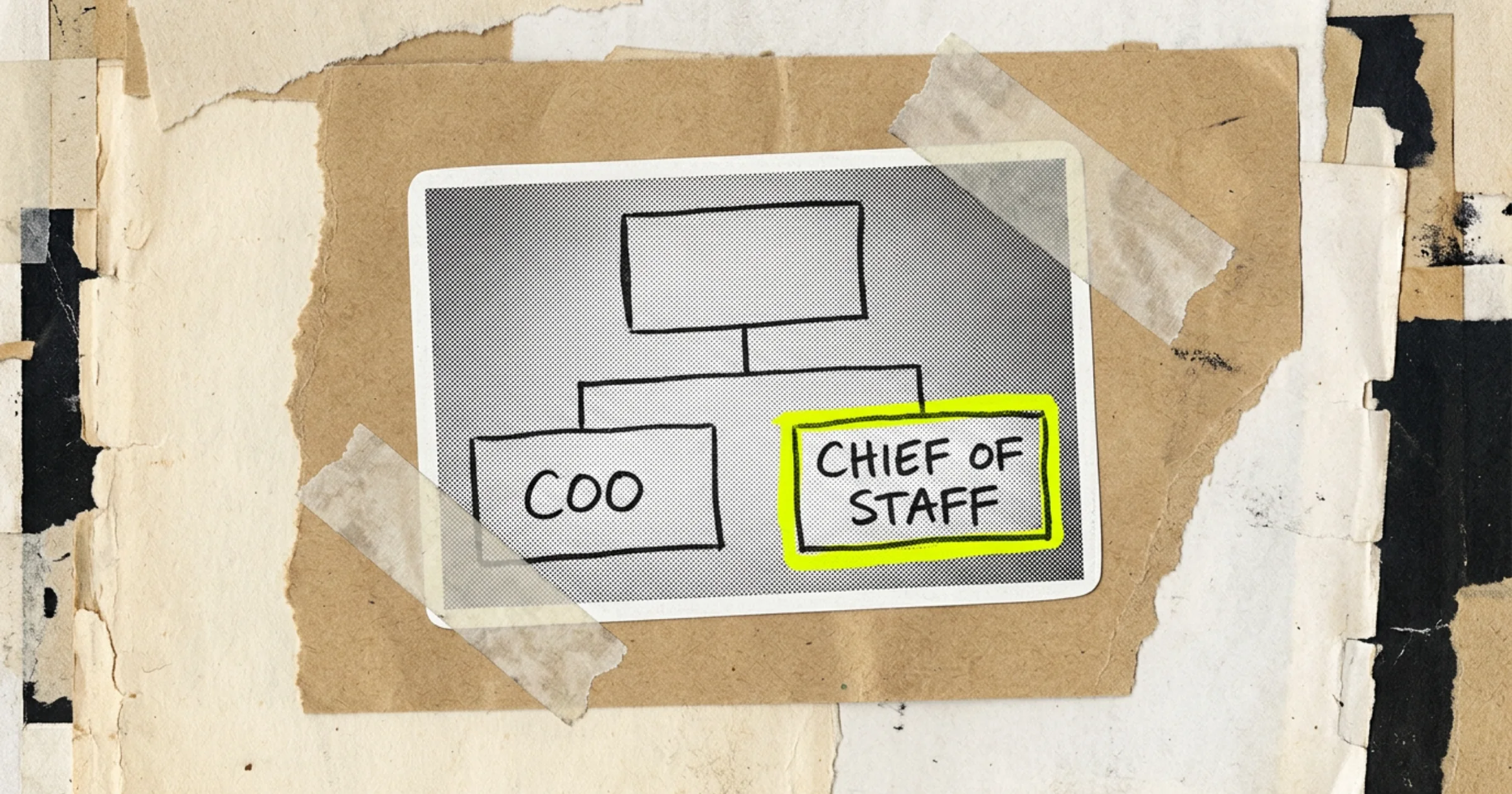
A COO runs the company's operations and owns results through a team and a budget. A Chief of Staff is the primary strategic operator for one senior leader, covering priorities and decisions, the operating rhythm, communication and cross-functional projects, usually without direct reports or a P&L. Some later step up: 7% reach COO within three years.
- Ownership is the line. A COO owns an operating result through people and budget. A Chief of Staff owns how the leadership team runs, and works through influence.
- 7% of Chiefs of Staff become COO within three years, and 46% of those who become COO are promoted at the same company, according to the Chief of Staff Network's 2026 Pathways Report.
- Most Chiefs of Staff are not C-suite. Executive-level roles make up around 20% of Chief of Staff roles at companies up to 500 people and 5% at companies over 50,000, according to the Chief of Staff Network's 2025 Salary Report (nearly 500 respondents).
- Chief of Staff postings advertise a $180k median, above the $155k for COO, VP and Head of Operations postings combined, a bucket dominated by smaller-company roles (median among US postings that list pay).
- Hire a COO when you need someone to own a number. Hire a Chief of Staff when the CEO is the bottleneck.
When Bryan Silverman's CEO at Suzy asked him to become Chief of Staff, he asked two people what the job was. One told him it was basically the COO. The other told him it was an executive assistant role and he shouldn't take it. Looking back, in his episode on going from Chief of Staff to COO, he said both were right, depending on the hour.
That confusion costs both sides. Founders hire one role when they needed the other, and candidates take a Chief of Staff job expecting COO authority and find they have none. For the role end to end, read our Chief of Staff handbook.
What is the difference between a Chief of Staff and a COO?
A COO owns an operating result. A Chief of Staff owns how the leader and the leadership team get to results. The COO's authority comes from the org chart: functional heads report to them and a budget sits under them. The Chief of Staff's authority is borrowed from the principal they work for.
A COO owns the operating plan and the metrics that track it, runs some or all of the functions that deliver it (often operations, customer success, supply chain, sometimes sales or people), manages those leaders and answers for the budget. Some COOs are a true second-in-command who runs the business while the CEO faces investors and the market; others are a scaling operator brought in to build systems after fast growth. A Chief of Staff covers four core responsibilities for one leader, as I set out in what a Chief of Staff does: priorities and decisions, the operating rhythm, communication up and down, and cross-functional projects.
You can see the difference in what each one gets blamed for. If the company misses its quarter because delivery slipped, that lands on the COO. If the leadership meeting has discussed the same decision for six weeks and nobody has made it, that lands on the Chief of Staff. Only the COO has a team to fix the first one.
Chief of Staff vs COO vs related roles
| Chief of Staff | COO | Chief strategy officer | Head of BizOps | Executive assistant | |
|---|---|---|---|---|---|
| Main job | Priorities and decisions, the operating rhythm, communication and cross-functional projects for one leader | Running operations and delivering the plan | Where the company plays: long-range plan, big bets, M&A | Planning, metrics and analysis that inform decisions | The leader's time, travel and logistics |
| Authority | Borrowed from the principal | Line authority over functions | Advisory, plus a small team | Analytical, plus a team | Delegated by the leader |
| Direct reports | Usually none, sometimes a small team | Functional heads | A small strategy team | Analysts | None |
| Owns a P&L or budget | Rarely, though often sees it | Usually | Rarely | No | No |
| Executive team member | Sometimes, depends on level | Yes | Usually | No | No |
| Typical time in seat | Median 20 months | Long-term (no COSN data) | Long-term (no COSN data) | Long-term (no COSN data) | Often years |
| Median advertised pay (US postings that list pay) | $180k | $155k (COO, VP or Head of Ops combined) | Not tracked separately (Strategy or Office of the CxO postings: $160k) | $156k | $95k (EA or EBP) |
Pay source: Chief of Staff Network, 2026 Pathways Report, US postings with a stated salary, June to October 2026. Time in seat for Chiefs of Staff: median completed stint from career histories in the same report.
Don't read the pay row as the Chief of Staff outranking the COO. The operations bucket mixes a Head of Operations at a 20-person startup with a COO at a global company, and C-suite pay at large companies rarely shows up in public postings. The salary guide has the full pay picture by level and company size.
My view is that most companies under 50 people don't need a COO title at all. They need a CEO who runs operations well, and often a Chief of Staff who makes that possible. Give someone the COO title early and you've created an executive seat you will have to manage around for years.
When does a company need a COO, and when a Chief of Staff?
Hire a COO when the CEO wants to hand off running part of the business, and someone needs to own an operating result with a team and a budget. Hire a Chief of Staff when the CEO wants to keep running the business but has become the bottleneck: too many decisions, too many cross-team projects, and a leadership team that doesn't run without them.
A COO splits the CEO's job: the CEO keeps the vision, investors and some functions, and the COO takes operations. A Chief of Staff extends it, with a second pair of hands that can carry the CEO's context into every room.
COO or Chief of Staff: which does your company need?
| What you're seeing | More likely hire | Why |
|---|---|---|
| The CEO wants to step back from day-to-day operations | COO | Someone has to own the operating result with line authority |
| Several functional leaders need a manager who isn't the CEO | COO | That needs a reporting line |
| The CEO is in every decision and everything waits on them | Chief of Staff | The fix is filtering, preparing and delegating decisions |
| Leadership meetings don't end in decisions | Chief of Staff | The fix is the operating rhythm |
| Cross-team projects keep stalling with no owner | Chief of Staff | Cross-functional projects are one of its four core responsibilities |
| A specific number (margin, delivery, service levels) keeps missing | COO | You need an owner with a team and budget |
| A founder-CEO is scaling past 50 to 100 people for the first time | Chief of Staff first, often | It builds the rhythm a future COO will run |
A growing company tends to need the Chief of Staff first and the COO later. Tyler Denk, co-founder and CEO of beehiiv, told us his first two Chiefs of Staff both went on to become COO, and when the Chief of Staff becomes the COO, the original problem comes back. Whichever you hire, write down what it should return in six months: the operating number for a COO, the hours and decisions taken off your plate for a Chief of Staff.
How to tell which problem you have
Most CEOs who ask me this have both symptoms, so the useful question is which one costs more. Take an illustration. A founder-CEO of an 80-person software company has six direct reports, misses the customer onboarding target three months running, and spends Monday to Wednesday in meetings where decisions get postponed. Run two checks over the last month of their calendar and metrics.
- The number test. Is the same operating metric missing every month, with the same team behind it? Onboarding is owned by customer success, and nobody senior manages it day to day except the CEO. That's a COO-shaped gap, or a VP of Operations one.
- The waiting test. Count the decisions that waited more than a week for the CEO. If it's more than a handful, and they span several teams, that's a Chief of Staff-shaped gap. A COO wouldn't fix it, because most of those decisions aren't operational.
If both checks come back positive, fix the waiting first. A Chief of Staff can build the rhythm that makes a missed number visible every week, and the future COO inherits a company that already decides things once. If the number is about to cost you a customer or a quarter, reverse the order.
Don't hand out a COO title to land a senior candidate, because the seat on the executive team is hard to take back. Tell your leadership team before you announce either hire: Tyler Denk got pushback when he proposed a new Chief of Staff, and a COO lands harder, because some of your direct reports just gained a manager who isn't you. A month after a COO starts, check whether functional heads still bring operating issues to you directly. Three months after a Chief of Staff starts, check whether decisions leave your desk.
Prompt: Do I need a COO or a Chief of Staff?
I'm a CEO (or founder) deciding whether to hire a COO or a Chief of Staff. Here is my situation:

- Company: [stage, headcount, business model]
- My leadership team: [titles of my direct reports]
- What I spend my time on in a typical week: [list]
- What keeps breaking or stalling: [list]
- What I want to keep doing myself: [list]
- What I want to stop doing: [list]

Using this framework:
- A COO owns an operating result through line authority over functions and a budget. Hiring one splits my job.
- A Chief of Staff owns four core responsibilities for me: priorities and decisions, the leadership team's operating rhythm, communication up and down, and cross-functional projects nobody owns. Hiring one extends my job. They usually have no direct reports.

Tell me:
1. Which role fits my situation better, and the two strongest reasons.
2. What would go wrong if I hired the other one.
3. The five decisions the person should own in their first six months.
4. The title and level I should advertise, and what the job description must say about authority.
Ask me up to three clarifying questions first if anything important is missing.
Don't hire a Chief of Staff as a cheaper COO. If what you need is someone to own a number, a Chief of Staff without line authority will spend their time negotiating with the people who do have it, and you'll both be frustrated by month six. Write the job description around the decisions the person will own, and our guide on how to hire a Chief of Staff covers the process.
Hiring a Chief of Staff or an operations leader? Post it on the Chief of Staff Network job board, where Chiefs of Staff and operators look for their next role.
Post a jobIs a Chief of Staff a C-level role?
Usually not. Despite the word "Chief", most Chiefs of Staff report to a C-level executive and don't sit on the executive team as a peer, and a growing share now report to VPs.
The pattern runs the opposite way from what most people expect. Executive-level Chiefs of Staff are common in small companies and rare in large ones, according to the Chief of Staff Network's 2025 Salary Report (nearly 500 respondents).
Chief of Staff level by company size, 2025
| Company size | What the level mix looks like |
|---|---|
| 1 to 10 employees | The only place Analyst/Associate roles are common (9% of roles) |
| Up to 500 employees | Executive/CXO-level Chiefs of Staff hold around 20% of roles |
| 1,001 to 5,000 employees | Director is the most common level, at its peak |
| 10,001 to 50,000 employees | Manager/Sr. Manager rises to 41% of roles; no Level 1 or 2 roles at all |
| 50,000+ employees | Executive/CXO falls to 5% of roles |
Source: Chief of Staff Network, 2025 Salary Report, seniority level by company headcount. Levels follow our Leveling Framework.
The level follows the principal's. Only 44% of the job postings that name a principal say CEO or founder, according to the Chief of Staff Network's 2026 Pathways Report, and in a large enterprise the Chief of Staff often supports a VP. I'd look for three things that make the seat executive.
- Membership of the executive meeting. Are you in it as a member who speaks to the agenda, or as the person who takes notes and sends follow-ups?
- Decisions in the principal's absence. When your principal is out, can you make a call and have it stick? Tyler Denk told us he wants a Chief of Staff who can step into any meeting he runs and make the decision if he isn't there.
- Title and reporting line. Postings for Chief of Staff roles with a VP, Director or Head title advertise a median of $230k, against $174k for a plain Chief of Staff title, according to our 2026 Pathways Report.
If none of the three is true, the role isn't C-suite, whatever the title says. It can still be a good job, so negotiate on scope and level. The skills that move you up a level are the same ones that earn a seat at the executive table.
Ask whether a decision you make while your principal is out will stick. If it will, the seat is executive.
How do a Chief of Staff and a COO work together?
When a company has both, the COO runs the operating machine and the Chief of Staff runs the CEO's agenda and the leadership team's rhythm. They fight when both think they own the operating cadence, annual planning and cross-functional projects.
Operating cadence, OKRs and KPIs are the most common ask in Chief of Staff postings, mentioned in 61% of the more than 1,800 in the Chief of Staff Network's 2026 Pathways Report, and they are also core COO territory. Split the work by accountability. The COO owns the operating metrics and the teams that move them. The Chief of Staff owns the process that brings those metrics to the leadership team, and the follow-through on the decisions it makes. Our guide to the operating rhythm shows how that process runs.
Bryan Silverman describes his job as COO at Suzy as one corner of a triangle with the CEO and the head of commercial. The Chief of Staff next to a triangle like that keeps the three corners working from the same facts, priorities and calendar. [SCOTT: at Spring, was there a COO or operating lead next to you, and how did you divide the work?] Because the Chief of Staff carries the CEO's context, leaders sometimes route around the COO through them. The cleanest rule I know: the Chief of Staff never gives a functional leader an instruction the COO hasn't seen.
Here is a one-page split to agree on in your first month. Edit the rows, then review it together after a quarter.
Template: Chief of Staff and COO: who owns what
Chief of Staff and COO: who owns what
- Company: [name] · CEO: [name] · Chief of Staff: [name] · COO: [name]
- Agreed on: [date] · Review on: [date, one quarter later]
| Area | Chief of Staff owns | COO owns | Decided together |
|---|---|---|---|
| CEO priorities and calendar | What reaches the CEO, what gets delegated, what gets declined | Which operating issues need the CEO this month | |
| Leadership team meeting | Agenda, pre-reads, decisions log, follow-ups | Operating review section and its metrics | Which decisions come to the meeting |
| Company OKRs and KPIs | The process: timeline, templates, scoring, quarterly reset | Operating KPIs and the teams that move them | Company-level objectives (CEO decides) |
| Annual plan and budget | Planning calendar, CEO's narrative, trade-off sessions | Operating plan, headcount and budget by function | Final plan sign-off (CEO decides) |
| Board meetings | Deck, narrative, pre-reads, follow-ups | Operating sections and metrics | What goes to the board |
| Cross-team projects with no owner | Scoping, staffing, running until handover | Owning anything that becomes ongoing operations | When a project hands over |
| Functional leaders | Relationship, context, honest communication to the CEO | Line management, goals, performance | Escalations that need the CEO |
| Company communications | CEO memos, all-hands, leadership updates | Operational announcements | Sensitive announcements |
| Executive hiring | Process and candidate experience for CEO hires | Hiring for operations roles | Who joins the leadership team |
Ground rules
- The Chief of Staff never gives a functional leader an instruction the COO hasn't seen.
- The COO brings operating problems that need the CEO through the Chief of Staff's agenda.
- If ownership is unclear, the two of us agree an owner within 48 hours, or take it to the CEO.
# Chief of Staff and COO: who owns what

- Company: [name] · CEO: [name] · Chief of Staff: [name] · COO: [name]
- Agreed on: [date] · Review on: [date, one quarter later]

| Area | Chief of Staff owns | COO owns | Decided together |
| --- | --- | --- | --- |
| CEO priorities and calendar | What reaches the CEO, what gets delegated, what gets declined | | Which operating issues need the CEO this month |
| Leadership team meeting | Agenda, pre-reads, decisions log, follow-ups | Operating review section and its metrics | Which decisions come to the meeting |
| Company OKRs and KPIs | The process: timeline, templates, scoring, quarterly reset | Operating KPIs and the teams that move them | Company-level objectives (CEO decides) |
| Annual plan and budget | Planning calendar, CEO's narrative, trade-off sessions | Operating plan, headcount and budget by function | Final plan sign-off (CEO decides) |
| Board meetings | Deck, narrative, pre-reads, follow-ups | Operating sections and metrics | What goes to the board |
| Cross-team projects with no owner | Scoping, staffing, running until handover | Owning anything that becomes ongoing operations | When a project hands over |
| Functional leaders | Relationship, context, honest communication to the CEO | Line management, goals, performance | Escalations that need the CEO |
| Company communications | CEO memos, all-hands, leadership updates | Operational announcements | Sensitive announcements |
| Executive hiring | Process and candidate experience for CEO hires | Hiring for operations roles | Who joins the leadership team |

## Ground rules
1. The Chief of Staff never gives a functional leader an instruction the COO hasn't seen.
2. The COO brings operating problems that need the CEO through the Chief of Staff's agenda.
3. If ownership is unclear, the two of us agree an owner within 48 hours, or take it to the CEO.
Agree in writing who owns the operating cadence, annual planning and board prep in your first month, and review it after a quarter.
Where the split gets tested
The first real test is usually annual planning, because both roles have a claim on it. As an illustration: the Chief of Staff sends the planning calendar and templates to every functional leader, while the COO has already asked the operations leaders for headcount plans in a different format, due a week earlier. Two leaders now have two deadlines and ask the CEO which one counts. Apply the split on the spot: one calendar, template and deadline from the Chief of Staff, the operating sections from the COO, the final call on objectives from the CEO. Agree it within 48 hours and tell the leaders together, so nobody has to pick a side.
Watch for two patterns in month three. In the first, leaders who don't like a COO decision bring it to the Chief of Staff, hoping it reaches the CEO with a better framing; send them back to the COO and tell the COO it happened. In the second, the COO starts using the Chief of Staff as their own analyst and the CEO's agenda gets thinner. The test is who set your priorities this week.
When the COO is your principal, the shape changes. About 18% of postings that name a principal support a finance, operations, people or legal leader, according to the Chief of Staff Network's 2026 Pathways Report. A Chief of Staff to the COO runs the COO's operating reviews and needs a standing check-in with the CEO's Chief of Staff, if there is one.
How is a Chief of Staff different from a chief strategy officer or head of BizOps?
A Chief of Staff makes the leadership team decide and then act. A chief strategy officer decides where the company should play, and a head of BizOps builds the analysis that tests those choices. (A president, where a company has one, is a senior operating executive and sits closer to a COO.)
In annual planning, the chief strategy officer frames the big bets, BizOps builds the model and scenarios, and the Chief of Staff runs the planning calendar, forces the trade-offs into the room and turns the decisions into OKRs and owners. In smaller companies one person often does all three, and that person is usually the Chief of Staff. "Strategy and annual planning" appears in 43% of Chief of Staff postings in our 2026 Pathways Report, yet only 0.4% of Chiefs of Staff reach a chief strategy officer title within three years. Many companies merge the Chief of Staff and strategy work, and that title pays: Chief of Staff postings that add strategy advertise a median of $250k, the highest of the title variants.
Can a Chief of Staff become a COO?
Yes, and it's one of the most common senior moves out of the role. 4.5% of Chiefs of Staff move straight into a COO seat and 7% hold the title within three years, according to the Chief of Staff Network's 2026 Pathways Report. Operations and strategy leadership as a whole is the most common next step, at 30% of moves out of the role.
The move usually happens in place. 46% of the Chiefs of Staff who become COO do it at the company where they were Chief of Staff, and two thirds of those who become VP or Head of Operations do too, with a median gap of zero months. Staying put pays more broadly: 61% of Chiefs of Staff step up when they stay at the same company for their next role, against 48% when they leave.
Bryan Silverman joined Suzy as an SDR, moved into enterprise sales, became Chief of Staff during a major pivot and spent about two years in the role. Then he moved through business development, product, a general-manager-style role and strategy and operations before becoming COO, almost 11 years after he joined. The Chief of Staff years gave him exposure to the P&L, the board and the product without owning any of them. What moved him on, he told us, was finding a problem in the business that needed a full-time owner.
What the move asks of you
The missing pieces are people and a number. Bryan Silverman called people management the hardest part of his transition: coaching, setting a vision and deciding between people who disagree are things "you don't really experience until you experience it." He thought that skill would have been tough to build inside the Chief of Staff seat at Suzy, then about 60 people, and more doable at a large company where a Chief of Staff can run an office of the CEO with a small team.
| Your situation | How to get the missing piece |
|---|---|
| Small company, no team under you | Ask for one piece of the business with a number attached, and run it alongside the Chief of Staff work |
| Large company, office of the CEO | Ask to manage the analysts or program managers in the office, which builds the people skill first |
| Early in your career | Expect the role to be an accelerator: people with five years' experience or less step up 61% of the time, but only 6% go straight to an executive role |
| 16 or more years' experience | Expect a bridge: 14% go straight to an executive role, the highest of any experience band |
Source: Chief of Staff Network, 2026 Pathways Report, outcomes by years of experience at the start of the role.
Make your ambition known to your principal early, because the move is usually a handover inside the company. Agree what you'll drop from your current scope before you start, and bring a backfill plan, because the role you'd be leaving is the one that makes your principal's week work. The backfill is where companies most often go wrong. When Tyler Denk's second Chief of Staff moved toward the COO job, Tyler got used to working without one, and his next Chief of Staff messaged him a few weeks in to say he didn't feel he was really being his Chief of Staff yet. Write down which parts of the role go with you into operations and which stay with the CEO, and help hire your successor before you start the new job.
If the company won't create the seat, you'll probably have to move for it: 54% of new COOs got there at a different company from the one where they were Chief of Staff. Our Pathways report covers every route out of the role; download the full report for the detail, and see how to become a Chief of Staff for the routes in.
Keep reading
 Chief of Staff salary (2026): pay by level, company size and cityStart here
 Chief of Staff job description (template and examples)Start here
 What does a Chief of Staff do?Start here
Start here
- The Chief of Staff handbook
- What does a Chief of Staff do?
- Chief of Staff vs COO: what's the difference?
- Chief of Staff vs executive assistant: what's the difference?
- A day in the life of a Chief of Staff
- Chief of Staff skills: what the job demands at every level
- Chief of Staff salary (2026): pay by level, company size and city
- Chief of Staff job description (template and examples)
- How to hire a Chief of Staff
- How to become a Chief of Staff
Take this guide with you
The full guide as a PDF: every section, template and chart, ready to print or share with your team.
Your PDF is ready.
Download the PDFFree. We may email you new guides; unsubscribe anytime.
Frequently asked questions
- 2026 Pathways Report, Chief of Staff Network. Career histories of 2,869 Chiefs of Staff (next-move analysis n=1,992 people; three-year analysis n=1,637; stint-level analysis 2,158 moves) and 1,819 Chief of Staff job postings, June to October 2026. Advertised salaries are annualized midpoints of stated US ranges (salary stated on about 1 in 5 postings).
- 2025 Salary Report, Chief of Staff Network (n=479). Seniority level by company headcount.
- Leveling Framework, Chief of Staff Network. Six levels from Analyst to Executive.
- Chief of Staff Network podcast: Bryan Silverman (COO, Suzy) and Tyler Denk (co-founder and CEO, beehiiv), with his Chief of Staff, from their episodes.
Learn the job with people who do it
Membership gets you the Power Skills program, member events and a private community of working Chiefs of Staff.
Land your first Chief of Staff role
Launchpad helps you prepare, position yourself and interview for the role.
Starting out in the role?
The Fundamentals email course walks you through scoping the mandate, setting the cadence and earning trust.
Lead AI adoption from the Chief of Staff seat
The Chief of AI Fellowship is for operators turning AI into how the company runs.
Hiring a Chief of Staff?
Post the role on the Chief of Staff job board, or browse open roles.
Get your resume ready for the role
Get feedback on your Chief of Staff resume before you apply.
Let the right roles find you
Join the talent network and hear about Chief of Staff roles first.
The Chief of Staff newsletter
What Chiefs of Staff are reading, hiring for and building.
Get the full report
Every chart and cut from our latest salary research, sent to your inbox.
Using AI with sensitive data?
Learn the legal side of using AI at work.