

Join the largest, most influential network of Chiefs of Staff shaping the future of leadership teams.


Episodes
98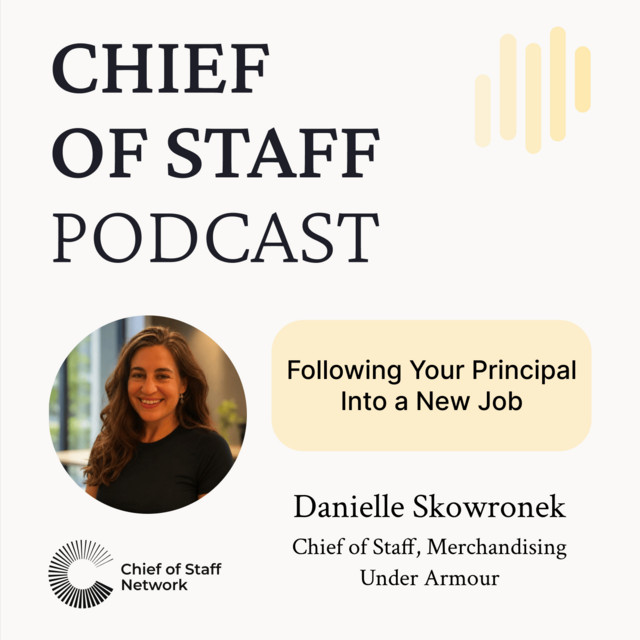
Following Your Principal Into a New Job with Danielle Skowronek
Guest: Danielle Skowronek, Chief of Staff to the Chief Merchandising Officer and head of strategy and business planning, Under Armour
Host: Scott Amenta, Founder, Chief of Staff Network
Episode Overview
Following your principal into a new role looks like the easy version of a job change. Danielle Skowronek did it at Under Armour, moving from the Americas business into merchandising, and found her principal's trust stopped at the door. Her new peers still had to be won over, and her reputation for running a tight operating rhythm made that harder.
About Danielle Skowronek
Danielle grew up a Phillies fan outside Philadelphia and worked for the team for three seasons, then at MLB headquarters and Monumental Sports. When COVID stopped ticket sales, she moved into real estate and ran a marketing team of 20. She joined Under Armour in strategic projects and became Chief of Staff to the President of the Americas six months later. When her principal was named Chief Merchandising Officer, she followed her into a function she'd never worked in.
Key Takeaways
- Your principal's trust doesn't transfer to your peers. Danielle had to build those relationships from scratch, and leading with questions did more than leading with a playbook.
- A strong reputation can work against you. New teammates expected a strict operating rhythm, and what she needed first was to learn the business.
- Keep the baseline of your operating rhythm and flex the rest. Weekly staff meetings and quarterly offsites stayed. Everything else had to fit around product creation milestones.
- You know a leadership meeting works when leaders bring you the agenda and it runs while you're on PTO.
- The role influences everything and owns nothing, so ask to own something. Danielle put strategy in her development plan, and now runs strategy and business planning alongside the Chief of Staff seat.
Join the Chief of Staff Network
The best thing Danielle did in her transition was talk to other Chiefs of Staff. That conversation continues at chiefofstaff.network.
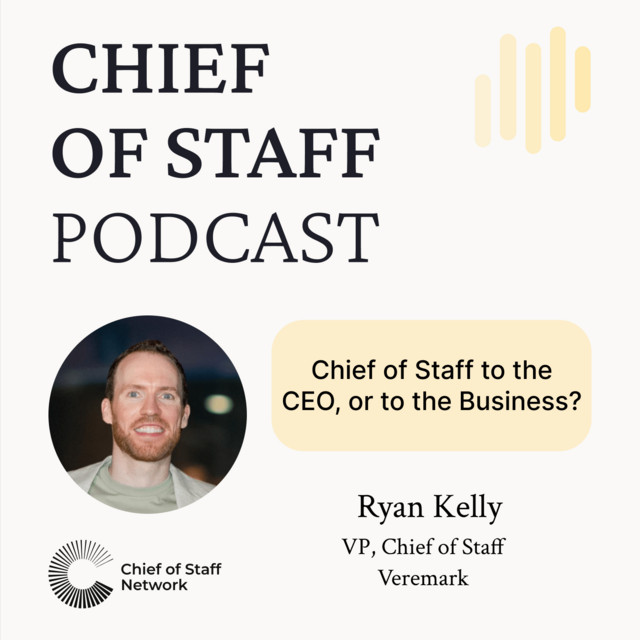
Chief of Staff to the CEO, or to the Business? with Ryan Kelly
Guest: Ryan Kelly, VP, Chief of Staff, Veremark
Host: Tristan Lim, founder of Beyond Founders and Chief of Staff Network Singapore chapter lead
Episode Overview
Every Chief of Staff gets pulled between the CEO's fires and the work that changes the business. Ryan Kelly, Veremark's first Chief of Staff, settles it with a monthly check on himself, because a CEO kept happy day to day won't be happy at the end of the quarter. He also walks through how he pitched the role into existence, earned his founder's trust in week one, and explained the job to a company that had never seen one.
About Ryan Kelly
Ryan started out as a welder, joined the JCB graduate scheme, then quit to study Mandarin in China. He moved into business operations at ITRS Financial Services in London, where he got his first taste of M&A, spent time at Skyscanner, and ran his own consultancy for three years before settling in Singapore. He met Veremark's CEO at a vendor event (and again at the gym), pitched him on the need for a Chief of Staff, and then won the role in an open process against more than 1,000 applicants. He now sits on the leadership team of the Series B workplace trust company, which has around 300 people working fully remote.
Key Takeaways
Frame a new Chief of Staff role around velocity, not repair. "Things are creaking" looks backward. Helping founders move at the speed they want is a value-creating pitch, the same reason revenue roles are easier to approve.
Front-load trust. Ryan spent his first month's trip asking his CEO 500+ questions, named his own blind spots, and asked to have dinner with the CEO's family. Seven months in, he has never had to justify the role.
Say what the role isn't. Ryan's town hall intro read out the questions people had been asking him ("What are you even here to do?") and answered them directly.
Listen for the quiet noise. Late laptops for new starters were too small for the CEO's radar but were straining HR. Mapping the whole process fixed it for good.
The job is negotiation between competing priorities, which is why Ryan argues it stays human: "Be a human Chief of Staff and you'll add more value."
Tristan and Ryan met at a Chief of Staff Network meetup in Singapore. Find your local chapter and upcoming events at chiefofstaff.network.
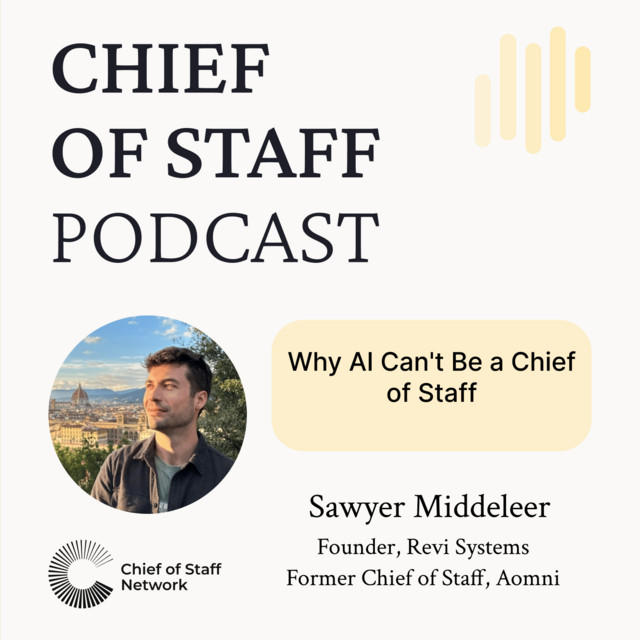
Why AI Can't Be a Chief of Staff with Sawyer Middeleer
Guest: Sawyer Middeleer, Founder, Revi Systems (former Chief of Staff, Aomni)
Host: Scott Amenta, Founder, Chief of Staff Network
Episode Overview
Every company has bought the AI seats. Very few have changed how they work. Sawyer Middeleer argues the gap closes when someone maps how work actually gets done before automating it, and that the Chief of Staff is usually the person with the view to do it.
Scott and Sawyer get into building tools you'll throw away in twelve months, the difference between what AI can do and what it can do well, and why AI Chief of Staff products can triage an inbox but can't do the job.
About Sawyer Middeleer
Sawyer came up through strategy and ops at a large e-commerce company and BizOps at scaling startups. In 2023 he joined Aomni, an AI sales research startup, as its first employee and Chief of Staff, and stayed the only non-engineer through its pre-seed and seed rounds.
Because he was closest to customers, he ended up shipping front-end features to production with Claude Code, straight from customer conversations and reviewed by the engineering team. Today he runs Revi Systems, helping Chiefs of Staff and other operators bring AI into their organizations without drowning in slop.
Key Takeaways
It's easy to automate and hard to automate well. The five-cent bot replacing the five-dollar human fails when nobody captured the context and judgment that lived in the person's head.
Map the process and the value it creates before choosing a tool. Where AI output and human output look the same, use AI. Where the human has "that special something," keep the person.
Assume the way you work changes every six to twelve months. The value you deliver to customers is durable; the rhythm you use to deliver it isn't.
Every role is becoming engineering. Chiefs of Staff don't need to become engineers, but they need to think in systems, architecture and build-versus-buy tradeoffs.
AI should add capacity, not justify cuts. An account manager who goes from 10 accounts to 15 is a reason to grow faster.
Sawyer leads the "Building the AI Flywheel" workshop at Chief of Staff Connect New York, October 22 to 23. Connect with him on LinkedIn: https://www.linkedin.com/in/sawyer-middeleer
Learn more about the Chief of Staff Network's membership, courses, and events here: https://www.chiefofstaff.network/
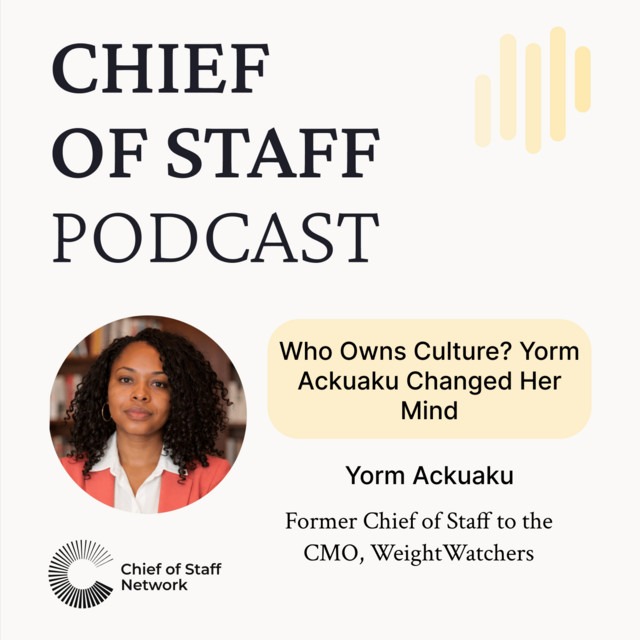
Who Owns Culture? Yorm Ackuaku Changed Her Mind
Guest: Yorm Ackuaku, Former Chief of Staff to the CMO, WeightWatchers
Host: Scott Amenta, Founder, Chief of Staff Network
Episode Overview
Yorm Ackuaku came into this conversation ready to argue that Chiefs of Staff own culture, then changed her mind. Her answer: leaders own culture through the behavior people watch, and the Chief of Staff owns the operating rhythm that either reinforces it or quietly erodes it.
Scott and Yorm get into what happens to a team when the top keeps turning over, how three principles drafted at a leadership offsite turned into an all-hands so popular they had to turn people away, and how a Chief of Staff keeps their own footing while everyone else's anxiety lands on their desk.
About Yorm Ackuaku
Yorm has spent more than a decade as a Chief of Staff, most recently at WeightWatchers, where she supported four leaders across different mandates, including a brand new Chief Engagement Officer role that combined three organizations for the first time. She started in accounting as a CPA and came up through Deloitte's technology risk consulting group before business school.
Her first taste of the role came through a Citi leadership program meant to develop leaders for franchises outside the US. As the most junior person on a cross-functional tiger team in London, she was handpicked to support a senior leader, which led to business manager roles in Dubai and Johannesburg. Before WeightWatchers, she built operations for a 500-person global marketing team at Vista (formerly Vistaprint).
Key Takeaways
Leaders own culture. HR and people teams own the systems and policies. The Chief of Staff owns the operating rhythm that holds it together: consistent messages month to month, decisions that match what was said, and forums where questions actually get answered.
Culture rarely breaks all at once. It erodes through hundreds of small moments: quieter meetings, fewer people challenging ideas, more side conversations, less willingness to experiment. During leadership churn, certainty goes first, and people start optimizing for survival and for whoever holds the most influence that week.
You can't get strategic alignment from a team that doesn't trust each other yet. Yorm once saw culture work as a luxury during a restructuring until her first CMO showed her the culture work was the strategy. In her telling, an offsite set the direction, a weekly Slack ritual built the muscle, and a monthly all-hands spotlight gave it meaning.
The job is to create clarity. People going through transformation don't expect certainty; they expect honesty and transparency. Say out loud what you know to be true, what you don't know yet, and that you'll tell them when you do. It grounds the team, and it grounds you.
New in the seat? Skip the process overhaul and find where trust has broken. In one role Yorm held more than 100 conversations in her first 60 days, asking which meetings waste time, which decisions surprise people, and where people feel unheard. Process doesn't fix trust. Trust is what makes process work.
Yorm counts the Chief of Staff Network among the outside sounding boards that kept her grounded through repeated leadership turnover. Connect with her on LinkedIn at https://www.linkedin.com/in/yorm/
Learn more about the Chief of Staff Network's membership, courses, and events here: https://www.chiefofstaff.network/
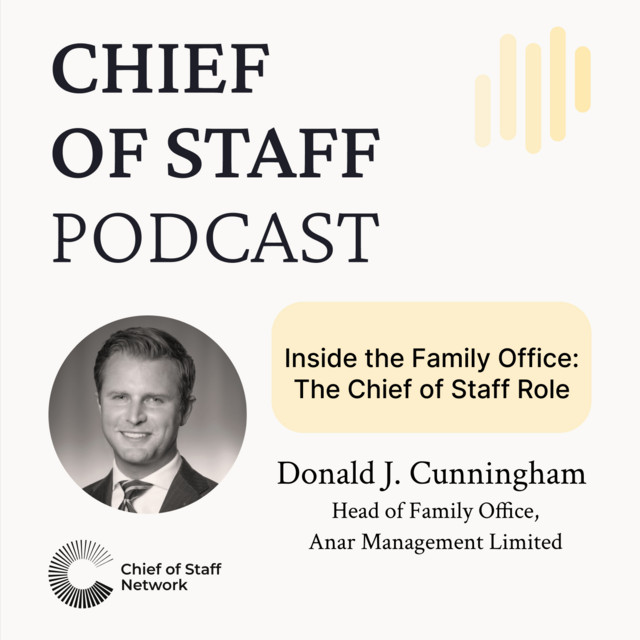
Inside the Family Office: The Chief of Staff Role with Donald J Cunningham
Guest: Donald J Cunningham, Head of Family Office for a senior member of the Qatari royal family
Host: Scott Amenta, Founder, Chief of Staff Network
Episode Overview
When your principal has virtually unlimited resources, the answer to almost every request is yes. That makes the job less about getting things done and more about knowing when, and how, to push back. Donald J Cunningham explains how the Chief of Staff role works inside a single family office, where there's no institution to hide behind and no clean line between the portfolio and the principal's personal life.
About Donald J Cunningham
Donald spent the first half of his career in capital markets and lower mid-market M&A, then hit a crisis of confidence about where it was headed. Friends kept telling him he'd make a great "person behind the person," so one restless night at 2am he applied to an obscure Indeed listing, calling himself a "recovering investment banker" in the cover letter. That led to seven years at a well-known hedge fund founder's family office in New York. He now leads the family office for his fourth principal, splitting his time between London and New York.
Key Takeaways
- Privacy isn't secrecy. The best principals are discreet and humble, and the high hedges around family offices are intentional. Don't expect them to come down, even as the industry adds more governance.
- There's no room for ego. Family offices run lean, often inside or next to the principal's home. If a toilet overflows, it doesn't matter whether you're the CIO or the housekeeper. Good family offices test for this in the interview.
- Three tools for advising a principal who can say yes to anything: name the trade-off (yes, but at the expense of what?), use the rule of three (say "I think this is a bad idea" three times with reasons, then execute), and anchor to the long term with a family charter or investment policy.
- Interview the principal as much as they interview you. Ask about their values, what keeps them up at night, and what happens when things go wrong. Prestige means nothing if the fit doesn't work, and red flags in the interview rarely go away.
- Corporate Chiefs of Staff being pulled into an executive's personal affairs should read it as trust, not a demotion. After a liquidity event, it can be an opening to help stand up a private office.
- The career path is horizontal. There's no associate-to-VP ladder in a family office. The reward is exposure, variety, and more delegation as trust grows.
Join the Chief of Staff Network
The Chief of Staff Network is where this conversation continues, through events, connections, and conversations with Chiefs of Staff in corporate, public sector, and family office roles. Find it at chiefofstaff.network.
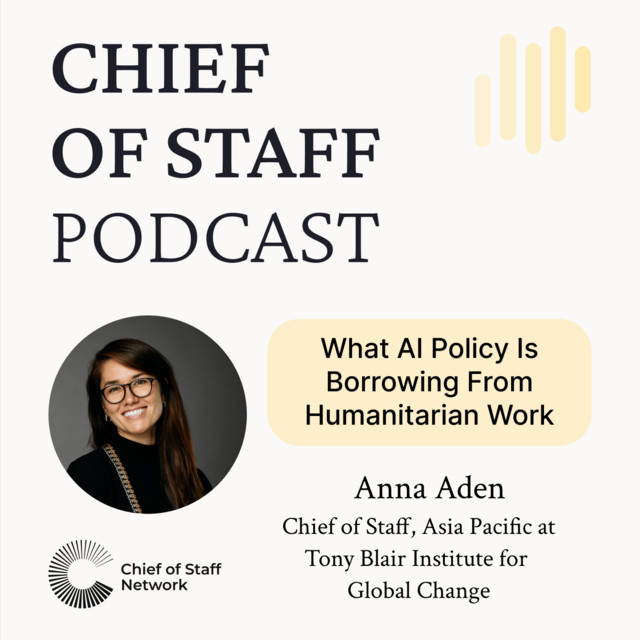
What AI Policy Is Borrowing From Humanitarian Work with Anna Aden
Guest: Anna Aden, Chief of Staff, Asia Pacific at Tony Blair Institute for Global Change
Host: Tristan Lim, Chief of Staff Network Fellow and Founder, Beyond Founders
The humanitarian sector spent decades working out how to serve the collective good without bending to partisan, commercial, or political interests. Anna Aden has worked on AI policy and AI safety, and she sees that same structure in the ethical guardrails tech companies are writing now, from OpenAI's mission to Anthropic's Claude Constitution.
Anna is Chief of Staff to the Managing Director for Asia Pacific at the Tony Blair Institute for Global Change. She got there by way of refugee camps in Myanmar, the Syria response, and aid programs she ran in the hundreds of millions of dollars. She joins Tristan Lim for a conversation that runs from that start to what the job actually looks like inside a global policy institute: setting priorities by working out which dependencies are load-bearing, what changes when HQ is in London and you're in Singapore taking calls at midnight, and why empathy is the skill she thinks the role runs on.
Learn more about the Chief of Staff Network's membership, courses, and events here: https://www.chiefofstaff.network/
Join us in Singapore at Chief of Staff Connect Singapore Forum
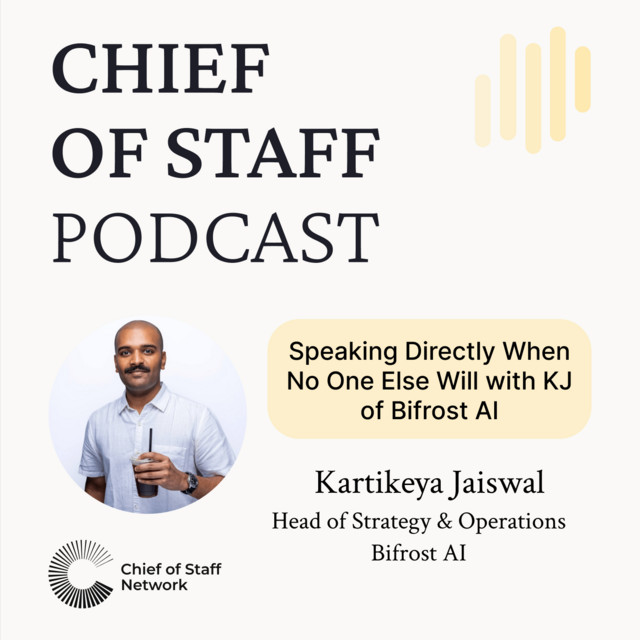
Speaking Directly When No One Else Will with KJ of Bifrost AI
Guest: Kartikeya Jaiswal (KJ), Head of Strategy and Operations, Bifrost AI
Host: Tristan Lim, Chief of Staff Network Fellow and founder at Beyond Founders
Episode Overview
Almost everyone in a company has the privilege of not saying the hard thing. KJ's argument is that the Chief of Staff is the one role that gives that privilege up, because founders rarely hear an honest read from anyone else on the payroll.
Recorded at the Bifrost office in Singapore, this conversation covers six years in the CEO's office across two startups, what the role looks like when the company is building physical AI, and why the working agreement between a Chief of Staff and a founder needs a version update every few months.
About Kartikeya Jaiswal
Kartikeya Jaiswal, who goes by KJ, spent his early career in commodity trading, corporate finance, private equity, and investment banking, always pointed at technology, then moved into consulting on energy transition with large global enterprises. He crossed into startups in 2020 at The Parent, where the CEO's office role took the company from Series B to Series D across seven countries, 30 million users, and the acquisition of Line Messenger's Vietnam business.
He joined Bifrost AI at pre-seed in late 2021, before ChatGPT, when AI companies still read to most people as science projects. Four years later Bifrost has moved to Series A, tripled its team, and sells computer vision model training and robotics evaluation software into maritime, aerial, space, Earth observation, and defense.
Key Takeaways
- High agency is essential and compassion is table stakes. The differentiator is being able to speak respectfully, directly, and bluntly all at the same time, especially when nobody else in the room will.
- Ask your founder the question before you need it: if I ever disagree with you, what is the best way for me to do it? That single conversation gives you a platform to be honest without spending the relationship.
- Priorities drift silently. The year opens with X as the goal, and by month three the founder's instinct has moved to Y without an explicit conversation. Asking point blank what has changed, on a quarterly cadence, is the job.
- The role divides into roughly two halves: process that has to run like clockwork because it is the spine of the company, and reactive, opportunistic work driven by a conference, a customer, or a raise. When the second half eats the first, flag it up front and send your input async so the decision still gets made without you.
- AI pays off first on what is repeatable, on data enrichment, and on internal tools, including finance dashboards built for non-finance people. On go-to-market, KJ's line is that you need to plow the field but you can't spray and pray, and financials still need a human in the loop.
KJ is based in Singapore, where the Chief of Staff Network runs a growing Southeast Asia community.
Learn more about the Chief of Staff Network's membership, courses, and events here: https://www.chiefofstaff.network/
Join us in Singapore at Chief of Staff Connect Singapore Forum
You Are the Product: Managing Yourself as a Chief of Staff
Host: Tristan Lim, Chief of Staff Network Fellow and Founder, Beyond Founders
Guest: BreeAnne Yek, Chief of Staff, Series A MedTech and luxury wellness startup
Episode Overview
Almost every piece of advice given to Chiefs of Staff points outward. Manage the principal, manage the team, run the process. BreeAnne Yek's argument is that none of it works until you can manage the one system you actually control, which is yourself.
She and Tristan Lim get into behavioral design as a core Chief of Staff skill, the difference between someone's intent and their skill, and what to do when a working relationship breaks past the point of repair.
About BreeAnne Yek
Bree started in Singapore's public sector at the Attorney-General's office, in knowledge management and training and development. Watching an enterprise system fail on contact with actual human behavior is where her people-before-process philosophy comes from. The system had been designed three years before she arrived, and the people who built it understood the workflow but not the humans running it.
She was headhunted into business development for oil and gas services, found she liked the revenue side of a business, and left in 2019 to build in climate. Her last startup was a Kickstarter-style platform that let people fractionally lend to climate projects, so the nonprofits and SMEs behind them could move off philanthropic capital toward something sustainable.
She's unusually direct about the two things she got wrong by the time that startup ended. She's now Chief of Staff to a Brazilian founder at a Series A, SF-based startup with a clinical device aimed at sports recovery and athletic performance. She works from Singapore.
Key Takeaways
- Understand how people already behave before you try to change anything. A process that makes sense on paper and falls apart in practice usually failed at the human layer, not the design layer.
- Assume good intent, then check for a skills gap. Most breakdowns with a principal aren't malice. They're communication, and communication is a skill that can be refined.
- Skill includes bandwidth. When someone overcommits, it's usually an honest misread of their own time and emotional capacity, not a broken promise. The same applies to you, which is the point.
- The best influence doesn't look like influence. Reflect the question back, let people work through their own thinking, then nudge the outcome slightly left or right. Asking directly for what you want rarely gets it.
- Ask whether it will kill the company in the next half hour. If not, drop the cortisol. But know which moments (fundraising, investor interest, user acquisition) genuinely can't wait, and move fast on those.
- Sometimes the repair is leaving. If you've honestly asked whether you adapted hard enough and you're still holding back the mission, someone else should take the seat.
Bree and Tristan met at a Chief of Staff Network event in Singapore earlier this year. This episode also picks up on Tristan's essay on life after being a Chief of Staff: https://www.chiefofstaff.network/blog/life-after-being-a-chief-of-staff
Learn more about the Chief of Staff Network's membership, courses, and events here: https://www.chiefofstaff.network/
Join us in Singapore at Chief of Staff Connect Singapore Forum
A Second Brain, Not an Assistant: beehiiv's Chief of Staff Model
Guests: Tyler Denk, Co-founder & CEO, beehiiv | Brian Schneider, Chief of Staff, beehiiv
Host: Scott Amenta, Founder, Chief of Staff Network
Episode Overview
Most conversations about the Chief of Staff role happen with only one side of the table in the room. This one has both. Tyler Denk has never viewed any of his three Chiefs of Staff as an assistant, and the bar he holds Brian Schneider to is specific: carry enough context to sub into any meeting Tyler is running and make any call he'd make if he isn't there. What follows is a working picture of that model, including what happens to the job when the CEO shares the board deck company-wide and there's nothing left to translate.
About Tyler Denk
Tyler joined Morning Brew as employee number two in 2017 and built most of the infrastructure behind it, the content management system, the ad platform, the growth mechanics, carrying the newsletter from 100,000 subscribers to four million before the Insider acquisition. The thousands of weekly reader replies asking how it all worked convinced him the gap in the market was the tooling itself, not another newsletter. After a year at YouTube he co-founded beehiiv, first pitched as Morning Brew in a box and now an all-in-one platform for newsletters, podcasts, websites and communities. He runs the company with unusual transparency, publishing revenue, costs and the ten things keeping him up at night to the whole team every quarter, and writes Big Desk Energy, a newsletter that started with no strategy behind it and produced one of beehiiv's largest enterprise deals.
About Brian Schneider
Brian's path started as a Morning Brew college ambassador at UConn, where he pulled a thousand referrals a semester by walking into lecture halls with a pen and paper. He was working nine to five at Prudential at the time and spending his evenings at the Morning Brew WeWork before he had a job there, which is what got Tyler to bet on him for a sales seat he had no background for. He climbed from sales into revenue strategy over five years, then followed Tyler to beehiiv into a rev ops role while the Chief of Staff seat was already filled. He did that work for three years and moved into the seat when it opened, which is a longer game than most people in this role are willing to play.
Key Takeaways
The split that matters isn't seniority, it's how the principal frames the job. Tyler puts his Chiefs of Staff in the "second CEO" bucket rather than the glorified EA bucket, and everything downstream, authority, context, delegation, follows from that single decision.
Deployability is the sharpest frame in the episode. Brian gets dropped into whichever part of the business needs him most, currently a six to eight week turnaround on the ad network team where he operates as if he's running it, then returns to the Chief of Staff seat when the next problem surfaces.
Radical transparency deletes a chunk of the traditional job. When anyone can see KPIs and rocks at any time, Brian doesn't spend his days interpreting what the CEO meant. He reiterates and clarifies instead, which frees him for the harder work.
Refusing a room is a red flag. Tyler has no patience for "I don't have engineering experience" or "I'm not interested in finance." The job isn't domain expertise, it's getting to the root problem and pulling the levers to fix it.
Trust gets built by showing up when you say you will. Brian's been at beehiiv three years and still treats relationship-building with team leads as the prerequisite to solving anything. It's also what killed the internal pushback beehiiv got for creating a role that reports to no one and moves through every team.
Fifteen minutes, five days a week, beats an hour on a Wednesday. Tyler calls Brian every weekday morning on his ten to fifteen minute drive to the gym to level-set priorities. Most Chief of Staff pairs settle for the weekly, and it's almost never enough.
COSN runs this podcast and its newsletters on beehiiv. If you're in the role now, PRO membership is where Chiefs of Staff operating at this level connect, and if you're working toward your first seat, the Chief of Staff Launchpad is the on-ramp.
Why Slowing Down is a Chief of Staff Superpower
Episode Overview
Speed is the currency of the Chief of Staff role, but Carrie McMahon argues the way to sustain it is to slow down. A two-time Chief of Staff at one of the fastest-growing AI companies in San Francisco, she treats energy regulation as a performance strategy, not a wellness perk, and shows why a depleted operator makes worse decisions right when the team needs them most.
About Carrie McMahon
Carrie came up through go-to-market, not operations. She started in sales at Zendesk, then built the sales-development and product-led-growth functions at Coda (now Superhuman), ran enablement at Benevity, and served as Chief of Staff and head of RevOps at Productboard. She's now Chief of Staff at Horizon3.ai. The through line is cross-functional building in ambiguity, which is also what led her to teach breath work, yoga, and somatics to other strategic operators on the side.
Key Takeaways
Energy management is four things, not one: your daily rhythm, matching tasks to your natural energy, building in micropauses, and how you wind down at night. Most burnout hides as a "leak" in one of them.
The Chief of Staff holds the container for the exec team. If you're spiraling, there's nowhere for everyone else to land.
When you're depleted, your prefrontal cortex stops optimizing. You get reactive and make fast calls without the analysis to back them.
"How are you feeling?" is a better opener for an exec 1:1 than "How's your week?" It reads state and lets you tailor the next 30 minutes.
Yoga isn't shapes on a mat. The goal is quieting the mental noise that keeps your nervous system in low-grade fight-or-flight, which is exactly the noise operators live in.
Start small and stay consistent: two breath-work techniques mid-day for four weeks, box breathing (inhale 4, hold 4, exhale 4, hold 4) at your desk. It's a practice, not a one-time fix.
Explore more of Carrie's Somatic Coaching and Corporate programs on her website here: https://www.groundandregulate.com/
The Incognito Test: Why Most AI Work Reveals Nothing About the Person
Guest: Alex Craig, Chief of Staff at PortSwigger
Host: Scott Amenta, Founder, Chief of Staff Network
Most companies say they're adopting AI. PortSwigger actually did it, and the results weren't what anyone expected. Alex Craig breaks down how a bootstrapped cybersecurity company built a real AI culture from the ground up and why, for Chiefs of Staff, the hardest part isn't the technology. It's figuring out where human thinking has to show up in the work.
About Alex Craig
Alex didn't apply for a Chief of Staff role. He kept raising his hand for problems no one else owned, and eventually the title caught up to the job he was already doing. He works directly with Daf, PortSwigger's CEO and founder, at a bootstrapped cybersecurity company of roughly 200 people in northwest England. His core function is reading organizational decisions and correcting course toward how Daf would actually make them.
Key Takeaways
• The fastest AI adopters weren't the engineers. Kitchen and front-of-house staff embraced it first. Developers pushed back hardest, resistant to anything non-deterministic.
• AI eliminated the lower-stakes work that gives you room to breathe. Slide formatting, meeting prep, basic synthesis. What's left is only the complex decisions, all the time.
• The biggest emerging problem isn't bad AI output. It's employees forwarding AI-generated work they haven't read, pushing decisions upward with no personal thinking attached.
• The incognito-context test: if your manager could produce the same output in five minutes with no context about you, there's no "you" in the work.
• A personal AI system is only as useful as the training behind it. Alex spent months building one that reflects his actual views, reading habits, and listening history. The mental model is a new hire you develop over time, not a tool you pick up and put down.
Alex is publishing a full technical breakdown of his personal AI Chief of Staff system alongside this episode. Look for his blog post, "I'm a Chief of Staff. So I Built Myself One."
Map Before You Buy: A Chief of Staff AI Playbook
Guest: Kanika Choudhary, Chief of Staff, People IX
Host: Scott Amenta, Founder, Chief of Staff Network
Episode Overview
Most companies are buying AI tools before they understand how their own company actually works, and Chiefs of Staff are getting handed the mess to fix. Kanika Choudhary argues that Chiefs of Staff are becoming the de facto owners of AI transformation by default, not by design, and the ones who succeed start with a map, not a purchase order. The companies that win do the unglamorous foundation work first.
About Kanika Choudhary
Kanika started her career in finance at PwC, burned out, pivoted to marketing, and relocated to Germany. She spent eight years as a first employee at early-stage startups before joining the BREAK Fellowship, a program that selects 200 women from 4,000 applicants to explore entrepreneurship in Spain. She came out of that experience and joined People IX, a conversation intelligence company that uses AI to interview entire organizations, cross-reference what employees say, and surface what's actually happening inside companies, as opposed to what leadership assumes is happening.
Key Takeaways
- Map before you buy. You cannot automate what you cannot see. Process documentation is not glamorous, but it is the only thing that makes any AI implementation stick.
- The "safest" first project is often the lowest-leverage one. Chiefs of Staff who default to low-risk AI projects to avoid failure end up losing credibility faster than if they had swung bigger and missed.
- Build an MVP before asking for permission. Scope the project, show leadership a bare-bones prototype, then execute. Approval is easier to get when the answer to "what will this look like?" is not a deck.
- Leadership almost never correctly understands how their company works. People IX has not once confirmed a leadership team's hypothesis after interviewing the full organization. The urgency to deploy AI is real; the self-awareness to do it well is rare.
Learn more about the Chief of Staff Network's membership, courses, and events here: https://www.chiefofstaff.network/
AI Is a Productivity Boost, Not a Compass with Eric Nehrlich
Guest: Eric Nehrlich, Executive Leadership Coach and former Chief of Staff for Google Search Ads
Host: Scott Amenta, Founder, Chief of Staff Network
Episode Overview
AI has collapsed the time between an idea and a working product, and every leader is racing not to be left behind. Eric Nehrlich makes the case that the tool can speed up the work but it cannot tell you what is worth doing, and that gap is exactly where the Chief of Staff becomes most valuable. The conversation covers why the five-month annual planning cycle is obsolete, why everyone now needs their own judgment, and how a Chief of Staff can protect an organization from burning itself out.
About Eric Nehrlich
Eric started as an engineer and spent a decade in startups before pivoting to the business side at Google, where he landed on the revenue forecasting team in the fall of 2008. Staring down anomalies in front of Larry, Sergey, and the leadership team through the Great Recession built the kind of trust that no interview process can manufacture. In 2012 one of his product partners asked him to come run the business as Chief of Staff for Google Search Ads, a role he held for over six years before becoming an executive leadership coach at Too Many Trees. He is also the author of "You Have a Choice: Beyond Hard Work to Meaningful Impact," which provides a transformational framework to help you redefine success when working harder isn’t working.
Key Takeaways
Trust is the deciding factor in landing a Chief of Staff role, and it compounds over years of working closely with a principal. Roughly five people from Eric's revenue forecasting team went on to become Chiefs of Staff because they already knew their leaders' businesses inside and out.
"Code is cheap now." When anything can be vibe-coded today and rebuilt tomorrow as the models improve, the bar for what is worth doing drops sharply, and the tedious monthly tasks a Chief of Staff used to grind through can be automated away.
AI is a productivity boost, not a compass. It cannot answer the value, mission, and purpose questions (where are we going, who are we serving, what matters), and handing those judgments to a model is a bad idea.
The five-month annual planning cycle is obsolete when the ecosystem can shift in five months. The more durable discipline is weekly: get clear on the purpose, decide what moves it forward this week, and define how you will measure progress.
Hard work is no longer the point. With AI moving faster than any top-down hierarchy can keep up with, everyone needs their own judgment about what is worth doing, and leaders create stability by being explicit about the mission, principles, and values that do not change.
A great flattening is underway, but there is no playbook yet, and stacking individual contribution, managing humans and agents, and strategic vision onto one person points toward more burnout. The Chief of Staff is well-positioned to be the brake on the system, asking whether the next bit of work is worth more than the team's long-term capacity.
The Chief of Staff Network is where this conversation continues, through events, connections, and conversations with other chief of staff practitioners at every level. Find it at chiefofstaff.network.
Steering AI at a Privacy-First Company with Delong Lu
Guest: Delong Lu, Chief of Staff, Proton
Host: Scott Amenta, Founder, Chief of Staff Network
Delong Lu has spent nearly a decade at Proton, the Swiss privacy company behind Proton Mail, growing from one of its earliest product managers into Chief of Staff, the "loose radical" on a ten-person management team. He joins Scott Amenta to talk about the hardest thing on his plate right now: how a company whose entire identity is user privacy moves fast on AI without breaking the promise that defines it.
Delong covers how Proton built its AI assistant Lumo on zero-knowledge encryption, why every line of AI-generated code still needs a human who can defend it, and why nothing ships without human oversight. His core lesson for any Chief of Staff leading an AI transformation: culture eats strategy for breakfast, so get clear on your values before you argue about tools.
About Delong Lu
Delong trained as an electrical engineer at ETH Zurich, added a business degree, and started his career in technology consulting and derivatives sales in London before deciding something was missing. He found Proton in 2017 after five cold emails (the last one finally got a reply from founder Andy) and joined as one of roughly 30 employees to help launch ProtonVPN. Over the next decade he cycled through Proton Mail, accounts and payments, and other business units as the company scaled past 600 people. That ground-level path through product is what made him the natural pick when Proton created its Chief of Staff role in 2022.
Key Takeaways
- The Chief of Staff role is often born from structure, not strategy. Proton organized into customer-facing business units, each with its own P&L, which optimized for shipping fast but thinned out the connective tissue between teams. When cross-coordination outgrew what the CEO and CTO could hold alone, the role had to exist.
- A senior Chief of Staff runs on autonomy, not a daily check-in. Delong meets his principal weekly and trades messages as needed. The mandate is "whatever it takes to hit our targets." That freedom is both liberating and confusing, and it only works because the CEO genuinely has his back.
- The most valuable move is closing the gap between vision and reality. When Delong noticed the CEO's AI vision did not match what teams were actually executing, he surfaced the disconnect and turned it into a work stream. Deciding what matters most is a skill he carried straight over from product management.
- AI transformation is a culture problem before it is a tools problem. "Culture eats strategy for breakfast." Proton's mission-driven people would walk before they would force AI at all costs, and that shared clarity resolves the circular debates about what data connects to what tool. For Chiefs of Staff at less principled organizations, the work starts with getting the executive team aligned on values, not picking software.
- The human stays accountable. Proton's policy is firm: engineers must understand and defend every line of code, nothing ships to production without human oversight, and no customer PII goes into third-party tools. The in-house assistant, Lumo, is the default.
Delong is part of the global Chief of Staff Network community. Links to connect with him are in the episode.
Learn more about the Chief of Staff Network's membership, courses, and events here: https://www.chiefofstaff.network/
Escaping the Doer Trap with David Kirby
Guest: David Kirby, Author of "The Ultimate Chief of Staff Guide" (2025), Former Chief of Staff at Ford Motor Company
Host: Scott Amenta, Founder, Chief of Staff Network
Episode Overview
The same execution skills that get you into a chief of staff seat are often what keep you stuck there. David Kirby breaks down the doer trap, why high performers get disincentivized from promotion, and what it actually takes to move from task completion to orchestration.
About David Kirby
David's path to chief of staff was anything but linear. He went to law school in North Carolina expecting to practice as an attorney, bounced around the country, and eventually landed in Detroit, where he owned a grocery store before pivoting into advertising and then the automotive industry. He landed his first chief of staff role at Ford by taking a calculated risk in a one-on-one with a new incoming executive, asking directly for the job he wanted. He went on to earn an MBA, continued operating as a chief of staff for years, and recently moved into the utility industry.
Key Takeaways
The doer trap is real. If you're great at executing, you'll be rewarded with more execution. Growth requires shifting from doing to orchestration, where one unit of your input produces outsized output across the org.
Chiefs of staff operate across altitudes (100,000-foot, 50,000-foot, and one-foot), and getting stuck at any single one is a warning sign. New chiefs of staff start in firefighting mode; the altitude mix should shift over time as governance and cadence get built.
Proactive gatekeeping is the opposite of bottlenecking. Think Amazon shipping manager, not roadblock. Sometimes you slow things down short-term so the executive engages at the right altitude with pre-aligned inputs, which speeds outcomes long-term.
Career stalls usually reflect a leverage problem, not a performance problem. High performers can be disincentivized from promotion because they're too valuable in their current seat. Counteroffers and external opportunities have unlocked internal moves in 24 to 48 hours.
Trust is the core output, built from three inputs: competence, integrity, and benevolence. Benevolence is not passivity; it can be "aggressively benevolent" pushback when others are misaligned with the broader vision. The strongest chiefs of staff are confidants, not yes-men.
Measure impact with an impact journal. Kirby keeps a OneNote annual tab where every deliverable, deck, and initiative is hyperlinked by date, making it easy to show concrete value during reviews and KPI updates when the work is otherwise hard to quantify.
The Chief of Staff Network is where this conversation continues, through events, connections, and conversations with other chief of staff practitioners at every level. Find it at chiefofstaff.network.
CoS to Functional Leader (and Back): Judy Abad's Career Playbook
Guest: Judy Abad, Chief of Staff, CFOO, Freshworks
Host: Scott Amenta, Founder, Chief of Staff Network
Judy Abad has oscillated between Chief of Staff and functional leadership roles at some of tech's most iconic companies, including Facebook, Instagram, Slack, WhatsApp, and Freshworks. In this conversation, she unpacks the key differences between owning metrics as a functional leader versus synthesizing priorities as a Chief of Staff, and why both paths build the skills you need for the C-suite.
You'll learn how to build credibility by running toward the hardest problems, why you should stop asking for permission and start apologizing later, and how to evaluate Chief of Staff opportunities with pointed questions that reveal whether the role is set up for success.
Judy's advice: think in decades, but act now, and know when to walk away from losing hands.
Learn more about Chief of Staff Network's upcoming events, courses, and membership on our website: https://www.chiefofstaff.network/
About Judy Abad
Judy began her career in tech at Facebook when the company had around 500 employees, starting in sales before becoming one of the first Chiefs of Staff to the CRO. From there, she helped launch Instagram's first ad products, ran product marketing at Slack as employee 100, and led business product launches at WhatsApp. She's also been an early-stage startup operator and investor. Today she's Chief of Staff to the CFOO at Freshworks, where she focuses on connecting cross-functional work and driving execution at scale.
Key Takeaways
- The CoS role and functional leadership are not rungs on a ladder, they are different lenses. Functional leaders own a domain and make decisions with imperfect information. Chiefs of Staff synthesize across all domains and know when to escalate. Both skills compound into each other over time.
- "No one knows what they're doing" is not an excuse. It's permission. Stewart Butterfield told Judy this before a major enterprise launch at Slack, and the point was that the person closest to the work, the person who lives and breathes it every day, is exactly who should be making the call.
- P&L ownership and team size are proxies for seniority, not guarantees of it. What actually matters for getting to C-suite level: the ability to learn quickly, high EQ, intense curiosity, and a strong sense of ownership. Chiefs of Staff can build all of these without ever carrying a functional title.
- Career decisions are two-way doors. Almost every move is reversible. The pressure to find the perfect forever role before you make a change leads people to stay stuck. Meeting yourself where you are in this moment is not a compromise, it is a strategy.
- Know when to walk away from losing hands and when to double down on winning ones. Thinking in decades means you are not just optimizing for the next role. You are building toward what will still feel meaningful when you are mid-career or beyond.
Inside Chief of Staff Connect SF: AI Transformation and What's Next
Guest: Tom Guthrie, President and Co-Founder, Chief of Staff Network
Nearly 100 chiefs of staff gathered in San Francisco, the epicenter of AI optimism and anxiety, to tackle the question: how do we lead transformation when adoption is uneven and the pace keeps accelerating? This episode recaps the first of seven global Chief of Staff Connect events in 2025, featuring workshops from OpenAI, Clarinet, Scribe, and LatchBio, plus surprising insights from cultural institutions managing dozens of board members and multiple unions. If you're navigating AI enablement or wondering how the role is evolving, this is your roadmap.
Learn more about Chief of Staff Network's upcoming events, courses, and membership on our website: https://www.chiefofstaff.network/
Episode Overview
Over 90% of chiefs of staff use AI every day. The harder question — how many are actually building with it — is what drove the agenda at Connect SF, the first of seven global Chief of Staff Connect events in 2025. Tom Guthrie breaks down what happened in the room, why AI adoption is so uneven across organizations, and what the shift from force multiplier to builder actually looks like when it's working.
About Tom Guthrie
Tom Guthrie is President and Co-Founder of the Chief of Staff Network, the global professional community connecting chiefs of staff across 20+ cities. He helped build COSN alongside Scott Amenta and now leads the network's programming, events, and community strategy. He hosted Connect SF in person and has a front-row view of how the role is evolving, at companies ranging from AI-native startups to century-old cultural institutions. He's one of the clearest thinkers in the community on what chiefs of staff can actually become.
Event Highlights
Connect SF drew approximately 100 chiefs of staff to San Francisco, COSN's biggest SF event yet, and the first of seven global stops planned for 2025
Laura Peng from OpenAI led a hands-on AI workflows workshop focused on what Codex now unlocks that wasn't possible before
Diane Sadowski-Joseph from Clarinet ran a session on enterprise AI enablement for mid-market and large companies navigating the transformation
The CTO and Chief of Staff from Scribe shared what it looks like to build AI-native products from the inside, and why the early builder days are the most fun
Jordan Ramsay and Alfredo Andere from LatchBio gave a rare inside look at a high-trust CEO and Chief of Staff partnership that's genuinely building something new together
Tom brought in chiefs of staff from the San Francisco Ballet and the San Francisco Symphony, each managing 50-80 board members and six or seven unions, as a deliberate reminder that the role's complexity runs far beyond tech
Key Takeaways
The AI adoption gap among chiefs of staff isn't about willingness. It's about whether the organization around them is ready to move. Companies built in the last 18-24 months are operating in a fundamentally different gear than those that aren't.
"Force multiplier to builder" is the defining shift of this moment in the role. It means moving from managing and improving what exists to creating something new, with AI as the primary instrument.
The fights on LinkedIn about what the Chief of Staff role actually is are a distraction. The real question is what the person in this seat can build right now, and whether they're asking it.
Fun is a leading indicator. The CEO and CoS relationships where there's genuine excitement about building, not just pressure to deploy, are the ones producing the most interesting outcomes. LatchBio's Jordan and Alfredo were a visible example.
It has never been a more valuable time to be a chief of staff. More complexity, more opportunity to build, and more leverage than the role has historically carried. The question is whether you're treating it that way.
Why This CoS Left Strategy for Clay: A Case Study in Career Pivots
Host: Tristan Lim, Chief of Staff Network Fellow and Founder at Beyond Founders
Guest: Lissa Sorgenfrei, Founder, Munich Clay Collective (former Chief of Staff at Capmo)
Episode Overview
Most Chiefs of Staff leave for a bigger title or more money. Lisa Sorgenfrei left to open a pottery studio. After eight years at German construction tech startup Capmo, where she moved from customer success to product management to Chief of Staff to go-to-market strategy, Lisa hit a wall. The problem wasn't burnout or bad leadership. It was realizing that the full-spectrum visibility she craved as CoS couldn't exist in any other traditional role. So she ran experiments, reduced to four days a week, and eventually traded spreadsheets for clay.
About Lisa Sorgenfrei
Lisa is the daughter of a Japanese mother and German father, raised in Germany with two cultural frameworks shaping how she sees the world. She studied business engineering with a focus on civil construction, originally dreaming of becoming an architect. She joined Capmo as one of the first employees during her studies, staying for eight years across multiple roles including functions in product, GTM and Chief of Staff. Now she runs Munich Clay Collective, a pottery studio in Munich designed around sensory experience and community.
Lessons Learned
The Chief of Staff role is inherently lonely, but not because you're isolated. You have full access to information across the company and behind closed doors, but you can't share most of it. You're trusted by employees and the CEO, but you're also filtering constantly. The only person who knows everything you know is yourself. That isolation is a feature of the role, not a bug.
Losing transparency after being CoS is harder than most people expect. Moving from a role where you knew everything the CEO knew to a narrower function, even one with leadership responsibility, feels like giving up "the sweet taste of nectar." Lisa struggled with this transition more than the actual work itself. If you've been CoS, prepare for that loss when you move on.
Good Chiefs of Staff make people feel seen. Lisa discovered her strength wasn't in process design or strategic planning, but in making employees feel valued and heard. This translated into motivation, retention, and culture sustainability as the company scaled. The interpersonal work isn't soft skills. It's leverage.
Being resourceful is a superpower, but it can also get in your way. Chiefs of Staff learn to solve undefined problems by finding the right people and dissecting challenges quickly. That same instinct can lead to over-optimization in areas where simplicity is better. Sometimes the best solution is just to drive 15 hours straight to Italy.
Learn more about Chief of Staff Network's upcoming events, courses, and membership on our website: https://www.chiefofstaff.network/
The CoS Who Won't Just Say Yes: Marlen Heske on Clarity Before Harmony
Guest: Marlen Heske, Chief of Staff at Enpal
Episode Overview
At fast-moving companies, the problem is rarely a lack of ideas or urgency. It's that everyone is chasing too many things at once. Marlen Heske, Chief of Staff at Enpal, has made it her job to slow that down just enough to create real clarity. In this episode, she breaks down her "clarity before harmony" philosophy, why saying yes to everything is one of the biggest failure modes in the CoS role, and how she's navigated 2.5 years at one of Germany's most ambitious energy companies.
About Marlen
Marlen studied socioeconomics at the University of Hamburg before discovering the Chief of Staff role during an internship at eBay in Silicon Valley. She moved through a deliberately varied career path including academic research, Greenpeace, an HR consultancy, an early-stage interior startup, and a circular economy venture builder before joining Enpal, where she serves as CoS to the Managing Director responsible for production engineering and supply chain.
Lessons Learned
Slow down before you execute. The first 90 days should be spent understanding the organization, the stakeholders, and the strategic direction before pushing anything forward.
Let go of perfectionism. The 80-20 rule matters. Not everything requires a perfect output, and chasing perfection will cost you more than the 20% you're trying to nail.
Balance patience with persistence. Choose your battles. Sometimes planting a quiet seed and watching it grow is more effective than pushing hard for immediate change.
Build real relationships. The role only works when people trust you enough to give you candid information. That trust is built through genuine human connection, not title or proximity to leadership.
Key Takeaways
The CoS role is one of the most flexible in any organization, shaped by company size, geography, seniority, and the specific gaps in the leadership team around you.
"Clarity before harmony" means making trade-offs visible, doing reality checks, and resisting the pressure to say yes to everything. Your job is not to keep the peace. It's to make sure the right decisions get made.
In Germany, the CoS role is still being adopted cautiously, with many companies using alternative titles. But adoption is accelerating, particularly in Berlin's startup ecosystem.
The CoS is not the decision-maker. The role is to bring transparency and surface trade-offs so that leadership can make better, faster decisions with a full picture.
Managing 5 Clients at Once: A Fractional Chief of Staff's Playbook
How do you switch contexts between skincare operations, luxury recruiting, and B2B financial modeling all in the same day?
Zoe Jakubowich joins Chief of Staff Network Fellow, Tristan Lim, to break down the systems behind her fractional Chief of Staff practice, including her time-boxing method for client work, the daily exercise that prevents mental overload, and why she treats context switching like changing school subjects.
You'll learn the three essential skills every Chief of Staff needs (organization, hunger for ambiguity, emotional intelligence) and how to build a network-driven business that compounds value over time without hard selling.
Learn more about the Chief of Staff Network membership, courses, and resources at chiefofstaff.network.
The VC Chief of Staff: Building in Ambiguity with Stephania Greco
Stephania Greco takes us inside the Chief of Staff role at Bicycle Capital, a growth-stage VC fund, and reveals how it differs from startup CoS work. Instead of managing product roadmaps and cross-functional teams, VC Chiefs of Staff focus on fundraising strategy, investor relations, and building the firm's operating system with minimal headcount.
Stephania shares tactical lessons from building Bicycle's infrastructure using fractional consultants and AI tools, why she views ambiguity as "a space where value is created," and how her resilience as an immigrant shaped her founder's mindset. Perfect for CoS professionals curious about the VC world or anyone managing lean operations.
Learn more about the Chief of Staff Network membership, courses, and resources at chiefofstaff.network.
The Integrity Pyramid: What Actually Makes a Great Chief of Staff
Priyanka Peeramsetty has been a Chief of Staff, a growth operator, a community builder, and is now Engineering Operations Director at Crunchyroll — and she'll tell you the one thing that underpins all of it: integrity.
In this episode, Executive Coach and Chief of Staff Fellow, Tristan Lim, sits down with Priyanka to hear her insights on what actually makes a great Chief of Staff. She breaks it down as a three-level pyramid, shares how she once predicted an attrition wave before anyone else saw it coming, and explains why the CoS role can feel existential if you're not doing it right.
Learn more about the Chief of Staff Network membership, courses, and resources at chiefofstaff.network
From Chief of Staff to Product Manager: Sarah Kislak on Following Your Talent
Sarah Kislak spent nearly a decade at Box, progressing from an executive assistant in a rotational program to Chief of Staff for a 1,000-person engineering org, and ultimately into product management.
In this episode, Sarah shares what she learned by observing a Chief of Staff before stepping into the role herself, how she ran a team of seven while keeping alignment across recruiting, finance, comms, and strategy, and the hackathon moment that made her realize she wanted to build products.
She unpacks the differences between an operator and a PM mindset, explains why she chose to follow her talent rather than her passion, and offers practical advice for Chiefs of Staff who are PM-curious — including how to run small experiments this week to test the fit.
Learn more about the Chief of Staff Network membership, courses, and resources at chiefofstaff.network.
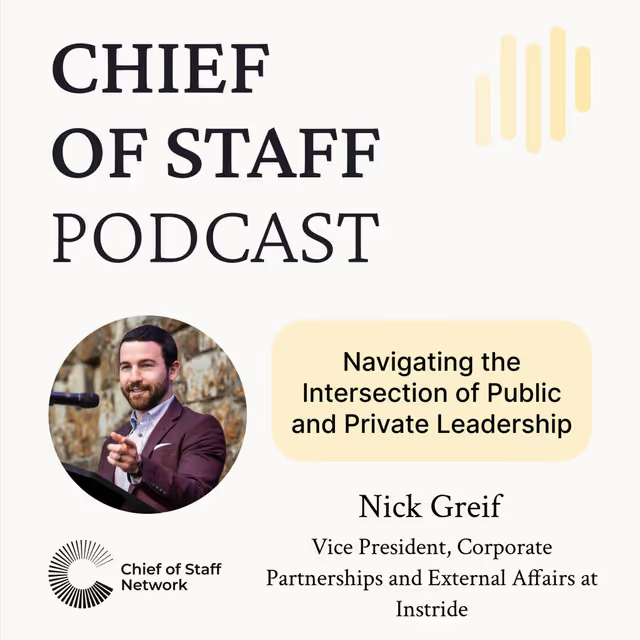
Navigating the Intersection of Public and Private Leadership
Have you ever wondered what it takes to manage the intricate dance of politics and business? Meet Nick Greif, a seasoned leader who has seamlessly maneuvered through both the public and private sectors as a Chief of Staff. We delve into the path charted by Nick, who transitioned from the Chief of Staff for an LA city council member to a pivotal role in the corporate world. Nick's journey is a masterclass in adaptability, strategic coalition building, and transformational leadership.
If you've ever wondered how government offices are surprisingly like startups or how the Chief of Staff role varies across sectors, this is the episode for you.
Learn more about the Chief of Staff Network membership, courses, and resources at chiefofstaff.network.
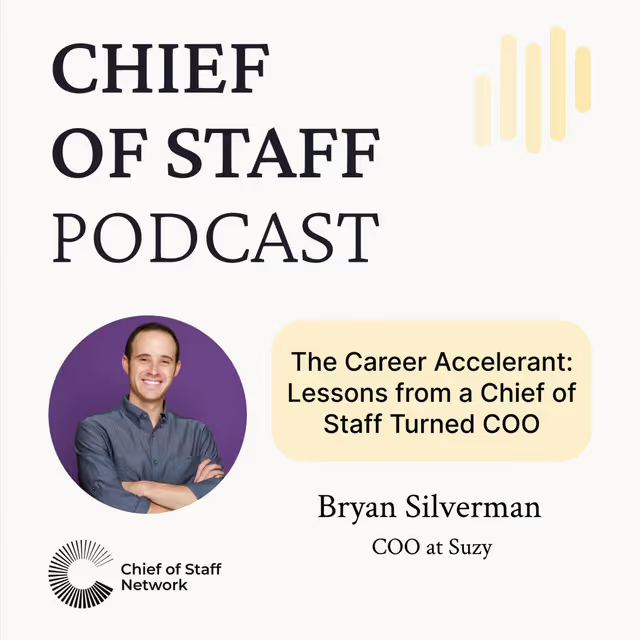
The Career Accelerant: Lessons from a Chief of Staff Turned COO
Bryan Silverman joined Suzy (then CrowdTap) as an SDR and never left. Over nearly 11 years, he's moved from enterprise sales to Chief of Staff, to running a business unit, to his current role as COO.
In this episode, Bryan talks with Scott about the leap of faith that brought him into the Chief of Staff role, what it means to be "involved in everything but in charge of nothing," and how establishing operating cadences became one of his most lasting contributions. He shares hard-won lessons on people management, the transition from doing the work yourself to delegating with context, and why driving leverage, not just output, has been the common thread across every role he's held.
Bryan also gets candid about the glass ceiling many Chiefs of Staff face around P&L ownership and people management, and how AI is shifting the balance from execution to problem selection.
Learn more about the Chief of Staff Network membership, courses, and resources at https://www.chiefofstaff.network/.
Tune into Bryan Silverman's discussion with Tom Guthrie on driving AI Transformation on AI for Operators podcast.
From Force Multiplier to Builder: Why We're Taking Connect to 7 Cities in 2026
Chief of Staff Connect is expanding to seven cities in 2026, our biggest year yet. We're meeting Chiefs of Staff at one of the most critical inflection points in the role.
In this episode, Scott Amenta and Tom Guthrie break down the strategy behind Connect 2026 and why this year's theme — FROM FORCE MULTIPLIER TO BUILDER — defines where the profession is heading.
You'll hear:
Why we're bringing flagship Connect events back to London, San Francisco, and New York and what's different this year
The story behind launching Chief of Staff Connect Forums in four new markets (tune in to find out where!)
What it means to shift from "force multiplier" to "builder" and why that matters for your career
How we designed this year's events to be more practical, hands-on, and regionally relevant
Why tickets (Flagship and Forum) include annual CoS Network PRO+ membership and what that unlocks
The best Chiefs of Staff aren't just amplifying their executives anymore, they're building systems, frameworks, and infrastructure that transform organizations. Connect 2026 is where you learn how to make that shift.
Registration is open now at chiefofstaffconnect.com. Early bird pricing ends soon. Don't wait.
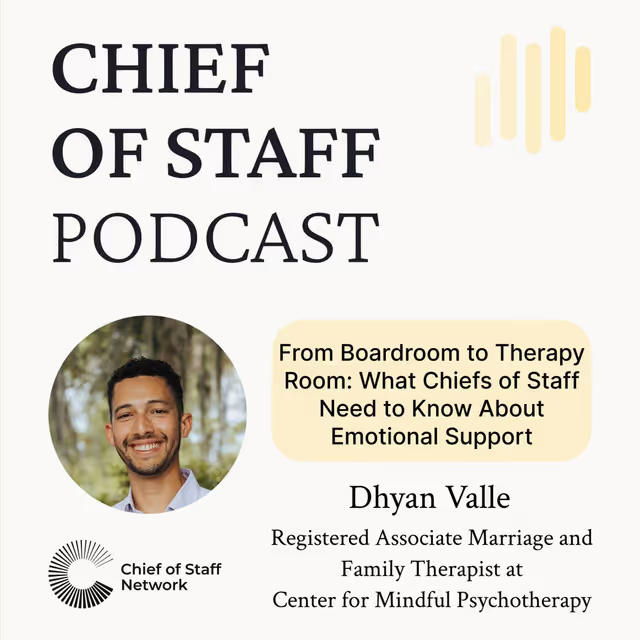
From Boardroom to Therapy Room: What Chiefs of Staff Need to Know About Emotional Support
Chiefs of Staff often find themselves serving as informal therapists to their principals, but where's the line? Dhyan Valle, spent 2.5+ years as Chief of Staff at MightyHive shares what he got right and wrong when supporting his principal, including through a stressful M&A process.
Now a licensed therapist, Dhyan returns to unpack what he learned about trust, containment, and why the best support sometimes means resisting the urge to fix things quickly.
Looking to find a therapist who also understands the ins and outs of the Chief of Staff role? Learn more about Dhyan's work here: https://www.therapywithdhyan.com/
Learn more about the Chief of Staff Network community, events, and programs at https://www.chiefofstaff.network/
The Builder's Mindset: How Chiefs of Staff Create Real Ownership
Elyse Levine's career has taken her from the FBI's cyber division to Disney Parks to running USC's new capital campus in Washington, DC.
Along the way, she's learned that the Chief of Staff role isn't just about support, it's about finding the projects no one else is raising their hand for. We dig into how she built trust, scaled initiatives, and eventually transitioned from advisor to owner.
Learn more about the Chief of Staff Network's membership, courses, and events here: https://www.chiefofstaff.network/
Finding Your Inner Compass: How Chiefs of Staff Can Lead with Purpose in the Age of AI
Chiefs of Staff are often the first to feel organizational misalignment, but rarely have the tools to address it. In this episode, Michaela Zuckova and Carl Miller, co-founders of The Purpose Project, share how AI can become a powerful tool for self-discovery, helping leaders find their "inner compass" before transforming their teams.
We explore why slowing down is the ultimate competitive advantage and how personal alignment creates capacity for high performance.
Discover more about Carl and Michaela's work at https://thepurposeproject.world/
Learn more about the Chief of Staff Network's membership, courses, and events here: https://www.chiefofstaff.network/
The Stunt Double: How Chiefs of Staff Create Impact Through Anticipation
How do you measure success in a role with no clear KPIs?
Itamar Melamed, Chief of Staff at Empathy, reveals his framework for managing up effectively: tracking decisions made on behalf of his CEO, anticipating needs before they're voiced, and building trust through careful observation of calendar patterns, communication styles, and organizational priorities.
Learn why the best Chiefs of Staff operate as stunt doubles, not gatekeepers.
Learn more about the Chief of Staff Network's membership, courses, and events here: https://www.chiefofstaff.network/
Strategy vs. Operations: The Chief of Staff's Balancing Act
Emily Sander, Founder + CEO + Executive Leadership Coach at Next Level Coaching joins us to unpack one of the most fundamental tensions in the Chief of Staff role: when to zoom out for strategy and when to dive into operations.
Drawing from her own experience running both a subsidiary and the Chief of Staff function simultaneously, Emily shares tactical frameworks for lifting yourself out of the weeds, communicating your strategic impact, and knowing when to switch hats—sometimes in the same meeting.
Plus: why the question "who can help me?" might be more important than "how can I do more?"
Learn more about the Chief of Staff Network's membership, courses, and events here: https://www.chiefofstaff.network/
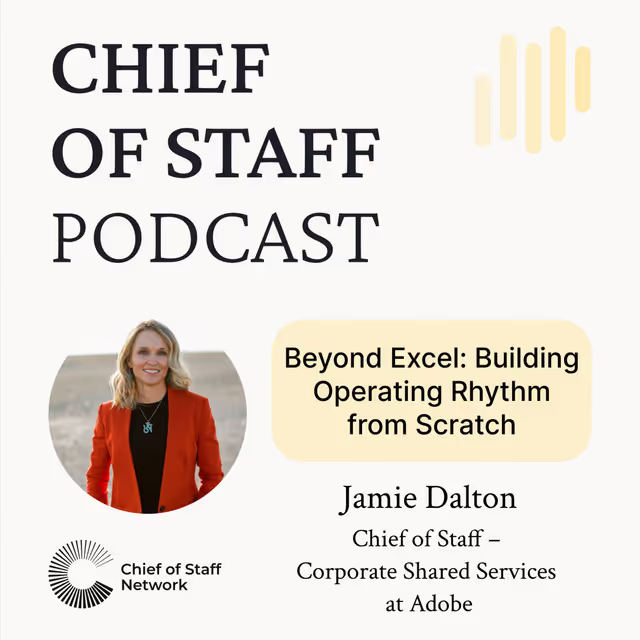
Beyond Excel: Building Operating Rhythm from Scratch
"I didn't inherit a broken one. I did inherit a non-existent one."
Jamie Dalton, Chief of Staff at Adobe, joins the podcast with Scott to share her experience building operating rhythm from nothing. When the team moved from finance into IT, they brought Excel tracking, sporadic meetings, and no cross-functional visibility.
Jamie walks through how she created structure without killing flexibility, why she limits meeting attendance despite FOMO, and what makes the Chief of Staff role uniquely positioned to drive horizontal alignment across vertical teams.
Learn more about the Chief of Staff Network's membership, courses, and events here: https://www.chiefofstaff.network/
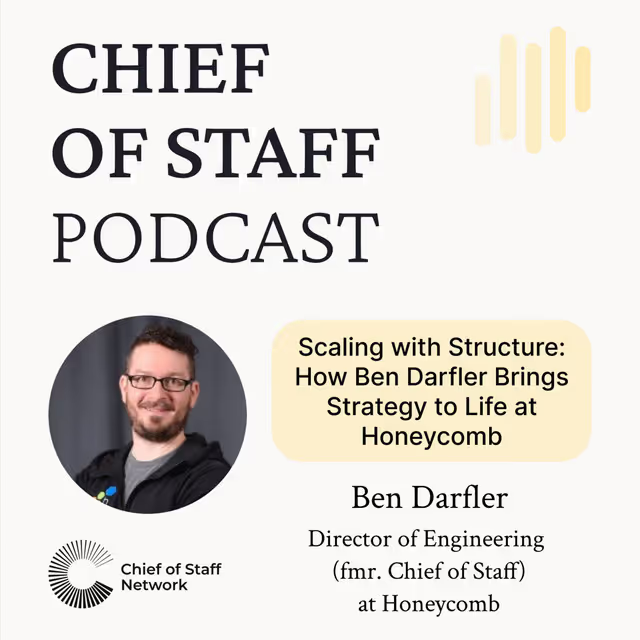
Scaling with Structure: How Ben Darfler Brings Strategy to Life at Honeycomb
As Honeycomb crosses 250 employees, Ben Darfler is focused on one thing: making strategy actionable at scale. In this episode, Ben sits down with Scott Amenta to share how his engineering background shaped his approach to planning, decision-making, and building leadership systems that extend beyond the executive team.
We cover the shift in team dynamics at scale, how to embed strategy through OKRs and rituals, and why lightweight processes often drive the most alignment.
Learn more about the Chief of Staff Network's membership, courses, and events here: https://www.chiefofstaff.network/
Ena Patel on Taking the Leap from Chief of Staff to President
Ena Patel, Team President at Innovation Baseball Partners, has built her career by stepping into complexity and turning it into momentum. In this episode, she joins Tom Guthrie, President of Chief of Staff Network, to share how she moved from tax law into the sports business, why shifting others’ perception (“not just a lawyer”) became one of her biggest early challenges, and how relationship-building across every business unit became her operating system.
Ena walks through what it takes to be effective as a Chief of Staff in environments that are either being built from scratch or shaped by deep tradition. We also explore Ena’s leap into the #1 seat as President of Innovation Baseball Partners, acquiring and building independent minor league teams with a community-first approach. Her advice to Chiefs of Staff considering a similar step is simple and direct: don’t say no to yourself.
Learn more about the Chief of Staff Network's membership, courses, and events here: https://www.chiefofstaff.network/
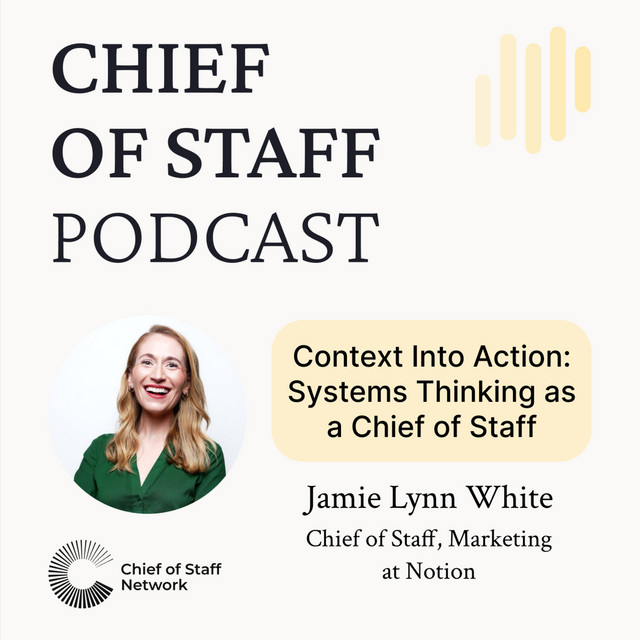
Context Into Action: Systems Thinking as a Chief of Staff
Jamie White, Chief of Staff, Marketing at Notion, shares her journey from Broadway and consulting to driving clarity and alignment in high-growth tech companies like Slalom, Grammarly and Notion. In this episode, she introduces her “Three Altitudes” framework, an operating model Chiefs of Staff can use to navigate principal alignment, leadership cadence, and cross-functional orchestration.
We discuss the evolving role of the Chief of Staff, how to partner effectively with executives, and how Jamie blends systems thinking, coaching, and AI to accelerate decision-making without losing context.
Learn more about the Chief of Staff Network's membership, courses, and events here: https://www.chiefofstaff.network/
Explore the Notion AI products Jamie utilizes here: https://www.notion.com/product/ai
Scaling Without Bureaucracy: How Lu Borko Builds High-Trust, High-Growth Teams
In this episode, we sit down with Lu Borko, Chief of Staff at Manychat, to unpack how fast-growing companies can scale without losing their edge.
Drawing from her experiences at Deliveroo, Intercom, and now Manychat, Lu shares how to build systems that support growth while keeping teams agile and aligned. We talk about the building blocks of operational excellence, the real work behind making an executive team act like a team, and how to lead without authority by connecting the dots others don’t see.
If you’re navigating scale, team complexity, or cross-functional friction this episode is for you.
Learn more about the Chief of Staff Network's membership, courses, and events here: https://www.chiefofstaff.network/
Hard Things Make Strong Teams: Inside the Mindset of The Tempest Two
Tommy Caulfield and James Whittle — better known as The Tempest Two — had never rowed a boat in their lives when they set out to cross the Atlantic Ocean. No experience. No support crew. Just a willingness to figure it out.
In this episode, we explore what extreme adventure can teach us about resilience, leadership, and adaptability — especially when facing uncertainty. From surviving a hurricane and a nighttime capsize to building teams and coaching startups, they share how to turn breakdowns into breakthroughs and why the best leaders actively put themselves and their teams just beyond their comfort zones.
We also talk about their upcoming keynote and immersive Experience at the upcoming Chief of Staff Connect EU in London, and why pushing boundaries is the key to real growth.
Learn more about Tommy and James' work at Tempest Experiences.
Learn more about the Chief of Staff Network's membership, courses, and events here: https://www.chiefofstaff.network/
Finding Your Anchor: Boundaries, Burnout, and Resilience with Tristan Lim
Tristan Lim went from scaling a high-growth startup as Chief of Staff at Commsor to coaching founders and operators on how to lead with clarity, courage, and purpose. In this episode, he joins Scott to explore the inner work that too often gets overlooked in fast-moving organizations—setting meaningful boundaries, avoiding burnout, and staying grounded through change.
Tristan shares powerful lessons on self-awareness, emotional resilience, and the importance of having a clear personal anchor in the chaos of startup life. You’ll walk away with practical tools for reflecting on your motivations, building your support system, and creating space for both yourself and your team to thrive—especially when things get hard.
Learn more about the Chief of Staff Network's membership, courses, and events here: https://www.chiefofstaff.network/
Storytelling That Sticks: Andrea Mayendia on Driving Change at Dow Jones
In this episode, Dow Jones Chief of Staff to the CTO/CPO, Andrea Mayendia, joins Scott to explore how storytelling can drive clarity and confidence during large-scale transformation. Drawing from her 20+ year career in product, strategy, and operations at S&P Global and Dow Jones, Andrea shares how clarity, transparency, and a few well-told stories can unite teams across silos.
It’s a masterclass in how Chiefs of Staff can lead transformation through communication, not control.
Learn more about the Chief of Staff Network's membership, courses, and events here: chiefofstaff.network/pro-membership
Building the CEO Operating System: Lessons on Scale, Conflict, and the People Side of Growth w/ Dora Nagy
Former SoftBank Chief of Staff to the COO, Dora Nagy, joins Scott Amenta to unpack the real operating system behind scaling leaders and organizations. From her early career at Google to helping launch SoftBank’s $100B Vision Fund, Dora shares what she’s learned about translating strategy into execution, building accountability into leadership rhythms, and managing the human dynamics that make or break scale.
She introduces her “CEO Operating System” framework and explores the Drama Triangle, a powerful model for transforming conflict into alignment—a preview of her upcoming workshop at Chief of Staff Connect London.
Links Mentioned:
The Concise Laws of Human Nature
Dora Nagy's CEO Operating System
Learn more about the Chief of Staff Network's membership, courses, and events here: https://www.chiefofstaff.network/
The Revenue-Minded CoS
Operator and fractional Chief of Staff Lauren Werner (ex-Slate, Vox) shares how she translates market signals into systems that drive growth. We cover her transition to fractional Chief of Staff, landing her first clients, defining high-impact scopes (GTM, RevOps, cross-functional alignment), and practical ways Chiefs of Staff can quantify their value and tie work to the P&L.
Plus we discuss how her media background has informed community growth and belonging at the Chief of Staff Network.
Learn more about the Chief of Staff Network's membership, courses, and events here: https://www.chiefofstaff.network/
Building Smarter Finance Teams: Tax, AI, and the Startup Chief of Staff with Andrew Rea
In this episode, Tom Guthrie, President of Chief of Staff Network, sits down with Andrew Rea, co-founder and CEO of Taxwire, to unpack the challenges of global sales tax compliance and the shifting role of finance teams in fast-growing startups. Andrew shares insights on leveraging automation and AI in finance, opportunities for young professionals to stand out, and the importance of building authentic company culture. He also highlights the evolving impact of Chiefs of Staff in early-stage companies—acting as force multipliers and strategic problem-solvers.
Humans, Fear, and AI: Leading Transformations with Dominique Lear
Scott Amenta sits down with Dominique Lear, Chief of Staff at Incandescent, to explore why organizational change so often falters on the human side. From her journey in publishing to consulting, Dominique shares lessons on managing fear, building trust, and navigating AI-driven transformations with empathy and clarity.
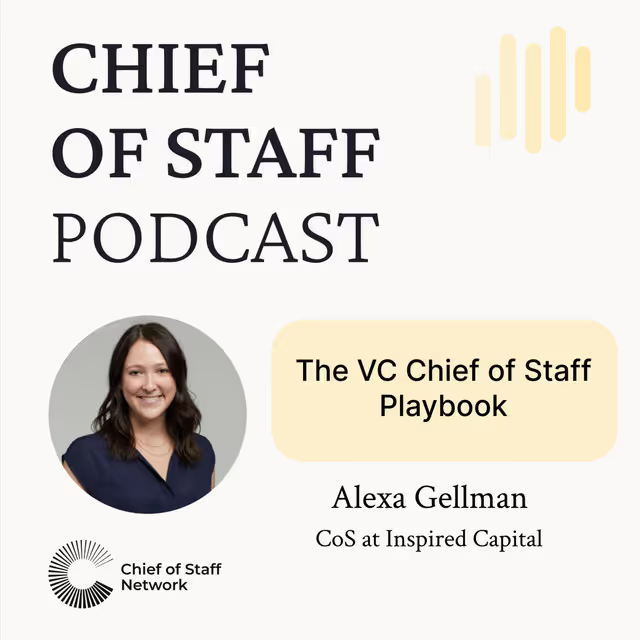
The VC Chief of Staff Playbook with Alexa Gellman
Go behind the scenes of venture capital with Alexa "Lex" Gellman, a Chief of Staff at Inspired Capital. Lex shares how she manages deal pipelines and supports portfolio founders. You will also learn about practical tools for network mapping and hear her insider perspective on today's capital markets. Whether you're aspiring to break into venture capital or looking to add more strategic value in your current Chief of Staff role, this episode offers actionable insights on building your internal brand and positioning yourself as a key strategic resource. Excited for you to level-up!
Learn more about the Chief of Staff Network's membership, courses, and events here: https://www.chiefofstaff.network/
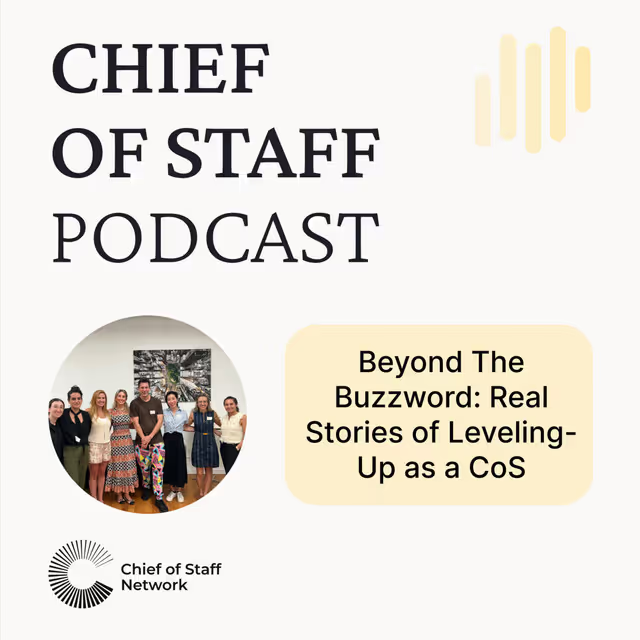
Beyond the Buzzword: Real Stories of Leveling-Up as a CoS
What does it really mean to "level up" as a Chief of Staff? In this episode recorded live at a dinner event in NYC, a select group of Chiefs of Staff share authentic stories of growth and impact in their roles. From using simple Google Docs to outperform complex systems to building reward programs that actually work, you will hear practical strategies that moved the needle. You'll learn how to prove your value, when to choose low-tech solutions, and how to maintain boundaries while excelling in this demanding role. Whether you're new to the role or looking to advance, these candid conversations offer actionable insights on building relationships, scaling through others, and finding your specialization as a generalist. Excited for you to level-up as a Chief of Staff!
You can learn more about our conferences, courses, and membership here: https://www.chiefofstaff.network/
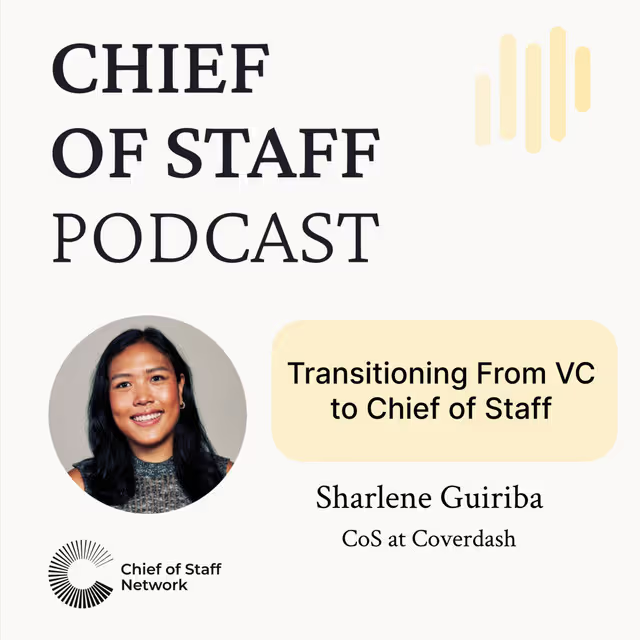
Transitioning From VC to Chief of Staff with Sharlene Guiriba
Are you looking to transition into the Chief of Staff role? In this episode, you will learn from Sharlene Guiriba, Executive Chief of Staff at Coverdash., Sharlene discusses her transition to the CoS role from operating roles and Venture Capital, emphasizing the importance of leveraging VC connections and the value of case studies in the interview process. She highlights her experience at Coverdash, noting the evolution from tactical to strategic initiatives and the importance of hiring to scale. Charlene also shares insights on navigating conflict, stressing the significance of emotions, data, and adaptability. Excited for you to level-up as a Chief of Staff!
You can learn more about our conferences, courses, and membership here: https://www.chiefofstaff.network/
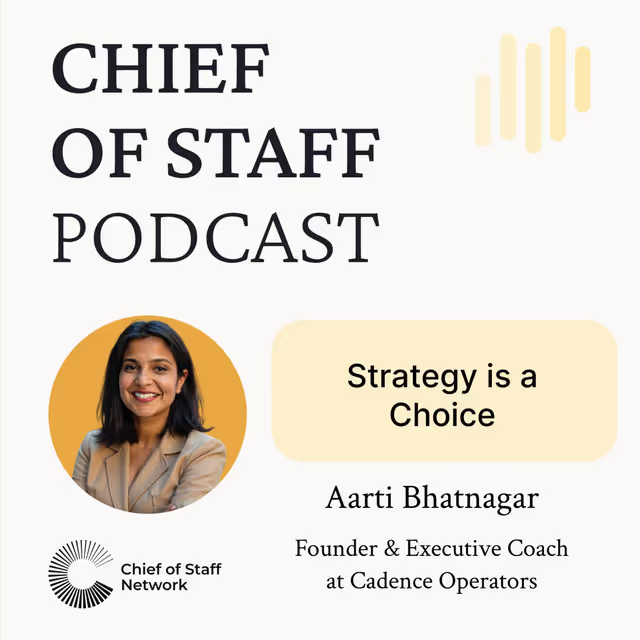
Strategy Is a Choice: Aarti Bhatnagar on Leading with Intention
In this episode, we sit down with Aarti Bhatnagar, former Chief of Staff at Change.org and Guild, and now executive coach and facilitator.
Aarti shares how she built a career as a generalist, navigated defining moments like company-wide layoffs, and discovered her superpower at the intersection of operations and people.
We dive deep into the role of the CoS in strategic planning, including:
How to drive alignment without formal authority
Common pitfalls in planning (and how to avoid them)
Aarti’s original C-FLEX Framework for effective strategy execution
Why owning your narrative is the most underrated leadership skill
Learn more about her work at Cadence Operators: https://cadence-operators.com/
Learn more about Chief of Staff Launchpad: https://www.chiefofstaff.network/chief-of-staff-launchpad?utm_source=spotify&utm_medium=podcast&utm_campaign=cos_podcast_aarti_bhatnagar
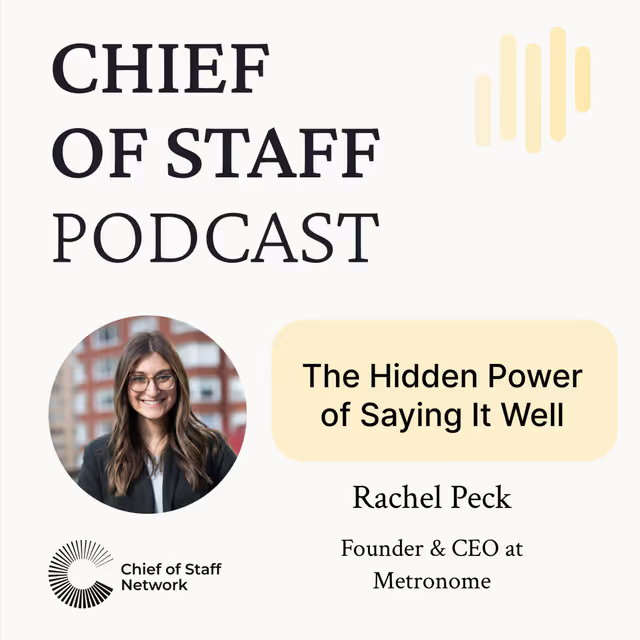
The Hidden Power of Saying It Well
Great communication isn’t just a nice-to-have. It’s a leadership skill that shapes culture, builds trust, and drives alignment.
In this episode, Rachel Peck shares lessons from nearly a decade at Harry’s, where she helped scale internal messaging from a 10-person startup to a global team of 1,000+.
From writing for founders, navigating crisis comms, and making company values stick, Rachel breaks down what most Chiefs of Staff overlook about internal and executive communications and how to build systems that work even in moments of chaos.
Explore Rachel's work: https://metronome.consulting/
Learn more from Rachel in Chief of Staff Launchpad: https://www.chiefofstaff.network/chief-of-staff-launchpad
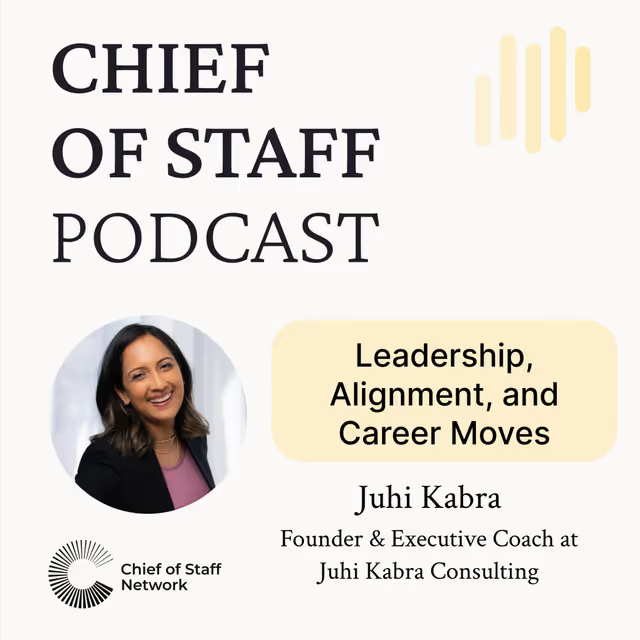
Inside the Launchpad: Leadership, Alignment, and Career Moves with Juhi Kabra
In this episode, we’re joined by Juhi Kabra, executive coach, facilitator, and former Chief of Staff at Redesign Health. Juhi spent five years supporting the CEO and leadership team through hypergrowth, and now advises founders and strategic operators on organizational design, executive effectiveness, and leadership development.
We discuss Juhi’s path from Blackstone to Palantir to Redesign Health, her biggest lessons in aligning executive teams, and how to succeed as a Chief of Staff in your first 90 days. She also shares a preview of the frameworks and workshops she’ll be leading in our upcoming Chief of Staff Launchpad program.
Learn more about her work at Juhi Kabra Consulting: https://www.juhikabra.com/
Learn more about Chief of Staff Launchpad: https://www.chiefofstaff.network/chief-of-staff-launchpad?utm_source=spotify&utm_medium=podcast&utm_campaign=cos_podcast_juhi_kabra
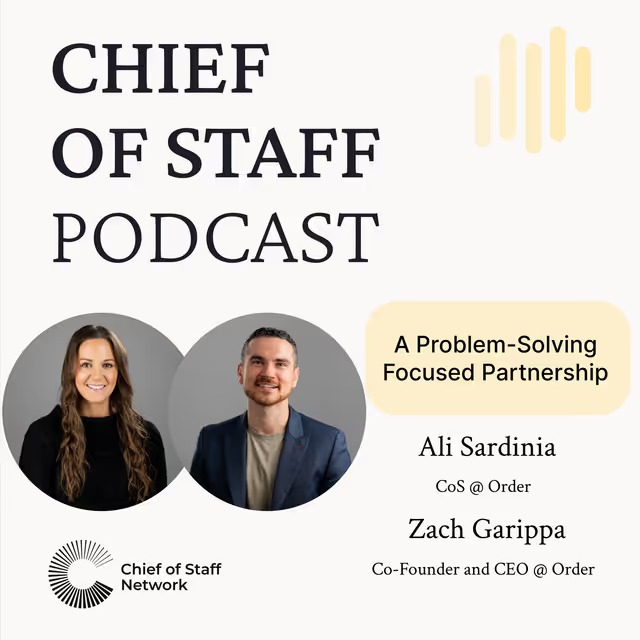
A Problem-Solving Focused Partnership with Ali Sardinia and Zach Garippa
In this podcast episode, Order CoS Ali Sardinia and CEO Zach Garippa share their successful four-year partnership built on co-creating the role through honest conversations about business needs. Their success stems from constant prioritization conversations, immediate communication to prevent issues from festering, and treating failures as shared ownership with an action-first mentality. They emphasize that cultural alignment matters more than perfect experience, and that effective CoS and Principal relationships require thought partnership and trust-building rather than constant agreement. Excited for you to level-up as a Chief of Staff!
You can learn more about the Chief of Staff Network's membership, courses, and events here: https://www.chiefofstaff.network/
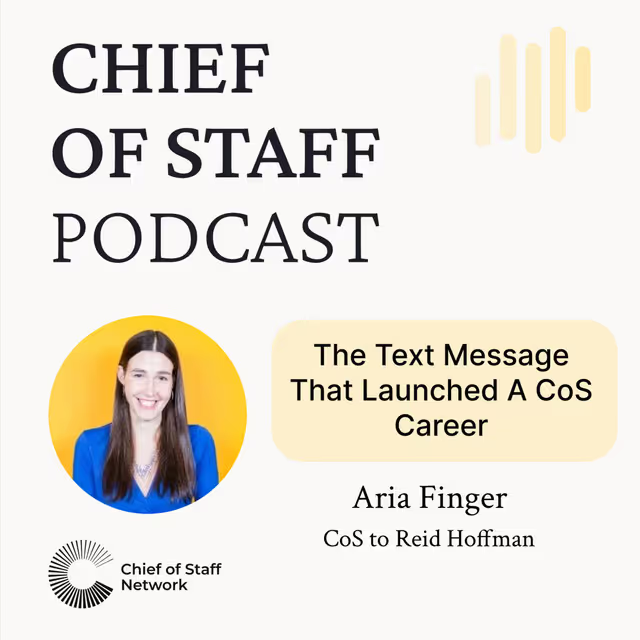
The Text Message That Launched A CoS Career with Aria Finger
In this episode, Aria Finger, Chief of Staff to Reid Hoffman, shares how she landed her role through an existing relationship and mentioned that she observed at an event that about half of Chief of Staff positions come from people that those CoS already knew. Key insights also mentioned include the importance of being authentically yourself, having permission to disagree with your principal, and using AI tools strategically. Aria also talks about what she is excited about with AI and how her role has evolved dramatically over her four years in the role too. Excited for you to level-up as a Chief of Staff!
You can learn more about our membership, courses, and conferences here: https://www.chiefofstaff.network/
Scaling People and Process
Are you working on scaling as a CoS right now? Listen to this episode to hear that successful scaling hinges on three core principles: intentional design, smart decision-making frameworks and scaling knowledge over headcount. The discussion emphasizes creating guardrails rather than rigid rules, protecting culture carriers during transitions, investing in relationship-building with distributed teams, and always starting with the problem you're solving rather than jumping to solutions. We are excited for you to level-up as a CoS!
This episode was recorded live at a NYC CoS dinner event. You can learn more about the Chief of Staff Network’s membership, upcoming events and courses on our website: https://www.chiefofstaff.network/
Leveling Up Without Losing The Human Touch with Ashlea Holt and Tim Bristow
In this episode, you will learn from Ashlea Holt and Tim Bristow about the art and science of getting stuff done in the modern workplace. From using ChatGPT, to navigating the Wild West of new productivity tools, they share hard-won insights on when efficiency isn't king, why direction matters more than speed, and the challenges of implementing tools at a company. You will also learn about why it may be better to pilot new tools initially, why consistency beats intensity every time, honest takes on AI dependency, decision fatigue, and protecting the human fundamentals that matter most. Listen to this episode to level-up as a Chief of Staff!
You can learn more about the Chief of Staff Network’s membership, upcoming events and courses on our website: https://www.chiefofstaff.network/
Change Management Strategies for Chiefs of Staff with Audrey Ware and Fanni Gabor
Are you tying to improve your change management as a CoS? Listen to this new podcast with Audrey Ware and Fanni Gabor as they share real stories from the trenches of organizational transformation. You will learn why "no change is perfect," how to build buy-in through strategic feedback, and why addressing instability head-on is crucial for success. From managing expectations during delays to navigating the AI transformation reshaping work itself, these two Chiefs of Staff offer candid insights on leading change when everything around you is constantly evolving. Excited for you to level-up as a Chief of Staff!
You can learn more about the Chief of Staff Network’s membership, upcoming events and courses on our website: https://www.chiefofstaff.network/
Creating Value In Your Role with Richard Hoffman and Eve Staszczyszyn
Chiefs of Staff create value for companies all of the time. Some times this work happens behind the scenes, and it is not showcased. We wanted to change that. In this episode, you will learn from Richard Hoffman and Eve Staszczyszyn about how they are creating value in their roles.
Eve talked about a value creation framework of making money, saving money, enhancing company culture, and /or driving innovation. Richard shared his experience at a FinTech startup, focusing on scaling partnerships and now managing customer programs. Both highlighted the need for flexibility, strategic alignment, and the ability to balance immediate tasks with long-term opportunities. Excited for you to level-up as a Chief of Staff!
You can learn more about the Chief of Staff Network’s membership, upcoming events and courses on our website: https://www.chiefofstaff.network/
Going from EA to Chief of Staff with Cher Murphy
Cher Murphy shares her journey from managing department stores in Alabama to being the Chief of Staff at Sydecar in NYC. You will learn how she networked her way into tech, overcame the challenge of being "too good" as an EA, and built strategic capabilities beyond administrative work. You will also learn about her use of Custom AI workflows and GPTs for executive communication, and Notion dashboards as operational "control centers.” Excited for you to level-up as a Chief of Staff!
You can learn more about the Chief of Staff Network’s membership, upcoming events and courses on our website: https://www.chiefofstaff.network/
Building A Startup As A CoS and First Employee with Jessica Li
Do you want to know what it is like on the ground floor of building a startup? In this episode, you will learn from Jessica Lee, the former Chief of Staff at Beacons. She was the first employee there and worked at the company for over four years. Jess emphasizes the importance of complementary skills with her CEO and highlights the use of tools like Clifton Strengths and Six Working Geniuses to understand team dynamics. Jess shares insights on building strong relationships, managing work-life balance, and evolving her role from foundational functions to growth and technical product management. She also reflects on the importance of self-reflection in career development.
You can learn more about the Chief of Staff Network’s membership, upcoming events and courses on our website: https://www.chiefofstaff.network/
From Being Rejected to Chief of Staff with Adaeze Okoli
To get a Chief of Staff role you may have to overcome a lot of rejections to get the role. For Adaeze Okioli, the Chief of Staff at Rethink Food, she initially got rejected for an internship role at Rethink but secured the Chief of Staff position after a networking opportunity and a pivotal lunch meeting with her principal.
To gel with her principal and other leaders, Adaeze emphasizes the importance of vulnerability, transparency, and empathy within the organization. She also highlights the use of AI tools like ChatGPT to streamline her work and advises aspiring Chiefs of Staff to thoroughly research and align with their principals. Excited for you to level-up as a Chief of Staff!
You can learn more about the Chief of Staff Network’s membership, upcoming events and courses on our website: https://www.chiefofstaff.network/
Why CoS Can Lead AI Adoption At Companies with Abhishek Vora
Is your company and executive team wanting to use and roll-out AI usage more broadly at your company? This potential initiative is a perfect example of a Chief of Staff project because it's new, innovative, and no one else or team is likely overseeing it. In this episode with Abhishek Vora, the Chief of Staff at LaunchDarkly, you will learn about his role in AI adoption, usage, and roll-out. Excited for you to level-up as a Chief of Staff!
You can learn more about the Chief of Staff Network’s membership, upcoming events and courses on our website: https://www.chiefofstaff.network/
From Associate Chief of Staff to Chief of Staff with Ada Madigan
Are you looking to break into a Chief of Staff role? Maybe you could start as an Associate Chief of Staff and then get promoted to a CoS role. That's what happened to Trust & Will Chief of Staff Ada Madigan. In this episode, you will learn how her role has evolved, how she is focused on helping build the company, and so much more. Excited for you to level-up as a CoS!
You can learn more about the Chief of Staff Network’s membership, upcoming events and courses on our website: https://www.chiefofstaff.network/
Eating Glass: How A CoS Helps Build A Startup
Are you looking to be a Chief of Staff at an early-stage startup? You may have to eat glass and do whatever it takes to help build the company. In this episode with Taxwire CoS David Moon and CEO Andrew Rea, you will learn how David initially presented an idea to Andrew, which sparked a conversation that led to them working together. This conversation highlights the importance of trust, adaptability, and willingness to handle various tasks in early-stage startups. They emphasized their working style of constant communication and the importance of understanding the CEO's priorities. Excited for you to level-up as a CoS!
You can learn more about the Chief of Staff Network’s membership, upcoming events and courses on our website: https://www.chiefofstaff.network/
Using AI To Be More Effective and Efficient with Ana Flávia Silva
Are you looking to use AI more in your role? Listen to this new episode with Ana Flávia Silva, a Chief of Staff at Section. In the episode, you will learn about why she got up-to-speed on AI while interviewing for her role and how she has been using AI regularly since. In particular, in this episode, we talk about Claude and Claude Projects, and she and Section have been using this tool. You will also learn about a framework to think about how and when to potentially use AI in your role. Excited for you to level-up as a CoS!
You can learn more about the Chief of Staff Network’s membership, upcoming events and courses on our website: https://www.chiefofstaff.network/
From Meeting-Heavy to an A-Sync Company Culture with Shelby Sly
Is your company growing fast and evolving? In this episode, you will learn from Shelby Sly, Chief of Staff and Director of Strategy and Operations at Ridgeline, who shares her career journey into the CoS role and her contributions to the Ridgeline’s growth. She details the company's evolution from around 200 employees to 400+ employees, emphasizing the shift from a meeting-heavy culture to a more efficient, asynchronous communication model.
Shelby highlights the importance of trust, adaptability, and effective meeting facilitation in her role. She also reflects on her career journey and growth, including her experience co-founding the Cal Poly Women in Business Association, and she also shared stories about career inflection moments. Excited for you to level-up as a Chief of Staff!
You learn more about the Chief of Staff Network, our membership, upcoming events and programs on our website.
https://www.chiefofstaff.network/
How They Work Together Remotely
In this episode, you will learn from Karly Gelardi, a Chief of Staff at Zapier, and Brandon Sammut, the Chief of People Officer at Zapier, about their roles and working relationship. Brandon emphasizes the importance of clarity in defining Chief of Staff roles and the need for a strong match between the leader and the Chief of Staff. They discuss the interview process, onboarding, and the importance of open communication and trust especially while working remotely. Karly highlights the evolving nature of her role and the significance of feedback.
Karly and Brandon will also be speaking together at our Chief of Staff San Francisco Connect conference on May 15-16. Join us in San Francisco! You learn more about the Chief of Staff Network, our membership and upcoming events and programs on our website.
https://www.chiefofstaff.network/
Excited for you to level-up as a Chief of Staff!
From Unconventional to Excellence with Jenna Parker
Do you have an unconventional background too? In this episode, you will learn from Jenna Parker, the Chief of Staff at Healthie, about her path into the role from a lack of healthcare and tech background. Her background has not deterred her in the role at all, as she has rotated and managed four different departments in 2024. Jenna also emphasized the importance of relationship building, direct communication, and setting boundaries as a Chief of Staff. She also shared CoS hiring tips that she has communicated with CEOs when they approach her about hiring another CoS like introspection and alignment of skills. Excited for you to level-up as a Chief of Staff!
Learn more about the Chief of Staff Network's membership and upcoming programs and events at:
https://www.chiefofstaff.network/
Doubling-Down On Strengths with Sofia Badalamenti and Nihal Mehta
In this episode, you will learn from Chief of Staff Sofia Badalamenti and Eniac Ventures Cofounder Nihal Mehta. They have been working together for two years. In this episode, they share communication best practices and workflows. They also talked about how they have worked together to double-down on both of their strengths, which is effective email use and relationship building. They also talked about the importance of trust and responsiveness in working together. Excited for you to level-up as a Chief of Staff!
Learn more about the Chief of Staff Network, our membership and upcoming events here:
https://chiefofstaff.network/
The Art of Wartime Leadership In Business with Lindsey O'Sullivan
In this episode, we dive deep into the world of crisis leadership through the lens of a Chief of Staff who has wartime CoS experience. When markets shift, competitors attack, or internal challenges threaten to derail progress, organizations need leaders who can make rapid decisions with imperfect information.
Chief of Staff veteran Lindsey O’Sullivan shares her related experiences, insights and techniques. Whether you're leading through a major transition, responding to market disruption, or simply preparing for the inevitable storms of business, this episode offers invaluable insights for modern leaders who must thrive under pressure. You will also learn about how Lindsey got her current role through networking and many other practical tips. Excited for you to level-up as a Chief of Staff!
Learn more about the Chief of Staff Network, our membership and upcoming events here:
https://chiefofstaff.network/
Mastering the Message: The Chief of Staff’s Role in Storytelling with Ali Sardinia
In this episode, you will learn from Ali Sardinia, the Chief of Staff at Order.co, about her two Chief of Staff experiences and the importance of storytelling in business. She highlights how, in her current role, her company is focused on embedding stories into presentations, all-hands meetings, and marketing materials to enhance understanding and impact. Ali also shares why this initiative came to be. Ali mentions the use of one-pagers to improve cross-functional collaboration and visibility within the company as well.
For aspiring CoS, Ali advises people take on challenging roles and to continuously learn. Excited for you to level-up as a Chief of Staff!
Learn more about the Chief of Staff Network, our membership and upcoming events here:
https://chiefofstaff.network/
Driving The Most Impact As A CoS with Kyle Hagge
In this episode, Kyle Hagge, Chief of Staff at Morning Brew Inc., discussed how he focuses on doing work that drives the most impact with a goal of being able to showcase the financial benefits of it too. As an example, Kyle talked about recently working on improving the company’s events and sponsorship packages. He also discussed using AI tools like Granola for note-taking. Kyle advised on effective and empathetic communication, using your access as a CoS to follow your curiosity, and his practice to eliminate any potential "Sunday scaries.” Excited for you to level-up as a Chief of Staff!
Learn more about the Chief of Staff Network, our membership, events, and programs here:
https://chiefofstaff.network/
Being The First Employee As A CoS with Remi Guarini
In this episode, you will learn from Remi Guarini, a three-time Chief of Staff, about her experiences. She is currently the Founding Chief of Staff at Neon and was the first employee there. In this episode, you will learn about how Remi’s approach to the role has evolved, the importance of building relationships and understanding the principal's needs.
She highlights her approach to managing operations, including creating a detailed Google sheet for task management and more. Remi also shares her thoughts on the evolving nature of Chief of Staff roles, the value of a generalist skill set, and the significance of team relationships. She encourages aspiring Chiefs of Staff to embrace the role's challenges and opportunities.
You can learn more about the Chief of Staff Network, our membership, upcoming events and more on our website:
https://www.chiefofstaff.network/
Behind the Deal: The Chief of Staff's Role in M&A Success with Sophie Kaye
In this episode, you will learn from Sophie Kaye, a Chief of Staff at Frame.io, which was acquired by Adobe in 2021. Sophie discusses her non-linear career path, including her role as employee 1 at a dental healthcare startup and her transition to being a Chief of Staff at Frame.io. She detail what it was like being a CoS at Frame.io during the acquisition by Adobe, emphasizing the importance of privacy and organization. Post-acquisition, Sophie's role has evolved, focusing on marketing, M&A, and business operations. She highlights the significance of relationship building, embracing ambiguity, and not striving for perfection. Sophie encourages aspiring Chiefs of Staff to build connections and be open to opportunities.
You can learn more about Chief of Staff Network, our membership, upcoming events and more on our website:
https://www.chiefofstaff.network/
Why We Are Hosting Three Chief of Staff Connect Conferences in 2025 with Scott Amenta
Are you looking to connect with other Chiefs of Staff in-person in 2025? Listen to this episode with Scott Amenta, the Founder of the Chief of Staff Network. In it, you will hear how Scott started the community and how in-person meetups were critical in the early days of launching the community. Fast forward to 2024, we hosted 60+ events globally. In 2024, we also hosted a two-day Chief of Staff Connect conference in New York City. In 2025, we plan to host three Chief of Staff Connect conferences in San Francisco (in May), New York (in October), and London (in November). In this episode, you will hear what we learned from the 2024 Connect conference and how the 2025 Connect conferences will be slightly different.
You can learn more about Chief of Staff Connect, our membership, and more on our website:
https://www.chiefofstaff.network/
10 Tips To Get A Chief of Staff Role with David Nebinski
Ready to land a coveted Chief of Staff position? Listen to this episode as we break down 10 practical tips to help you secure an influential role. Drawing from conversations with Chiefs of Staff and from David Nebinski's own experiences, you will hear insights on networking, relationship building, and much more. If you are looking for a new role, this episode is for you.
Learn more about the Chief of Staff Network's membership and upcoming events on our website:
https://www.chiefofstaff.network/
Scaling Companies And Leaders with Crystelle Desnoyer
In this episode, you will learn from Crystelle Desnoyer about her experiences and insights into the Chief of Staff role. She used to be the CoS at Techstars. Crystelle discusses her journey from building and scaling 20+ business entities and her scaling framework.
Crystelle emphasized the importance of building trust, stakeholder mapping, and managing conflicts. She also highlighted the challenges of balancing internal and external focus and the need for self-care to avoid burnout as a CoS. If you are a new CoS or are looking to scale your role, this episode for you.
Learn more about our membership and events here:
https://www.chiefofstaff.network/
---
Support this podcast: https://creators.spotify.com/pod/show/chief-of-staff-podcast/support
Insights From The Chief of Staff Network’s 2024 Salary Report
Are you looking to be paid more fairly? In this episode, Rahul Desai and David Nebinski discuss the Chief of Staff Network’s 2024 Salary Report. You will learn about how you might be able to use this data as an in-role CoS. We also discuss the CoS job market and our State of Chief of Staff Jobs report. If you are looking to better understand Chief of Staff compensation, this episode is for you!
Learn more about the Chief of Staff Network's membership and upcoming events here:
https://www.chiefofstaff.network/
---
Support this podcast: https://creators.spotify.com/pod/show/chief-of-staff-podcast/support
Going After What You Want with Sydney Scherer
In this episode, you will learn about how Sydney Scherer landed her current role by sending a creative email advocating for herself and a CoS role. She contrasts and overlap her current CoS experience with her prior CoS role, noting the shift to more creative, media-focused work. Both of those CoS roles happened after leaving the consulting industry. Sydney also emphasizes the importance of aligning with one's passions and pushing beyond comfort zones. In addition, she advises aspiring Chiefs of Staff to lean on their community and take calculated risks.
Learn more about the Chief of Staff Network's membership and upcoming events here:
https://www.chiefofstaff.network/
---
Support this podcast: https://creators.spotify.com/pod/show/chief-of-staff-podcast/support
Building A Team Around Yourself with Teddy Owen
In this episode with Teddy Owen, the Chief of Staff at Moonhub, you will learn about his career journey to date and how it helped him get his current CoS role. Teddy highlighted the strategic use of third-party vendors for areas like finance and legal to build a team around yourself as a CoS. He also stressed the value of networking and building a support system to navigate the often-lonely role of a Chief of Staff.
Teddy also emphasized the importance of leveraging AI tools like ChatGPT and Claude. You will also learn about when he has seen companies hire a CoS and why.
Learn more about the Chief of Staff Network's membership and upcoming events here:
https://www.chiefofstaff.network/
---
Support this podcast: https://creators.spotify.com/pod/show/chief-of-staff-podcast/support

Shaping How A Company Operates with Dara Chen
In this episode, we talk with Dara Chen, the Chief of Staff at Rad AI. Dara shared her journey to her current role, highlighting the importance of networking and leveraging her Wharton alumni network, and her prior CoS experiences. She emphasized the value of being organized and detail-oriented while also strategic to help a company operate and build the company’s culture. Dara also shared her experience taking over the recruiting function, focusing on creating efficient processes and aligning teams. She underscored the evolving nature of the Chief of Staff role, which involves balancing strategic thinking with detailed execution and fostering strong relationships within the leadership team. Learn more about the Chief of Staff Network's membership and upcoming events here: https://www.chiefofstaff.network/ --- Support this podcast: https://creators.spotify.com/pod/show/chief-of-staff-podcast/support
Non-Traditional Path and Mental Health with Michael Novak
In this episode, we talk with Michael Novak, a Principal of Strategy and Business Operations at Adobe and former CoS, about his career journey. Michael discusses his non-traditional path, including his time as a project manager, his mental health struggles, and his transition into the Chief of Staff role through networking. He highlights the differences between being a Chief of Staff and working in Strategy and Operations, emphasizing the importance of identifying organizational gaps and planning. Michael also touches on the significance of well-being and mental health, advocating for living a values-based life and maintaining calm in stressful situations.
Learn more about the Chief of Staff Network's membership and upcoming events here:
https://www.chiefofstaff.network/
---
Support this podcast: https://creators.spotify.com/pod/show/chief-of-staff-podcast/support

Non-Traditional Path and Mental Health with Michael Novak
In this episode, we talk with Michael Novak, a Principal of Strategy and Business Operations at Adobe and former CoS, about his career journey. Michael discusses his non-traditional path, including his time as a project manager, his mental health struggles, and his transition into the Chief of Staff role through networking. He highlights the differences between being a Chief of Staff and working in Strategy and Operations, emphasizing the importance of identifying organizational gaps and planning. Michael also touches on the significance of well-being and mental health, advocating for living a values-based life and maintaining calm in stressful situations. Learn more about the Chief of Staff Network's membership and upcoming events here: https://www.chiefofstaff.network/ --- Support this podcast: https://creators.spotify.com/pod/show/chief-of-staff-podcast/support

Private Sector CoS Role vs a Public Sector CoS Role with Sue Broderick
Sue Broderick, the Chief of Staff at We Know Training, discussed her career trajectory, highlighting her transition from an executive assistant to a Chief of Staff. She contrasted the public and private sector roles, noting the public sector's political pressures and accountability. You will learn about the importance of relationship building, loyalty, and straight talk as a CoS. Sue also discussed the significance of CEOs publicly supporting their Chiefs of Staff, which enhances the role's influence and execution. Learn more about the Chief of Staff Network's membership and upcoming events here: https://www.chiefofstaff.network/ --- Support this podcast: https://creators.spotify.com/pod/show/chief-of-staff-podcast/support

Building Relationships and Becoming a CoS with Rico Ashab
Rico Ashab, the Chief of Staff at Destination DC, discusses his career progression from EA to Chief of Staff, emphasizing the importance of relationship building. He highlights the growth of Destination DC from 180 to ~500 employees and the creation of his Chief of Staff role in January 2023. Rico also shares insights on managing relationships with his CEO, effective communication strategies, and the significance of in-person interactions. Learn about the Chief of Staff Network's membership and events here: https://www.chiefofstaff.network/ --- Support this podcast: https://creators.spotify.com/pod/show/chief-of-staff-podcast/support

Approaching The Role With A Hypothesis with Alex Cherucheril
In this episode, we chat with Alex Cherucheril, the Head of Business Operations and former CoS at Welcome Tech in Los Angeles. Alex discusses the evolving role of Chief of Staff, noting that over 50% of CoS roles may now come from internal promotions. He highlights the importance of adaptability, flexibility, and a strategic mindset for Chief of Staffs. Alex emphasizes the value of community among Chief of Staffs to combat loneliness and shares insights on the interview process, suggesting that candidates should approach the role with a specific learning hypothesis. David and Alex also discuss the significance of a strong relationship with the principal for job satisfaction. Alex has hosted two CoS events with us in LA. Our next LA CoS Mixer is on Thursday November 14th. Join us! Learn more about our membership and events on our website: https://www.chiefofstaff.network/ --- Support this podcast: https://creators.spotify.com/pod/show/chief-of-staff-podcast/support

Creating Opportunities and Quantifying Your Impact with Anna Buckley
Anna Buckley, a two-time Chief of Staff at Barstool Sports, discussed her career journey, emphasizing the transition from an EA role to a Chief of Staff. She highlighted the importance of complementary skill sets with her principals and the value of leveraging resources like the Chief of Staff Network. Anna stressed the need for reflection, quantifiable success metrics, and the adaptability of Chief of Staff skills across roles. She also underscored the significance of building a network within the Chief of Staff community for mentorship and support. Learn more about the Chief of Staff Network on our website: https://www.chiefofstaff.network/ --- Support this podcast: https://creators.spotify.com/pod/show/chief-of-staff-podcast/support

Getting Stuff Done As A Chief of Staff with Melinda Munroe
Melinda Munroe, Chief of Staff at Nexla, shared her journey from forensic anthropology to marketing and then to Chief of Staff roles. She highlighted the importance of ruthless prioritization and cross-functional collaboration. Melinda also discussed her love for marketing, particularly customer and product marketing, and how it influenced her Chief of Staff roles. In this episode, she also stressed the need for empathy, work-life balance, and the importance of finding the right company and manager. Excited for you to level-up as a Chief of Staff! Learn more about the Chief of Staff Network here: https://www.chiefofstaff.network/ --- Support this podcast: https://creators.spotify.com/pod/show/chief-of-staff-podcast/support

Behind the Scenes: How a Chief of Staff Shapes Organizational Communication with Maggie Mullooly
Executive and company communication is hard work. Many Chiefs of Staff work on this to communicate a vision and empathize with all stakeholders. Maggie Mullooly has developed experience and expertise on this kind of work as a CoS. In this episode, she also shares about getting CoS roles, networking, and what it is like working as a CoS at a startup. Learn more about the Chief of Staff Network's upcoming events, courses, and membership on our website. https://www.chiefofstaff.network/ --- Support this podcast: https://creators.spotify.com/pod/show/chief-of-staff-podcast/support

From HR Manager to CoS with Taraneh Ansari
What is your path into the Chief of Staff world? Just like how the Chief of Staff role can vary at different companies, the path into the CoS role can be different too. For Taraneh Ansari, the CoS at OpenSponsorship, she used to be the HR Manager at OpenSponsorship. In this episode, you will learn about how her role has evolved, what it is now, and so much more. Learn more about Chief of Staff Network's upcoming events, courses, and membership on our website. https://www.chiefofstaff.network/ --- Support this podcast: https://creators.spotify.com/pod/show/chief-of-staff-podcast/support

Toolbox Talk: Software Tools and Tips for Everyday Efficiency
Are you looking to level-up your software tech stack and workflow? Listen to this episode with Lauren Stein and Maria Mejia talking about some tools that they use and why they use them. You will also learn about what they look for in tools, and how to think about getting other people at your company to potentially use new tools. Learn more about Chief of Staff Network's upcoming events, courses, and membership on our website. https://www.chiefofstaff.network/ --- Support this podcast: https://creators.spotify.com/pod/show/chief-of-staff-podcast/support

How To Be An Effective Chief of Staff with Kyle Hagge
Are you looking to be an effective Chief of Staff? Kyle Hagge, CoS at Morning Brew, shared tips about the first 90 days in a new role, relationship building, operating cadence with your Principal, developing influence, and creating value as a CoS. Before his CoS role starting in January 2024, Kyle was a Community Manager at Morning Brew. You will also learn about how his transition to the CoS role happened. Learn more about Chief of Staff Network's upcoming events, courses, and membership on our website. https://www.chiefofstaff.network/ Excited for you to level-up as a CoS! --- Support this podcast: https://creators.spotify.com/pod/show/chief-of-staff-podcast/support

How We Built The Chief of Staff Network with Rahul and David
Want an inside look at The Chief of Staff Network, a membership-based community for 900+ CoS globally? Listen to this episode with General Manager Rahul Desai and Community Lead David Nebinski. In this episode, you will learn about both Rahul and David's CoS experiences, how they started working together, why they do this work, how they support CoS, tips to get a CoS role, and about the Chief of Staff Network's signature courses, events, and research reports like the Leveling Framework. Learn more about Chief of Staff Network's upcoming events, courses, and membership on our website. https://www.chiefofstaff.network/ --- Support this podcast: https://creators.spotify.com/pod/show/chief-of-staff-podcast/support

Resetting A Company's Operating Rhythm with Alexis Summit
What is the heart beat of a company? It is a company's operating rhythm. Often times, a Chief of Staff oversees this project. In some cases, it may make sense to reset it and that's what Chief of Staff Alexis Summit has been working on recently. Tune into this episode to learn about this and more! Learn more about Chief of Staff Network's upcoming events, courses, and membership on our website. https://www.chiefofstaff.network/ --- Support this podcast: https://creators.spotify.com/pod/show/chief-of-staff-podcast/support

Creating A Company Culture with Katie Mogul
Helping improve a company's culture can be incredibly empowering and fulfilling. For Katie Mogul, she loves working on this. Tune in to this episode to learn about measuring impact, time management, formalized professional development, creating a culture of growth and so much more! Learn more about Chief of Staff Network's upcoming events, courses, and membership on our website. https://www.chiefofstaff.network/ --- Support this podcast: https://creators.spotify.com/pod/show/chief-of-staff-podcast/support

Scaling as a CoS with Alyssa Palomba
Scaling as a CoS is part-thrilling and part-challenging. Alyssa emphasized the importance of continuous learning and growth, while also prioritization and delegation. Alyssa became a CoS after previously being the Director of Customer Success at the same company. In this episode, you will also learn about the customer success role and more. Learn more about Chief of Staff Network's upcoming events, courses, and membership here. https://www.chiefofstaff.network/ --- Support this podcast: https://creators.spotify.com/pod/show/chief-of-staff-podcast/support

RevOps vs CoS with Ravi Neppalli
In this episode, you will learn about Ravi’s evolution of RevOps roles in startups, emphasizing the importance of managing and optimizing sales teams. You will learn about the responsibilities, skills, and applications of RevOps and Chief of Staff roles across industries and verticals. Ravi highlighted the need to understand top-of-funnel activity, marketing efforts, and sales cycles to achieve success. Learn more about Chief of Staff Network's upcoming events, courses, and membership here. https://www.chiefofstaff.network/ --- Support this podcast: https://creators.spotify.com/pod/show/chief-of-staff-podcast/support

Using AI To Help With Hiring with Michael Finkbeiner
Are you looking to learn about emerging technologies like AI to improve your workflow and productivity? Listen to this episode with Michael Finkbeiner, the Chief of Staff at Vertosa, share about using AI to help with hiring people and process at his company. You will also learn about how Michael got this Chief of Staff role and more. Learn more about Chief of Staff Network's upcoming events, courses, and membership here. --- Support this podcast: https://creators.spotify.com/pod/show/chief-of-staff-podcast/support

Aiming To Be The World’s Best Sidekick with Lauren Stein
What is the career path of a Chief of Staff??? Lauren Stein, the Chief of Staff at GrowthLoop, is aiming to be the world's best sidekick. Lauren shares about how she got her current role and how it did not happen in a very traditional way. Lauren also talks about some of the work she is doing now in current role. Learn more about Chief of Staff Network's upcoming events, courses, and membership here. --- Support this podcast: https://creators.spotify.com/pod/show/chief-of-staff-podcast/support

Chief of Staff Podcast: What To Expect
Are you looking to level-up as a Chief of Staff? Listen to the Chief of Staff Podcast to hear actionable insights, stories, and experiences that you can apply in your role today. You will also hear about how people got their CoS roles. This podcast is produced by the Chief of Staff Network, the leading global community for Chiefs of Staff. Check out our upcoming events and courses! Excited for you to level-up and learn with this show! --- Support this podcast: https://creators.spotify.com/pod/show/chief-of-staff-podcast/support