

Join the largest, most influential network of Chiefs of Staff shaping the future of leadership teams.


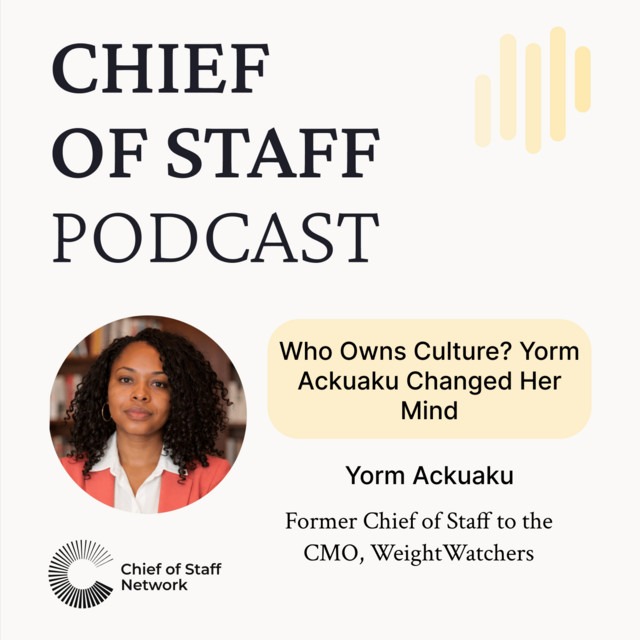
Who Owns Culture? Yorm Ackuaku Changed Her Mind
Guest: Yorm Ackuaku, Former Chief of Staff to the CMO, WeightWatchers
Host: Scott Amenta, Founder, Chief of Staff Network
Episode Overview
Yorm Ackuaku came into this conversation ready to argue that Chiefs of Staff own culture, then changed her mind. Her answer: leaders own culture through the behavior people watch, and the Chief of Staff owns the operating rhythm that either reinforces it or quietly erodes it.
Scott and Yorm get into what happens to a team when the top keeps turning over, how three principles drafted at a leadership offsite turned into an all-hands so popular they had to turn people away, and how a Chief of Staff keeps their own footing while everyone else's anxiety lands on their desk.
About Yorm Ackuaku
Yorm has spent more than a decade as a Chief of Staff, most recently at WeightWatchers, where she supported four leaders across different mandates, including a brand new Chief Engagement Officer role that combined three organizations for the first time. She started in accounting as a CPA and came up through Deloitte's technology risk consulting group before business school.
Her first taste of the role came through a Citi leadership program meant to develop leaders for franchises outside the US. As the most junior person on a cross-functional tiger team in London, she was handpicked to support a senior leader, which led to business manager roles in Dubai and Johannesburg. Before WeightWatchers, she built operations for a 500-person global marketing team at Vista (formerly Vistaprint).
Key Takeaways
Leaders own culture. HR and people teams own the systems and policies. The Chief of Staff owns the operating rhythm that holds it together: consistent messages month to month, decisions that match what was said, and forums where questions actually get answered.
Culture rarely breaks all at once. It erodes through hundreds of small moments: quieter meetings, fewer people challenging ideas, more side conversations, less willingness to experiment. During leadership churn, certainty goes first, and people start optimizing for survival and for whoever holds the most influence that week.
You can't get strategic alignment from a team that doesn't trust each other yet. Yorm once saw culture work as a luxury during a restructuring until her first CMO showed her the culture work was the strategy. In her telling, an offsite set the direction, a weekly Slack ritual built the muscle, and a monthly all-hands spotlight gave it meaning.
The job is to create clarity. People going through transformation don't expect certainty; they expect honesty and transparency. Say out loud what you know to be true, what you don't know yet, and that you'll tell them when you do. It grounds the team, and it grounds you.
New in the seat? Skip the process overhaul and find where trust has broken. In one role Yorm held more than 100 conversations in her first 60 days, asking which meetings waste time, which decisions surprise people, and where people feel unheard. Process doesn't fix trust. Trust is what makes process work.
Yorm counts the Chief of Staff Network among the outside sounding boards that kept her grounded through repeated leadership turnover. Connect with her on LinkedIn at https://www.linkedin.com/in/yorm/
Learn more about the Chief of Staff Network's membership, courses, and events here: https://www.chiefofstaff.network/